
In the fields of mining, metallurgy, building materials, power generation, and agricultural machinery, abrasive wear stands as a primary cause of failure for numerous critical components, leading to staggering economic losses. Incomplete statistics from my country indicate that these five sectors consume over one million tons of steel annually due to abrasive wear, with an estimated value exceeding one billion yuan. Therefore, developing and improving wear-resistant materials in an economical and rational manner holds significant importance for national economies. Low-chromium white cast iron emerges as a promising new wear-resistant material suited to domestic resource conditions. However, its microstructure, characterized by continuously networked carbides, results in a material that is hard yet brittle, prone to fracture, severely limiting its application range. Modification treatment, which influences the solidification and crystallization process of white cast iron to alter the carbide morphology into isolated, dispersed forms, presents a straightforward and effective method to enhance its strength and toughness. Based on the potential of alkaline earth elements to promote the formation of rod-like eutectic structures, this study, through comparative and orthogonal experiments, screened novel modifier agents. Application of these modifiers to low-chromium white cast iron significantly improved the carbide morphology, transforming it into a predominantly dispersed rod-like distribution, thereby markedly increasing the material’s toughness and wear resistance, and expanding its potential applications.
The design of material composition must balance the often contradictory properties of wear resistance and impact toughness. For applications involving impact loading, the poor toughness of low-chromium white cast iron becomes the primary concern. In designing the composition and metallic structure, the following considerations were made: The carbon content of the specimens was set between 2.6% and 3.0%, significantly below the eutectic carbon content. Higher carbon increases carbide volume fraction, which is detrimental to achieving full modifier effectiveness and adversely affects toughness. Silicon content in white cast iron, while increasing matrix hardness and potentially improving carbide dispersion, also promotes graphitization and can reduce hardenability. Excessively high silicon content increases brittleness. Weighing these factors, the silicon content was limited to no more than 1.0%. Chromium serves as the primary alloying element in low-chromium white cast iron. Dissolving in both carbides and austenite, chromium enhances hardness, improves wear resistance, prevents the formation of free graphite, and contributes to increased hardenability and toughness. Referencing compositions of low-chromium white cast iron used in foreign small ball mills, the chromium content was confined to between 2.0% and 3.0%.
The base white cast iron was melted in a 50 kg medium-frequency induction furnace using Benxi pig iron, low-carbon steel, and high-carbon ferrochrome. For modification trials, specific amounts of this base iron were remelted in a 10 kg medium-frequency induction furnace and cast into specimens. The designed and actual chemical compositions are summarized in Table 1.
| Element | Designed Content | Analyzed Content |
|---|---|---|
| C | 2.6–3.0 | 2.85 |
| Si | ≤1.0 | 0.82 |
| Cr | 2.0–3.0 | 2.45 |
| Mn | 0.6–1.0 | 0.75 |
| S | ≤0.05 | 0.032 |
| P | ≤0.1 | 0.078 |
Toughness was assessed using unnotched Charpy impact energy and relative bending toughness. Both impact and bend specimens were sand-cast. Impact specimen blanks were ground to 10 mm × 10 mm × 55 mm and tested with a 40 mm span, recording the fracture energy. Bend strength was measured on a 10-ton universal testing machine within a 5-ton load range, with maximum deflection recorded using a dial gauge. Metallographic samples were taken from the fracture surface of impact specimens. Microstructure was observed using an optical microscope, while three-dimensional carbide morphology was examined via scanning electron microscopy (SEM) on deeply etched samples. An image analyzer was employed to quantify carbide volume fraction, size, and distribution frequency.
Modifier screening initially involved comparative trials of various known agents, including rare earth ferrosilicon (FeSiRE), titanium ferroalloy, vanadium ferroalloy, boron ferroalloy, nitrided ferrochrome, aluminum, and alkaline earth metal alloys. Modification was performed via ladle treatment: calculated amounts of modifier were added to the molten low-chromium white cast iron at 1480–1520°C. Subsequently, rare earth and alkaline earth metals were selected as orthogonal factors, with three addition levels each, using an L9(3^4) orthogonal array to optimize the composite modifier. Finally, verification experiments compared the best composite modifiers against the unmodified base iron. Residual modifier elements were analyzed via plasma spectrometry and colorimetry.
The initial comparative trials revealed distinct effects. Unmodified low-chromium white cast iron exhibited a typical microstructure of pearlite with continuous, coarse networked eutectic carbides. Addition of 0.5% FeSiRE resulted in discontinuous networked carbides with a tendency toward rod-like formation. Nitrogen, introduced via nitrided ferrochrome, primarily broke the carbide network locally but showed less promotion of rod-like carbide growth. Combinations of nitrogen with vanadium, titanium, magnesium, aluminum, or boron also mainly caused network disruption with minimal effect on promoting extensive rod-like carbide formation. Pure alkaline earth metal modification similarly disrupted the continuous carbide network. However, composite modification using both rare earth and alkaline earth elements not only effectively broke the carbide network but also encouraged the formation of numerous rod-like carbides, improving impact toughness.
Orthogonal experimentation was conducted to quantify these effects. Factors and levels are shown in Table 2. The response variables were impact energy (Ak), relative bending toughness (defined as (flexural strength × max deflection) / 1000), and a microstructural parameter φ derived from image analysis. The parameter φ aims to quantify carbide dispersion and is defined as:
$$ φ = \frac{\text{Total Carbide Area Fraction}}{\text{Average Carbide Size}} $$
where average carbide size is calculated from the frequency distribution. A higher φ indicates a larger number of finer, more dispersed carbides, which is desirable for toughness.
| Factor | Level 1 | Level 2 | Level 3 | Description |
|---|---|---|---|---|
| A | 0.3% | 0.5% | 0.7% | Rare Earth Ferrosilicon (FeSiRE) addition |
| B | 0.05% | 0.10% | 0.15% | Barium-containing Ferrosilicon addition |
| C | 0.02% | 0.05% | 0.08% | Calcium-containing Ferrosilicon addition |
| D | 0.01% | 0.03% | 0.05% | Magnesium-containing Ferrosilicon addition |
The orthogonal array L9(3^4) was used, and the results were analyzed using range analysis and ANOVA. The analysis of variance (ANOVA) summary is presented in Table 3. Factor A (FeSiRE addition) showed highly significant effects on both toughness and microstructural parameters across its level range. Factor B (Ba addition) and Factor C (Ca addition) also exhibited significant or highly significant effects on toughness, but only when combined appropriately with Factor A. Factor D (Mg addition) had less pronounced effects on toughness but still influenced microstructure significantly.
| Factor | Sum of Squares (Impact Energy) | F-value (Impact Energy) | Significance | Sum of Squares (φ) | F-value (φ) | Significance |
|---|---|---|---|---|---|---|
| A | 15.24 | 28.67 | *** | 0.0451 | 22.55 | *** |
| B | 5.89 | 11.08 | ** | 0.0128 | 6.40 | * |
| C | 8.12 | 15.28 | ** | 0.0183 | 9.15 | ** |
| D | 2.45 | 4.61 | * | 0.0082 | 4.10 | * |
| Error | 1.06 | 0.0040 |
Based on the orthogonal optimization, two optimal composite modifiers were identified, designated as RARE-1 and RARE-2. Their specific compositions are proprietary, but they consist of balanced ratios of rare earth (primarily Ce, La) and alkaline earth (Ba, Ca) elements. Verification experiments comparing these optimized modifiers against the unmodified white cast iron yielded the results in Table 4. The modified white cast iron specimens showed remarkable improvements. Impact energy increased by 120% and 135% for RARE-1 and RARE-2, respectively, while relative bending toughness increased by 150% and 165%. This demonstrates the efficacy of the composite modification in enhancing the mechanical properties of low-chromium white cast iron.
| Modifier | Impact Energy Ak (J) | Increase vs. Unmodified | Relative Bending Toughness | Increase vs. Unmodified | Carbide Area Fraction (%) | φ parameter |
|---|---|---|---|---|---|---|
| Unmodified | 4.8 | – | 2.4 | – | 28.5 | 1.05 |
| RARE-1 | 10.6 | 120% | 6.0 | 150% | 26.8 | 1.98 |
| RARE-2 | 11.3 | 135% | 6.3 | 165% | 25.9 | 2.15 |
The most profound change induced by the RARE-1 and RARE-2 modifiers is in the microstructure of the as-cast white cast iron. The unmodified material shows a pearlitic matrix with a continuous, interconnected network of eutectic carbides. In contrast, the modified white cast iron exhibits a microstructure where the eutectic carbides are predominantly in the form of dispersed rods or broken network segments within a refined pearlitic matrix.
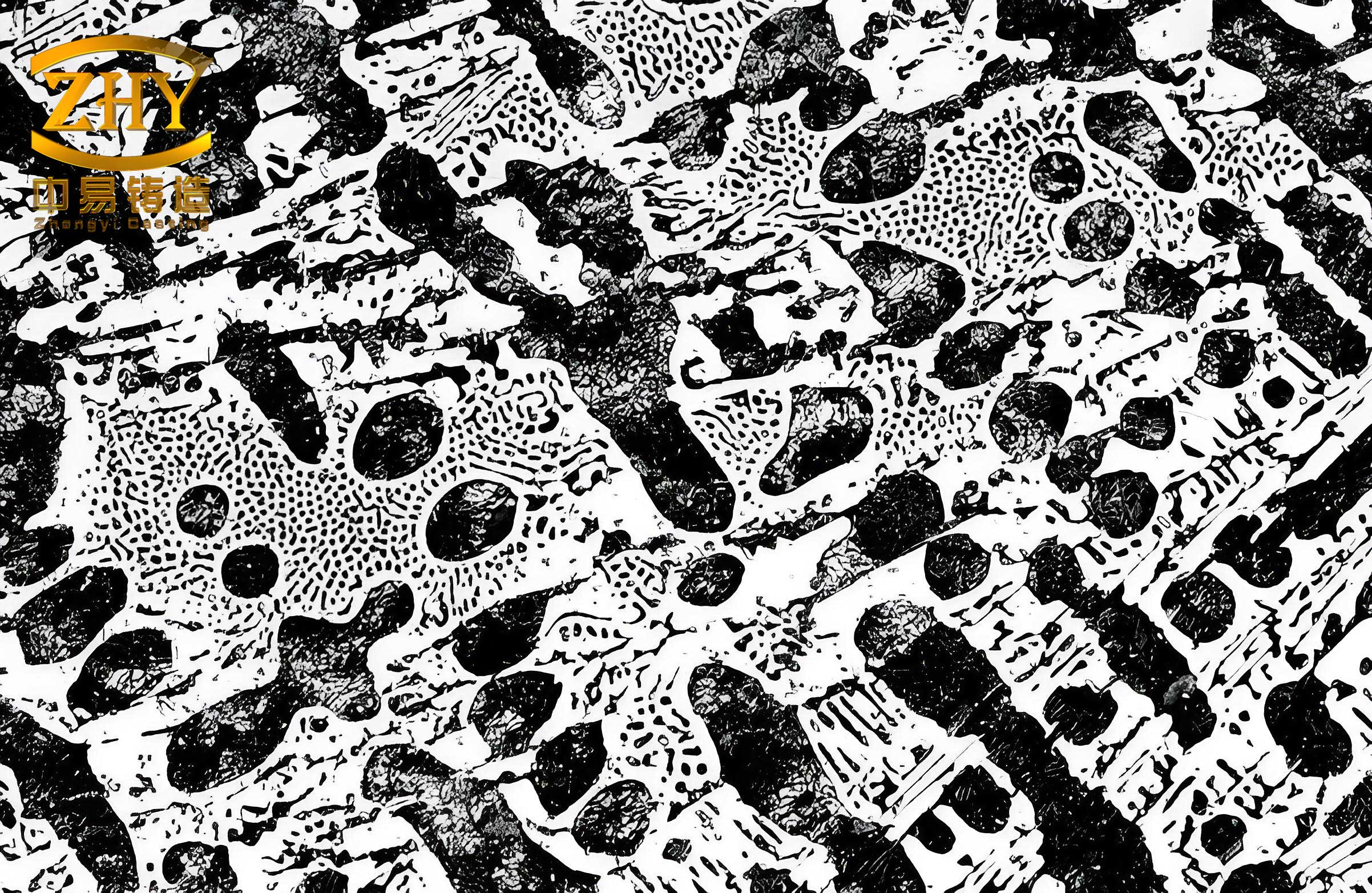
To understand the three-dimensional morphology, deep-etched samples were examined via SEM. The unmodified white cast iron revealed two basic carbide morphologies: lamellar eutectic carbides growing in a specific direction and honeycomb-like eutectic carbides segmented by rod-like austenite, together forming a continuous, interconnected network surrounding the primary austenite dendrites. In the modified white cast iron, the rod-like carbides were actually revealed to be bundles of increased interlamellar spacing, formed by the rapid growth of numerous branches protruding along the [010] direction (the covalent bond direction in cementite) during the layered growth of cementite plane dendrites. The cross-sectional view of these bundles appears as the observed rods or plates. Therefore, the modified microstructure essentially consists of finely elongated cementite bundle sections interspersed within the matrix, breaking the continuity of the carbide network.
The influence of modification on the heat-treated microstructure was also investigated. Specimens of modified white cast iron were subjected to various heat treatments: normalizing, quenching, austempering, and cyclic annealing. The heat treatment schedules and resulting microstructures are summarized in Table 5. The heat-treated microstructures of the modified white cast iron differed from the as-cast structure, but the modification did not fundamentally alter the transformation behavior of undercooled austenite. The key effect persisted: the carbides remained non-continuous. During heating, part of the eutectic carbides dissolved into austenite, subsequently precipitating as fine secondary carbides upon cooling. This process not only elevated the Ms point but also contributed positively to toughness. The modified white cast iron’s performance thus becomes less dependent on the brittle carbide network and more reliant on the matrix properties, which can be tailored through heat treatment.
| Process Name | Heating Temp. (°C) | Holding Time (min) | Cooling Medium / Isothermal Temp. | Isothermal Time (min) | Resulting Microstructure |
|---|---|---|---|---|---|
| Normalizing | 950 | 60 | Air | – | Pearlite + Eutectic Carbides + Secondary Carbides |
| Quenching | 950 | 30 | Oil quench | – | Martensite + Eutectic Carbides + Secondary Carbides + Retained Austenite |
| Austempering | 950 | 30 | Salt bath at 280°C | 90 | Lower Bainite + Eutectic Carbides + Secondary Carbides + Retained Austenite |
| Cyclic Annealing | 950 ↔ 720 (3 cycles) | 30 at 950, 60 at 720 | Furnace cool to 720°C each cycle | – | Pearlite + Eutectic Carbides + Secondary Carbides |
To elucidate the modification mechanism, thermal analysis and vacuum liquid quenching experiments were conducted. Cooling curves revealed that the addition of RARE-1 and RARE-2 modifiers lowered the eutectic transformation temperature of the low-chromium white cast iron by 8–12°C, as shown in Table 6. This increase in eutectic undercooling (ΔTeutectic) enhances the nucleation rate of carbides, promoting their more dispersed precipitation. The relationship between undercooling and nucleation rate (I) can be described by classical nucleation theory:
$$ I = I_0 \exp\left(-\frac{\Delta G^*}{kT}\right) \exp\left(-\frac{Q}{kT}\right) $$
where ΔG* is the critical free energy for nucleation, Q is the activation energy for diffusion, k is Boltzmann’s constant, and T is temperature. Increased undercooling reduces ΔG*, significantly increasing I.
| Sample | Modifier | Pouring Temp. (°C) | Eutectic Temp. TE (°C) | Undercooling ΔT (°C) relative to unmodified |
|---|---|---|---|---|
| 1 | Unmodified | 1450 | 1148 | – |
| 2 | RARE-1 | 1450 | 1138 | 10 |
| 3 | RARE-2 | 1450 | 1136 | 12 |
Liquid quenching experiments at different temperatures provided further insight. In unmodified white cast iron, primary austenite dendrites exhibited extensive branching. In the modified white cast iron, the degree of dendrite branching was markedly reduced, and the dendrites appeared more developed and uniformly distributed. This suggests that the rare earth and alkaline earth elements promote heterogeneous nucleation of primary austenite. When added to the melt, these elements rapidly form sulfides and oxysulfides (e.g., Ce2O2S, BaS, CaS). Many of these compounds possess a cubic crystal structure with lattice parameters that show low mismatch (often below 12%) with the face-centered cubic (fcc) γ-Fe (austenite) lattice. According to the crystallographic theory of heterogeneous nucleation, a mismatch below 12% indicates potent nucleating substrates. Therefore, these particles can act as effective sites for primary austenite nucleation, leading to a finer, more uniform austenite grain structure. Furthermore, these particles may also inhibit the growth and branching of dendrites. Electron probe microanalysis (EPMA) on quenched samples showed that rare earth (Ce) and alkaline earth (Ba, Ca) elements were uniformly distributed, while sulfur exhibited a tendency to segregate at the primary austenite boundaries.
Another aspect of the mechanism involves the alteration of cementite growth habits. Cementite (Fe3C) has a strong covalent bonding character along its [010] direction, which is its preferred growth direction. The rare earth and alkaline earth elements are proposed to adsorb at the growing carbide interface, potentially weakening the Fe-C covalent bonds. This adsorption modifies the interfacial energy and growth kinetics, favoring lateral growth or branching over uninterrupted linear extension. The modified growth mode leads to the formation of the observed rod-like or broken network carbide morphology instead of a continuous sheath. The combined effect of promoted austenite nucleation and modified carbide growth results in the refined, toughened microstructure of the modified low-chromium white cast iron.
In conclusion, the developed rare earth-alkaline earth metal composite modifiers, RARE-1 and RARE-2, are highly effective in improving the microstructure and mechanical properties of low-chromium white cast iron. They transform the detrimental continuous carbide network into a dispersed, rod-like morphology, resulting in dramatic increases in impact toughness and bending toughness. The modification mechanism is multifaceted: it involves lowering the eutectic temperature to increase undercooling, promoting heterogeneous nucleation of primary austenite via formed sulfide/oxysulfide particles, and altering the growth mode of eutectic cementite. These changes collectively disrupt the carbide network continuity. The heat treatment response of the modified white cast iron remains favorable, allowing for further optimization of matrix properties. This composite modification technique presents a viable and efficient method to expand the application range of low-chromium white cast iron in components subject to abrasive wear with impact loading, offering significant potential for economic savings in industries reliant on durable wear-resistant materials. The successful application of these modifiers underscores the importance of synergistic alloy design in advancing the performance of traditional materials like white cast iron.