
White cast iron stands as a crucial metallic material for resisting wear, particularly under abrasive conditions. Its wear resistance is not governed by a single property but is determined by a comprehensive performance indicator encompassing hardness, strength, and toughness. This performance is intrinsically linked to the structure, microhardness, relative volume fraction, distribution, and cohesive strength of its microstructural constituents. The ideal as-cast microstructure is considered to be one where high-microhardness carbides are dispersed in isolation within a martensitic matrix. The most economical and rational method to achieve this desired microstructure lies in the correct selection of alloying and modification treatments.
From the perspective of utilizing domestic resources, manganese alloying presents a promising avenue for developing white cast iron. However, to leverage its advantages while mitigating its shortcomings, manganese content should not be excessively high. To obtain an as-cast martensitic structure, supplementary alloying elements such as copper, chromium, molybdenum, and boron are necessary. Boron addition, in particular, can enhance the hardenability of manganese white cast iron, as well as the microhardness of its carbides and the overall bulk hardness. An appropriate amount of boron can yield these benefits without compromising toughness. Boron can also increase the carbide microhardness in nickel-chromium white cast iron. Notably, the addition of boron tends to increase the volume fraction of carbides within white cast iron.
Employing ladle-based modification treatment, rather than relying solely on high-alloying strategies to alter carbide distribution, is an economically rational, simple, and feasible approach. Rare earth modification treatment can transform carbides into compact, blocky shapes instead of coarse, interconnected networks, leading to a significant improvement in toughness, with impact values reaching approximately 2.0 kgf·m/cm². Boron addition can also promote a more blocky carbide morphology. However, further experimental research is required to control the process parameters to consistently achieve the intended modification effects.
White Cast Iron as a Primary Wear-Resistant Material
Currently, worldwide emphasis is placed on research concerning wear and wear-resistant materials to enhance the service life of machinery. Wear, fatigue, and corrosion constitute the three primary causes of component failure. Wear primarily includes sliding wear, rolling wear, and abrasive wear, with abrasive wear being a major factor leading to rapid component failure, where service life can sometimes be measured in mere hours or days. For instance, pump casings made from medium-manganese ductile iron used for conveying tailings slurry in mineral processing plants often last only slightly over half a month. The service life of components in shot blasting machines may be as short as a single shift. In thermal power plants, fan mill beaters made from Hadfield manganese steel for crushing coal blocks might last only a few hundred hours.
The frequent replacement of these vulnerable components not only results in significant wastage of manpower and material resources and creates supply chain pressures but also adversely affects the operational availability of machinery. In various industrial sectors handling ores or sandy materials, numerous components subjected to abrasive wear have become focal points for research and development, with urgent demands for extended service life. Examples include slurry pumps, shot blasting machine blades, crusher teeth, ball mill liners and grinding balls, tractor track shoes, and mixer blades. The specific conditions of abrasive wear are immensely diverse, and consequently, no universal, all-purpose material exists.
Through nearly a century of practice and material development, the primary wear-resistant ferrous materials include Hadfield manganese steel for high-impact, gouging abrasion; low-alloy steels for components subjected to moderate-impact crushing; and medium-manganese ductile iron and white cast iron for various low-impact wear conditions. However, based on international records of wear-resistant material applications, white cast iron has often demonstrated superior performance compared to Hadfield manganese steel and low-alloy steels in both laboratory wear testing and various field applications involving different wear modes. The wear resistance of a material is not solely dependent on high hardness; it also requires a certain level of toughness and strength, along with strong cohesive strength between the hard carbides and the softer matrix. Therefore, white cast iron’s performance hinges on the integrated metrics of hardness, strength, and toughness, closely related to its microstructure.
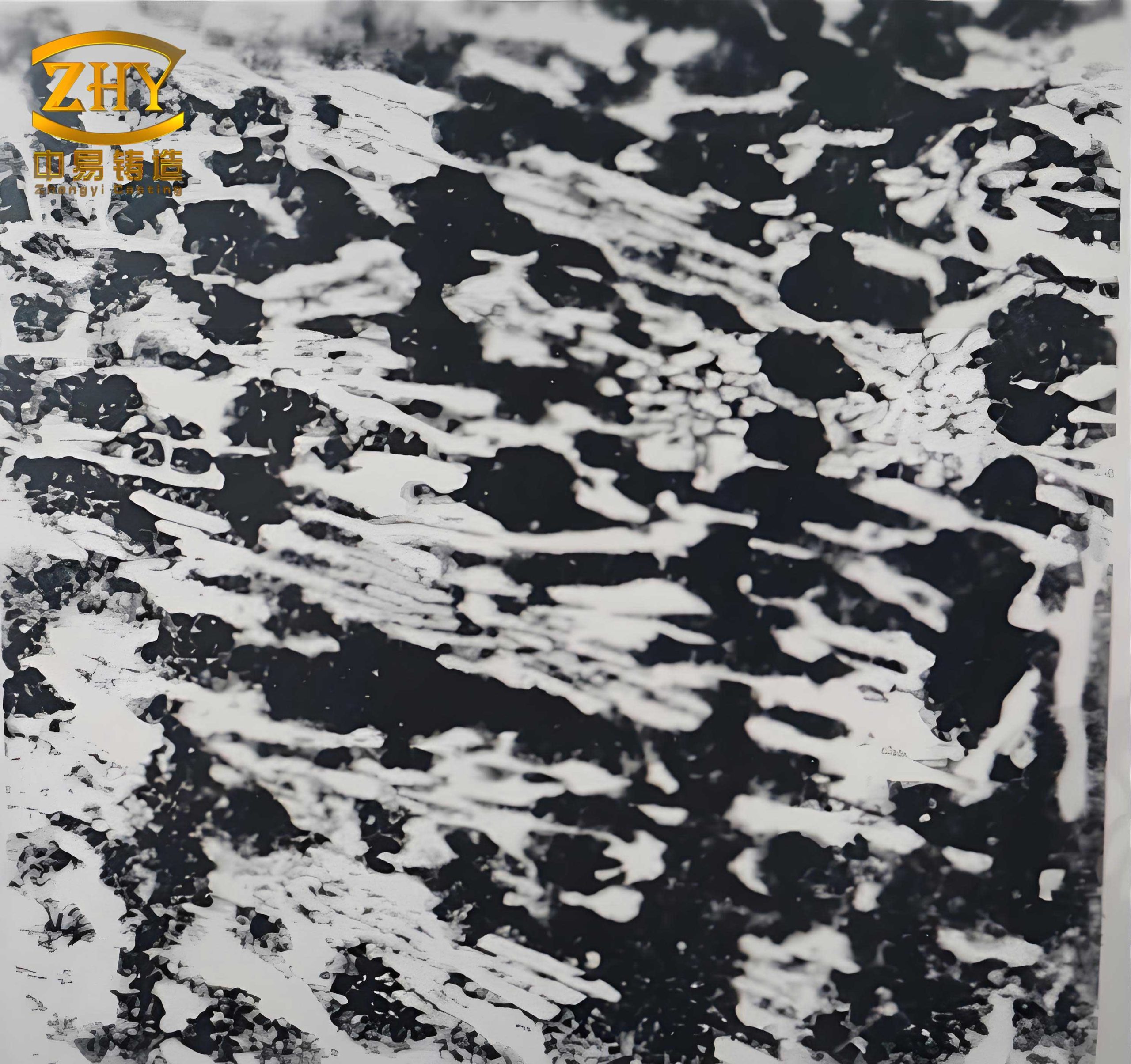
The Relationship Between Wear Resistance and Microstructure in White Cast Iron
The ability of white cast iron to resist abrasive wear is intimately connected to its microstructure. Abrasive wear typically involves both impact deformation wear and ploughing/ cutting wear by abrasive particles. When abrasive particles impact a surface, they induce stress that can cause brittle fracture, plastic deformation (indentation), or cracking at the edges of indentations, leading to material removal—this is deformation wear. When abrasive particles penetrate the surface and move across it, they cause ploughing deformation or cutting wear.
Hardness represents a material’s resistance to plastic flow and its ability to resist penetration by abrasives or even to fracture them. However, the traditional notion that higher hardness always equates to better wear resistance is not universally accurate, as high hardness often accompanies increased brittleness, reducing resistance to impact loads. Therefore, for a given abrasive hardness $H_a$, the workpiece material should possess a minimum hardness $H_m$, where $H_m \geq k \cdot H_a$ (with $k$ being a constant factor, often cited as ~0.8-1.0 for optimal wear resistance against quartz), while also maintaining adequate toughness and strength. The specific requirements for these properties vary with the mode of abrasive wear.
The bulk hardness of white cast iron is determined by the relative amounts and microhardness of the metallic matrix and the carbides. Martensitic white cast iron offers high hardness, although a certain amount of retained austenite can be beneficial. During service under impact, retained austenite can work-harden and undergo strain-induced transformation, potentially enhancing toughness without detriment to wear resistance. Carbides are the high-hardness phases in white cast iron; they protrude and bear the load after the softer matrix is worn away. However, carbides also act as crack initiation sites, and cracks propagate easily along them. Therefore, the carbide volume fraction should ideally be limited, for instance, to below 30%, to ensure sufficient toughness. A continuous, interconnected carbide network is particularly detrimental to the toughness of white cast iron, whereas a microstructure featuring disconnected or isolated carbide blocks can significantly improve toughness, thereby expanding the range of applications for this material.
In white cast iron, the ledeburitic structure can appear in rod-like, plate-like, or divorced eutectic forms. From a wear resistance perspective, a plate-like eutectic structure is often considered favorable because the high-hardness carbide phase presents a larger surface area and is separated by the more ductile austenite, which can hinder crack propagation. The presence of specific intergranular phases, such as phosphides or boron-rich phases, is generally detrimental to toughness, which in turn can reduce wear resistance. It is noted that rare earth elements can counteract the adsorption of boron at austenite grain boundaries and improve toughness in steels, suggesting a potential synergistic effect in white cast iron.
The wear resistance of white cast iron is not determined by high hardness alone but also by the composition of the softer matrix. Besides influencing the overall strength and toughness, the matrix affects the cohesive strength between the microstructural constituents. The microhardness of common matrix constituents is lower than that of typical abrasives like quartz sand (Hv ~1000-1200), meaning the matrix will be worn away, creating an uneven surface or grooves. While carbides are wear-resistant, if they exist as isolated, protruding brittle phases, they are susceptible to being bent, broken off by impacting abrasives, or spalled from the metal matrix. Furthermore, dislodged, high-hardness carbide fragments can become additional abrasive particles, accelerating wear. Therefore, the matrix also needs a minimum level of hardness and high cohesive strength with the carbides, the latter being related to the crystal structures of both phases.
In summary, the wear resistance of white cast iron depends on the comprehensive performance metrics of hardness, strength, and toughness, which are intimately related to the structure, microhardness, volume fraction, distribution, and interfacial strength of its microstructural constituents. Consequently, the correct application of alloying and modification treatments is the key to economically and rationally enhancing its wear resistance.
International Research on Alloying and Modification of White Cast Iron
The most effective methods for altering the microstructure of white cast iron are alloying, modification (inoculation), and heat treatment. The development history of white cast iron is essentially the history of researching alloying and modification to achieve high hardness and improved toughness using the simplest and most economical methods, thereby enhancing wear resistance and broadening its application scope.
Due to its low toughness, ordinary white cast iron was initially limited to chill castings like wheels and rolls. Starting in the 1930s, research focused on developing martensitic white cast iron. Martensite, with a microhardness of approximately Hv 500-900, can resist wear from quartz abrasives and firmly anchor the hard carbide phases, preventing their premature spallation, which is particularly important under high-velocity abrasive flow. White cast iron is often used for heavy-section wear parts (e.g., pump casings with wall thicknesses over 50 mm), which are complex and difficult to heat treat. This created a demand for as-cast martensitic structures with high hardenability. Internationally, nickel, chromium, and molybdenum became the primary alloying elements, leading to the development of the Ni-Hard series of white cast iron, considered the first generation of high-hardness white cast iron. Heat treatment was typically limited to low-temperature stress-relief annealing. Ni-Hard white cast iron demonstrated service lives several times to over ten times longer than ordinary white cast iron for applications like ball mill liners and pump parts.
However, nickel is in limited supply in many major industrial nations, prompting ongoing research into substituting nickel with copper and manganese in Ni-Hard type irons. Furthermore, the carbides in Ni-Hard white cast iron remain of the M3C type (cementite) and form coarse aggregates, resulting in relatively low toughness (impact strength often below 1.5 kgf·m/cm²). This made them prone to fracture in severe impact-abrasion conditions, such as in large ball mill liners.
Subsequently, low-carbon, high-chromium white cast irons were developed. With sufficient chromium content, the carbide type changes from M3C to M7C3. The M7C3 carbide has a hexagonal crystal structure and forms as isolated, compact blocks within the microstructure. This transformation significantly improves the toughness, bending strength, and deflection of high-chromium white cast iron, with impact strength reaching approximately 3-6 kgf·m/cm² and bending strength up to 100 kgf/mm². Additionally, M7C3 carbide possesses a higher microhardness (Hv ~1300-1800) than quartz. This combination of hardness and toughness marks high-chromium white cast iron as a second-generation material, suitable for components like impact crusher hammers and jaw crusher plates that endure medium-to-high impact loads.
Recently, international attention has turned to vanadium-alloyed white cast iron. Research indicates that vanadium carbides (e.g., VC) form as isolated, globular particles with strong cohesive bonding to the matrix and very high microhardness (Hv ~2800). The volume fraction of carbides plays a crucial role in the wear resistance of white cast iron. Modification treatment to refine the solidification structure, particularly to alter carbide morphology and distribution, is gaining widespread attention due to its simplicity, significant effects, and potential for saving costly alloying elements.
Various modification methods have been explored: cobalt or zirconium powder washes to refine dendritic structures and eliminate hot tearing; silicon treatment to refine eutectic cells in high-chromium white cast iron; boron-calcium treatment to improve wear resistance of chromium-manganese white cast iron; boron treatment to promote carbide spheroidization in high-chromium iron; and rare earth (cerium) treatment to influence eutectic solidification. A German patent mentions that modification with tellurium, bismuth, or antimony can produce tough white cast iron with plate-like carbides.
In summary, international alloying research has largely focused on nickel-chromium and chromium-molybdenum systems and on using high alloying to change the Cr/C ratio and carbide structure. Research on modification treatment is still in its early stages but holds great promise.
Research on Manganese Alloying of White Cast Iron
While some domestic research focuses on promoting high-chromium and high-tungsten white cast irons (which also rely on a high alloy-to-carbon ratio to obtain non-M3C type carbides), our approach emphasizes utilizing domestic resources. We aim to employ manganese, boron, vanadium, titanium, and other elements to enhance hardenability for obtaining martensite, coupled with modification treatments to alter carbide shape and distribution. This strategy is conducive to expanding the application of wear-resistant white cast iron and establishing a domestic alloy white cast iron series.
Our initial investigation into the effect of manganese content on the hardenability of white cast iron involved melting a base iron (C ~3.0%, Si ~1.0%) and progressively increasing the manganese content from 0.5% to over 7.0%. Samples were taken at intervals, and their microstructure, hardness, and toughness were evaluated. The results are summarized in Table 1.
| Manganese Content (wt.%) | Microstructure (Qualitative) | Hardness (HRC) | Impact Toughness (kgf·m/cm²) |
|---|---|---|---|
| ~0.5 | Pearlite + Ledeburite | ~45 | ~0.5 |
| ~3.0 | Pearlite + Ledeburite | ~46 | ~0.5 |
| ~4.5 | Pearlite + Ledeburite + (Martensite begins) | ~48 | ~0.5 |
| ~5.5 | Martensite increased | ~52 | Slightly decreased |
Hardness increased slightly with manganese, while toughness changed little initially. Martensite appeared in the microstructure at around 4.5% Mn, and its amount increased further at 5.5% Mn, accompanied by a hardness increase and a slight toughness drop. Subsequent melts with lower silicon content confirmed these trends, as shown in Table 2.
| Chemical Composition (wt.%) | Microstructure |
|---|---|
| C: 2.8, Si: 0.8, Mn: 5.5 | Pearlite + Ledeburite + Some Martensite |
| C: 2.9, Si: 0.9, Mn: 5.6 | Pearlite + Ledeburite + More Martensite |
Considering practical foundry constraints (like cupola melting where silicon cannot be too low), tests were conducted with slightly higher silicon content (~1.8%). The results, shown in Table 3, indicated that higher carbon and particularly higher silicon levels are detrimental to obtaining an as-cast martensitic structure in manganese white cast iron.
| Chemical Composition (wt.%) | Microstructure | Hardness (HRC) |
|---|---|---|
| C: 3.2, Si: 1.9, Mn: 5.8 | Pearlite, Martensite, Retained Austenite, Divorced Carbides | ~45 |
| C: 3.3, Si: 2.0, Mn: 6.0 | Pearlite, Martensite, Retained Austenite, Divorced Carbides | ~46 |
Relying solely on manganese to obtain an as-cast martensitic white cast iron is challenging. However, medium-manganese white cast iron (Mn ~5.5-6.0%) can achieve a hardness of HRC 45-52, making it suitable for certain abrasive wear conditions. Its toughness can be further enhanced through rare earth modification, which refines the microstructure. Rare earth also improves hardenability and acts as an anti-graphitizing agent. Tests on white cast iron with C ~3.0%, Si ~1.8%, Mn ~5.8% treated with Baotou #1 rare earth alloy showed optimal results with a residual rare earth content of ~0.05%. Excessive rare earth leads to inclusions detrimental to toughness.
Typical properties for rare earth-modified manganese white cast iron are: hardness HRC 48-52, impact toughness ~0.8-1.2 kgf·m/cm², and bending strength ~70-80 kgf/mm². This material is suitable for components like sand pumps and liners under general abrasive冲刷 conditions, offering simple production and low cost.
To further improve the hardenability of manganese white cast iron, especially for heavy-section castings, a multi-element, low-addition alloying approach was adopted. For a slurry pump casing application, a manganese-chromium-molybdenum-copper white cast iron was tested. Chromium improves corrosion resistance, while copper and molybdenum enhance toughness. Different manganese levels were evaluated in an alloy base (C ~3.0%, Si ~1.8%, Cr ~2.0%, Mo ~0.8%, Cu ~1.0%), all treated with rare earth-magnesium alloy. The results are in Table 4.
| Manganese Content (wt.%) | Microstructure | Hardness (HRC) | Remarks |
|---|---|---|---|
| ~3.0 | Troostite, Austenite, Carbides | ~48 | Small amount of Martensite |
| ~5.0 | Martensite, Austenite, Carbides | ~55 | – |
Initially, a composition with ~5.0% Mn was used for trial production of pump casings. After adjustments, a final composition of C: 3.0-3.3%, Si: 1.6-1.9%, Mn: 4.5-5.0%, Cr: 1.5-2.0%, Mo: 0.6-1.0%, Cu: 0.8-1.2% was established, modified with rare earth-magnesium alloy. Test bars showed hardness HRC 55-58 and bending strength ~85 kgf/mm². The service life of pump casings produced with this material doubled compared to previous medium-manganese ductile iron casings, exceeding one month. However, in heavy sections (~50 mm), the hardness dropped to HRC ~48, and the matrix was primarily troostitic. To improve wear resistance, hardenability needs further enhancement by adjusting compositions: lowering Si and Mn while increasing Cr, Mo, and Cu. Nevertheless, rare earth-manganese-aluminum-chromium white cast iron remains a valuable wear-resistant material.
Research on Boron Alloying of White Cast Iron
Boron, an abundant domestic resource, is known to strongly enhance hardenability in steels. Its addition to white cast iron can also improve hardenability and act as a modifier. We investigated the effects of boron in plain white cast iron, as well as in medium-manganese and nickel-chromium alloyed white cast irons.
Studies on boron in plain white cast iron involved adding varying amounts of boron (0.02% to 0.30%) to two base irons with different carbon levels: a lower-carbon group (C ~2.8%, Si ~1.8%) and a higher-carbon group (C ~3.4%, Si ~1.9%). The microstructure consisted of pearlite + ledeburite + carbides in all cases. Key findings are summarized in Table 5.
| Boron Addition (wt.%) | Carbide Microhardness (Hv) | Bulk Hardness (HRC) | Bending Strength (kgf/mm²) | Deflection (mm) |
|---|---|---|---|---|
| 0.00 | ~1100 (Low C), ~1150 (High C) | ~46 / ~50 | ~85 / ~75 | ~2.5 / ~2.0 |
| 0.10 | ~1250 / ~1300 | ~48 / ~53 | ~80 / ~70 | ~2.3 / ~1.8 |
| 0.20 | ~1400 / ~1450 | ~50 / ~55 | ~75 / ~65 | ~2.0 / ~1.5 |
| 0.30 | ~1550 / ~1600 | ~52 / ~57 | ~70 / ~60 | ~1.8 / ~1.3 |
As boron content increased, the volume fraction and microhardness of carbides increased significantly, leading to higher bulk hardness. This relationship for carbide microhardness can be expressed as:
$$ Hv_{carbide} \approx Hv_0 + k_B \cdot [B] $$
where $Hv_0$ is the base carbide microhardness and $k_B$ is a positive constant. However, bending strength and deflection decreased. Boron’s effect on pearlite microhardness was not pronounced. The trends were similar for both carbon levels, with the higher-carbon iron exhibiting more carbides, higher hardness, and lower strength. Neutron activation autoradiography confirmed that boron segregates to the carbide phase, likely forming (Fe, M)3(C,B) or (Fe, M)23(C,B)6. The larger boron atom distorts the carbide lattice, increasing its microhardness.
In a hypoeutectic manganese white cast iron (C ~3.0%, Si ~1.8%, Mn ~5.5%), adding 0.10-0.15% boron increased the amount of martensite in the matrix and raised the hardness. It also disrupted the distinct primary austenite dendrites, leading to a more random distribution. However, when residual boron exceeded ~0.08%, toughness dropped markedly. Further combined treatment of manganese-boron white cast iron with rare earth modification increased martensite, reduced retained austenite, and increased hardness. Statistical analysis indicated that boron content had a more significant influence on bending strength than residual rare earth content in these systems.
Trial castings of pump casings with a base composition (C ~3.2%, Si ~1.7%, Mn ~5.0%) and boron/rare earth treatment faced cracking issues when boron addition was too high (~0.25%). Reducing furnace boron addition to 0.15% combined with ladle treatment of rare earth and 0.05% boron, along with improved mold yielding, produced sound castings. Their service life was comparable to Mn-Cu-Cr-Mo white cast iron pumps, with hardness ~HRC 52 and bending strength ~75 kgf/mm². Further composition adjustments are needed. Typically, rare earth-manganese-boron white cast iron can undergo low-temperature tempering at 200-250°C, which relieves casting stresses without reducing hardness and may even improve wear resistance.
To improve the service life of nickel-chromium indefinite chill roll iron, different boron additions were tested in a base iron (C ~3.4%, Si ~0.8%, Mn ~0.8%, Ni ~4.2%, Cr ~1.6%). The results are shown in Table 6.
| Boron Addition (wt.%) | Bulk Hardness (HS) | Carbide Microhardness (Hv) | Impact Toughness (kgf·m/cm²) |
|---|---|---|---|
| 0.00 | ~68 | ~1050 | ~0.40 |
| 0.05 | ~68 | ~1150 | ~0.38 |
| 0.10 | ~72 | ~1250 | ~0.35 |
| 0.15 | ~75 | ~1350 | ~0.30 |
Bulk hardness increased noticeably at a boron addition of 0.10%. Carbide microhardness and volume fraction increased gradually with boron, while toughness decreased.
Research on Modification Treatment of White Cast Iron
Altering the morphology and distribution of carbides in white cast iron to improve its toughness and wear resistance is of great interest globally. Methods include austempering heat treatment, high-temperature forging, and modification. The last method is simple and economical and has been applied in the production of various white cast irons. Modifiers used include boron, vanadium, titanium, tellurium, rare earths, and aluminum, either singly or in combination, with varying degrees of success, though in-depth theoretical understanding requires further development.
Our experiments with boron modification showed that it refines the ledeburitic structure in both high- and low-carbon white cast irons. Furthermore, in a white cast iron with C ~3.5%, Si ~2.0%, Mn ~0.8%, P ~0.3%, boron addition promoted the formation of blocky carbides.
Experiments using mixed rare earths and Baotou #8 rare earth alloy on hypoeutectic white cast iron revealed that adding an appropriate amount of rare earth refines the primary austenite and changes the eutectic carbide morphology from a continuous network towards a more disconnected, blocky/plate-like form. While bulk hardness did not change markedly, impact toughness improved. The mechanism involves influencing the solidification process, potentially modifying the eutectic growth interface. The effect can be conceptually related to changes in the growth restriction factor or the interfacial energy between the carbide and the melt. Combined rare earth and boron treatment holds potential for further microstructural improvement, but more systematic research is needed to optimize parameters and understand interactions.
Concluding Remarks
White cast iron has evolved into a critically important material for resisting abrasive wear. High-chromium white cast iron, with its isolated blocks of high-microhardness M7C3 carbides, offers an exceptional combination of hardness and toughness, extending its application into areas previously dominated by Hadfield manganese steel with good results. Its properties are achieved through a high Cr/C ratio, which dictates the carbide type and microstructure.
Our research explores a path based on domestic resources, focusing on manganese and boron as primary alloying elements, supplemented by low additions of chromium, molybdenum, copper, and others to achieve high hardenability and adequate as-cast hardness depth in heavy-section white cast iron components. Preliminary results indicate that boron, chromium, molybdenum, and copper additions to manganese white cast iron enhance its hardenability, allowing for the attainment of a martensitic matrix at lower manganese levels than required in plain manganese white cast iron.
Boron additions to medium-manganese, nickel-chromium, and chromium-molybdenum white cast irons can increase the carbide microhardness to levels exceeding Hv 1500, matching or surpassing the hardness of common quartz abrasives, while also increasing carbide volume fraction. However, boron tends to reduce bending strength and deflection. Rare earth elements can counteract some of the detrimental effects of boron.
Rare earth modification of both medium-manganese and nickel-chromium white cast irons demonstrates the potential to alter carbide morphology and distribution, improving toughness. While achieving a truly “tough white cast iron” with dramatically higher impact values requires further research, the findings are valuable for both advancing eutectic solidification theory and practical applications. Consequently, rare earth-manganese-boron white cast iron holds promise for development into a wear-resistant material with properties approaching those of high-chromium white cast iron.
In applications like rolling mill rolls, wear is a primary life-limiting factor. Boron’s ability to increase carbide microhardness and rare earth’s potential to improve carbide distribution and fracture resistance can significantly enhance the wear resistance of both plain and alloy chilled cast iron rolls and Ni-Cr composite rolls. The continued development of alloyed and modified white cast iron represents a vital strategy for improving the durability and efficiency of industrial machinery subjected to severe wear.