
In the realm of internal combustion engine manufacturing, the crankshaft stands as a critical component, enduring complex cyclic loads of bending and torsion during operation. Its primary failure modes are fatigue fractures stemming from these stresses. Consequently, the material chosen must exhibit high rigidity, superior fatigue strength, and excellent wear resistance. Over recent decades, ductile iron, with its continuously improving properties and cost-effectiveness, has emerged as a paramount material for crankshaft production. However, the casting process for such high-integrity components is fraught with challenges, among which slag inclusion defects are particularly prevalent and detrimental. In my extensive experience with foundry operations, addressing these slag inclusion issues requires a systematic approach, blending metallurgical knowledge with practical engineering design. This article delves deep into the root causes, analysis, and successful remediation strategies for slag inclusion defects in a specific grade of ductile iron crankshaft castings, sharing insights gained from hands-on investigation and process optimization.
The manifestation of slag inclusion, often termed black slag or black dross, is a common yet serious defect in ductile iron castings. Visually, these defects appear as dark, non-metallic, discontinuous patches or spots on the fracture surface or casting skin, typically concentrated in upper surfaces and dead corners of the mold cavity. Mechanically, they act as stress concentrators, severely degrading the material’s continuity, thereby diminishing tensile strength, elongation, impact toughness, and most critically, fatigue performance. The sensitivity to slag inclusion size is acute; as the base material strength increases, the detrimental effect of even small inclusions becomes magnified. From a formation chronology perspective, slag inclusions are classified into two primary types: primary and secondary slag, with the latter often posing a greater threat to dynamic component integrity like crankshafts.
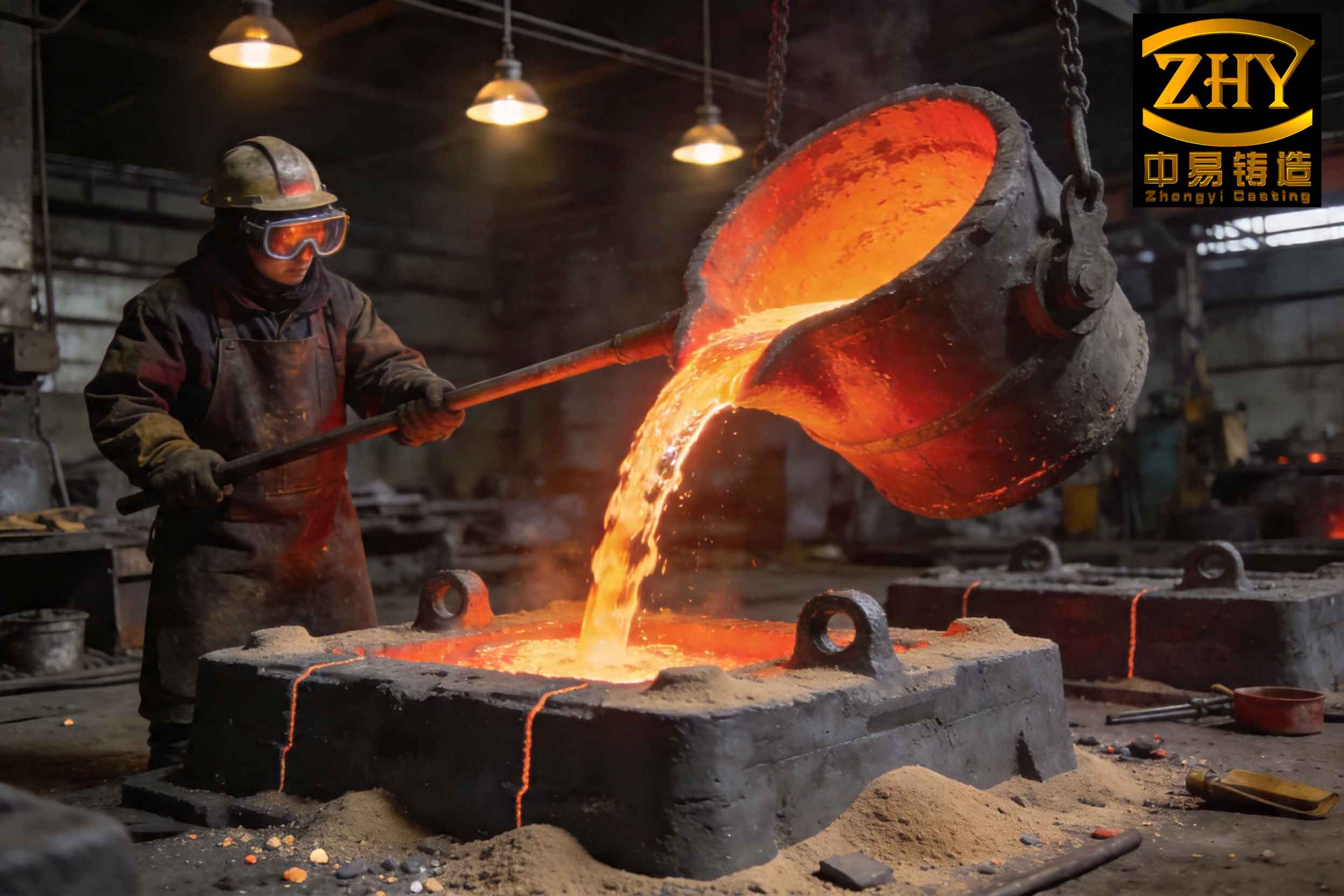
To understand the genesis of slag inclusion, one must first examine the physicochemical reactions during iron treatment. During the spheroidization process, elements like magnesium (Mg) and rare earths (RE) react vigorously with sulfur (S) and oxygen (O) present in the molten iron. This leads to the formation of various sulfides and oxides, such as manganese sulfide (MnS), magnesium sulfide (MgS), silicon dioxide (SiO2), magnesium oxide (MgO), and rare earth oxides like La2O3 and Ce2O3. While many of these compounds have lower density than iron and can float to the surface for removal, certain rare earth oxides possess densities comparable to molten ductile iron, making them prone to remain suspended within the melt. When this contaminated metal is poured into the mold, these inclusions are carried along. Upon solidification, sulfides, which have lower melting points, precipitate out, forming coarse, particulate slag inclusions. This constitutes primary slag. The chemical composition control of the base iron is therefore foundational. For a grade like QT700-2, a pearlitic matrix is desired, necessitating tight control over key elements. The typical target range is summarized in Table 1.
| Element | Control Range | Rationale |
|---|---|---|
| C | 3.5 – 3.8 | Ensures graphitization, provides buoyancy for slag flotation. |
| Si | 2.2 – 2.7 | Promotes ferrite, aids inoculation, but excess can increase slag formation. |
| Mn | 0.4 – 0.6 | Strengthens pearlite; higher levels can promote segregations. |
| P | < 0.05 | Minimizes brittle phosphide eutectic at grain boundaries. |
| S | < 0.03 (Post-treatment) | Critical for reducing sulfide-based slag inclusion; demands low-sulfur charge materials. |
| Mg (residual) | 0.03 – 0.05 | Essential for nodular graphite formation but promotes oxide film. |
| RE (residual) | 0.02 – 0.04 | Aids in controlling trace elements and graphite morphology. |
| Cu | 0.2 – 0.4 | Alloying element to strengthen and stabilize pearlite matrix. |
| Mo | 0.1 – 0.3 | Enhances hardenability and strength, refines matrix. |
Secondary slag inclusion formation is more intimately linked to the dynamics of the pouring and mold-filling process. After treatment, ductile iron melt develops a protective but fragile surface oxide film, primarily composed of MgO and SiO2. The thickness and stability of this film are inversely related to the pouring temperature and directly related to the residual Mg content. During turbulent transfer, pouring, and mold filling, this film can be ruptured, fragmented, and entrained into the bulk metal. If the gating system design is suboptimal—causing excessive velocity, spray, splashing, or vortexing—the entrainment of this oxide film, along with air and mold gases, is exacerbated. These entrapped films act as nuclei, adsorbing other suspended sulfides, oxides, and free graphite, and subsequently float to the upper surfaces of the casting as it solidifies, forming the characteristic macroscopic slag inclusion defects. The governing fluid dynamics can be described by the Reynolds number (Re) for flow in the channels:
$$ Re = \frac{\rho v D_h}{\mu} $$
where $\rho$ is the molten iron density, $v$ is the flow velocity, $D_h$ is the hydraulic diameter of the channel, and $\mu$ is the dynamic viscosity. Turbulent flow (Re > 4000) promotes entrainment, while laminar flow (Re < 2000) is desirable for clean metal entry. The key is to design the gating system to maintain Re as low as practically possible during mold filling.
My initial approach to mitigating slag inclusion focused on the metallurgical front, adhering strictly to best practices. This involved sourcing high-purity, low-sulfur pig iron and clean, rust-free steel scrap, eliminating returns of unknown history. For melting in a cupola, using foundry coke with sulfur content below 0.5% and implementing effective desulfurization pretreatment to achieve a base S < 0.03% was mandatory. The spheroidization treatment was revised based on the charge materials. Originally, a higher-rare-earth alloy QRMg8RE7 was used. However, to minimize the formation of dense rare-earth oxides that contribute to primary slag inclusion, we switched to a modified alloy with lower rare earth content, QRMg8RE5. The specifications for these alloys are compared in Table 2.
| Element | QRMg8RE7 | QRMg8RE5 | Function |
|---|---|---|---|
| Mg | 7.0 – 9.0 | 7.0 – 9.0 | Primary spheroidizing element. |
| RE | 6.0 – 8.0 | 4.0 – 6.0 | Neutralizes trace elements, aids nodularity. |
| Si | 35.0 – 44.0 | 35.0 – 44.0 | Carrier, provides some inoculation. |
| Ca | ≤ 4.0 | ≤ 4.0 | Desulfurization, slag formation. |
| Al | 0.5 | 0.5 | Deoxidizer. |
| Fe | Balance | Balance | Base. |
The inoculation practice was also enhanced by employing a late-stream inoculation method with a Ba-containing长效 (long-lasting) inoculant to increase graphite nodule count and improve morphology, thereby reducing the undercooling tendency and promoting a more homogeneous matrix. Despite implementing these rigorous metallurgical controls, a pilot batch of 20 castings still yielded 4 with significant slag inclusion defects. This indicated that while material factors were crucial, the hydrodynamic aspects of the casting process—specifically the gating system design—were the dominant contributors to the persistent slag inclusion problem, likely fostering secondary slag formation.
The original gating system was a conventional pressurized design with a choke at the sprue base. The ratio of cross-sectional areas was Fsprue : ΣFrunner : ΣFingate = 2 : 1.5 : 1. With a sprue area of 9 cm², the calculated pouring time was 15 seconds, but actual measurements averaged 19 seconds, a 21% deviation indicating improper calibration or excessive flow restriction. The small ingate area likely resulted in high metal velocity, causing turbulence and air entrainment. To address this, I led a complete redesign based on the principles of hydraulics and the theory of free (unpressurized) or partially pressurized flow aimed at achieving quiescent mold filling. The goal was to increase the ingate area to reduce velocity and redesign the system using the “large orifice outflow” theory for more accurate sizing.
The casting parameters were: Casting weight (G) = 63 kg, Casting height (C) = 15.5 cm, and we aimed for a reduced pouring time (t) of approximately 12 seconds to minimize temperature drop and reoxidation. The effective sprue height (Hp) was maintained at 40 cm. The first step was to determine the average effective metallostatic pressure head (hp) during filling, which accounts for the changing head as the mold fills. For a system with multiple restrictions, the calculation involves the flow coefficients (μ) and area ratios. We selected: μ1 for sprue = 0.6, μ2 for runner = 0.6, μ3 for ingate = 0.5. The target area ratio was set to a less pressurized scheme: Fsprue : ΣFrunner : ΣFingate = 1 : 2 : 1.5. From this, we derive the coefficients k1 and k2:
$$ k_1 = \frac{\mu_1 F_{sprue}}{\mu_2 \Sigma F_{runner}} = \frac{0.6 \times 1}{0.6 \times 2} = 0.5 $$
$$ k_2 = \frac{\mu_1 F_{sprue}}{\mu_3 \Sigma F_{ingate}} = \frac{0.6 \times 1}{0.5 \times 1.5} = 0.8 $$
The average pressure head hp is then given by:
$$ h_p = \frac{k_2^2}{1 + k_1^2 + k_2^2} \left( H_p – \frac{C}{2} \right) $$
Substituting the values:
$$ h_p = \frac{0.8^2}{1 + 0.5^2 + 0.8^2} \left( 40 – \frac{15.5}{2} \right) = \frac{0.64}{1 + 0.25 + 0.64} \left( 40 – 7.75 \right) = \frac{0.64}{1.89} \times 32.25 \approx 10.92 \, \text{cm} $$
With hp determined, the total required ingate area (ΣFingate) can be calculated using the fluid flow discharge formula:
$$ \Sigma F_{ingate} = \frac{G}{0.31 \cdot \mu_3 \cdot t \cdot \sqrt{h_p}} $$
Plugging in the numbers:
$$ \Sigma F_{ingate} = \frac{63}{0.31 \times 0.5 \times 12 \times \sqrt{10.92}} = \frac{63}{0.31 \times 0.5 \times 12 \times 3.305} \approx \frac{63}{6.15} \approx 10.24 \, \text{cm}^2 $$
We rounded this to ΣFingate = 10.6 cm² for practical pattern-making. Consequently, the other areas were computed proportionally:
$$ F_{sprue} = \frac{\Sigma F_{ingate}}{1.5} = \frac{10.6}{1.5} \approx 7.07 \, \text{cm}^2 \quad \text{(taken as 7 cm²)} $$
$$ \Sigma F_{runner} = 2 \times F_{sprue} = 2 \times 7 = 14 \, \text{cm}^2 $$
Thus, the final designed area ratio was Fsprue : ΣFrunner : ΣFingate = 7 : 14 : 10.6 ≈ 1 : 2 : 1.5. This represented a significant enlargement of the ingate and runner areas compared to the old system (9 : 6.8 : 4.5), shifting it towards a more open, less pressurized system intended to lower flow velocity and promote laminar filling. The theoretical pouring time was verified using the common empirical formula for gray iron, adjusted for ductile iron’s faster desired pour rate:
$$ t = S \sqrt{G} $$
where S is a coefficient typically between 1.7 and 2.2 for medium castings. Using S=1.95 for estimation: t = 1.95 × √63 ≈ 1.95 × 7.94 ≈ 15.5 seconds. Our target of 12 seconds was more aggressive to reduce exposure time, but the system design using the hydraulic calculation above ensures the required flow rate. The key is that the actual velocity (v) at the ingates is reduced, calculable by:
$$ v_{ingate} = \frac{Q}{\Sigma F_{ingate}} = \frac{G / (\rho \cdot t)}{\Sigma F_{ingate}} $$
Assuming ρ ≈ 7000 kg/m³ for iron, the volumetric flow rate Q ≈ 63 / (7000 * 12) ≈ 0.00075 m³/s = 750 cm³/s. Therefore, vingate ≈ 750 / 10.6 ≈ 70.8 cm/s, a substantial reduction from the higher velocity in the previous restrictive design, which we can estimate was roughly vingate_old = Q / 4.5 ≈ 750 / 4.5 ≈ 166.7 cm/s. This lower velocity is critical for minimizing turbulence and oxide film entrainment, thereby directly combating secondary slag inclusion formation.
The implementation of the new gating design was integrated with the stringent metallurgical controls previously established. The entire process flow was monitored: from charge material selection and superheating to precisely timed spheroidization and inoculation, followed by controlled pouring within the temperature window of 1350-1370°C using the newly crafted molds. The sand molds were green sand, and care was taken to ensure proper venting to allow gases to escape easily, further reducing the potential for gas-backed slag inclusion defects. After a two-month production period, a statistical quality audit was performed on a sample of 100 randomly selected crankshaft castings. The results were markedly improved. Only 3 castings exhibited noticeable slag inclusion defects, translating to a reject rate of 3%, down from the initial 13% and significantly better than the 20% reject rate in the pilot batch after metallurgical improvements alone. This confirmed the hypothesis that the gating system hydrodynamics were the linchpin in the slag inclusion problem for this specific casting.
To generalize the findings, the battle against slag inclusion in ductile iron castings, especially for demanding applications like crankshafts, is fought on two interconnected fronts: chemistry and fluid dynamics. Table 3 summarizes the holistic strategy derived from this investigation.
| Aspect | Specific Action | Primary Target (Slag Type) | Key Parameter/Control |
|---|---|---|---|
| Charge Materials | Use low-S, low-trace element pig iron; clean, dry steel scrap. | Primary | S < 0.07% in base iron. |
| Melting & Treatment | Effective desulfurization; controlled spheroidization with optimal Mg/RE alloy; efficient late inoculation. | Primary & Secondary | Post-treatment S < 0.03%; Residual Mg 0.03-0.05%; Pouring temp > 1350°C. |
| Gating System Design | Use hydraulic calculations (e.g., large orifice theory) to design for laminar flow; increase ingate area; use open/unpressurized systems. | Secondary | Ingate velocity < 100 cm/s; Re in runners < 3000; Proper area ratios. |
| Pouring Practice | Quick, smooth pour to minimize temperature loss; avoid interrupted flow; use pouring basins to reduce turbulence. | Secondary | Pouring time optimized per weight; minimal slag carryover from ladle. |
| Mold Design | Adequate venting, especially in upper sections and blind spots; use of chills strategically to control solidification direction. | Secondary | Vent area > 0.5% of mold cavity volume; proper riser placement. |
In conclusion, the journey to eliminate slag inclusion defects from these ductile iron crankshafts was an instructive exercise in root-cause analysis and systematic problem-solving. It underscored that while advanced metallurgy is non-negotiable for achieving the required microstructure and mechanical properties, the casting process itself—the conduit through which the refined metal becomes a shaped component—holds equal importance. A poorly designed gating system can undo all the careful chemical preparation by creating turbulent conditions ripe for the formation of secondary slag inclusion. The application of fundamental fluid mechanics principles, embodied in the recalculation of gating dimensions using the average pressure head method, proved decisive. The dramatic reduction in defect rate from 13% to 3% validates this integrated approach. For foundry engineers, this case reinforces the mantra: control the melt, but equally, command the flow. Continuous vigilance and a willingness to challenge existing designs are essential in the relentless pursuit of casting quality, ensuring that critical components like crankshafts are free from the hidden weaknesses imposed by slag inclusion defects.
The mathematical framework used here can be adapted to other casting geometries. The core equations governing the flow can be expressed in a consolidated form for system design:
$$ \text{1. Determine required pouring time: } t = K_t \cdot G^{1/2} $$
$$ \text{2. Calculate average effective head: } h_p = f(k_1, k_2, H_p, C) = \frac{k_2^2}{1 + k_1^2 + k_2^2} \left( H_p – \frac{C}{2} \right) $$
$$ \text{3. Size the choking area (typically ingate): } A_{choke} = \frac{G}{\rho \cdot \mu_{choke} \cdot t \cdot \sqrt{2 g h_p}} $$
where $K_t$ is an empirical coefficient (usually 1.7-2.2), $\rho$ is density, $g$ is gravity, and $A_{choke}$ is the minimum controlled area. In our case, we used the simplified constant 0.31 which incorporates $\rho$ and $\sqrt{2g}$ for iron in consistent units. This structured calculation replaces rule-of-thumb ratios, providing a scientific basis for gating design that directly addresses the fluid dynamics contributing to slag inclusion formation. Future work could involve computational fluid dynamics (CFD) simulation to visualize the flow patterns and further optimize the system, but the analytical approach described remains a powerful and accessible tool for foundries aiming to conquer the persistent challenge of slag inclusion in high-quality ductile iron castings.