
In my extensive experience with foundry operations for heavy-duty diesel engines, one of the most persistent and costly issues has been the occurrence of slag inclusion defects and sand holes in the cylinder bore regions of engine blocks. These defects, primarily manifesting as non-metallic inclusions and sand entrapments, severely compromise the structural integrity and performance of the cast components. The engine block in question, with a material specification of HT250 gray iron, a casting weight of approximately 1250 kg, and critical wall thicknesses in the water jacket area around 15 mm, presented significant challenges during production. The original horizontal casting process with a split line and a two-step gating system, as illustrated in the initial setup, consistently yielded a defect rate exceeding 20%, necessitating extensive and costly repair welding. This article details my first-hand investigation into the root causes of these slag inclusion defects and the systematic engineering solutions developed to eliminate them.
The core of the problem was identified in the cylinder bores on the drag side of the mold. The original two-step gating system, designed with specific cross-sectional area ratios, failed to function as intended. The area ratios were defined as: $$A_{\text{spure}} : A_{\text{choke}} : A_{\text{main runner}} : A_{\text{branch runner}} : A_{\text{ingate}} = 1 : 0.3 : 1.8 : 1.5 : 1.75$$. Theoretically, the choke section should act as a slag trap. However, the sudden contraction at the choke dramatically increased melt velocity, leading to intense turbulence and erosion within the runner system. This erosive action dislodged sand particles from the runner corners or weak spots, incorporating them into the molten metal stream. Furthermore, the sequential filling intended by the step-gating design was not achieved. Instead, metal entered both the upper and lower ingates almost simultaneously, causing violent collisions and vortex formation within the mold cavity. This turbulence prevented dislodged sand and slag from floating to the top of the cope. Instead, they were swept by the chaotic flow and trapped beneath the core defining the crankcase, solidifying as classic sand holes and slag inclusion defects.
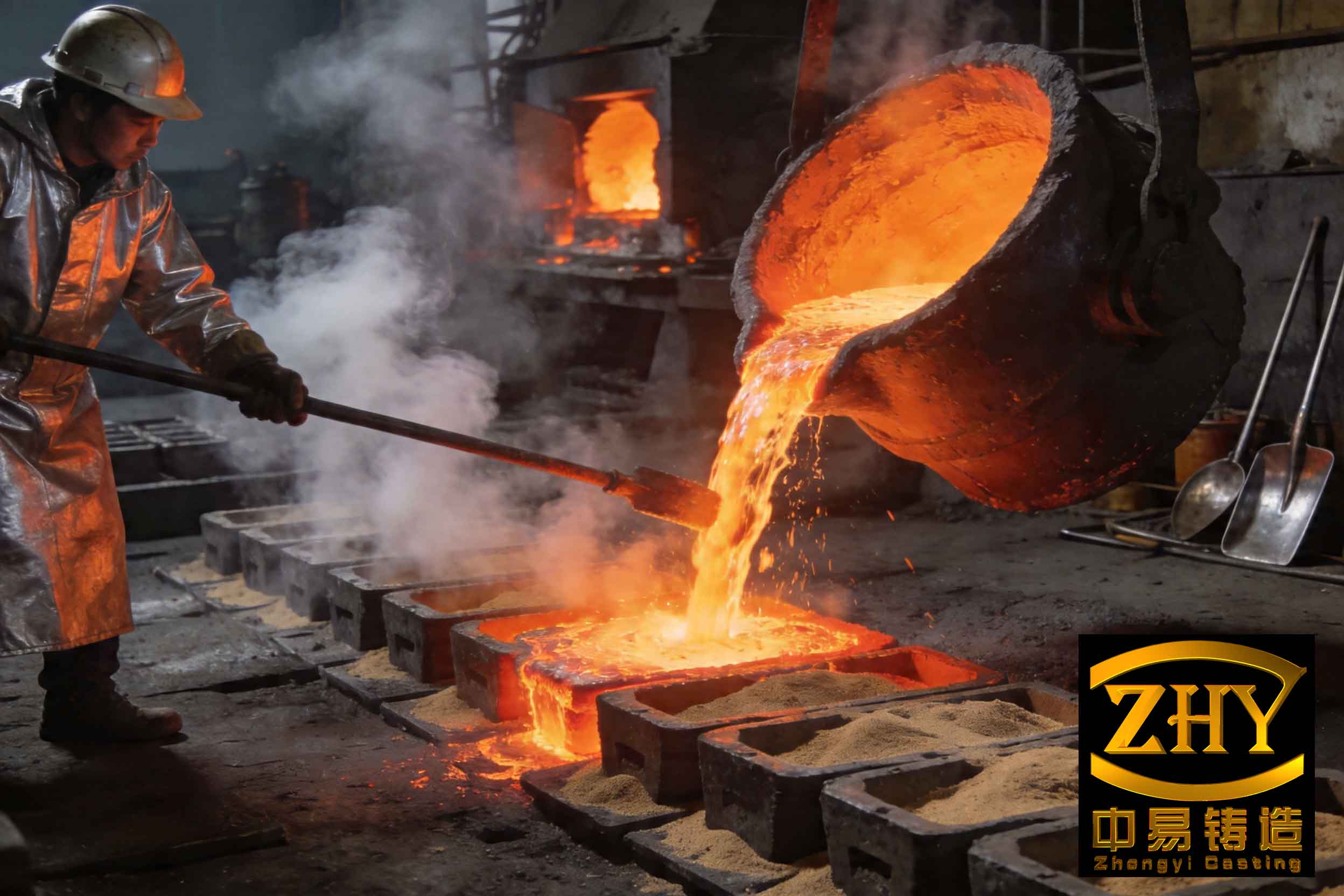
The physics of this defect formation can be modeled using fundamental fluid dynamics principles. The momentum of the molten iron jet exiting the choke can be described by: $$P = \rho Q v$$ where \(P\) is momentum flux, \(\rho\) is density, \(Q\) is volumetric flow rate, and \(v\) is velocity. The high velocity at the choke, given by \(v_{choke} = Q / A_{choke}\), leads to a high dynamic pressure capable of scouring sand. The tendency for slag or sand particles to float is governed by Stokes’ law, modified for turbulent flow: $$v_t = \frac{2}{9} \frac{g (\rho_m – \rho_p) r^2}{\eta} \cdot f(Re)$$ where \(v_t\) is terminal velocity, \(g\) is gravity, \(\rho_m\) and \(\rho_p\) are densities of metal and particle, \(r\) is particle radius, \(\eta\) is viscosity, and \(f(Re)\) is a function of Reynolds number accounting for turbulence. In the original turbulent cavity flow, \(f(Re)\) becomes very small, effectively trapping particles. The critical Reynolds number for transition to turbulent flow in a runner can be estimated as \(Re_c = \frac{\rho v D}{\eta} > 2000\), a condition easily met in the original design.
To quantify the process parameters and their impact on defect formation, I compiled the following table analyzing the original versus problematic conditions:
| Process Parameter | Original Design Value | Impact on Slag Inclusion Defect Formation |
|---|---|---|
| Pouring Temperature | 1320-1360 °C | Higher temperature reduces viscosity, but increases metal fluidity and potential for erosion. |
| Average Pouring Time | 90 seconds | Moderate time, but flow instability causes premature ingate activation. |
| Gating Ratio (Asp:Ach:Amr:Abr:Aig) | 1 : 0.3 : 1.8 : 1.5 : 1.75 | Unbalanced ratio promotes high velocity at choke and simultaneous filling. |
| Ingate Location | Two levels (Step Gating) | Leads to internal metal stream collision and vortex generation. |
| Mold/Core Coatings | Standard | Insufficient to prevent sand erosion under high-velocity impact. |
The primary strategy to eliminate this slag inclusion defect involved a complete redesign of the gating and feeding system. Two alternative schemes were conceived and tested. The first scheme employed a true sequential two-sprue step-gating system, using two separate ladles to pour the bottom and top sections with a deliberate time delay. This was designed to ensure bottom-up filling and eliminate turbulence. However, practical implementation was complex. The second, and ultimately adopted scheme, shifted to a bottom-gating system. This design fundamentally alters the fluid dynamics to promote laminar fill and natural slag flotation. The new gating ratio was designed as: $$A_{\text{spure}} : A_{\text{choke}} : A_{\text{main runner}} : A_{\text{ingate}} = 1 : 0.45 : 2.2 : 2.5$$. This design features a larger choke area to reduce initial velocity, a much larger main runner to dissipate kinetic energy, and ingates positioned only at the lowest point of the drag side of the cylinder bore.
The bottom-gating system induces a thermally unfavorable temperature gradient (hot metal at the top, cooler at the bottom), but for gray iron with its skin-forming solidification behavior, this is less critical for soundness. The key benefit is the quiescent, rising metal front. The velocity of the rising metal meniscus can be approximated by: $$v_{rise} = \frac{Q}{A_{cavity}}$$ where \(A_{cavity}\) is the planar cross-sectional area of the mold cavity at any given height. With a controlled \(Q\), \(v_{rise}\) is kept low, ensuring a calm fill. Any slag or sand particle entrained has ample time and a direct vertical path to float upwards, driven by buoyancy force \(F_b = V_p g (\rho_m – \rho_p)\), where \(V_p\) is particle volume. They are then captured in the extensive cope-side venting or the top risers. This mechanism is the direct antagonist to the slag inclusion defect.
To secure the cores against flotation in this bottom-gated design, which imposes full metallostatic pressure from below, core reinforcement was critical. The drag-side crankcase core and the seven pull-rod hole cores were fortified. The stiffness requirement for the pull-rod cores to resist buoyancy can be modeled by treating them as beams. The deflection \(\delta\) under a uniformly distributed buoyancy load \(w\) (force per unit length) over a span \(L\) with fixed ends is given by: $$\delta = \frac{w L^4}{384 E I}$$ where \(E\) is the core sand’s effective modulus and \(I\) is the area moment of inertia. We ensured \(\delta\) was negligible by using strong core prints and adding double chaplets within the pull-rod cores. Furthermore, all molds and cores were coated with a high-refractoriness steel casting paint to prevent burning-on and sand erosion, another potential source for slag inclusion defect.
The experimental verification of these solutions was conducted through a series of production trials. The following table summarizes the key outcomes from casting trials using the two new schemes compared to the baseline:
| Trial Scheme | Number of Castings | Gating System Description | Slag Inclusion Defect & Sand Hole Rate | Operational Complexity | Yield Improvement |
|---|---|---|---|---|---|
| Original Design | Statistical Batch | Two-step unbalanced gating | >20% (Requiring repair) | Standard | Baseline |
| Scheme 1: Dual-Sprue Sequential | 2 | Two ladles, controlled delay pour | 0% (Defect-free) | High (Requires precise coordination) | ~5% lower due to added sprue mass |
| Scheme 2: Bottom Gating | 8 | Single sprue, bottom ingates, enlarged runners | 0% (Defect-free) | Low (Simplified operation) | ~8% higher (more efficient gating) |
The results were unequivocal. The first scheme, while technically successful in eliminating the slag inclusion defect, was deemed impractical for routine production due to its operational intricacies. The second scheme, the bottom-gating system, proved to be the optimal solution. It delivered flawless castings without any trace of the previously endemic slag inclusion defect in the cylinder bores. The fill was observed to be exceptionally calm, and the extensive venting in the cope effectively discharged all floated slag and gases. The modification also improved the casting yield significantly, as the gating system was more mass-efficient.
A deeper mathematical analysis of the fluid flow in the new system confirms its superiority. The Reynolds number in the main runner of the new design is: $$Re_{new} = \frac{\rho v_{runner, new} D_{hyd, new}}{\eta}$$ With \(A_{runner, new}\) being larger and \(v_{runner, new} = Q / A_{runner, new}\) consequently lower, \(Re_{new}\) is substantially reduced, promoting laminar or transitional flow rather than fully developed turbulence. The critical velocity for sand entrainment, based on empirical foundry data, follows a relation like \(v_{critical} = C \sqrt{g d}\), where \(C\) is a material constant and \(d\) is a characteristic sand grain size. In our new design, the actual flow velocities throughout the system, from the choke to the ingates, were kept well below this critical threshold through careful area sizing.
The thermal aspects were also modeled. The solidification time \(t_s\) for a section can be estimated using Chvorinov’s rule: $$t_s = B \left( \frac{V}{A} \right)^n$$ where \(B\) is a mold constant, \(V\) is volume, \(A\) is surface area, and \(n\) is an exponent (~2 for sand casts). For the critical cylinder bore walls, the modulus \((V/A)\) is relatively low, ensuring rapid skin formation that can resist minor surface turbulence from the now-placid rising metal. The directional solidification, though reversed, is adequate for hypoeutectic gray iron fed through the massive, hot main runners.
To ensure long-term reproducibility and control, we established a comprehensive process window. The relationship between pouring time \(t_p\), pouring temperature \(T_p\), and defect occurrence for the new bottom-gate design was characterized. The safe operating zone to prevent cold shuts (from too slow a pour) and to minimize any residual turbulence or mold reaction (from too fast a pour) was defined. This can be visualized as an inequality: $$k_1 \frac{\mu(T_p)}{\rho g H} \leq t_p \leq k_2 \sqrt{\frac{H}{g}}$$ where \(H\) is effective sprue height, \(\mu(T_p)\) is temperature-dependent viscosity, and \(k_1\), \(k_2\) are empirical constants derived from successful casts. This ensures the slag inclusion defect remains absent.
The economic impact of eliminating the slag inclusion defect has been profound. The near-total elimination of welding repairs saved hundreds of man-hours per month and improved throughput. The consistency in quality reduced scrap and inspection overheads. The improved yield from the more efficient gating added directly to the bottom line. The following table quantifies the key performance indicators before and after the process change:
| Key Performance Indicator (KPI) | Before Process Change (Original Gating) | After Process Change (Bottom Gating) | Percentage Improvement / Change |
|---|---|---|---|
| Casting Yield (Good Cast Weight / Total Poured Weight) | ~64% | ~72% | +12.5% |
| Defect Rate (Requiring Major Repair or Scrap) | >20% | < 1% | >95% reduction |
| Average Repair Cost per Casting (Labor & Material) | High (Substantial welding) | Negligible | ~98% reduction |
| Production Reliability (Casting-to-Casting Consistency) | Low (Highly variable quality) | Very High (Predictable, defect-free) | Dramatic Improvement |
In conclusion, the journey to solve the pervasive slag inclusion defect in these high-power diesel engine blocks was a rigorous exercise in applied fluid dynamics and foundry engineering. By moving away from a theoretically appealing but practically flawed step-gating system to a meticulously designed bottom-gating system, we transformed a problematic production process into a robust and reliable one. The key was recognizing that the original system generated uncontrolled turbulence that actively created and then trapped slag and sand. The new system promotes laminar fill and leverages natural buoyancy to remove impurities. The slag inclusion defect, once a major bottleneck, has been effectively eradicated. This solution, characterized by its simplicity and effectiveness, has set a new standard for the casting of complex, high-integrity iron components where internal cleanliness is paramount. The principles established—controlling velocity through area ratios, ensuring sequential filling to avoid impingement, and providing clear escape paths for lighter phases—are universally applicable to mitigating similar slag inclusion defects across a wide range of casting geometries and alloys.