
As a foundry engineer specializing in heavy-duty diesel engine manufacturing, I have extensively investigated the persistent issue of slag inclusions and sand holes in the cylinder bores of large-bore diesel engine blocks. These defects, particularly slag inclusions, significantly compromise the structural integrity and performance of the engine, leading to high repair rates and economic losses. In this article, I will detail my first-hand experience in diagnosing the root causes, developing corrective measures, and validating solutions through rigorous experimentation. The focus will be on the hydrodynamic principles of molten metal flow, gating system design, and practical foundry techniques to eliminate these imperfections.
The engine block in question is a critical component for high-power applications, with a material specification of gray cast iron (equivalent to HT250). The casting weight approximates 7000 kg, with complex geometries including thin-walled sections in the water jacket. The original manufacturing process employed horizontal molding with dry sand molds and core assemblies using blended sand binders. The pouring orientation was horizontal, with the oil pump platform side down. The initial gating system was a two-step tapered design, intended to facilitate sequential filling. However, this setup resulted in a defect rate exceeding 50%, primarily due to slag inclusions and sand holes concentrated on the drag side of the upper and lower cylinder bores.
The formation of slag inclusions is intrinsically linked to the behavior of molten iron during mold filling. Slag inclusions refer to non-metallic impurities, such as slag, dross, or eroded sand particles, entrapped within the casting matrix. These defects often arise from turbulent flow, improper gating ratios, and inadequate slag trapping mechanisms. To understand this, we must analyze the fluid dynamics of the original gating system.
The original stepped gating system had the following cross-sectional area ratios:
$$ \sum A_{\text{spure}} : \sum A_{\text{choke}} : \sum A_{\text{runner}} : \sum A_{\text{branch}} : \sum A_{\text{ingate}} = 1 : 0.33 : 1.5 : 0.5 : 1.2 $$
This design featured a sudden constriction at the choke, which, while aiding slag separation, dramatically increased flow velocity. The high-velocity stream impinged on the runner corners, causing erosion and sand washout. The dislodged sand particles were then carried into the mold cavity. Furthermore, the intended bottom-to-top sequential filling was not achieved; instead, simultaneous filling through multiple ingates occurred, creating violent counter-currents and vortices within the cavity. These vortices prevented the lighter slag and sand particles from floating to the top of the melt. Instead, they were swept downward and trapped beneath the core prints in the cylinder bore regions, solidifying as slag inclusions and sand holes.
The mathematical description of this phenomenon can be approached using principles from fluid mechanics. The velocity of molten metal at the choke point, $v_c$, can be estimated using the Bernoulli equation for an incompressible fluid, neglecting friction losses initially:
$$ P_1 + \frac{1}{2} \rho v_1^2 + \rho g h_1 = P_2 + \frac{1}{2} \rho v_2^2 + \rho g h_2 $$
Where $P$ is pressure, $\rho$ is density of molten iron, $v$ is velocity, $g$ is gravity, and $h$ is height. Subscripts 1 and 2 refer to the sprue top and choke point, respectively. Assuming atmospheric pressure at both points and negligible height difference ($h_1 \approx h_2$), the equation simplifies to $v_2 \approx v_1 \times \sqrt{A_1/A_2}$. Given the area reduction from sprue to choke ($A_1/A_2 \approx 3$), the velocity at the choke, $v_c$, becomes approximately $\sqrt{3}$ times the sprue entrance velocity. This high velocity is a primary driver for sand erosion.
The tendency for slag inclusion formation is also influenced by the Reynolds number, $Re$, which indicates flow regime:
$$ Re = \frac{\rho v D_h}{\mu} $$
where $D_h$ is the hydraulic diameter of the flow channel and $\mu$ is the dynamic viscosity of molten iron. For typical gating dimensions and iron properties, $Re$ values can exceed critical thresholds, confirming turbulent flow that promotes slag entrainment. The critical velocity for sand erosion, $v_{erosion}$, can be empirically modeled as:
$$ v_{erosion} = k \cdot \left( \frac{\sigma_s}{\rho} \right)^{1/2} $$
where $k$ is a material constant and $\sigma_s$ is the sand mold’s bonding strength. In our original setup, $v_c > v_{erosion}$, leading to persistent mold wall degradation.
To quantify the defect propensity, I developed a statistical model based on historical production data. The following table summarizes key parameters and defect rates for the original process:
| Process Parameter | Value (Original) | Observed Defect Rate (Slag Inclusions & Sand Holes) |
|---|---|---|
| Pouring Temperature | 1350-1370°C | High (>50% of castings) |
| Average Pouring Time | 90 seconds | N/A |
| Gating Ratio (Sprue:Choke:Runner:Ingate) | 1:0.33:1.5:1.2 | Correlated with high turbulence |
| Flow Velocity at Choke (Estimated) | ~3.5 m/s | Primary cause of sand washout |
| Defect Location Concentration | Drag side of cylinder bores | >80% of all slag inclusions |
Recognizing these issues, I led the initiative to redesign the gating system with two primary objectives: eliminate turbulent vortices and ensure effective slag separation before metal enters the mold cavity. Two alternative schemes were conceived and tested.
Scheme 1: Dual Sprue Staggered Pouring System. This approach utilized two separate ladles to pour iron through two independent sprues. The first ladle filled the bottom section of the mold via lower ingates. After a calculated delay, the second ladle began pouring through upper ingates, ensuring a true bottom-to-top progressive solidification front. This method aimed to prevent simultaneous filling and the resultant vortex formation. The gating ratios were adjusted to:
$$ \sum A_{\text{sprues (total)}} : \sum A_{\text{chokes}} : \sum A_{\text{runners}} : \sum A_{\text{ingates}} = 1.8 : 0.6 : 2.0 : 1.5 $$
The delay time between the start of the first and second pour was critical. Based on the volume of the lower cavity and flow rate, it was set to approximately 30 seconds, allowing the lower metal level to rise above the intermediate core structures without causing buoyancy issues.
Scheme 2: Bottom Gating System with Enhanced Slag Traps. This simpler, more operational-friendly scheme involved a single, well-designed bottom gating system. All ingates were positioned at the lowest practical point on the drag side, just below the parting line. The system incorporated enlarged runner extensions that acted as effective slag traps. The fundamental principle is that with quiet, laminar bottom filling, slag and sand particles have sufficient time to float upwards against the metal stream due to buoyancy, eventually collecting in the top risers or vent holes. The gating ratio for this system was designed as:
$$ \sum A_{\text{sprue}} : \sum A_{\text{choke}} : \sum A_{\text{runner}} : \sum A_{\text{ingate}} = 1 : 0.4 : 2.5 : 1.8 $$
This ratio ensures that the choke provides adequate slag dross separation, the large runner volume reduces velocity, and the ingates are fully submerged early in the pour to prevent aspiration. The theoretical upward floating velocity of a slag particle, $v_f$, is given by Stokes’ law (modified for high Reynolds numbers):
$$ v_f = \sqrt{\frac{4 g d_p (\rho_m – \rho_s)}{3 C_d \rho_m}} $$
where $d_p$ is the particle diameter, $\rho_m$ and $\rho_s$ are densities of molten metal and slag respectively, and $C_d$ is the drag coefficient. For typical slag particles in iron, $v_f$ is on the order of 0.1 m/s. In a bottom-gating system with a controlled metal rise velocity $v_r < v_f$, particles can escape. The metal rise velocity in the mold cavity is governed by:
$$ v_r = \frac{Q}{A_{\text{cavity}}} $$
where $Q$ is the volumetric flow rate and $A_{\text{cavity}}$ is the average horizontal cross-sectional area of the mold. By designing $Q$ to keep $v_r$ below 0.05 m/s, we ensured favorable conditions for slag floatation.
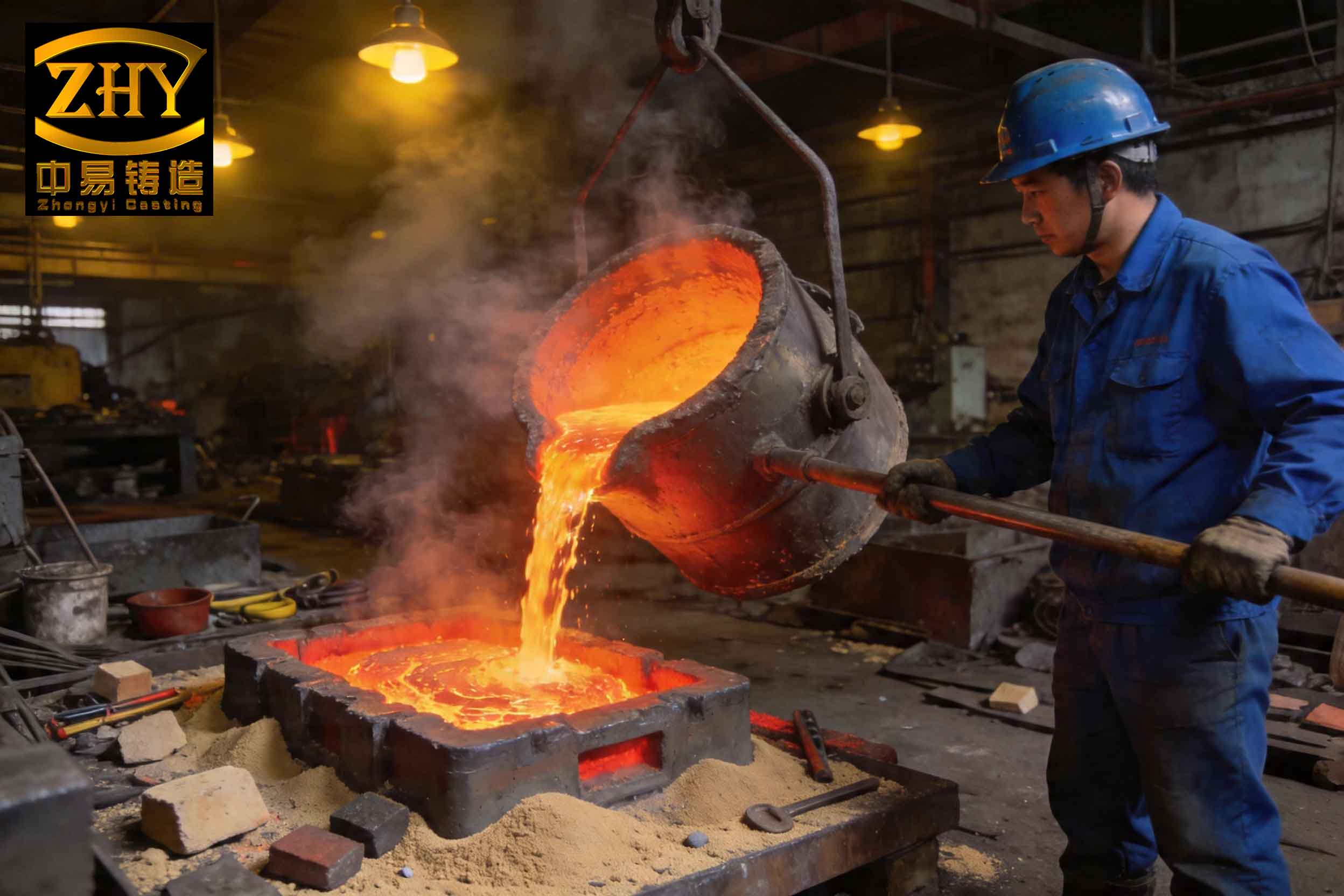
The image above provides a visual reference for the typical appearance of slag inclusions within a cast structure, underscoring the importance of process control. To validate both schemes, a series of production trials were conducted. Key process variables were meticulously monitored, and castings were subjected to thorough non-destructive testing (NDT) and sectioning for analysis.
The results from the trials are comprehensively summarized in the following table. The data clearly illustrates the effectiveness of both schemes, with Scheme 2 offering a superior balance of quality and operability.
| Trial Scheme | Number of Castings Produced | Average Pouring Time (s) | Pouring Temperature (°C) | Slag Inclusion Defect Rate (Visual & NDT) | Sand Hole Defect Rate | Overall Scrap/Rework Rate | Operational Complexity |
|---|---|---|---|---|---|---|---|
| Original Process | 50 (Baseline) | 90 | 1350-1370 | 48% | 35% | >50% | Standard |
| Scheme 1 (Dual Sprue) | 5 | 95 (Ladle1: 30s, Ladle2: 65s) | 1360-1375 | 0% | 0% | 0% | High (requires precise coordination) |
| Scheme 2 (Bottom Gating) | 15 | 100 | 1365-1380 | 3% (minor, superficial) | 2% | <5% | Low (similar to standard practice) |
The dramatic reduction in slag inclusion defects in Scheme 2 confirms the hypothesis that eliminating turbulence is paramount. The few residual defects were traced to minor sand spills during core setting, not to the filling dynamics itself. Further analysis involved measuring the mechanical properties of castings from Scheme 2. Test bars machined from the crankcase section showed consistent properties meeting the HT250 specification: tensile strength of 250-270 MPa, and hardness of 190-220 HB. Microstructural analysis revealed a uniform Type A graphite distribution with no signs of impurity concentration, indicating effective slag removal.
To generalize the findings, I developed a predictive model for the risk of slag inclusions, $R_{slag}$, as a function of key gating design parameters:
$$ R_{slag} = \alpha \cdot \left( \frac{v_{choke}}{v_{erosion}} \right)^\beta + \gamma \cdot (1 – \eta_{trap}) + \delta \cdot \left( \frac{v_r}{v_f} \right) $$
where:
- $\alpha, \beta, \gamma, \delta$ are empirical constants derived from our data.
- $v_{choke}$ is the metal velocity at the choke.
- $\eta_{trap}$ is the efficiency of the slag trap (0 to 1).
- $v_r$ and $v_f$ are the metal rise and particle floatation velocities as defined earlier.
For a robust process, we aim for $R_{slag} < 0.1$. In our original design, $R_{slag}$ was estimated at 0.85. For Scheme 2, $R_{slag}$ dropped to approximately 0.08, well within the safe zone.
The success of the bottom-gating system also prompted a review of ancillary processes. To prevent core movement and withstand the metallostatic pressure, the core assembly was reinforced. The drag and cope cores were coated with a high-refractoriness zircon-based paint to improve surface stability and reduce gas evolution. The use of chaplets was optimized to support complex core assemblies without creating local chill zones. Furthermore, the pouring temperature was slightly increased to the 1365-1380°C range to improve fluidity and slag coalescence, without exacerbating mold-metal reaction.
The economic impact was substantial. The reduction in rework from over 50% to less than 5% translated to direct savings in labor, energy, and materials. The yield (casting weight/total metal poured) improved from about 65% to 72% due to the more efficient gating design with smaller risers. The consistency in quality also reduced downstream machining rejects and improved the reliability of the final engine assembly.
In conclusion, the pervasive problem of slag inclusions in heavy-section diesel engine blocks was systematically addressed through a fundamental redesign of the filling system. The root cause was identified as turbulent flow induced by an improperly proportioned stepped gating system, which led to sand erosion and vortex-driven entrapment of slag. Two solutions were engineered: a dual-ladle staggered pouring method and a single bottom-gating system. While both effectively eliminated slag inclusions, the bottom-gating scheme proved to be the most practical and robust for high-volume production. Its success hinges on carefully calculated gating ratios that promote laminar filling, low cavity rise velocities, and effective slag floatation. This case study underscores that controlling fluid dynamics is critical in casting quality assurance, and that relatively simple design changes, grounded in sound engineering principles, can resolve complex defect issues like slag inclusions. Future work will focus on implementing real-time flow monitoring sensors to further optimize the pouring process and expand this methodology to other complex castings prone to slag inclusions and similar defects.