
In my extensive research and practical experience within the foundry industry, the development of robust casting processes for critical automotive components remains a paramount challenge. This article delves deeply into the analysis and optimization of the casting process for a specific, yet representative, complex component: the automotive steering pump housing. As a quintessential example of intricate shell castings, this component demands meticulous attention to every facet of its manufacturing. The success of producing high-integrity shell castings in mass production hinges on a holistic understanding of geometry, material behavior, and thermal dynamics during solidification. Here, I will systematically explore the structural characteristics, process design decisions, parameter calculations, and operational protocols necessary for the efficient and reliable production of such shell castings.
The steering pump housing is a vital shell casting in vehicle hydraulic systems. Its internal geometry is remarkably complex, featuring intersecting thin-walled cylindrical structures, internal annular flanges, and small supporting bosses. A particularly challenging feature is the small-diameter U-shaped return oil channel located within the valve bore. This complexity makes it an excellent case study for advancing methodologies in producing precision shell castings. The primary objective is to achieve a sound casting—free from defects like shrinkage porosity, cold shuts, or misruns—while maintaining dimensional accuracy and mechanical properties, all within the constraints of high-volume manufacturing.
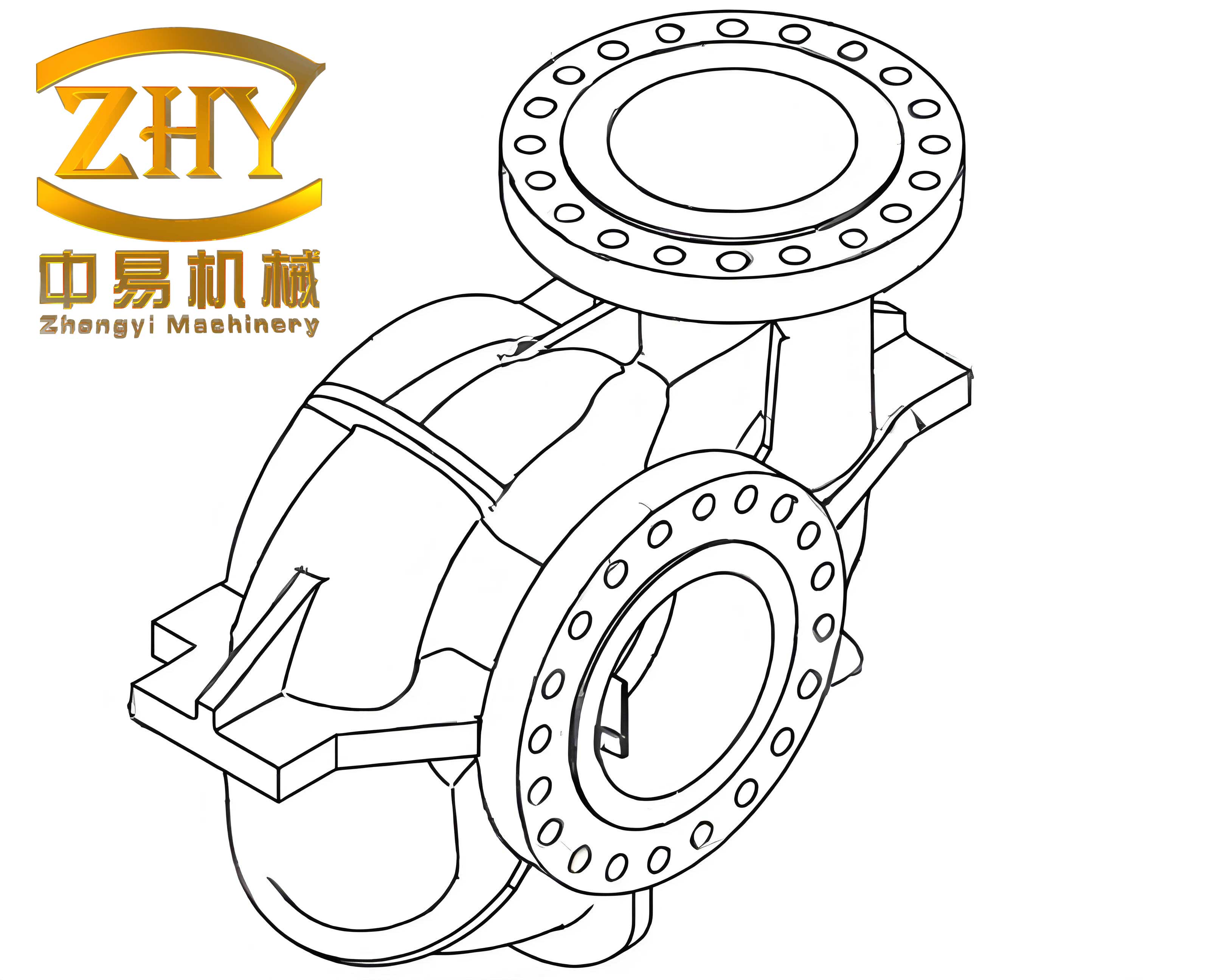
The foundation of any successful casting project lies in its initial process design. For these shell castings, the first step involves establishing a reliable datum system. Given the cylindrical nature of the pump housing, the primary datum plane is set on the lower surface of a specific boss feature. In the radial direction, two positioning holes on this datum plane serve as secondary datums, ensuring consistent alignment across machining and assembly stages. Determining the optimal position of the casting within the mold is equally critical. To facilitate molding and core placement, the largest planar face of the shell casting is oriented downward. A combination of vertical and horizontal parting lines is employed. This split-line strategy simplifies mold construction, eases core setting, and aids in the ejection of the finished shell casting. The parting line is strategically placed along the geometric symmetry plane of the component to minimize flash and finishing work.
With the basic orientation settled, the next phase involves defining a comprehensive set of casting parameters. These parameters are derived from material properties, desired quality, and the capabilities of the metal mold process. The table below summarizes the key parameters established for these aluminum alloy shell castings.
| Process Parameter | Determined Value / Range | Technical Rationale |
|---|---|---|
| Minimum Castable Hole Diameter | 8 – 10 mm (Theoretically) | Based on fluidity of aluminum alloy in metal molds. Often enlarged in practice to simplify tooling. |
| Machining Allowance (External Surfaces) | 1.5 mm | Provides sufficient material for final machining to achieve required surface finish and tolerances. |
| Machining Allowance (Internal Surfaces) | 1.5 – 2.0 mm | |
| Fillet Radius (Heavy Sections) | R = 5 mm | Reduces stress concentration, improves metal flow, and enhances casting strength. |
| Fillet Radius (General) | R = 1 – 3 mm | |
| Linear Shrinkage Allowance | 0.85% | Empirical value for this specific aluminum alloy in metal molds, accounting for contraction from solidification to room temperature. |
| Draft Angle (Mold Walls) | 1° | Ensures reliable ejection of the shell casting from the metal mold without damage. |
| Draft Angle (Casting External Features) | 0°30′ | Minimizes drag during ejection while preserving part geometry. |
The internal cavities of these shell castings necessitate the use of sophisticated core assemblies. For the pump housing, two distinct sand cores are designed. The primary core, designated Core #1, forms the main internal oil gallery. It is a relatively large core that must be precisely positioned in the drag half of the mold before closing. Core #2 is a cantilevered core, shaped to create the side valve bore and the intricate U-shaped return channel. The design of such cores for shell castings must balance geometrical accuracy with sufficient strength to withstand metal pressure and erosion during pouring. Core prints and venting channels are meticulously incorporated to ensure stable positioning and allow gases to escape.
The design of the gating system is perhaps the most calculative aspect of process engineering for shell castings. Its purpose is to deliver molten metal into the mold cavity smoothly, completely, and with minimal turbulence, oxidation, or temperature loss. For vertical parting molds typically used for such components, the choke cross-sectional area is the governing parameter. I employ the following empirical formula for aluminum alloys:
$$A_g = \frac{3100 \cdot G_l}{\mu_g \cdot t \cdot \sqrt{H}}$$
Where:
\(A_g\) is the choke area (mm²),
\(G_l\) is the total mass of molten metal to be poured (kg),
\(t\) is the pouring time (s),
\(H\) is the effective metallostatic pressure head height (mm),
\(\mu_g\) is the discharge coefficient (typically 0.65 for such systems).
The casting mass for the pump housing shell is approximately 0.96 kg. Accounting for the additional metal required for the riser system, a factor of 1.8 is applied:
$$G_l = 0.96 \text{ kg} \times 1.8 = 1.728 \text{ kg}$$
The pouring time is estimated using another empirical relation for shell castings:
$$t = 2.3 \times \sqrt{G_l} = 2.3 \times \sqrt{1.728} \approx 3.02 \text{ seconds}$$
With an effective head height \(H\) of 150 mm, the required choke area is calculated:
$$A_g = \frac{3100 \times 1.728}{0.65 \times 3.02 \times \sqrt{150}} \approx \frac{5356.8}{0.65 \times 3.02 \times 12.247} \approx \frac{5356.8}{24.07} \approx 222.6 \text{ mm}^2$$
Based on this, a sprue with a choke diameter of 17 mm (area ≈ 227 mm²) is selected. To promote laminar flow, a tapered sprue with a trumpet-shaped top is used. The runner system consists of two channels with a semi-circular cross-section (radius 10 mm, total area ~314 mm²). A small blind riser acting as a slag trap is incorporated in the middle of the runner. The ingates are located at the thick boss sections of the shell casting to facilitate directional solidification. Each ingate has a modified semi-circular cross-section (7 mm thick, 20 mm wide, area ~102 mm²). With two ingates, the total ingate area is 204 mm². The area ratios for this gating system are summarized as:
$$F_{\text{sprue}} : F_{\text{runner}} : F_{\text{ingate}} = 1.0 : 1.24 : 0.8$$
This ratio helps control the flow velocity and pressure throughout the system, which is crucial for filling thin-walled sections of shell castings without erosion or mist runs.
Riser design is essential for feeding solidification shrinkage and ensuring soundness in the thicker sections of the shell casting. An open top riser is employed for its effectiveness in both feeding and allowing escape of gases. The riser must compensate for shrinkage in the main body and the lower sections of the casting. Although the hottest spot (a flange) has a thickness of ~10 mm, the riser dimensions are enlarged to extend its feeding range downward. The designed riser is annular, surrounding part of the casting’s top feature. Its key dimensions are: height = 85 mm (including 4 mm cutoff allowance), effective height = 65 mm, and outer diameter = 84 mm. The volume of the riser is significantly larger than the localized hot spot volume to provide adequate feed metal. The efficiency of a riser for shell castings can be related to its modulus (Volume/Surface Area ratio). The riser modulus should exceed that of the casting section it is intended to feed. For a cylindrical riser, the modulus \(M_r\) is:
$$M_r = \frac{V_r}{A_r} = \frac{\pi (R_o^2 – R_i^2) h}{2\pi (R_o + R_i)h + \pi(R_o^2 – R_i^2)}$$
Where \(R_o\) and \(R_i\) are the outer and inner radii, and \(h\) is the height. Simplifying for an annular riser with an open top (one major surface is a free surface for feeding), the calculation adjusts accordingly to ensure \(M_r > M_c\) (casting modulus).
The mold for producing these shell castings is a permanent metal mold, typically made from a hot-work tool steel like H13 for its thermal fatigue resistance. The mold dimensions are determined by the casting layout, gating system, and necessary structural strength. The core plates (side molds) and base plate are designed with sufficient wall thickness to ensure durability and consistent temperature control. Approximate plate dimensions are: Side Plates: 380 mm (L) x 135 mm (W) x 190 mm (H); Base Plate: 285 mm (L) x 200 mm (W) x 74 mm (H). The mold cavity incorporates precisely machined impressions for the shell casting, the gating channels, and seats for the sand cores. Cooling channels or heater cartridge slots are integrated to manage the mold thermal regime, which is critical for cycle time and casting quality in high-volume production of shell castings.
The final layer of process optimization lies in the established pouring and handling procedures. A consistent thermal cycle is vital for reproducible quality in shell castings. The metal mold must be preheated to around 300°C before the start of production. This prevents thermal shock, improves metal flow, and reduces defects like cold shuts. The pouring temperature for the aluminum alloy is tightly controlled at approximately 700°C. This temperature offers a good balance between fluidity (for filling thin sections) and minimizing total heat content (to reduce shrinkage and cycle time). After pouring, the solidifying shell casting must remain in the mold for a specific duration to gain enough strength for ejection without distortion. Based on empirical data for similar shell castings, the in-mold time is set at about 240 seconds. This time allows for significant solidification and cooling within a safe ejection temperature range. The table below consolidates these critical pouring parameters.
| Operational Parameter | Target Value | Impact on Shell Casting Quality |
|---|---|---|
| Mold Preheating Temperature | 300 °C | Ensures proper metal flow, reduces thermal stress, and minimizes premature solidification in thin walls. |
| Metal Pouring Temperature | 700 °C | Optimizes fluidity for complex geometries while controlling grain structure and shrinkage behavior. |
| In-Mold Solidification Time | 240 s | Guarantees sufficient mechanical strength for ejection, preventing hot tearing or deformation of the shell casting. |
Throughout this detailed exploration, the interconnectedness of all these factors—from initial design to final pour—becomes evident. The production of high-quality automotive shell castings, such as the steering pump housing, is not a series of independent steps but a finely tuned system. Every parameter, from the fillet radius to the riser volume, interacts with others. For instance, the gating system design directly affects the temperature gradient, which in turn influences the effectiveness of the riser. The use of metal molds for these shell castings introduces additional constraints and opportunities regarding heat extraction and dimensional stability.
Further analytical depth can be added by considering solidification modeling. The rate of heat transfer from the solidifying shell casting to the metal mold governs the microstructure and soundness. The fundamental heat transfer equation, Fourier’s law, underpins this phenomenon:
$$q = -k \frac{dT}{dx}$$
Where \(q\) is the heat flux, \(k\) is the thermal conductivity of the mold or metal, and \(\frac{dT}{dx}\) is the temperature gradient. In practice, for shell castings, achieving directional solidification towards the riser is key. This is often assessed by calculating the solidification modulus for different sections of the casting. The modulus \(M\) for a given casting section is its volume \(V\) divided by its cooling surface area \(A_c\):
$$M = \frac{V}{A_c}$$
Sections with a higher modulus solidify slower and require feeding from adjacent sections or risers. For the pump housing, the boss sections where the ingates are located have a higher modulus than the thin cylindrical walls, justifying the placement of both gates and the riser at these locations. This scientific approach, combined with empirical data, forms the backbone of reliable process design for complex shell castings.
In conclusion, the mass production of defect-free automotive shell castings demands a comprehensive and analytical approach to process design. This article has detailed the systematic journey from analyzing the component’s challenging geometry to specifying every critical parameter of the casting process. The interplay between mold design, core making, gating and risering calculations, and precise pouring control has been highlighted. The methodologies and calculations presented—from the choke area formula to modulus analysis—provide a robust framework that can be adapted and applied to a wide range of intricate shell castings beyond the steering pump housing. The ultimate goal is to establish a stable, repeatable process that maximizes yield, maintains dimensional accuracy, and ensures the mechanical integrity of these vital components, thereby contributing significantly to the quality and reliability of modern automotive systems. Continuous refinement through simulation and real-production feedback loops remains essential for advancing the state-of-the-art in shell casting technology.