
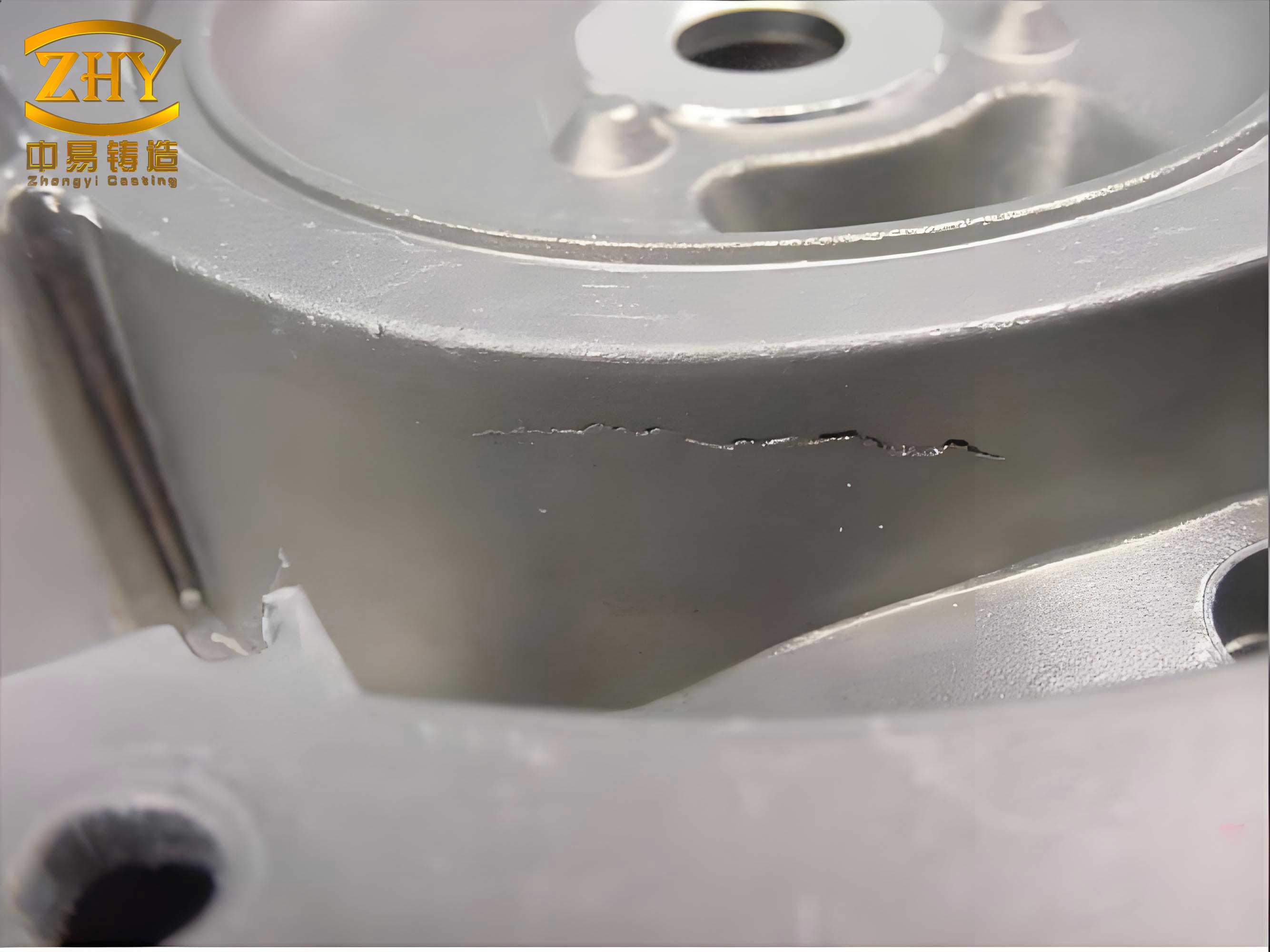
Throughout my career in foundry engineering, I have dedicated significant effort to understanding and mitigating the various casting defects that plague iron castings. These imperfections not only compromise the structural integrity and service life of components but also lead to substantial economic losses through scrap and rework. The following analysis synthesizes my observations and practical experience regarding the root causes and, most importantly, the effective prevention strategies for common casting defects. A visual summary of several key defect types is provided below.
1. Porosity Defects (Blowholes)
Porosity represents a class of casting defects characterized by smooth-walled cavities within the casting. These defects are primarily classified based on their origin.
1.1 Invasive Blowholes: These are relatively large, often pear-shaped cavities located near the casting surface, caused by gases emanating from the mold or core infiltrating the metal.
Prevention Focus:
- Minimize gas generation from molds/cores (control moisture, binder content).
- Maximize mold permeability and ensure proper venting.
- Optimize pouring temperature to facilitate gas escape.
1.2 Precipitation Porosity (Pinholes): This defect manifests as numerous small, dispersed pores throughout the casting cross-section, resulting from gases dissolved in the melt precipitating during solidification.
Prevention Focus:
- Use dry, clean charge materials.
- Ensure thorough drying of all ladles, troughs, and transfer channels.
- Maintain protective slag covers on the molten metal surface.
- Keep all additives (inoculants, nodularizers) perfectly dry.
1.3 Subsurface Pinholes: These appear as clusters of small pores just 2-3 mm beneath the casting skin, often revealed after machining or heat treatment.
Prevention Focus: This casting defect is closely linked to reactions at the metal-mold interface. Key measures include controlling aluminum content in inoculants (Al + H2O → Al2O3 + H2), preventing metal oxidation during melting, minimizing nodularizer additions, using mold surface treatments (e.g., cryolite powder), and reducing sand moisture.
2. Sand Inclusions and Slag Defects
These are inclusion-type casting defects. Sand inclusions are cavities filled with molding sand, while slag defects contain non-metallic oxides or sulfides.
Prevention Strategies:
For Sand Inclusions:
- Enhance mold/core strength and hardness; eliminate sharp edges.
- Thoroughly clean molds before closing and pour promptly.
- Design gating systems to minimize metal turbulence and erosion.
For Slag Defects (Primary & Secondary):
- Increase superheating temperature to improve slag fluidity and separation.
- Employ effective slag raking practices and allow holding time for flotation.
- Design gating systems with slag traps, filters, and use teapot ladles.
- For ductile iron, specifically control “secondary slag” formation by managing residual magnesium ($$w_{Mg_{res}}$$ typically 0.035-0.055%), performing desulfurization, and optimizing rare-earth content in nodularizers.
3. Shrinkage Cavities and Porosity
These are volumetric casting defects occurring in hot spots or heavy sections where liquid and solidification shrinkage is not compensated. Macroscopic cavities are shrinkholes, while microscopic ones are shrinkage porosity.
Prevention Focus: The core strategy is to establish directional solidification towards a feeding source (riser). This involves:
- Adjusting composition (e.g., Carbon Equivalent) for the section size: $$CE = w_{C} + \frac{1}{3}w_{Si}$$.
- Implementing proper risering and chilling. The required riser volume can be estimated by: $$V_{riser} \geq \frac{\epsilon_{L+S} \cdot V_{casting}}{n \cdot \eta}$$, where $\epsilon_{L+S}$ is the liquid+solidification shrinkage, $n$ is the feeding efficiency, and $\eta$ is the riser yield.
- Controlling inoculation to avoid excessive ferrite promotion which increases shrinkage tendency.
- Preventing metal oxidation which reduces effective carbon equivalent.
- Increasing mold rigidity to resist wall movement.
4. Metal Penetration and Burn-on
This surface casting defect involves the mechanical infiltration of metal into sand interstices (penetration) or a severe chemical reaction forming a fused sand layer (burn-on).
Prevention Focus:
- Use high-refractoriness sands (SiO2 > 92%, preferably >95%). For critical parts, consider zircon or chromite sands.
- Lower pouring temperature and increase pouring rate to reduce contact time.
- Achieve high, uniform mold hardness (B-scale > 85, preferably > 90).
- Apply stable, non-flaking mold coatings.
5. Cracking (Hot Tearing and Cold Cracking)
Cracking is a critical casting defect resulting from stresses exceeding the material’s strength during or after solidification. Hot tears are irregular, oxidized fractures. Cold cracks are straighter, with a brighter fracture surface.
Prevention Focus:
- Control chemistry: Limit sulfur (“hot shortness”) and phosphorus (“cold shortness”). For gray iron, a balance is needed: $$0.05\% < w_{S} < 0.12\%$$, and $$w_{P} < 0.15\%$$. For ductile iron, $$w_{P} < 0.08\%$$ is crucial.
- Modify cooling uniformity using chills to reduce thermal gradients.
- Delay shakeout until casting temperature is below the brittle temperature range (e.g., < 600°C). Never quench hot castings.
- Modify design: add fillets, use strengthening ribs, and avoid drastic section changes.
6. Distortion (Warping)
This dimensional casting defect is common in long or uneven-section castings (e.g., machine beds, engine blocks) due to residual stresses from differential cooling.
Prevention Focus:
- Employ “distortion allowance” by machining the pattern with a reverse warp.
- Perform stress-relief annealing or natural aging.
- Avoid early shakeout and do not stack castings while hot.
7. Hardness Inhomogeneity
This metallurgical casting defect appears as soft spots, hard spots, or excessive hardness variation (>30 HB) on machined surfaces, leading to uneven wear.
Prevention Focus:
- Use high superheating temperatures (>1480°C) to break down genetic inheritance from pig iron.
- Prevent oxidation loss of C and Si; control inoculation amount and uniformity precisely.
- Use low-alloy, rust-free steel scrap; pre-compact light scrap.
- Design cooling for uniformity; use chills in heavy sections.
8. Specific Ductile Iron Defects
Ductile iron introduces a unique set of casting defects related to the nodularization process.
8.1 Failed or Degraded Nodularization: The graphite remains flaky or vermicular, drastically reducing properties.
| Defect Type | Main Cause | Key Preventive Measures |
|---|---|---|
| Failed Nodularization | Insufficient residual Mg/RE | Adjust nodularizer addition based on base S and temperature. See Table 1. |
| Nodularization Degradation | Mg fade over time | Minimize delay between treatment and pouring; use cover fluxes; for heavy sections, use fade-resistant nodularizers (e.g., Yttrium-based). |
Table 1: Guideline for Nodularizer Addition (for Mg 7-9%, RE 2-5% alloy)
| Base Iron Sulfur, $w_{S}$ (%) | Nodularizer Addition (%) |
|---|---|
| 0.03 – 0.04 | 1.3 |
| 0.04 – 0.05 | 1.4 |
| 0.05 – 0.06 | 1.5 |
| 0.06 – 0.07 | 1.6 |
| 0.07 – 0.08 | 1.7 |
| 0.08 – 0.09 | 1.8 |
| 0.09 – 0.10 | 1.9 |
8.2 Graphite Floatation (and Exploded Graphite): A segregation casting defect where graphite balls float and concentrate in the upper parts of heavy sections, sometimes accompanied by exploded graphite.
Prevention:
- Strictly control carbon equivalent (typically CE = 4.3-4.7%).
- Accelerate cooling in thick sections using chills.
- Limit rare-earth content in the nodularizer.
8.3 Reverse Chill: A perplexing casting defect where carbides (white iron) appear in the slowly-cooled center while the faster-cooled surface is mottled or gray.
Prevention:
- Desulfurize base iron (S promotes centerline segregation).
- Maintain the Mn:S ratio: $$w_{ ext{Mn}} = 1.7w_{ ext{S}} + 0.3$$.
- Control residual Mg and RE levels according to section size.
- Eliminate hydrogen sources (moisture).
- Use powerful inoculants (e.g., containing Ba, Ca) to increase graphite nuclei count and counteract undercooling.
9. White Bright Spots in Ductile Iron
This is a localized microstructural casting defect appearing as extremely hard spots, often due to undissolved or segregated inoculant particles. Prevention requires ensuring sufficient pouring temperature and effective mixing to fully dissolve and diffuse the inoculant within the molten iron.
10. Synthesis and Integrated Process Control
My experience suggests that preventing casting defects is not about addressing single factors but managing a complex, interconnected system. The table below summarizes the primary causes and levers for control for the major defect categories.
| Defect Category | Root Cause Drivers | Key Process Control Levers |
|---|---|---|
| Gas-Related Defects | Moisture, Volatiles, Oxidation | Dryness, Permeability, Pouring Temperature, Metal Cleanliness |
| Shrinkage Defects | Thermal Contraction, Feeding Inefficiency | Risering/Chilling, Mold Rigidity, Composition (CE) |
| Inclusion Defects | Sand Erosion, Slag Entrapment, Reaction Products | Mold Strength, Gating Design, Slag Control, Mg/S Balance |
| Shape/Size Defects | Thermal Stress, Mold Restraint | Cooling Uniformity, Stress Relief, Pattern Allowance |
| Metallurgical Defects | Segregation, Undercooling, Fade | Inoculation Practice, Cooling Rate, Process Timing |
Furthermore, the interrelationship between process parameters can be conceptualized. For instance, the risk of gas and shrinkage casting defects often has an inverse relationship with pouring temperature, creating an optimal processing window. Similarly, the efficiency of feeding (preventing shrinkage) is a function of the thermal gradient ($ abla T$) and the solidification mode, which can be influenced by chills and inoculants. The loss of magnesium over time, a primary cause of nodularization fade, can be modeled with a kinetic equation: $$w_{Mg}(t) = w_{Mg_0} \cdot e^{-kt}$$, emphasizing the critical need for rapid pouring after treatment.
In conclusion, the battle against casting defects in iron foundries is waged on multiple fronts: metallurgical control, mold engineering, process timing, and thermal management. A deep understanding of the underlying mechanisms—gas precipitation, solidification shrinkage, stress formation, and nodularization kinetics—provides the foundation for effective prevention. By implementing a disciplined, systematic approach that integrates composition control, rigorous sand preparation, optimized gating and risering, precise inoculation/nodularization, and controlled cooling, the incidence of these costly casting defects can be dramatically reduced, leading to higher quality, more reliable castings and improved foundry profitability.