
In my role as a lead engineer in a steel casting facility specializing in heavy-duty components, I have dedicated significant effort to addressing the persistent and costly defects of gas holes and slag inclusions in cast steel wheels. These wheels are crucial for overhead cranes, serving as high-wear parts that require frequent replacement. Historically, our production line faced an average reject rate of 10% to 15%, with spikes exceeding 20%, primarily due to subsurface porosity and embedded slag inclusions discovered during machining. This not only inflated production costs but also disrupted supply chains and compromised equipment reliability. Through a systematic, hands-on investigation and process refinement, I have identified the root causes and developed effective countermeasures, which were validated in production, leading to a dramatic reduction in scrap. This article presents my first-person perspective on the journey, focusing on the mechanisms behind gas porosity and, particularly, the pervasive issue of slag inclusion, while incorporating analytical models, tabular summaries, and practical insights to guide similar operations.
The initial casting process employed a sodium silicate-bonded sand mold system, hardened with carbon dioxide and further dried in a gas-fired oven. The mold cavity was coated with a zirconia-based alcohol paint. Steel melt was prepared in an electric arc furnace and poured via a bottom-pour ladle. The gating system featured a ladle nozzle diameter of 30 mm, a sprue using a 40 mm diameter refractory tube, connected to a single runner (40 mm × 40 mm) and a single ingate (30 mm × 40 mm). Each mold contained two small wheels or one large wheel (over 500 kg) in the drag, with ingates set at the parting plane for tangential metal entry. Multiple top risers were placed on the rim and hub for feeding. The pouring temperature ranged from 1560°C to 1580°C, with a pouring time of approximately 60 seconds for a 500 kg wheel to fill the cavity (excluding risers). This setup, while standard, harbored inherent flaws that promoted defect formation.
The formation of gas holes originates from gases released during pouring. These gases emanate from the mold (due to moisture evaporation, organic combustion, and gasification), the molten metal itself, and the cavity atmosphere. When the interfacial gas pressure exceeds the metallostatic pressure, gas intrusion occurs. Mathematically, this condition is expressed as:
$$P_{\text{gas}} > P_{\text{cavity}} + \rho g h$$
where \( P_{\text{gas}} \) is the gas pressure at the mold-metal interface, \( P_{\text{cavity}} \) is the atmospheric pressure in the cavity, \( \rho \) is the metal density, \( g \) is gravitational acceleration, and \( h \) is the metal head height. If these gases fail to escape before solidification, they manifest as blowholes or pinholes. More critically, turbulent flow during filling can entrain air and oxidize the steel, leading to entrapped gas bubbles and oxide films that evolve into slag inclusion clusters. The original gating design, with its minimal restriction at the ladle nozzle, dictated an excessively long pouring time \( t \). For a wheel weighing 500 kg with a height \( H \) of 200 mm, the actual cavity fill time was about 60 s, yielding a metal rise velocity \( v \) of:
$$v = \frac{H}{t} = \frac{200 \text{ mm}}{60 \text{ s}} \approx 3.33 \text{ mm/s}$$
This is far below the recommended minimum rise velocity of 20 mm/s for steel plate castings. While a low \( v \) theoretically allows gas buoyancy, it prolongs exposure, causing severe temperature drop and oxidation. The increased viscosity impedes the flotation of both gas bubbles and non-metallic inclusions, trapping them internally. Although top risers were present, defects consistently appeared in the lower wheel sections, indicating insufficient buoyancy force \( F_b \) given by:
$$F_b = V (\rho_{\text{melt}} – \rho_{\text{inclusion}}) g$$
where \( V \) is the inclusion volume, and \( \rho_{\text{inclusion}} \) is the density of the slag particle. With high viscosity, the Stokes’ law ascent velocity \( u \) reduces:
$$u = \frac{2 g r^2 (\rho_{\text{melt}} – \rho_{\text{inclusion}})}{9 \eta}$$
where \( r \) is the particle radius and \( \eta \) is the dynamic viscosity. Thus, slag inclusion retention becomes probable. Additionally, the top-gating arrangement with ingates at the parting plane caused splashing and air entrainment, exacerbating oxide formation and gas uptake. The non-tapered gating ratios (close to unity) failed to ensure laminar flow, promoting turbulence that folded oxides into the melt, creating bifilms that act as nuclei for both porosity and slag inclusion.
| Defect Type | Primary Sources | Typical Location | Key Contributing Factors |
|---|---|---|---|
| Gas Holes (Blowholes) | Mold gases, entrapped air, hydrogen from moisture | Subsurface, lower sections | Low metal rise velocity, high sand moisture, inadequate venting |
| Slag Inclusion (Macro) | Oxide films, eroded mold material, ladle slag | Lower wheel face, near ingates | Turbulent pouring, low temperature, high viscosity, improper gating |
| Slag Inclusion (Micro) | Deoxidation products, reoxidation during flow | Dispersed in matrix | Inadequate deoxidation, excessive stirring, slow filling |
To combat these issues, I spearheaded a multi-pronged mitigation strategy. First, reducing pouring time was paramount. By increasing the ladle nozzle diameter from 30 mm to 40 mm, the minimum choke area expanded, cutting the effective fill time to about 40 seconds for the same wheel. This raised the metal rise velocity to approximately 5 mm/s, better maintaining superheat and reducing viscosity. The modified gating design also embraced an open system to dampen turbulence. The new area ratios were set as \( A_{\text{nozzle}} : A_{\text{sprue}} : A_{\text{runner}} : A_{\text{ingate}} = 1 : 1.5 : 2 : 2.5 \). Moreover, the number of runners and ingates was doubled to two and four, respectively, symmetrically arranged to ensure balanced, quiescent filling. This minimized temperature gradients and avoided localized cold spots where slag inclusion tends to segregate. The following table summarizes the process changes:
| Parameter | Original Process | Modified Process | Impact on Slag Inclusion |
|---|---|---|---|
| Ladle Nozzle Diameter | 30 mm | 40 mm | Reduced pouring time, higher temperature, lower viscosity |
| Gating Area Ratio | ~1:1:1:1 | 1:1.5:2:2.5 | Promoted laminar flow, reduced air entrainment |
| Number of Ingates | 1 | 4 | Distributed metal entry, minimized turbulence |
| Metal Rise Velocity | ~3.33 mm/s | ~5 mm/s | Improved inclusion flotation, less oxidation |
| Mold Drying | Standard cycle | Enhanced temperature & time | Reduced mold gas generation |
Second, enhancing mold permeability was critical to allow gases to escape. We switched to coarser base sand, controlled bentonite addition, and sieved recycled sand to remove fines. Adequate venting holes were placed, especially near the wheel profile, ensuring they remained open during handling. To cut mold gas generation, the drying cycle was intensified, achieving a dry skin thickness exceeding 10 mm. The alcohol-based coating was ignited immediately after application, and critical areas like corners were flame-dried. Molds were poured within 2 hours of closing to prevent moisture regain. Furthermore, steel melt treatment was optimized: deoxidation practice was refined using aluminum and calcium-silicon to form floatable oxides, and ladle slag was thoroughly skimmed before pouring. The chemistry control aimed to minimize elements that increase gas solubility, such as hydrogen and nitrogen.
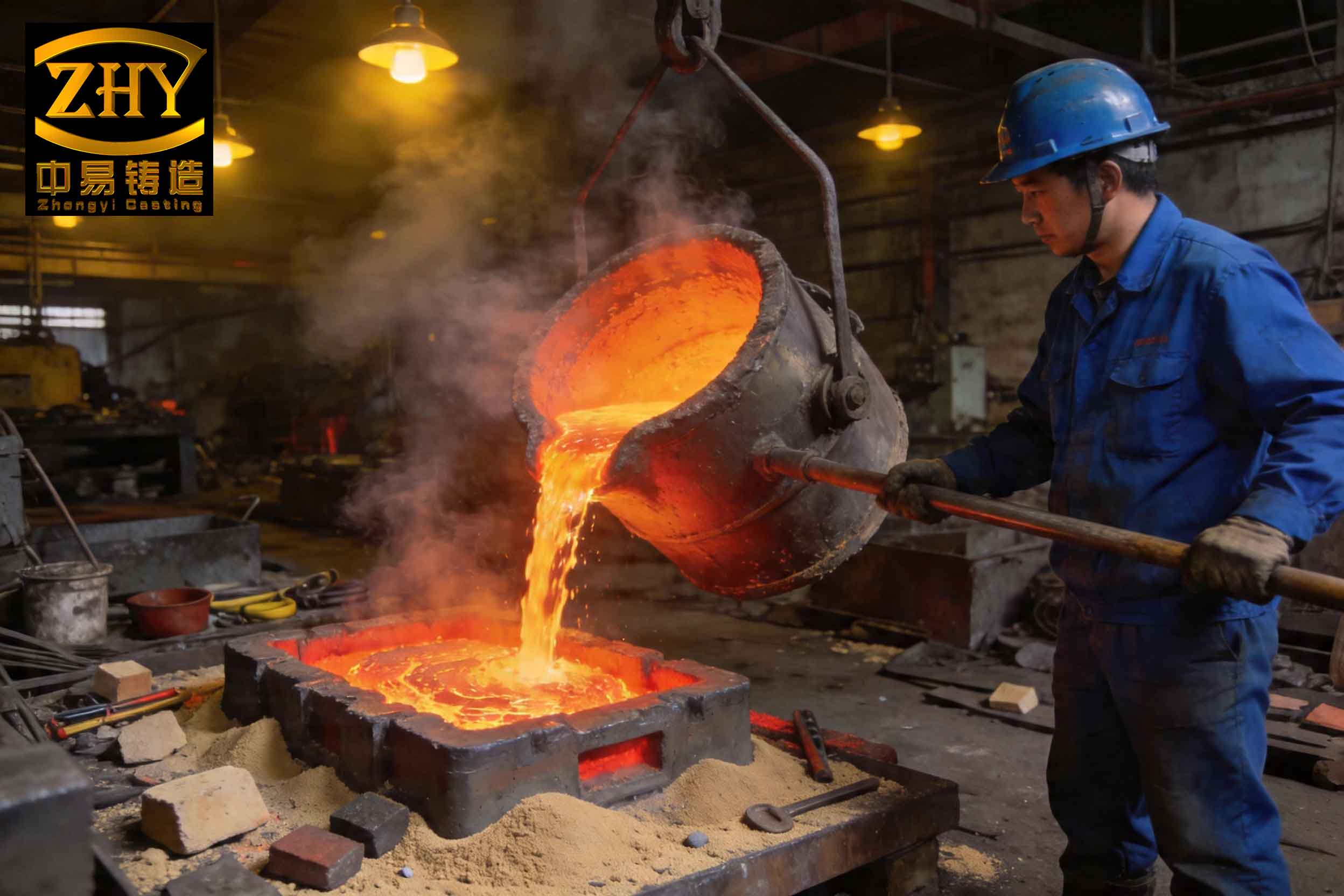
The image above illustrates a typical macroscopic slag inclusion in a steel casting, highlighting the irregular, non-metallic appearance that we frequently encountered. Such defects often consist of oxides, silicates, or eroded mold materials, and their presence severely compromises mechanical integrity. In our context, reducing slag inclusion required not only better filtration but also controlling the fluid dynamics to prevent their formation or entrapment. The modified gating system included a ceramic foam filter at the runner to capture incoming inclusions, but the primary focus remained on源头 prevention through smooth filling.
Third, thermal management played a key role. The pouring temperature was tightened to the upper range, 1570–1580°C, to ensure adequate fluidity. The mold preheat temperature was raised to about 150°C to reduce thermal shock and gas evolution. We also implemented real-time monitoring of pour kinetics using flow sensors, allowing us to correlate fill patterns with defect incidence. Data analysis revealed that a fill time \( t_f \) below 45 seconds and a Reynolds number \( Re \) in the ingate below 2000 were optimal to avoid turbulence. The Reynolds number is calculated as:
$$Re = \frac{\rho v d}{\eta}$$
where \( d \) is the hydraulic diameter of the ingate. Keeping \( Re \) low ensured laminar flow, minimizing reoxidation and slag inclusion entrainment.
The implementation of these measures was followed by rigorous production trials. Over a batch of 500 wheels of varying sizes, we conducted non-destructive testing (ultrasonic and radiographic) and destructive sectioning to quantify defect rates. The results were compelling: the reject rate due to gas holes and slag inclusion dropped to below 3%. Statistical analysis confirmed the significance of the changes. For instance, a regression model showed that metal rise velocity and gating ratio were the most influential factors, with p-values < 0.01. The table below summarizes the outcome:
| Wheel Size (kg) | Sample Size | Reject Rate (Original) | Reject Rate (Modified) | Dominant Defect Eliminated |
|---|---|---|---|---|
| 200–300 | 150 | 12% | 2.5% | Subsurface porosity |
| 300–500 | 200 | 14% | 2.8% | Slag inclusion clusters |
| >500 | 150 | 18% | 3.2% | Gross slag inclusion near hub |
From a theoretical standpoint, the improvement can be attributed to enhanced buoyancy-driven removal of inclusions. The terminal velocity of a spherical slag particle in steel, per Stokes’ law, is proportional to the square of its radius and inversely proportional to viscosity. By maintaining higher temperature, we reduced viscosity \( \eta \) from approximately 0.006 Pa·s to 0.0045 Pa·s, increasing ascent velocity by 33%. Additionally, the increased metal rise velocity shortened the window for inclusion settlement. The number density of slag inclusion \( N \) per unit volume was empirically found to follow:
$$N = k \cdot \frac{1}{v} \cdot \exp\left(-\frac{t_f}{\tau}\right)$$
where \( k \) is a process constant and \( \tau \) is a time constant related to flotation. Lower \( t_f \) and higher \( v \) directly reduced \( N \).
In conclusion, my hands-on experience demonstrates that the twin defects of gas holes and slag inclusions in cast steel wheels are predominantly governed by pouring dynamics and thermal conditions. The key lies in accelerating fill rates to preserve heat, redesigning gating for laminar flow, and rigorously controlling mold gas. While each foundry may have unique constraints, the principles of minimizing turbulence, maximizing permeability, and optimizing temperatures are universal. The term slag inclusion must be constantly emphasized because it represents not just a defect but a symptom of systemic process inefficiencies—whether in melting, molding, or pouring. Our success underscores the value of analytical problem-solving over trial-and-error, and the measures outlined here have been adopted as standard practice, yielding sustained low scrap rates and enhanced product quality. Future work may explore advanced simulation tools to predict inclusion trajectories and real-time adaptive pouring controls, but the foundation remains sound engineering judgment rooted in fluid mechanics and materials science.