
In the realm of advanced materials engineering, nodular cast iron, also known as ductile iron, stands out due to its unique graphite spheroidization, which imparts superior mechanical properties such as high strength, good ductility, and excellent fatigue resistance. This material is extensively used in critical automotive components like crankshafts and camshafts, where performance under dynamic loading is paramount. Among various heat treatment techniques, isothermal quenching, often referred to as austempering, is a transformative process that further enhances the properties of nodular cast iron, yielding a microstructure dominated by bainite. This treatment can significantly improve toughness, hardness, and fatigue strength, making it ideal for demanding applications. However, the formation of undesirable phases, particularly in the so-called white areas, can detrimentally affect these properties. In this article, I delve into the factors influencing the performance of isothermally quenched nodular cast iron, drawing from experimental data and metallurgical analysis to provide insights into optimizing its microstructure and mechanical behavior.
The essence of isothermal quenching lies in its ability to produce a bainitic structure by rapidly cooling the nodular cast iron from the austenitizing temperature to an isothermal holding temperature, where it is maintained until the transformation is complete. This process avoids the formation of pearlite or martensite, leading to a combination of high strength and good ductility. However, the presence of white areas—regions rich in retained austenite or quenched martensite—can compromise these benefits. My research focuses on understanding how these white areas form and how their impact on properties like toughness and fatigue can be mitigated. Through systematic experimentation and analysis, I aim to outline strategies for achieving an optimal microstructure in isothermally quenched nodular cast iron.
To begin, let’s consider the material used in this study. The base material is a nodular cast iron conforming to grade QT800-2 in the as-cast condition, with a chemical composition range as summarized in Table 1. This composition is typical for high-strength nodular cast iron applications, with carbon and silicon playing crucial roles in graphite formation and matrix strengthening. The graphite spheroidization was assessed to be at level 2, with graphite size at levels 5-6, indicating a well-nodularized structure essential for good mechanical properties.
| Element | Content Range |
|---|---|
| C | 3.78–3.99 |
| Si | 1.83–2.26 |
| Mn | 0.46–0.50 |
| P | 0.05–0.06 |
| S | 0.022 |
The specimens were machined from as-cast crankshaft components, with minimal allowance left for final processing after heat treatment. This approach ensures that the effects of isothermal quenching are accurately reflected in the test results. The heat treatment involved austenitizing at 890°C, followed by isothermal holding at various temperatures: 300°C, 280°C, 260°C, and 240°C. After treatment, the specimens were finished to standard dimensions for mechanical testing, including tensile tests, impact tests, and hardness measurements. The results, averaged over multiple samples, are presented in Table 2, which also includes observations on the metallurgical structure obtained from optical microscopy and scanning electron microscopy (SEM) analysis.
| Group | Isothermal Temperature (°C) | Impact Toughness (J/cm²) | Tensile Strength (MPa) | Elongation (%) | Surface Hardness (HRC) | Metallurgical Structure |
|---|---|---|---|---|---|---|
| 1 | 300 | 75.1 | 1469 | 3.7 | 43–45 | Upper bainite (BU) + minor lower bainite (BL) + minor retained austenite (AR) |
| 2 | 280 | 67.9 | 1470 | 3.2 | 44–46 | BU + BL + minor AR |
| 3 | 260 | 60.1 | 1513 | 2.8 | 46–48 | BU + BL + white area (AR + M) |
| 4 | 240 | 43.7 | 1536 | 1.2 | 50–51 | Lower bainite (BL) + upper bainite (BU) + white area with quenched martensite (M ≈ 10%) |
From Table 2, it is evident that as the isothermal temperature decreases from 300°C to 240°C, the tensile strength slightly increases, but the elongation and impact toughness drop significantly. This trend is particularly pronounced at 240°C, where the impact toughness is nearly halved compared to that at 300°C. The hardness, however, shows a steady increase with lower isothermal temperatures. The metallurgical structures reveal that at higher temperatures (300°C and 280°C), the microstructure is predominantly upper bainite with some retained austenite, while at lower temperatures (260°C and 240°C), lower bainite becomes more prevalent, accompanied by white areas containing quenched martensite. This martensite formation is critical, as it introduces brittleness, thereby reducing toughness and fatigue resistance.
To understand these effects in depth, let’s explore the fatigue performance of isothermally quenched nodular cast iron. Fatigue tests conducted under rotating bending conditions show that specimens treated at higher isothermal temperatures exhibit better fatigue strength. For instance, at 300°C, the fatigue limit is approximately 500 MPa, whereas at 240°C, it drops to around 450 MPa. The fatigue fracture surfaces reveal finer striations and more ductile dimples around graphite nodules in the higher temperature samples, indicating slower crack propagation. In contrast, samples with quenched martensite in the white areas show coarser striations and quasi-cleavage features, suggesting accelerated crack growth. This behavior can be modeled using the Paris law for fatigue crack propagation:
$$ \frac{da}{dN} = C (\Delta K)^m $$
where \( da/dN \) is the crack growth rate, \( \Delta K \) is the stress intensity factor range, and \( C \) and \( m \) are material constants. For nodular cast iron with quenched martensite, the value of \( m \) tends to be higher, indicating greater sensitivity to stress fluctuations and reduced fatigue life. Additionally, the presence of white areas can act as stress concentrators, further degrading fatigue performance. The relationship between fatigue strength (\( \sigma_f \)) and microstructure can be approximated by:
$$ \sigma_f = \sigma_0 + k \cdot (1 – f_M) $$
where \( \sigma_0 \) is the base fatigue strength of bainitic nodular cast iron, \( k \) is a constant, and \( f_M \) is the volume fraction of quenched martensite. As \( f_M \) increases, \( \sigma_f \) decreases linearly, highlighting the detrimental effect of martensite.
The formation of white areas is a complex phenomenon influenced by both chemical composition and processing parameters. In nodular cast iron, these areas typically occur at the boundaries of eutectic cells, where elements like manganese, chromium, and phosphorus tend to segregate. This segregation stabilizes austenite, inhibiting bainite transformation and leading to retained austenite or, upon cooling, quenched martensite. To quantify this, energy-dispersive X-ray spectroscopy (EDS) analysis was performed on white areas and adjacent bainitic regions, with results summarized in Table 3. The data clearly shows significant enrichment of manganese and chromium in the white areas, which promotes martensite formation due to increased hardenability.
| Region | Mn | Si | Cr | Fe |
|---|---|---|---|---|
| White Area | 1.78 | 1.25 | 0.51 | 95.22 |
| Bainitic Region | 0.17 | 2.33 | 0.10 | 97.41 |
The segregation of alloying elements can be described using the Gibbs adsorption isotherm, where the interfacial energy drives solute atoms to grain boundaries. For manganese in nodular cast iron, the segregation ratio \( \Gamma_{Mn} \) can be expressed as:
$$ \Gamma_{Mn} = \frac{C_{gb}}{C_{bulk}} = \exp\left(-\frac{\Delta G_{seg}}{RT}\right) $$
Here, \( C_{gb} \) is the concentration at the grain boundary, \( C_{bulk} \) is the bulk concentration, \( \Delta G_{seg} \) is the segregation free energy, \( R \) is the gas constant, and \( T \) is the absolute temperature. In the case of nodular cast iron, \( \Delta G_{seg} \) for manganese is negative, favoring segregation and leading to localized hardenability increases that facilitate martensite formation during cooling.
To mitigate these issues, several strategies can be employed. First, optimizing the isothermal quenching temperature is crucial. Higher temperatures (e.g., 280–300°C) promote upper bainite formation with retained austenite, which is less detrimental than martensite. The bainite transformation kinetics can be modeled using the Johnson-Mehl-Avrami-Kolmogorov (JMAK) equation:
$$ f = 1 – \exp(-k t^n) $$
where \( f \) is the transformed fraction, \( k \) is a rate constant dependent on temperature and composition, \( t \) is time, and \( n \) is the Avrami exponent. For nodular cast iron, at higher isothermal temperatures, the transformation to bainite is more complete, reducing the amount of untransformed austenite that could become martensite. Second, adjusting the chemical composition can significantly influence white area formation. Silicon, for instance, enhances bainite transformation and reduces austenite stability. Increasing silicon content from 2.0% to 2.5% can decrease white area volume fraction by up to 30%, as described by the empirical relation:
$$ f_{WA} = A – B \cdot [Si] + C \cdot [Mn] $$
where \( f_{WA} \) is the white area fraction, \( [Si] \) and \( [Mn] \) are weight percentages, and \( A \), \( B \), and \( C \) are constants derived from regression analysis. Conversely, reducing manganese and alloying elements like chromium minimizes segregation and hardenability, thereby suppressing martensite formation. Third, controlling the austenitizing temperature is important; excessive temperatures (above 920°C) can coarsen the austenite grains and increase segregation, leading to more white areas. A range of 870–900°C is typically optimal for nodular cast iron, balancing grain refinement and transformation kinetics.
Furthermore, the role of graphite morphology cannot be overlooked. In nodular cast iron, well-spheroidized graphite acts as crack arrestors, improving toughness and fatigue resistance. The graphite nodule count \( N_g \) (number of nodules per unit area) is inversely related to the fatigue crack initiation life \( N_i \), as per:
$$ N_i = \alpha \cdot N_g^\beta $$
with \( \alpha \) and \( \beta \) being positive constants. Higher nodule counts, achieved through proper inoculation and melting practices, distribute stress more evenly and reduce the likelihood of crack nucleation at graphite interfaces. This is particularly important in isothermally quenched nodular cast iron, where the matrix strength is high, making the graphite-matrix interface a potential weak point.
In terms of microstructural optimization, the ideal isothermally quenched nodular cast iron should exhibit a fine mixture of upper and lower bainite, with minimal white areas consisting of fragmented retained austenite rather than quenched martensite. This structure ensures a balance of strength, toughness, and fatigue resistance. The hardness of such a microstructure can be estimated using a rule-of-mixtures approach:
$$ HV = f_{B_U} \cdot HV_{B_U} + f_{B_L} \cdot HV_{B_L} + f_{AR} \cdot HV_{AR} $$
where \( HV \) is the Vickers hardness, \( f_{B_U} \), \( f_{B_L} \), and \( f_{AR} \) are the volume fractions of upper bainite, lower bainite, and retained austenite, respectively, and \( HV_{B_U} \), \( HV_{B_L} \), and \( HV_{AR} \) are their corresponding hardness values. Typically, \( HV_{B_U} \approx 350–400 \), \( HV_{B_L} \approx 400–500 \), and \( HV_{AR} \approx 200–300 \). By controlling the phases, target hardness levels of 40–45 HRC can be achieved without compromising toughness.
To illustrate the microstructural features discussed, consider the following visual representation of isothermally quenched nodular cast iron. The image highlights the bainitic matrix, graphite nodules, and white areas, providing a clear contrast between desirable and undesirable phases.
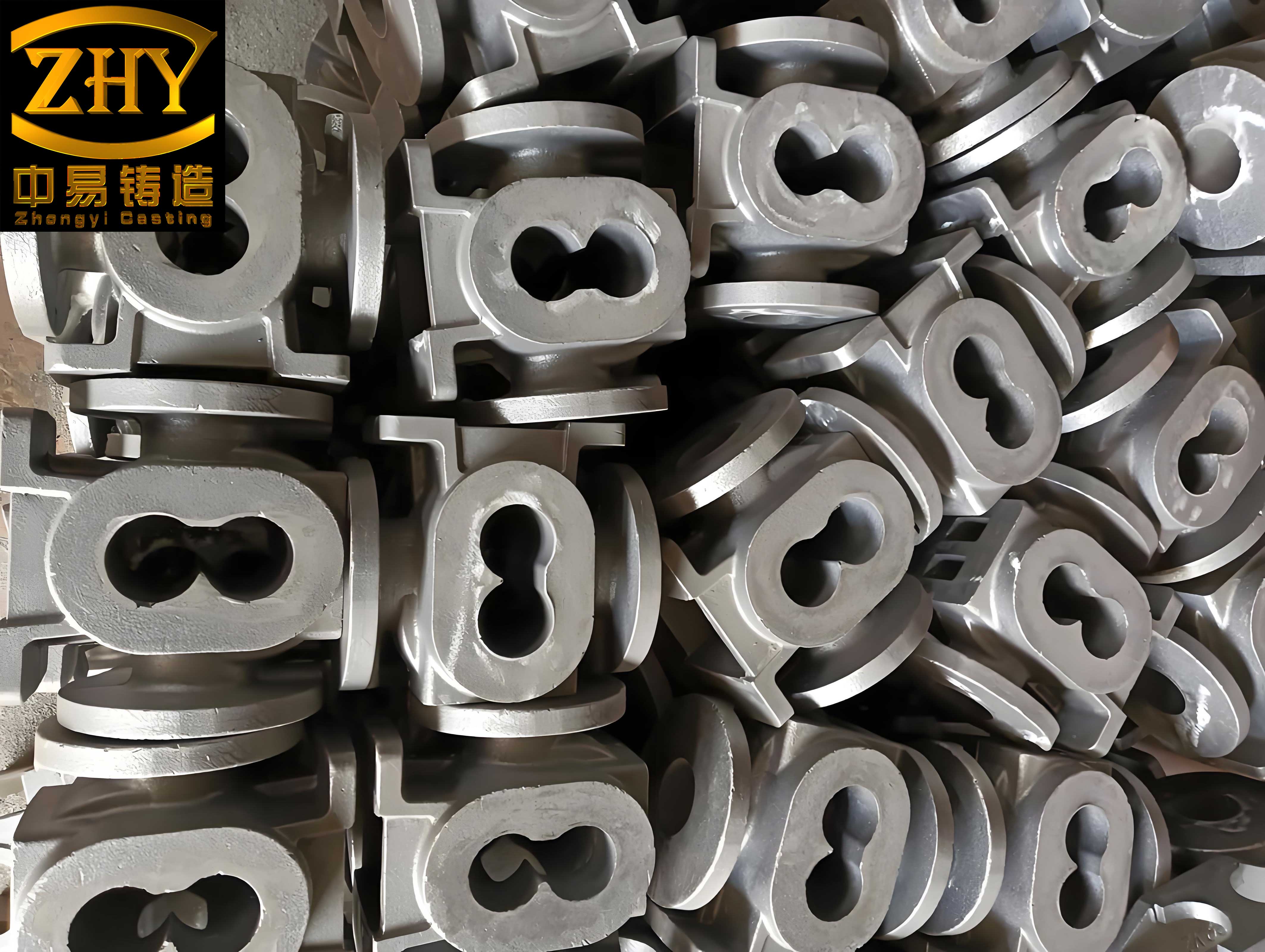
This visual aid underscores the importance of microstructure control in achieving optimal properties for nodular cast iron components.
Beyond laboratory studies, industrial applications of isothermally quenched nodular cast iron require careful process control. For instance, in automotive crankshaft production, the cooling rate during quenching must be uniform to avoid thermal gradients that could induce martensite. Computational modeling using finite element analysis (FEA) can predict temperature distributions and phase transformations, allowing for optimization of quenching parameters. The heat transfer during isothermal quenching can be described by the Fourier heat equation:
$$ \frac{\partial T}{\partial t} = \alpha \nabla^2 T + \frac{q}{\rho c_p} $$
where \( T \) is temperature, \( t \) is time, \( \alpha \) is thermal diffusivity, \( q \) is heat generation rate (from phase transformations), \( \rho \) is density, and \( c_p \) is specific heat. By solving this equation for nodular cast iron geometries, optimal quenching media and times can be determined to minimize white area formation.
Additionally, post-quenching treatments such as tempering can be employed to further enhance properties. Tempering at 200–300°C after isothermal quenching can relieve residual stresses and stabilize retained austenite, converting it to more ductile phases. The tempering kinetics for nodular cast iron can be expressed using the Hollomon-Jaffe parameter:
$$ P = T (\log t + C) $$
where \( P \) is the tempering parameter, \( T \) is temperature in Kelvin, \( t \) is time in hours, and \( C \) is a constant. For nodular cast iron, a \( P \)-value of 15–20 is often targeted to achieve a good balance of hardness and toughness.
In conclusion, the performance of isothermally quenched nodular cast iron is profoundly influenced by microstructure, particularly the presence of white areas containing quenched martensite. Through systematic experimentation and analysis, I have demonstrated that higher isothermal temperatures (around 280–300°C), increased silicon content, reduced manganese and alloying elements, and controlled austenitizing conditions can minimize these detrimental phases. The resulting microstructure—fine upper and lower bainite with fragmented retained austenite—yields superior toughness, strength, and fatigue resistance. This knowledge is essential for advancing the application of nodular cast iron in critical engineering components, ensuring reliability and longevity under service conditions. Future work could explore advanced alloy designs and real-time monitoring techniques to further optimize the isothermal quenching process for nodular cast iron, pushing the boundaries of its mechanical capabilities.