
In my extensive work on diesel engine components, I have focused on the critical issue of crankshaft failures, which often stem from inherent casting defects. These casting defects, if undetected, can lead to catastrophic failures during operation. This article details the development and implementation of advanced nondestructive testing (NDT) methodologies specifically tailored for identifying casting defects in crankshafts, particularly in the high-stress regions such as the crank cheeks. The presence of casting defects—such as porosity, shrinkage, and inclusions—within the material matrix significantly compromises the structural integrity and fatigue life of the component. Therefore, a robust inspection protocol is paramount.
The crankshaft, a pivotal motion component in diesel engines, transmits power and endures cyclic loading. Its failure typically manifests in two modes: wear beyond permissible limits and destructive failure due to material fatigue or brittle fracture. Fatigue failures can be initiated by operational overloads or, more critically, by material inhomogeneities introduced during the casting process. These inhomogeneities are essentially casting defects that act as stress concentrators. To mitigate this risk, a systematic approach to detecting casting defects through NDT is essential. My research and practical applications have centered on locating these critical casting defects, especially in the crank cheek area, which is a common fracture origin.
The crank cheek, the region connecting the main journal and the pin journal, is particularly susceptible to casting defects due to its complex geometry and the solidification characteristics during casting. It represents a thermal hotspot where shrinkage and porosity—key types of casting defects—are prone to occur. Fracture analyses often reveal that fatigue origins coincide with surface or subsurface casting defects near the fillet radii, where stress concentration is highest. Consequently, the inspection must target both internal and near-surface casting defects in this zone.
| Defect Type | Typical Location | Potential Impact on Crankshaft | Preferred Detection Method |
|---|---|---|---|
| Shrinkage Porosity | Crank cheek core, near fillets | Reduces load-bearing area, initiates fatigue cracks | Ultrasonic Testing (UT) |
| Gas Porosity | Randomly distributed in cheek | Lowers dynamic strength, causes stress concentration | Ultrasonic Testing, Radiography |
| Inclusions (Slag, Sand) | Throughout casting, often in cheek | Creates brittle points, promotes crack propagation | Ultrasonic Testing, Visual Inspection |
| Cold Shuts | Surface of cheek or journals | Acts as notch, severe stress riser | Magnetic Particle Testing (MT), Dye Penetrant |
| Micro-shrinkage (Dispersed) | Entire cheek section | Degrades material homogeneity, reduces fatigue limit | High-sensitivity Ultrasonic Testing |
The fundamental challenge lies in probing the internal structure of the crank cheek. Traditional inspection of finished journals is insufficient as it cannot adequately assess the cheek’s interior. My solution involves using ultrasonic longitudinal waves propagated from the inner walls of the journal holes. This approach allows direct interrogation of the entire cheek cross-section, including the critical fillet regions. The sound field behavior in this curved geometry is complex. When an ultrasonic wave transits from a flat transducer face, through a coupling block, onto a concave surface (the journal bore), refraction occurs. The wavefront converges, creating a focused beam. The degree of focusing is inversely proportional to the radius of curvature. For a journal bore diameter of, for example, 80 mm, the resulting sound field can be described by considering Snell’s Law at the interface. The relationship between the incident angle $\theta_i$ and the refracted angle $\theta_t$ for longitudinal waves is given by:
$$ \frac{\sin \theta_i}{V_1} = \frac{\sin \theta_t}{V_2} $$
where $V_1$ is the sound velocity in the coupling medium (e.g., perspex, approximately 2730 m/s) and $V_2$ is the sound velocity in the nodular cast iron crankshaft material (approximately 5600 m/s for longitudinal waves). This focusing effect must be controlled to achieve precise defect localization.
To enhance lateral resolution and minimize positioning errors during arc-wise scanning along the bore, I designed a specialized small-beam probe. This probe incorporates a central transmitting core made of perspex, surrounded by an acoustic damping material to restrict the active aperture. This design effectively creates a directive sound beam. The beam spread angle $\alpha$ can be approximated by the formula for a circular piston source in a far-field:
$$ \alpha \approx \arcsin\left(1.22 \frac{\lambda}{D}\right) $$
where $\lambda$ is the wavelength in the coupling block and $D$ is the effective diameter of the active core. With a core diameter of 6 mm and a frequency of 2.5 MHz ($\lambda_{perspex} \approx 1.1$ mm), the nominal half-angle is reduced, improving the ability to pinpoint casting defects. The probe’s performance was validated on a curved reference block with flat-bottom holes (FBH). The detection sensitivity is established using such a block. The basic ultrasonic equation relating echo height $H$, defect reflectivity, and material attenuation is:
$$ H = H_0 \cdot \frac{A_d}{A_b} \cdot \frac{e^{-2\alpha x}}{x^2} $$
where $H_0$ is the initial pulse height, $A_d$ is the reflective area of the defect (e.g., a FBH), $A_b$ is the beam cross-sectional area at the defect, $\alpha$ is the attenuation coefficient (in Nepers per unit length) of the material, and $x$ is the sound path distance. For nodular cast iron, $\alpha$ is relatively high due to scattering from graphite nodules, which complicates the detection of small casting defects. Therefore, adequate gain reserve is necessary.
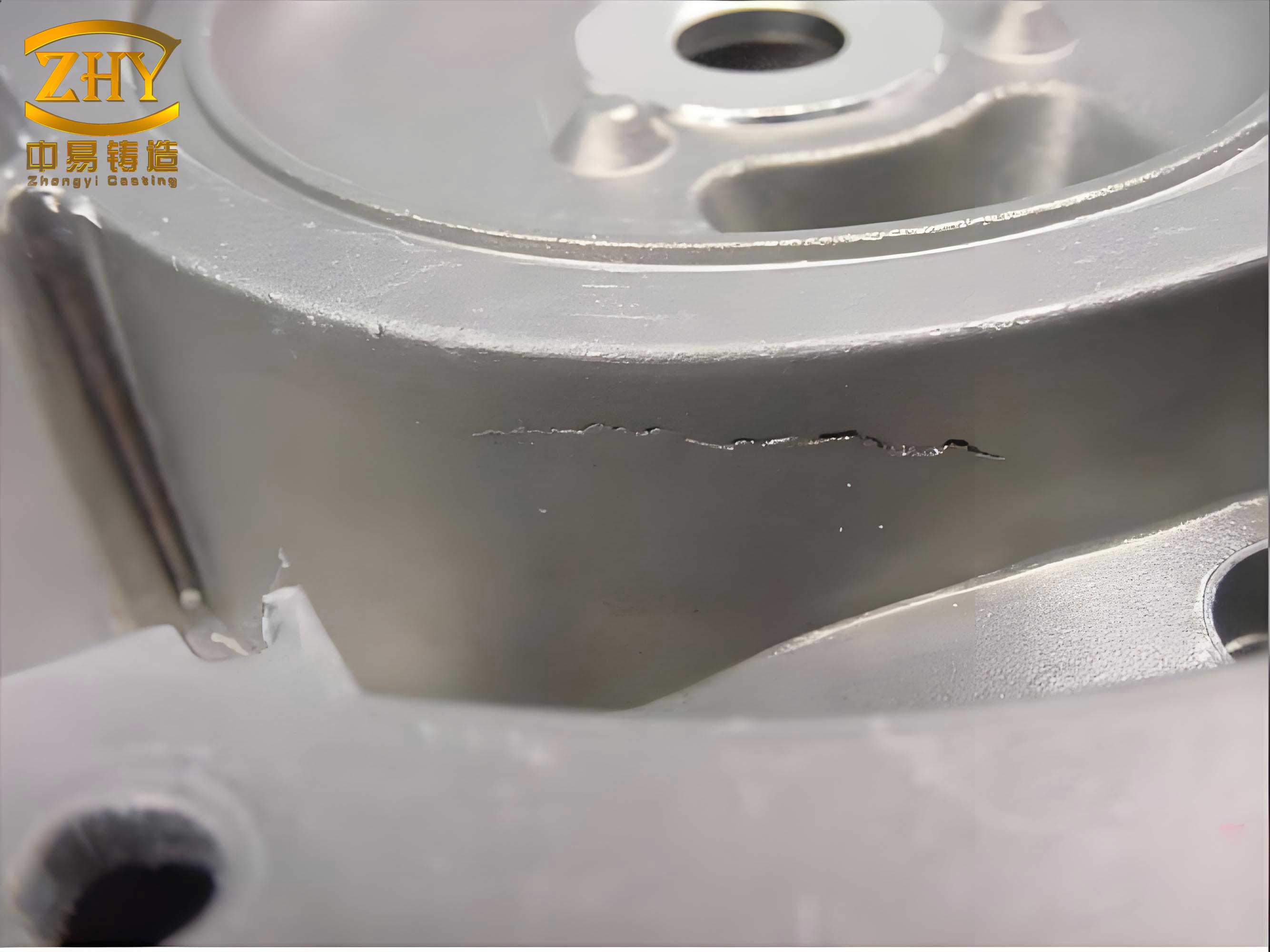
The practical inspection procedure begins with the selection of the inspection surface. The inner bore of the main journal or pin journal serves as the entry point for the ultrasonic probe. The region of interest is the volume bounded by an approximate 45-degree line connecting the fillet roots of the main and pin journals—the so-called “dangerous cross-section.” The probe is manipulated in two axes: axial (along the bore) and circumferential (arc-wise). At each axial station (e.g., every 5 mm), an arc-wise scan is performed from -10 to +10 degrees relative to the fillet center. The signal amplitude and time-of-flight are recorded to map the three-dimensional extent of any detected discontinuity. The sound path $S$ for a defect located within the cheek at a radial distance $r$ from the bore center and an angular offset $\phi$ can be calculated geometrically. If $R$ is the bore radius and $d$ is the depth of the defect from the bore surface along the beam central ray, the total sound path is:
$$ S = \frac{d}{\cos(\theta_t)} $$
where $\theta_t$ is derived from the incident geometry. A set of calibration curves relating sound path to actual defect position in the cheek is essential for accurate sizing and location of casting defects.
| Parameter | Specification | Rationale |
|---|---|---|
| Probe Frequency | 2.5 MHz | Compromise between resolution (higher freq.) and penetration (lower freq.) in cast iron |
| Probe Type | Special small-beam, curved-faced contact probe | To accommodate bore curvature and achieve focused beam for precise location of casting defects |
| Coupling Medium | High-viscosity sugar syrup or similar | Provides stable coupling on rough, non-horizontal cast surfaces; good acoustic transmission |
| Reference Block | Curved block with 2 mm diameter FBH at 40 mm sound path | Simulates inspection geometry and sets sensitivity for relevant casting defects size |
| Sensitivity Setting | FBH echo height = 10 mm, then add 18 dB gain | Ensures detection of small casting defects while accounting for material attenuation and coupling variations |
| Scanning Pattern | Axial step 5 mm, Arc-wise ±10° from fillet center | Covers the entire dangerous cross-section where critical casting defects are likely |
| Defect Recording | Log amplitude vs. position; create 3D maps | Documents size, location, and orientation of casting defects for acceptance/rejection decisions |
In addition to internal inspection, surface and near-surface casting defects must be addressed, especially at the fillet radii where fatigue cracks often initiate. For this, magnetic particle testing (MT) is employed. The principle involves magnetizing the component and applying ferromagnetic particles that cluster at leakage fields caused by surface-breaking or near-surface discontinuities like casting defects. The magnetic flux density $B$ in the part is related to the magnetizing current $I$ and the geometry. For a circular component like a journal, the tangential field strength $H$ at the surface is:
$$ H = \frac{N I}{\pi D} $$
where $N$ is the number of turns (for a coil) and $D$ is the diameter. Ensuring adequate field strength is crucial to detect fine casting defects like cracks or cold shuts. The inspection is performed after final machining, focusing on the fillet regions using longitudinal magnetization to reveal transverse flaws. The findings from both UT and MT are cross-referenced to build a complete picture of the casting defects present in the crankshaft.
The integration of these methods forms a proposed inspection workflow for newly manufactured crankshafts. After rough machining and shot blasting, the crankshaft undergoes ultrasonic testing from the journal bores to screen for internal casting defects in the cheeks. Subsequently, after finish machining, magnetic particle inspection is conducted on all critical surfaces, especially fillets, to detect any surface-connected casting defects. This two-stage process ensures comprehensive coverage. The acceptance criteria must be based on the size, location, and nature of the casting defects. For instance, any cluster of casting defects within the dangerous cross-section exceeding a certain aggregate length should be cause for rejection, while isolated, minor casting defects outside high-stress zones may be acceptable. The relationship between defect size and fatigue strength can be modeled using fracture mechanics. The stress intensity factor range $\Delta K$ for a surface crack of length $a$ under a stress range $\Delta \sigma$ is:
$$ \Delta K = Y \Delta \sigma \sqrt{\pi a} $$
where $Y$ is a geometric factor. Casting defects effectively act as initial cracks, and the fatigue life $N_f$ can be estimated by integrating the crack growth law:
$$ \frac{da}{dN} = C (\Delta K)^m $$
This underscores why even small casting defects in critical locations are detrimental.
My experimental validation involved inspecting numerous crankshafts, followed by sectioning and macro-examination of indicated areas. The results confirmed the ultrasonic method’s capability to accurately map the volume and location of internal casting defects such as shrinkage cavities. In one representative case, the ultrasonic C-scan record showed an anomaly in the upper region of the cheek. Sectioning revealed a classic shrinkage cavity, approximately 15 mm in extent, precisely where predicted. Another challenge is the material’s inherent noise due to the graphite nodules in ductile iron, which generates ultrasonic backscatter. This noise can mask small casting defects. Signal processing techniques, like time-averaging or frequency analysis, can improve the signal-to-noise ratio. The attenuation coefficient $\alpha$ for nodular cast iron is not constant but depends on frequency and nodule size. An empirical relation is:
$$ \alpha = \alpha_0 + \beta f^n $$
where $f$ is frequency, and $\alpha_0$, $\beta$, $n$ are material constants. This must be considered when setting sensitivity across different sound paths.
| Method | Defect Types Detected | Detection Depth | Advantages | Limitations |
|---|---|---|---|---|
| Ultrasonic Testing (Bore Probe) | Internal porosity, shrinkage, inclusions | Full cheek thickness (up to ~80 mm) | Volumetric inspection, good depth penetration, sizes defects | Requires bore access, sensitive to surface roughness, complex interpretation |
| Magnetic Particle Testing | Surface & near-surface cracks, cold shuts | Typically < 1-2 mm | Excellent for surface-breaking casting defects, fast, relatively simple | Only ferromagnetic materials, detects mainly surface flaws, requires magnetization |
| Radiographic Testing | Volumetric defects like porosity, shrinkage | Full thickness | Provides permanent image, good for complex geometries | Radiation safety, expensive, less sensitive to planar defects, 2D projection |
| Eddy Current Testing | Surface cracks, near-surface porosity | Typically < 5 mm | Very fast, no coupling, can automate | Limited penetration, sensitive to material properties, not for deep internal casting defects |
The economic and safety implications of implementing this rigorous inspection are significant. Early detection and rejection of crankshafts with critical casting defects prevent in-service failures, which can lead to costly downtime, engine damage, and even safety hazards. The cost of inspection is offset by the reduced warranty claims and enhanced reliability. Furthermore, the data collected from systematic inspection can feedback into the casting process to reduce the incidence of such casting defects, improving overall yield. Statistical process control can be applied: if the rate of crankshafts rejected due to casting defects exceeds a control limit, the foundry process parameters (e.g., pouring temperature, mold design, cooling rate) must be investigated.
Looking forward, advancements in technology could further refine the inspection for casting defects. Phased array ultrasonic testing (PAUT) could electronically steer and focus beams within the cheek from a single probe position, simplifying scanning and improving imaging. Automated systems with robotics could perform the bore inspection consistently. Moreover, the integration of artificial intelligence for signal classification could help distinguish between harmful casting defects and benign microstructural noise. The fundamental equations governing wave propagation would remain, but the implementation would become more sophisticated. For instance, the sound pressure field $p(r,\theta)$ from a phased array can be computed by superposition:
$$ p(r,\theta) = \sum_{n=1}^{N} A_n \frac{e^{-i(k r_n – \omega t)}}{r_n} $$
where $A_n$ is the complex excitation of the $n^{th}$ element, $k$ is the wave number, and $r_n$ is the distance from the element to the point. This allows dynamic focusing at different depths, enhancing the detection of small casting defects.
In conclusion, the battle against crankshaft failures necessitates a vigilant and sophisticated approach to identifying casting defects. Through the combined application of tailored ultrasonic testing from journal bores and surface magnetic particle inspection, a comprehensive assessment of both internal and surface casting defects is achievable. The key lies in understanding the material behavior, the stress-critical geometries, and the physics of the inspection methods. The casting defects—whether shrinkage, porosity, or inclusions—must be hunted with precision and rigor. The methodologies described here, born from practical experience and theoretical analysis, provide a reliable framework for ensuring that only crankshafts free from detrimental casting defects enter service, thereby safeguarding the performance and longevity of diesel engines. Continuous improvement in both casting technology and NDT capabilities will further minimize the risks posed by these inherent material flaws.