
The pursuit of advanced, lightweight, and durable components across aerospace, marine, and chemical processing industries has consistently driven the adoption of titanium alloys. My focus is on leveraging the **investment casting process** to manufacture intricate parts like impellers with complex curved blades. This **investment casting process**, often termed lost-wax casting, is quintessential for achieving near-net-shape components that are otherwise economically unviable or technically impossible to produce via machining or fabrication. The primary challenge lies not just in replication but in mastering the dimensional accuracy, internal soundness, and surface finish of reactive alloys like titanium under the stringent demands of high-performance applications.
Titanium alloys, such as ZTC4 (Ti-6Al-4V), offer an exceptional combination of low density, high specific strength, excellent corrosion resistance, and biocompatibility. However, their high reactivity in the molten state, particularly with oxygen and most refractory materials, coupled with a relatively low thermal conductivity and specific solidification characteristics, presents significant hurdles in casting. Traditional manufacturing from wrought stock involves massive material removal, leading to exorbitant cost and lead time for a part like a multi-bladed impeller. Therefore, a robust **investment casting process** is not merely an alternative but the most viable pathway to cost-effective production of such complex geometries. The success of this **investment casting process** hinges on a holistic design strategy encompassing pattern engineering, gating methodology, mold shell integrity, and controlled melting and solidification.
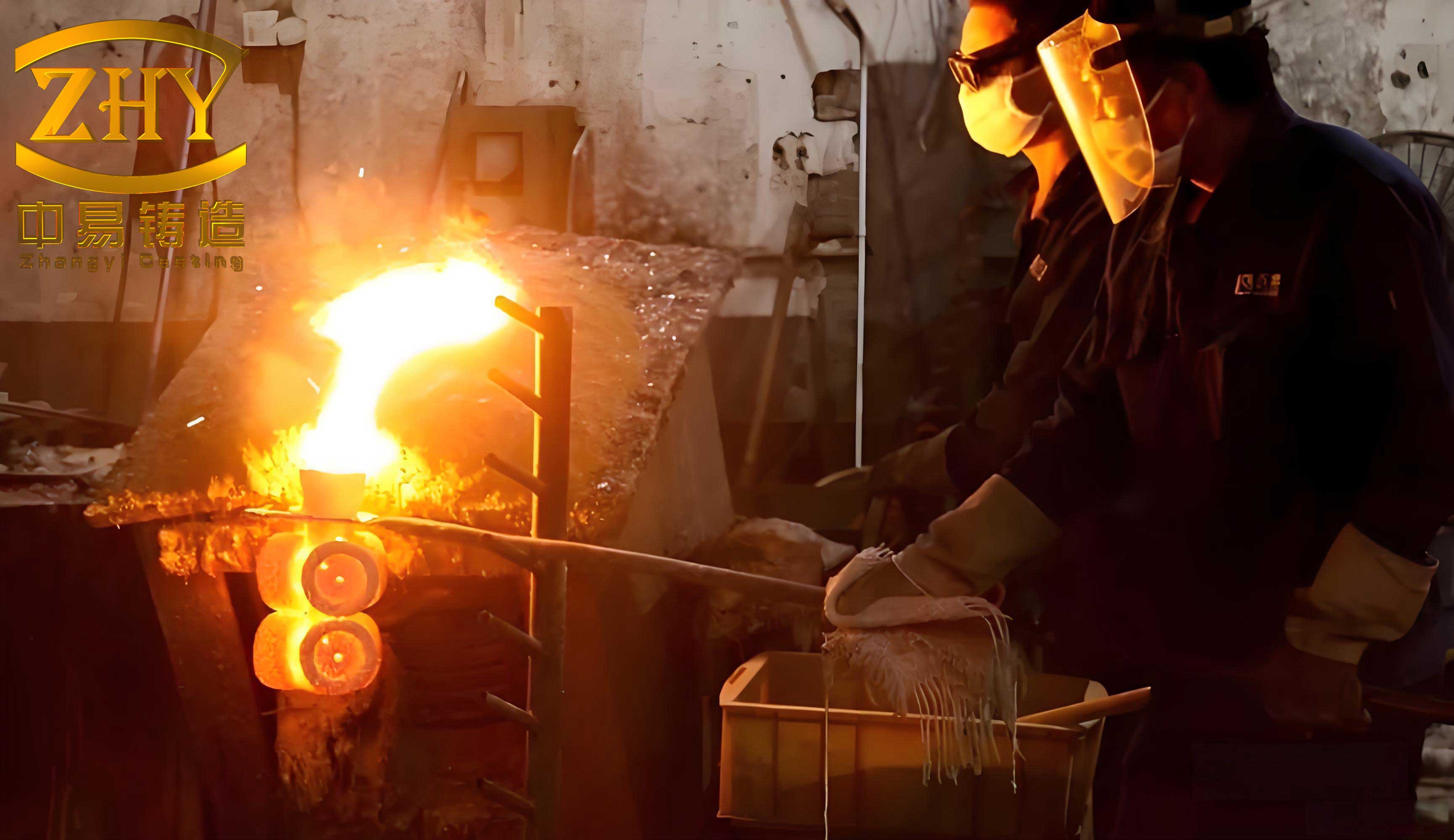
1. Foundational Challenges in Titanium Investment Casting
Before delving into the specific **investment casting process** design, it is critical to understand the fundamental physical phenomena that govern the outcome. Titanium’s behavior during casting is dictated by its thermophysical properties and chemical activity.
1.1 Solidification Shrinkage and Distortion: The total linear shrinkage of a titanium casting from liquidus to room temperature is a composite of liquid contraction, solidification shrinkage, and solid-state contraction. The net linear shrinkage ($S_L$) is often empirically determined but can be conceptually broken down. A critical issue is differential shrinkage. For a complex impeller, the thick hub and thin blades cool at vastly different rates. This creates internal stresses leading to distortion, often making the final part deviate from the intended design. The final shape is a function of the geometry and the thermal field during cooling.
$$ S_L \approx \alpha_{l} \Delta T_{l} + \beta V_{f} + \alpha_{s} \Delta T_{s} $$
Where:
$\alpha_{l}$ = Liquid metal contraction coefficient
$\Delta T_{l}$ = Temperature drop from pouring to liquidus
$\beta$ = Volumetric solidification shrinkage factor
$V_{f}$ = Volume fraction of solid formed (simplified representation)
$\alpha_{s}$ = Solid-state thermal contraction coefficient
$\Delta T_{s}$ = Temperature drop from solidus to room temperature
1.2 Molten Metal Reactivity: Titanium readily reacts with oxides (SiO$_2$, Al$_2$O$_3$) to form brittle interfacial layers and oxygen-enriched “alpha-case,” degrading mechanical properties. This mandates the use of highly stable refractories like yttria (Y$_2$O$_3$) or zirconia (ZrO$_2$) for the mold face coat.
1.3 Fluid Flow and Filling: The thin, twisted blade sections are prone to mistun or cold shuts if the metal front does not fill the cavity smoothly and rapidly. The flow must be laminar to avoid entrapment of mold gases or slag. The Reynolds number ($Re$) for flow in a section should ideally be kept low to ensure laminar flow.
$$ Re = \frac{\rho v D_h}{\mu} $$
Where:
$\rho$ = density of molten titanium
$v$ = flow velocity
$D_h$ = hydraulic diameter of the channel
$\mu$ = dynamic viscosity of molten titanium
2. Comprehensive Process Design Methodology
My approach to the **investment casting process** for the ZTC4 impeller is systematic, addressing each foundational challenge through tailored design features.
2.1 Advanced Pattern Design with Segmented Scaling and Reverse Distortion
The starting point of any **investment casting process** is an accurate pattern. For this impeller, I employ additive manufacturing (3D printing) to produce the initial wax or resin pattern. The key innovation lies in not applying a uniform shrinkage allowance. Instead, I implement a segmented scaling algorithm based on the distance from the geometric center of mass (approximated by the hub) and the local section modulus.
Segmented Scaling: The pattern is divided into zones (Z). For each zone $i$, a specific scale factor $k_{s,i}$ is applied during the pattern design to compensate for the predicted solidification shrinkage.
$$ k_{s,i} = 1 + f_s(r_i, t_i) $$
Where $r_i$ is the radial distance of zone $i$ from the contraction center, and $t_i$ is the characteristic thickness of zone $i$. The function $f_s$ is derived from historical data and simulation. For the impeller:
- Zone A (Hub, thick section): $k_{s,A} \approx 1.010$ (1.0% scale)
- Zone B (Blade root, medium section): $k_{s,B} \approx 1.010$ to $1.015$
- Zone C (Blade tip, thin section): $k_{s,C} \approx 1.018$ to $1.020$ (1.8-2.0% scale)
Reverse Distortion Compensation: To counteract thermal distortion, I introduce a pre-warped geometry into the pattern. This is a negative of the predicted distortion. The compensation vector $\vec{C}_i$ for a node $i$ on the pattern is calculated based on finite element analysis (FEA) of the cooling process.
$$ \vec{C}_i = -\vec{D}_i $$
Where $\vec{D}_i$ is the predicted displacement vector from the ideal geometry due to thermal stresses. In practice, for this impeller, this translates to an additional, directional scaling factor that varies across the blade, effectively “bending” the wax model in the opposite direction of the expected casting warp.
The combined effect ensures the ceramic mold cavity, after pattern removal, will yield a casting that shrinks and distorts into the correct final dimensions. This dual compensation strategy is the cornerstone of achieving dimensional precision in this **investment casting process**.
2.2 Gating and Feeding System Design for Controlled Solidification
The goal is to achieve progressive solidification from the thin, remote sections (blade tips) back toward the heavy feeder (hub/gate). This minimizes shrinkage porosity. I selected a top-pouring, center-gated system with multiple ingates.
System Layout:
- Main Feeder: A large cylindrical feeder is placed atop the hub, serving as the primary heat and metal reservoir.
- Gating: Five radial ingates connect the feeder to the hub’s top surface, distributing metal evenly and reducing localized hot spots.
- Blade Feeders: Small open feeders are placed at the extremity (trailing edge) of each blade tip. These act as hot tops to feed the very last portions to solidify and act as vents.
- Vents: Additional vents are placed along the blade’s leading edge to facilitate air escape.
Design Calculations: The feeder size must satisfy the feeding demand based on Chvorinov’s Rule. The solidification time $t$ of a section is proportional to the square of its volume-to-surface-area ratio $(V/A)^2$.
$$ t = B \left( \frac{V}{A} \right)^n $$
Where $B$ is the mold constant and $n$ is approximately 2 for simple geometries. For soundness, the feeder’s solidification time $t_f$ must be greater than that of the casting section $t_c$ it is intended to feed.
$$ t_f > t_c $$
Therefore,
$$ \left( \frac{V}{A} \right)_f > \left( \frac{V}{A} \right)_c $$
This principle guides the diameter and height of the central feeder. Furthermore, the gating system is designed to minimize velocity and turbulence. The initial filling velocity $v$ is estimated using the Bernoulli equation for a falling stream:
$$ v = \sqrt{2 g h} $$
Where $g$ is gravity and $h$ is the effective metallostatic head. I aim to keep this velocity below a critical threshold to prevent mold erosion and turbulence.
The following table summarizes the key design parameters of the gating system for this **investment casting process**:
| Component | Quantity | Dimensions / Description | Primary Function |
|---|---|---|---|
| Main Feeder | 1 | Diameter: 180mm, Height: 250mm | Provide thermal & metal mass, induce directional solidification |
| Radial Ingates | 5 | Rectangular, 20mm x 15mm cross-section | Distribute metal flow evenly into hub |
| Blade Tip Feeders (Vents) | 4 | Diameter: 25mm, Height: 40mm | Feed blade tips, provide venting path |
| Auxiliary Vents | ~12 | Diameter: 8mm | Enhance mold exhaust along blade length |
3. Mold Shell Engineering for Chemical Inertness and Strength
The mold shell in a titanium **investment casting process** is a critical barrier. My shell build-up recipe is designed for maximum chemical stability and thermal shock resistance.
3.1 Layering Strategy:
- Primary Coat (Face Coat): Refractory: Fine-grade yttria-stabilized zirconia (ZrO$_2$·Y$_2$O$_3$). Binder: Zirconium acetate-based colloidal binder. This layer provides the direct interface with molten titanium and must prevent reaction.
- Secondary Coat: Refractory: Coarser zirconia. Binder: Colloidal silica (SiO$_2$) stabilized for lower reactivity. This reinforces the face coat.
- Back-up Coats (Tertiary and beyond):
Refractory: Fused alumina (Al$_2$O$_3$) or mulite (3Al$_2$O$_3$·2SiO$_2$). Binder: Colloidal silica. These layers provide the bulk mechanical strength to withstand metallostatic pressure and handling.
Each coat is stuccoed with refractory grains of appropriate size (e.g., zirconia sand for first coats, alumina for later coats).
3.2 Dewaxing, Firing, and High-Temperature De-gassing: After build-up, the shell undergoes a steam autoclave dewaxing. The critical subsequent steps are firing and de-gassing. The shell is fired at 950–1000°C in an air atmosphere to burn out residual organics and sinter the binder. However, for titanium, this is insufficient. The shell must then undergo a high-temperature vacuum de-gassing cycle. This involves heating the empty shell in a vacuum furnace to 1000–1050°C under a vacuum better than 5 x 10$^{-2}$ Pa for several hours. This process drives off chemically bonded water and volatiles from the silica binder that would otherwise dissociate and contaminate the titanium melt during pouring. The shell is then transferred directly to the casting furnace while hot to prevent moisture re-absorption.
The table below outlines the shell parameters:
| Process Step | Key Parameters | Objective |
|---|---|---|
| Slurry Viscosity Control | Face Coat: 15-20 sec (Ford Cup #4) | Ensure uniform coating thickness |
| Drying per Coat | Temperature: 22-25°C, Humidity: 50-60%, Time: 8-12 hrs | Prevent cracking, ensure complete gelling |
| Dewaxing | Steam Autoclave, 150-165°C, 6-8 bar pressure | Rapid removal of pattern material |
| Firing | 900-950°C, 2-2.5 hours, Air atmosphere | Burn out residues, develop bond strength |
| Vacuum De-gassing | 1000-1050°C, >2 hours, Vacuum ≤5×10$^{-2}$ Pa | Remove volatile contaminants, prevent gas defects |
4. Melting, Pouring, and Post-Processing
The final stages of the **investment casting process** involve transforming the prepared mold and alloy into a finished component.
4.1 Vacuum Arc Skull Melting and Pouring: Melting is conducted in a Vacuum Arc Skull Melting (VASM) or similar furnace. A consumable electrode of ZTC4 is arc-melted into a water-cooled copper crucible (“skull”), which forms a protective layer of solidified titanium between the melt and the crucible. The key controlled parameters are:
- Vacuum Level: Maintained below 1 Pa, typically 0.1-0.5 Pa, before and during melting to minimize gaseous contamination.
- Arc Current & Voltage: A stable arc is maintained. High current (e.g., 30-40 kA) ensures adequate superheat, while voltage (35-45 V) controls arc length and stability.
- Superheat and Pouring: Once the desired mass is melted and superheated (~50-100°C above liquidus), the furnace is tilted to pour the metal into the pre-positioned mold cavity. The entire operation occurs under high vacuum or inert gas (Ar) backfill.
4.2 Hot Isostatic Pressing (HIP) and Heat Treatment: To guarantee the elimination of any internal micro-porosity, the as-cast component undergoes Hot Isostatic Pressing. The HIP cycle subjects the casting to high temperature and isostatic gas pressure, plastically collapsing internal voids. A typical cycle for ZTC4 is:
$$ \text{Temperature: } 920 \pm 10^\circ\text{C}, \quad \text{Pressure: } 100-140 \, \text{MPa}, \quad \text{Time: } 2-3 \, \text{hours} $$
This is often followed by a solution treatment and aging cycle to optimize the microstructure (alpha+beta phase distribution) for mechanical properties.
5. Validation of the Investment Casting Process
The efficacy of the entire **investment casting process** is validated through rigorous inspection.
5.1 Dimensional and Surface Inspection: Coordinate Measuring Machine (CMM) scanning confirms that all critical dimensions, including blade profile, wall thickness, and hub geometry, fall within the CT9 tolerance band per ISO 8062. Surface roughness measurements on the airfoil surfaces consistently achieve Ra ≤ 3.2 μm, exceeding the typical 6.3 μm requirement. Liquid penetrant inspection reveals no surface cracks, cold laps, or inclusions.
5.2 Internal Quality and Composition: Radiographic (X-ray) inspection is performed per relevant standards (e.g., ASTM E1030). The castings show freedom from shrinkage porosity, gas holes, and non-metallic inclusions in critical areas. Chemical analysis taken from different sections of the impeller confirms uniform composition meeting ZTC4 specifications, with no significant alpha-case buildup due to the effective mold face coat.
| Element | Specification (ZTC4) | Hub Result | Blade Root Result | Blade Tip Result |
|---|---|---|---|---|
| Aluminum (Al) | 5.5 – 6.8 | 6.02 | 5.98 | 5.95 |
| Vanadium (V) | 3.5 – 4.5 | 4.11 | 4.08 | 4.05 |
| Iron (Fe) | ≤ 0.30 | 0.18 | 0.17 | 0.16 |
| Oxygen (O) | ≤ 0.20 | 0.12 | 0.13 | 0.14 |
| Titanium (Ti) | Balance | Balance | Balance | Balance |
5.3 Mechanical Properties: Test coupons cast alongside the impeller (or taken from sacrificial areas of the casting after HIP) are tested. The results meet or exceed the minimum requirements for cast ZTC4, demonstrating the integrity achieved by this **investment casting process**.
6. Conclusion
The successful production of a high-integrity, complex-curved ZTC4 titanium impeller is a testament to a meticulously engineered and integrated **investment casting process**. This **investment casting process** transcends simple mold filling; it is a symphony of predictive geometry compensation, hydrodynamic design for controlled filling, advanced ceramic engineering for chemical inertness, and precise thermal management during melting and solidification. The key technological takeaways are:
- The implementation of a segmented, geometry-aware scaling and reverse distortion compensation model in the pattern stage is paramount for achieving net-shape dimensional accuracy in complex parts with varying section moduli.
- The **investment casting process** must incorporate a gating and feeding system designed not just for filling but explicitly for promoting directional solidification, using principles like Chvorinov’s rule to size feeders correctly.
- For titanium, the mold shell is a functional component requiring a multi-layer design with inert face coats and a rigorous high-temperature vacuum de-gassing protocol to eliminate gaseous contamination sources.
- Post-casting densification via Hot Isostatic Pressing is an essential and integral step in the **investment casting process** for high-reliability titanium components, ensuring the elimination of internal micro-porosity.
This holistic approach to the **investment casting process** delivers a component that combines geometric fidelity, excellent surface finish, and sound internal metallurgy, offering a compelling and cost-effective alternative to machining from billet for complex titanium parts. The methodology outlined provides a scalable framework for the **investment casting process** of other challenging reactive alloy components.