
In the field of materials engineering, the pursuit of enhanced wear-resistant materials is paramount due to the significant economic losses caused by the wear of mechanical components and tools. Among various candidates, high chromium white cast iron has emerged as a critical material owing to its superior abrasion resistance, which is achieved through the formation of hard carbides and adaptable matrix structures. This article, from my perspective as a researcher in metallurgy, delves into the extensive research, production methodologies, and practical applications of high chromium white cast iron, aiming to provide a holistic understanding for its optimal selection and utilization. The term “white cast iron” refers to iron-carbon alloys with carbide-rich microstructures that impart high hardness, and in this context, the high chromium variant leverages chromium additions to transform carbide types, thereby improving performance. Throughout this discussion, the phrase “white cast iron” will be frequently emphasized to underscore its relevance in wear-resistant applications.
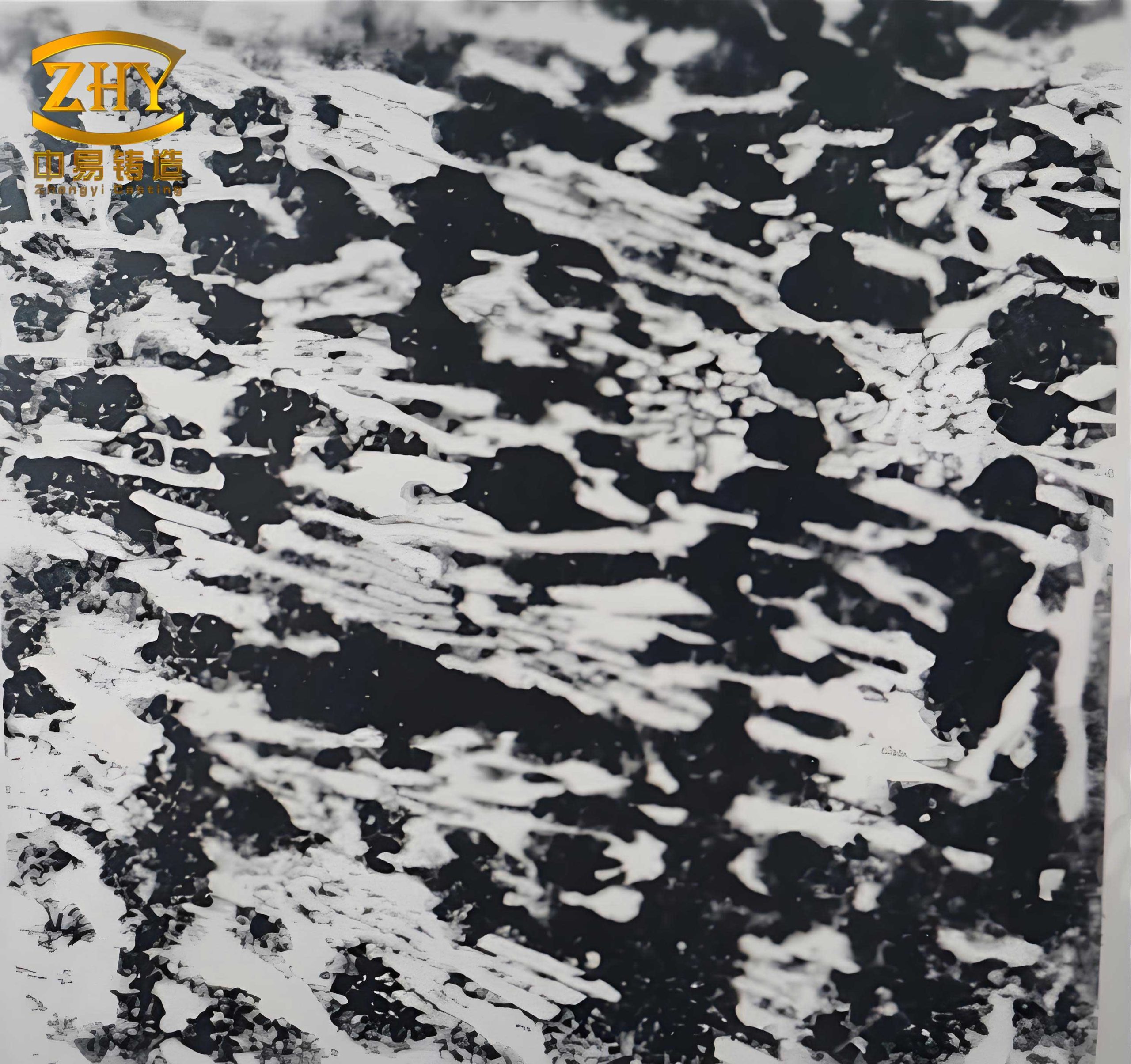
The wear resistance of high chromium white cast iron is fundamentally linked to its microstructure, which comprises hard carbides embedded in a metallic matrix. The addition of chromium, typically around 20-30%, promotes the formation of M7C3-type carbides instead of the softer M3C carbides found in conventional white cast iron. These M7C3 carbides exhibit a higher hardness, often in the range of 1200-1800 HV, and they distribute as isolated rods or blocks during solidification, which enhances toughness compared to networked carbides. The matrix can be tailored through heat treatment to achieve martensitic, austenitic, or pearlitic structures, depending on the service conditions. This versatility makes high chromium white cast iron a preferred choice for combating diverse wear mechanisms, including high-stress abrasion, low-stress scratching, impact, and erosion. The study of this white cast iron involves investigating its failure modes under different wear scenarios and the roles of carbides and matrix in resisting material loss, which guides material selection for specific environments.
To quantify the wear behavior, researchers have employed various testing methods, such as pin-on-disk (two-body wear) and three-body wear testers, simulating conditions where cutting or repeated indentation dominates. In two-body wear with hard abrasives like silicon carbide (SiC, hardness ~2600 HV), the abrasives effectively cut through the M7C3 carbides, rendering them less protective; thus, a ductile austenitic matrix is preferred to absorb deformation. Conversely, with softer abrasives like garnet (hardness ~1350 HV), the carbides remain intact and shield the matrix, so a hard martensitic matrix provides better support, maximizing wear resistance. In three-body wear, where abrasives roll freely, carbides may undergo spalling or fracture due to impact, and the matrix choice again depends on abrasive hardness. These insights underscore that optimal performance of high chromium white cast iron requires both carbides that protect the matrix and a matrix that supports the carbides, coupled with sufficient toughness to prevent brittle fracture. The interplay can be summarized using a wear resistance parameter $R_w$ defined as:
$$R_w = f(H_c, H_m, K_{ic})$$
where $H_c$ is carbide hardness, $H_m$ is matrix hardness, and $K_{ic}$ is fracture toughness. Empirical studies show that for high-stress abrasion, $R_w$ increases with $H_m$ when $H_c > H_{abrasive}$, but for low-stress conditions, $R_w$ correlates more with $H_c$.
The alloying of high chromium white cast iron has been explored to enhance properties or reduce costs. Elements such as vanadium, boron, manganese, and molybdenum are commonly added. Vanadium, when incorporated up to 5%, promotes the formation of vanadium-rich carbides and refines the microstructure, leading to improved hardness, toughness, and corrosion resistance. Boron additions, typically in the range of 0.5-2.0%, increase the volume fraction of hard phases but may reduce wear resistance against very hard abrasives due to increased brittleness. Manganese can partially replace molybdenum to lower costs, though it may slightly decrease hardness and abrasion resistance; for thin-section castings, full substitution is feasible, while for thick sections, partial replacement is advised. The effects of alloying elements on the microstructure and properties of high chromium white cast iron are summarized in Table 1.
| Element | Typical Range (wt.%) | Microstructural Effect | Impact on Wear Resistance | Notes |
|---|---|---|---|---|
| Chromium (Cr) | 15-30 | Forms M7C3 carbides, refines structure | Significantly improves against soft abrasives | Core element for white cast iron enhancement |
| Vanadium (V) | 1-5 | Promotes secondary carbides, refines grains | Enhances in corrosive environments | Increases toughness and hardness |
| Boron (B) | 0.5-2.0 | Increases hard phase volume, forms borides | Improves against quartz but may reduce vs. SiC | Can lead to brittleness if excessive |
| Manganese (Mn) | 1-5 | Stabilizes austenite, replaces Mo partially | Slight decrease, but cost-effective | Used for cost reduction in white cast iron |
| Molybdenum (Mo) | 0.5-3 | Enhances hardenability, refines carbides | Improves overall wear resistance | Often combined with Cr in premium grades |
Heat treatment is crucial for optimizing the matrix of high chromium white cast iron, as it transforms the as-cast structure into desired phases like martensite. The process typically involves austenitizing at temperatures between 950°C and 1050°C, followed by quenching and tempering. Research indicates that the cooling rate and austenitizing temperature interplay to determine final hardness. For instance, at lower austenitizing temperatures (e.g., 950°C), slower cooling results in lower martensite carbon content and reduced hardness, while faster cooling increases hardness. At higher temperatures (e.g., 1050°C), slower cooling reduces retained austenite, boosting hardness. An optimal window exists where cooling rate and temperature balance martensite formation and carbon dissolution. The hardness $H$ after quenching can be modeled as:
$$H = H_0 + k_1 \cdot \exp\left(-\frac{Q}{RT}\right) – k_2 \cdot V_{ra}$$
where $H_0$ is base hardness, $k_1$ and $k_2$ are constants, $Q$ is activation energy, $R$ is gas constant, $T$ is austenitizing temperature, and $V_{ra}$ is volume fraction of retained austenite. Tempering at 200-500°C shows minimal hardness loss due to high tempering resistance, making this white cast iron suitable for high-temperature applications. To prevent cracking during heating, a controlled ramp rate of 50-100°C/h is recommended up to 700°C, after which faster heating can be employed. Overall, heat treatment tailors the white cast iron for specific wear conditions, emphasizing the importance of process control.
Modification or inoculation of high chromium white cast iron is another key area to improve toughness by altering carbide morphology and distribution. Elements like potassium, sodium, magnesium, cerium, and boron-vanadium-titanium-rare earth combinations have been used as modifiers. These additives adsorb on growing carbide surfaces or accumulate at interfaces, inhibiting preferential growth and promoting isolated, blocky carbides instead of continuous networks. As a result, impact toughness increases by 30-50%, and wear loss decreases by 20-40%, with hardness remaining stable or slightly improved. For example, potassium-based modification yields the best results, enhancing both toughness and abrasion resistance. The mechanism can be described by a refinement factor $F_r$:
$$F_r = \frac{1}{\lambda_c}$$
where $\lambda_c$ is the mean free path between carbides; smaller $\lambda_c$ indicates finer, more dispersed carbides, improving toughness. Modified high chromium white cast iron has been successfully applied in components like fan mill beaters and ball mill liners, showing lifespan improvements of 2-4 times over traditional materials. This underscores the value of modification in expanding the applicability of white cast iron in impact-prone environments.
The production processes for high chromium white cast iron involve melting, casting, and specialized techniques to achieve desired properties. Melting is typically conducted in electric furnaces with basic, neutral, or acidic linings, as induction or arc furnaces provide better control over composition and reduce chromium loss compared to cupola melting, which tends to cause erratic chromium burn-off and carbon pickup. The molten white cast iron exhibits good fluidity, allowing pouring temperatures in the range of 1350-1450°C to promote fine-grained structures. Casting can be done in green sand, dry sand, or other molds, with a pattern shrinkage allowance of 1.5-2.0% due to shrinkage similar to steel. However, the low thermal conductivity and high elastic modulus of this white cast iron necessitate uniform cooling and minimized restraint to prevent cracking. Risering is essential for feeding shrinkage, and gating systems should be designed to reduce turbulence.
Metal mold casting has gained popularity for producing grinding balls made of high chromium white cast iron, as it eliminates the need for heat treatment, simplifying production and reducing costs. In this process, the rapid cooling of metal molds yields a matrix of troostite or austenite, which can be further stabilized by low-temperature aging at 250-350°C for 2-4 hours. Such balls demonstrate wear resistance 3-5 times higher than forged steel balls in cement mills, with low breakage rates. The absence of heat treatment also reduces energy consumption, making metal mold casting an economical route for high-volume white cast iron components.
Composite casting methods have been developed to address the inherent brittleness of high chromium white cast iron by combining it with tough steel substrates, creating bimetallic parts that marry wear resistance and impact strength. Techniques include electroslag casting, immersion casting,镶铸 (insert casting), dual-pour casting, centrifugal casting, and钢筋包铸 (reinforcement embedding). In electroslag casting, a consumable electrode of white cast iron is melted onto a steel base, forming a metallurgically bonded interface without defects. Immersion casting involves dipping a preheated steel core into molten white cast iron, allowing alloy layer deposition. Dual-pour casting sequentially pours steel and white cast iron into a single mold, controlling oxidation and timing to ensure good bonding. Centrifugal casting produces rolls or sleeves with a white cast iron outer layer and steel inner core, leveraging centrifugal force for adhesion. Reinforcement embedding places steel bars or meshes into molds before pouring white cast iron, enhancing toughness. These methods yield components like crusher hammers, liner plates, and excavator teeth with service lives 2-3 times longer than single-material parts. The bond strength $\sigma_b$ in such composites can be approximated by:
$$\sigma_b = \sigma_0 + \alpha \cdot \Delta T \cdot E$$
where $\sigma_0$ is intrinsic adhesion, $\alpha$ is thermal expansion coefficient difference, $\Delta T$ is temperature change, and $E$ is Young’s modulus. Proper process parameters, such as preheat temperature and pouring interval, are critical to avoid delamination.
The applications of high chromium white cast iron are vast across industries suffering from abrasive wear. It is successfully used in coal mills, ore crushers, cement mills, shot blasting machines, and slurry pumps, offering substantial economic benefits. For instance, in MPS-type medium-speed coal mills, high chromium white cast iron rollers and liner plates last 6-10 times longer than manganese steel counterparts. In反击式破碎机 (impact crushers), hammers made of this white cast iron exhibit 2-3 times improved lifespan. Cement mill liners and grinding balls show durability enhancements of 3-6 times over conventional materials, while shot blast machine叶片 (blades) outperform ordinary white cast iron by over fortyfold. These successes highlight how high chromium white cast iron, through tailored microstructures and innovative production, meets the demands of harsh environments, reducing downtime and maintenance costs. The widespread adoption of this white cast iron underscores its role as a cornerstone in wear-resistant material technology.
In conclusion, the research and application of high chromium white cast iron have advanced significantly, yet challenges remain. The toughness of this white cast iron, though improved through modification and composite techniques, still limits its use in high-impact scenarios. Further studies are needed on non-martensitic matrix variants, such as austenitic or bainitic white cast iron, to broaden performance envelopes. Additionally, casting process optimization, including simulation and control of solidification, deserves more attention to minimize defects and enhance reproducibility. Future directions may involve nano-scale carbide engineering, additive manufacturing for complex geometries, and sustainable alloy design to reduce reliance on critical elements. As a researcher, I believe that continued innovation in high chromium white cast iron will unlock new potentials, reinforcing its status as a vital material in the fight against wear. The journey of this white cast iron from laboratory to industry exemplifies how material science drives industrial progress, and its evolution will undoubtedly contribute to more efficient and durable engineering solutions worldwide.