
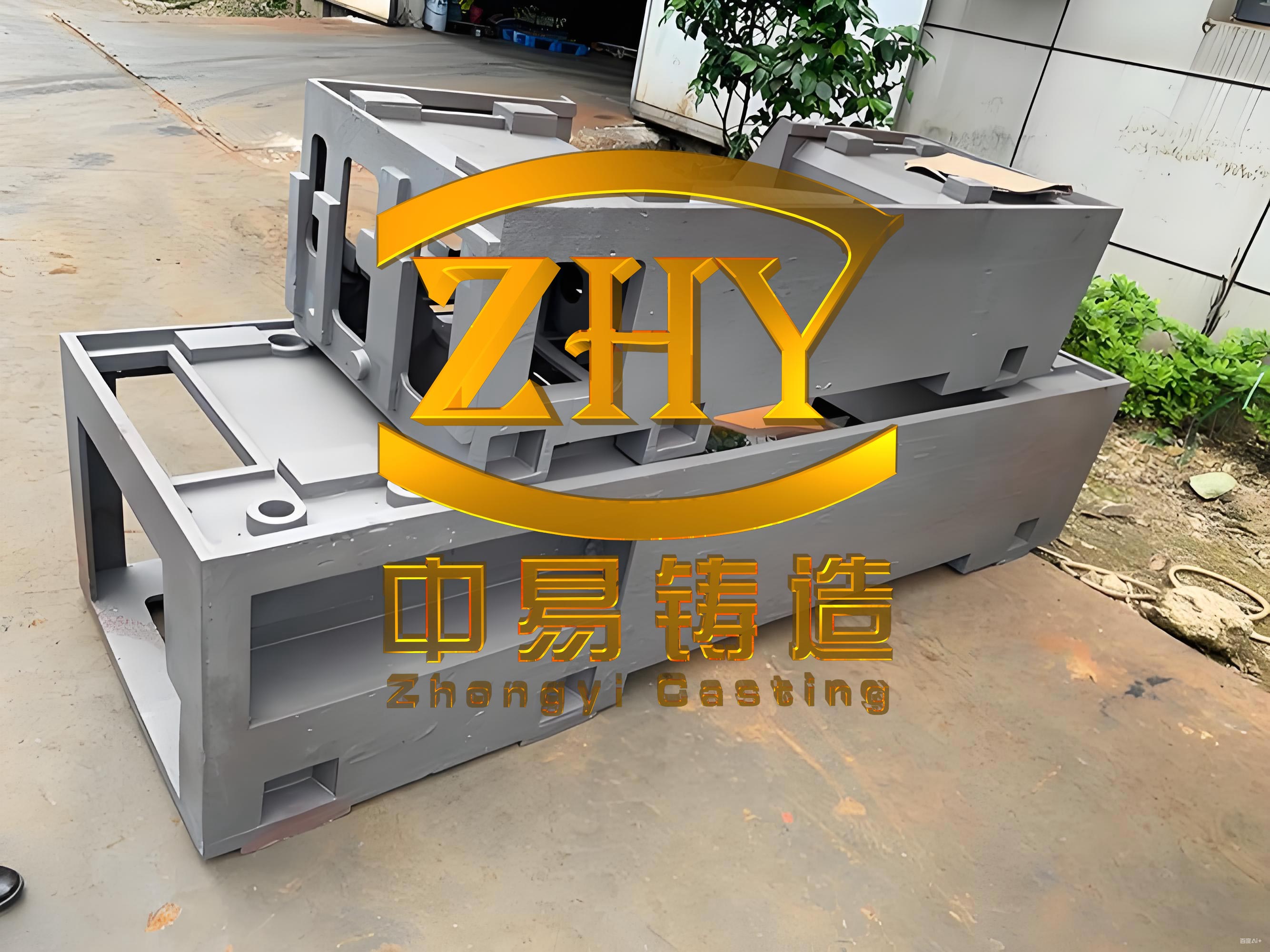
In the automotive industry, the engine is a critical power component, and the quality of machine tool castings, such as cylinder blocks and heads, directly influences vehicle performance metrics like power output, driving comfort, fuel efficiency, and noise levels. With increasing competition among automakers, these indicators have become fundamental customer expectations. Moreover, recent shortages and price hikes in raw materials for engine castings necessitate reducing scrap rates to maintain profitability. The machining precision of light holes in these machine tool castings is paramount, as it dictates functional performance, making it essential to address abnormalities in diameter control charts. This article analyzes common fluctuations in control charts for light hole diameters machined by CNC, using SPC rules, and provides insights into causes and remedies.
CNC machining of light holes in machine tool castings involves processes like drilling, reaming, boring, and honing, each employing specialized tools mounted on the spindle. For instance, boring tools often incorporate expansion mechanisms. The selection of process routes depends on tolerance requirements and applications, as summarized in Table 1. Understanding these methods is crucial for identifying sources of variation in diameter control.
| Process Route | Tolerance Grade | Surface Roughness Ra (μm) | Main Applications | Practical Examples |
|---|---|---|---|---|
| Drilling | IT12-IT11 | 50-12.5 | Initial hole creation in solid blanks for subsequent operations; low-precision non-contact holes. | Oil passage holes, bolt holes for small components in machine tool castings. |
| Reaming | IT10-IT9 | 6.3-3.2 | Enlarging drilled or cast holes for tapping or as precision assembly holes. | Water plug holes, avoidance holes, thread plug holes in machine tool castings. |
| Drilling – Reaming | IT9-IT7 | 3.2-0.8 | High-precision small-diameter (≤20 mm) holes for positioning, guiding, or sealing. | Positioning pin holes, guide tube press-fit holes in machine tool castings. |
| Boring – Honing | IT8-IT7 | 1.6-0.8 | Very high-precision large-diameter (≥20 mm) holes for core component fit affecting engine performance. | Camshaft holes, motor installation holes in machine tool castings. |
The functions of light holes in machine tool castings fall into two categories: those for component fit (e.g., pins, seals) and those for tapping into threads. Diameter deviations can cause severe issues. Undersized holes lead to assembly difficulties, jamming, or tap breakage, while oversized holes result in loosening, leaks, or torque deficiencies. For example, in machine tool castings, incorrect diameters in camshaft holes can cause engine seizure. Thus, monitoring via control charts is vital, with abnormalities indicating process instability. The control limits are defined as:
$$ UCL = \mu + 3\sigma $$
$$ LCL = \mu – 3\sigma $$
where $\mu$ is the process mean and $\sigma$ is the standard deviation. Deviations from these limits signal the need for investigation.
Common Manifestations of Control Chart Abnormalities
In SPC, specific rules help detect anomalies. For machine tool castings, fluctuations in light hole diameter control charts often follow patterns like stratification, trends, or outliers. Below, I detail each manifestation, its SPC rule, potential causes, temporary measures, and long-term solutions, supported by formulas and tables to summarize key points.
Stratification (Nine Consecutive Points on One Side of the Center Line)
Stratification indicates a shift in the process mean, commonly observed in machine tool castings due to tool-related issues. For instance, during tool changes, if the new tool’s tip diameter differs significantly, diameters may cluster on one side. Tool chipping, caused by hard blanks, casting defects, or excessive parameters, can also lead to sudden increases. Additionally, for tools with expansion mechanisms, variations in dwell time or compensation may cause stratification. Temporary measures include using tools with similar diameters or adjusting parameters, while long-term solutions involve supplier collaboration to tighten tolerances and regular maintenance. The process mean shift can be modeled as:
$$ \Delta \mu = \mu_{\text{new}} – \mu_{\text{old}} $$
where a large $\Delta \mu$ indicates significant stratification.
Trend of Decreasing (Six Consecutive Points Decreasing)
A decreasing trend often results from excessive tool wear in machine tool castings machining, where the diameter diminishes before tool life ends. This can be modeled linearly:
$$ D(t) = D_0 – k \cdot t $$
where $D(t)$ is diameter at time $t$, $D_0$ is initial diameter, and $k$ is the wear rate. High $k$ values indicate rapid wear. Temporary fixes involve reducing speed or increasing feed, but optimizing tool materials for better wear resistance is essential. For expansion tools, check for pressure leaks in the system. Regular monitoring of tool condition in machine tool castings processes can preempt this issue.
Trend of Increasing (Six Consecutive Points Increasing)
An increasing trend typically stems from growing runout in the spindle or tool, leading to centrifugal effects and larger diameters. Runout can be expressed as:
$$ R(t) = R_0 + \alpha \cdot t $$
where $R(t)$ is runout at time $t$, $R_0$ is initial runout, and $\alpha$ is the increment rate. If tool change temporarily resolves it, inspect the tool; otherwise, spindle issues may require counterweights or replacement. This is common in high-precision machine tool castings machining, where even minor runout affects diameter consistency.
High Overall Variability (Fourteen Consecutive Points Alternating Up and Down)
This pattern reflects large fluctuations, often due to inconsistencies in previous machining steps or between multiple CNC machines. For example, abnormal drilling in some batches of machine tool castings can cause uneven material removal in reaming or boring. The process capability index $C_p$ highlights variability:
$$ C_p = \frac{USL – LSL}{6\sigma} $$
where $USL$ and $LSL$ are specification limits. Low $C_p$ indicates high variability. Temporary measures include sorting batches, while long-term solutions standardize drilling processes and align machine accuracies across all units handling machine tool castings.
Single or Multiple Outliers (One Point Outside Control Limits)
Outliers arise from transient issues like built-up edge (BUE), where chips adhere to the tool under high temperatures, increasing cutting area. The probability of an outlier under normal distribution is:
$$ P(|X – \mu| > 3\sigma) \approx 0.0027 $$
Contamination on tool holders or locating surfaces can also cause misalignment and diameter jumps. Temporary steps include cleaning and parameter adjustments, while long-term strategies enhance cooling, add air blast systems, and enforce regular cleaning protocols for machine tool castings machining.
| Abnormality Type | SPC Rule | Common Causes | Temporary Measures | Long-Term Measures |
|---|---|---|---|---|
| Stratification | 9 points on one side | Tool change differences, tool chipping, expansion mechanism variations in machine tool castings. | Use similar diameter tool; adjust feed or speed. | Improve tool supplier standards; maintain expansion systems. |
| Decreasing Trend | 6 points decreasing | Tool wear, expansion mechanism degradation in machine tool castings machining. | Reduce spindle speed; increase feed per tooth. | Optimize tool material; inspect for leaks. |
| Increasing Trend | 6 points increasing | Spindle or tool runout increase in CNC machines for machine tool castings. | Replace tool; check parameters. | Add counterweights; replace spindle if needed. |
| High Variability | 14 points alternating | Previous step abnormalities; machine differences in machine tool castings processing. | Separate abnormal batches; adjust secondary operations. | Standardize drilling; calibrate machines. |
| Outliers | 1 point outside limits | BUE, tool holder contamination, locating surface issues in machine tool castings. | Clean tools and surfaces; modify cutting parameters. | Enhance cutting fluid delivery; implement preventive maintenance. |
To quantify tool wear effects, consider the Taylor tool life equation:
$$ VT^n = C $$
where $V$ is cutting speed, $T$ is tool life, $n$ and $C$ are constants. Optimizing these parameters can reduce abnormalities in machine tool castings machining.
Conclusion
In analyzing control chart fluctuations for light hole diameters in machine tool castings, I have outlined common patterns, SPC rules, and remedial actions. A systematic approach—checking for variations at abnormality onset and prioritizing causes from tools to machine software—enhances investigation efficiency. Implementing these measures improves machining precision, reduces scrap, and ensures reliability in engine performance. Continuous monitoring and adherence to SPC principles are crucial for maintaining quality in the production of machine tool castings.