
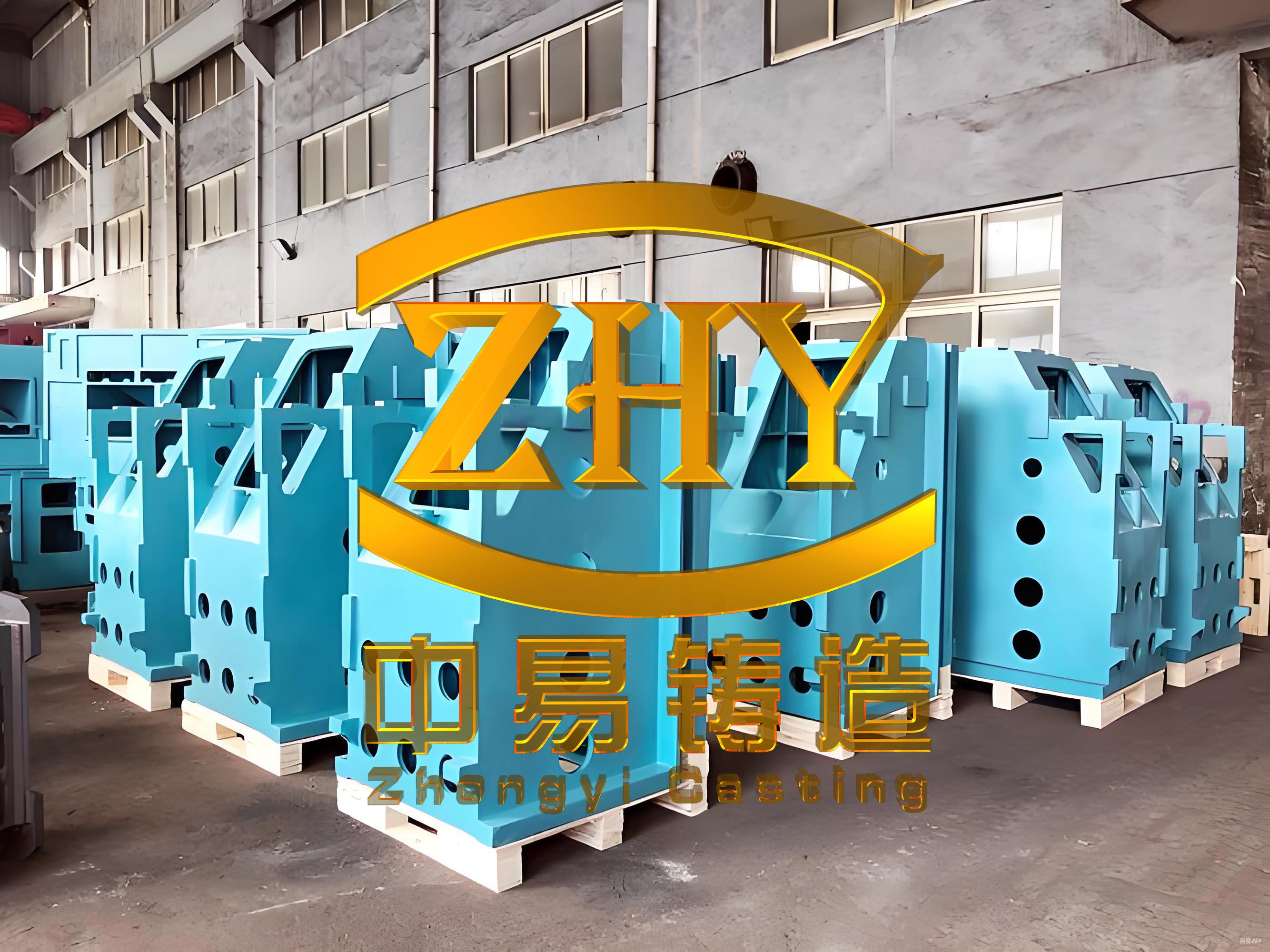
In the production of machine tool castings, such as beds, columns, and saddles, Full Mold Casting (FMC) technology is widely employed due to its adaptability for large-scale, single-batch components. However, carbon slag defects remain a significant challenge, adversely affecting the quality and performance of these machine tool castings. As a practitioner in this field, I have extensively studied the formation mechanisms and control strategies for these defects in machine tool castings. This article delves into the factors influencing carbon slag formation and presents experimental findings and practical improvements to mitigate these issues in machine tool castings. The insights shared here are based on hands-on experience and systematic analysis, aiming to enhance the reliability of machine tool castings produced through FMC.
Carbon slag defects typically manifest as black inclusions on the top and side-top surfaces of machine tool castings after machining, accompanied by surface wrinkles and carbon accumulation. These imperfections compromise the structural integrity of machine tool castings, leading to increased rejection rates. In my observations, the comprehensive scrap rate for such machine tool castings can reach 15–16%, with carbon slag alone accounting for over half of these defects. Understanding and addressing this issue is crucial for improving the yield and quality of machine tool castings.
The root cause of carbon slag defects lies in the pyrolysis of expanded polystyrene (EPS) patterns used in FMC. When molten iron replaces the EPS pattern during pouring, EPS undergoes thermal degradation. Initially, it breaks down into monomers like styrene, dimers, trimers, and toluene, which then further decompose into smaller molecules such as benzene and ethylbenzene. The extent of secondary decomposition depends on temperature; insufficient decomposition leads to viscous, tar-like liquid residues. These residues form a carbon-rich film between the metal and coating, resulting in poor wettability and eventual slag entrapment in machine tool castings. The relationship between EPS pyrolysis products and temperature can be modeled using Arrhenius equations, where the reaction rate constant $k$ is given by $k = A e^{-E_a / RT}$, with $A$ as the pre-exponential factor, $E_a$ the activation energy, $R$ the gas constant, and $T$ the temperature in Kelvin. This explains why higher temperatures promote complete gasification, reducing liquid residues in machine tool castings.
To quantify the impact of various process parameters on carbon slag defects in machine tool castings, I conducted an orthogonal experimental design with four factors at two levels. The factors included EPS density, coating thickness, pouring temperature, and gating system restriction cross-section. A stepped test block measuring 300 mm × 300 mm, with thicknesses ranging from 20 mm to 80 mm, was used to simulate different sections of machine tool castings. The gating system was designed with a bottom-pouring approach to ensure stable filling, as top-pouring could cause backfire and safety hazards in FMC for machine tool castings.
The experimental setup involved 16 test blocks divided into four groups (A, B, C, D), each with variations in EPS density (18 g/L and 21 g/L), coating thickness (1 mm and 2 mm), pouring temperature (1,370 °C and 1,430 °C), and restriction diameter (60 mm and 80 mm). After pouring, the blocks were cleaned, and their surfaces were machined at depths of 5 mm, 10 mm, and 15 mm to assess slag inclusion frequency, location, and area percentage. Penetrant testing (PT) was employed to determine defect depths. The results are summarized in the following tables, highlighting the correlation between process parameters and slag defects in machine tool castings.
| Group | Block ID | Pouring Temperature (°C) | Restriction Diameter (mm) | Coating Thickness (mm) | EPS Density (g/L) |
|---|---|---|---|---|---|
| A | #1 | 1,430 | 60 | 1 | 21 |
| #2 | 1,430 | 60 | 2 | 21 | |
| #3 | 1,430 | 60 | 1 | 18 | |
| #4 | 1,430 | 60 | 2 | 18 | |
| B | #5 | 1,430 | 80 | 1 | 21 |
| #6 | 1,430 | 80 | 2 | 21 | |
| #7 | 1,430 | 80 | 1 | 18 | |
| #8 | 1,430 | 80 | 2 | 18 | |
| C | #9 | 1,370 | 60 | 1 | 21 |
| #10 | 1,370 | 60 | 2 | 21 | |
| #11 | 1,370 | 60 | 1 | 18 | |
| #12 | 1,370 | 60 | 2 | 18 | |
| D | #13 | 1,370 | 80 | 1 | 21 |
| #14 | 1,370 | 80 | 2 | 21 | |
| #15 | 1,370 | 80 | 1 | 18 | |
| #16 | 1,370 | 80 | 2 | 18 |
After machining, the slag defect areas were measured, and the percentage of defect area relative to the total surface area was calculated. The results indicated that all blocks exhibited slag inclusions after 5 mm of machining, primarily in thicker sections (40–80 mm). This underscores the inherent challenge in FMC for machine tool castings, where slag formation is pervasive without adequate countermeasures. The defect severity was ranked based on area percentage after 10 mm machining, with blocks #3, #7, #2, #4, #5, and #6 showing the least slag (3.3% to 10%). These corresponded to higher pouring temperatures, slower pouring (smaller restriction diameters), and thinner coatings. The relationship between wall thickness and slag accumulation can be expressed mathematically as $S = k \cdot t^2$, where $S$ is the slag residue amount, $k$ is a constant dependent on process parameters, and $t$ is the wall thickness. This equation highlights that thicker sections in machine tool castings accumulate more slag, necessitating targeted interventions.
| Block ID | Defect Area Percentage (%) | Primary Defect Locations (Thickness in mm) | PT Depth (mm) |
|---|---|---|---|
| #1 | 12.0 | 60, 80 | 3–10 |
| #2 | 6.7 | 40, 60 | < 5 |
| #3 | 3.3 | 60 | < 3 |
| #4 | 7.3 | 80 | 5–7 |
| #5 | 8.7 | 60, 80 | 4–8 |
| #6 | 10.0 | 80 | 6–9 |
| #7 | 4.7 | 40 | < 3 |
| #8 | 12.5 | 60, 80 | 5–10 |
| #9 | 15.3 | 40, 60, 80 | 8–12 |
| #10 | 18.7 | 80 | 10–15 |
| #11 | 20.1 | 60, 80 | 9–14 |
| #12 | 22.5 | 80 | 11–16 |
| #13 | 25.0 | 40, 60, 80 | 12–18 |
| #14 | 28.7 | 80 | 15–20 |
| #15 | 23.3 | 60, 80 | 10–17 |
| #16 | 26.4 | 80 | 13–19 |
Based on these findings, I implemented several process improvements to reduce carbon slag defects in machine tool castings. First, the gating system was redesigned from a single-point to a multi-point inlet system. This modification ensures more uniform temperature distribution during filling, reducing localized cooling and residual slag in machine tool castings. The gating ratio was standardized to 1 : (1.3–1.5) : (3–5) for sprue, runner, and ingate cross-sectional areas, respectively. For machine tool castings weighing 500–1,000 kg, a 70 mm diameter sprue is used; for 1,000–2,000 kg, an 80 mm sprue; and for over 2,000 kg, a 100 mm sprue. Additionally, a flow restriction near the sprue base, sized at 0.8–0.9 times the sprue area, helps trap slag and ensure rapid sprue filling. The energy balance during pouring can be described by $$Q_{\text{metal}} = m C_p \Delta T + m L_f$$ where $Q_{\text{metal}}$ is the heat content of the metal, $m$ is the mass, $C_p$ is the specific heat, $\Delta T$ is the temperature drop, and $L_f$ is the latent heat of fusion. By minimizing $\Delta T$ through multi-point gating, the pyrolysis efficiency improves in machine tool castings.
Second, machining allowances and reinforcements were optimized. For critical machining surfaces on the top and top-side areas of machine tool castings, I added 10–15 mm subsidies. These are removed during rough machining, eliminating subsurface slag without compromising the final dimensions of machine tool castings. The design considers the solidification dynamics, ensuring that slag floats to the non-critical zones.
Third, spherical slag collectors with diameters of 60–100 mm were incorporated at the top and thick sections of machine tool castings. These collectors trap the initial cold iron and unburned EPS residues, preventing their incorporation into the casting. The size selection is based on the modulus of the section, calculated as $M = V / A$, where $M$ is the modulus, $V$ is the volume, and $A$ is the cooling surface area. For instance, a 80 mm thick section in machine tool castings might require a 100 mm diameter collector to effectively capture slag.
Process control enhancements were also vital. I elevated the pouring temperature for gray iron machine tool castings from 1,380 ± 10 °C to 1,440 ± 10 °C. Higher temperatures promote complete EPS gasification, reducing liquid residues. This is supported by the pyrolysis kinetics, where the fraction of gaseous products $f_g$ increases with temperature according to $f_g = 1 – e^{-k(T) t}$, with $t$ as time. Additionally, I adopted coatings with high refractoriness and permeability to withstand the elevated temperatures without compromising the surface quality of machine tool castings.
Moreover, for thick-walled sections in machine tool castings, I introduced localized hollowing in the EPS patterns. By reducing the volume of foam in these areas, the amount of pyrolysis products decreases, directly lowering slag formation. This approach is particularly effective for machine tool castings with wall thicknesses exceeding 60 mm, where slag accumulation is most pronounced. The reduction in foam volume $V_f$ can be modeled as $V_f = V_{\text{total}} – V_{\text{hollow}}$, leading to a proportional decrease in slag potential.
The implementation of these measures has yielded significant improvements. Currently, the monthly production capacity for FMC-based machine tool castings is 240–250 tons, with the comprehensive scrap rate dropping to 10–11% and the carbon slag-specific scrap rate falling below 4%. This demonstrates the effectiveness of the integrated approach in enhancing the quality of machine tool castings. Continued monitoring and optimization are essential to maintain these standards, especially as the demand for high-performance machine tool castings grows.
In conclusion, controlling carbon slag defects in machine tool castings requires a holistic understanding of FMC process parameters. Through experimental analysis and systematic improvements, including multi-point gating, strategic subsidies, slag collectors, and elevated pouring temperatures, I have successfully reduced defect rates. The mathematical models and empirical data presented here provide a framework for further advancements in the production of machine tool castings. Future work could explore advanced materials for patterns or real-time monitoring systems to dynamically adjust process conditions, ensuring consistent quality in machine tool castings.