
In my experience with steel production, the utilization of slag steel as a raw material presents a significant opportunity for resource recycling and waste reduction. Slag steel, a by-product of iron and steelmaking processes, contains valuable metallic elements alongside slag components. However, when producing large-section medium-carbon low-alloy steel ingots from this material, controlling casting defects becomes a critical challenge. The primary casting defects encountered are shrinkage cavities and cracks, which can severely compromise the integrity and usability of the ingots. This article details my first-hand investigation and optimization of the casting process to mitigate these defects, leading to a substantial improvement in product yield.
The production process involved melting slag steel in a 30t EBT electric arc furnace, followed by refining in a 40t LF ladle furnace. The molten steel, conforming to 42CrMo grade specifications, was then cast into large ingots with dimensions of 820mm × 620mm × 2600mm and a weight of 9.42t. Initial production trials revealed a significant issue with casting defects, where approximately 14.3% of ingots exhibited either severe shrinkage cavities or surface cracks, rendering them unfit for subsequent forging operations. This prompted a comprehensive study to identify the root causes and implement effective countermeasures.
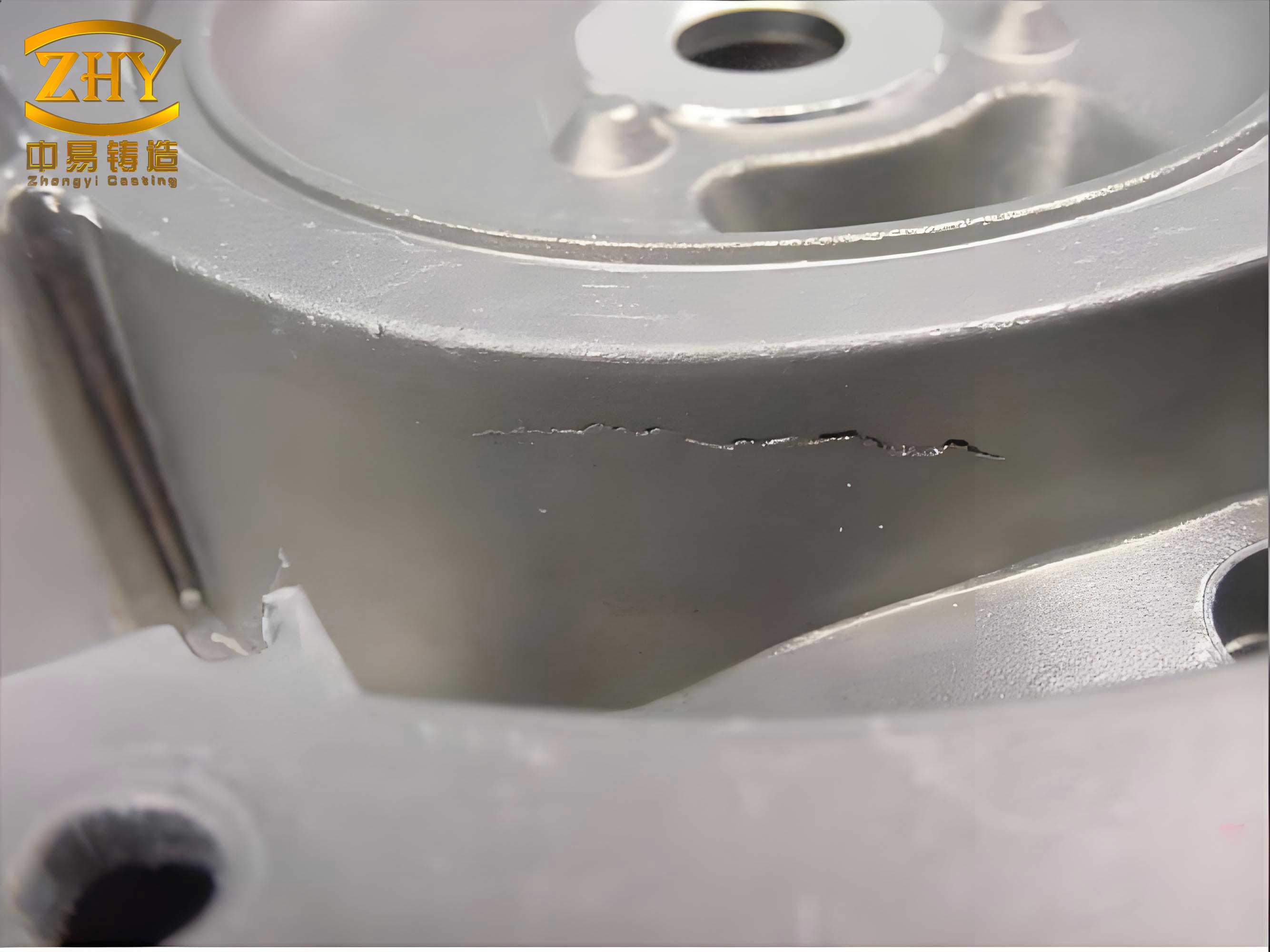
The formation of casting defects, particularly shrinkage cavities, is intrinsically linked to the solidification behavior of the steel. The volumetric shrinkage during the liquid-to-solid transition must be compensated by adequate feeding from the riser. Key factors influencing this include pouring temperature and pouring speed. Higher temperatures increase the liquid contraction volume, while faster pouring rates can alter the temperature gradient and feeding efficiency. To quantify this relationship, I conducted a series of controlled pouring experiments. The goal was to establish a safe operating window that minimizes the risk of both shrinkage cavities and surface defects like wrinkles.
The experimental data from multiple heats were analyzed, and the correlation between pouring parameters and ingot quality was mapped. The results indicated that a combination of excessively high temperature and rapid pouring led to pronounced shrinkage cavities. Conversely, low temperature coupled with slow pouring caused surface wrinkles. The optimal region lay in a specific range of these parameters. To validate this, I designed eight distinct pouring trials, the results of which are summarized in the table below.
| Test Zone | Pouring Temperature (°C) | Pouring Time (min) | Riser Shrinkage Profile | Surface Quality |
|---|---|---|---|---|
| Optimal Zone | 1570 | 16 | Good, shallow dish | No wrinkles |
| Optimal Zone | 1574 | 18 | Good, shallow dish | No wrinkles |
| Optimal Zone | 1574 | 19 | Good, shallow dish | No wrinkles |
| Optimal Zone | 1564 | 20 | Good, shallow dish | No wrinkles |
| Optimal Zone | 1568 | 22 | Good, shallow dish | No wrinkles |
| Optimal Zone | 1575 | 23 | Good, shallow dish | No wrinkles |
| Shrinkage Cavity Zone | 1578 | 12 | Severe cavity, deep into ingot | No wrinkles |
| Wrinkle Zone | 1565 | 24 | No cavity | Severe wrinkles |
Based on this analysis, I determined the safe operating window for pouring 9.42t ingots. The pouring temperature should be controlled between 1564°C and 1575°C, and the pouring time should range from 16 to 23 minutes. This corresponds to a controlled pouring speed. The relationship can be conceptually expressed by a quality function Q:
$$ Q = f(T, v) $$
where T is the pouring temperature and v is the pouring speed. The goal is to maintain Q within an acceptable range to avoid casting defects. A simplified model for the risk of shrinkage formation R_s can be related to the superheat and solidification time:
$$ R_s \propto \Delta T_{superheat} \cdot \exp(-k \cdot t_s) $$
where $\Delta T_{superheat}$ is the superheat above the liquidus, $t_s$ is the local solidification time, and $k$ is a material constant. Faster pouring at high temperature reduces $t_s$ in the upper sections, increasing $R_s$.
Another critical factor in managing casting defects is the performance of the mold flux, or protection slag. Its primary functions are to insulate the molten metal, prevent oxidation, absorb inclusions, and lubricate the mold-ingot interface. The original slag formulation used for smaller ingots proved inadequate for the 9.42t section. It melted too quickly, failing to provide sustained insulation over the longer solidification period of the large ingot. This poor thermal coverage exacerbated feeding problems and increased the propensity for shrinkage cavities.
To address this, I reformulated the protection slag. The key was to increase its melting point and reduce its melting rate to enhance its insulating power over the extended solidification time of a heavy ingot. This was achieved by increasing the fixed carbon content and adjusting the basicity ratio. The physicochemical properties of the original and newly designed slags are compared below.
| Property | Original Slag (for smaller ingots) | Newly Designed Slag (for 9.42t ingots) |
|---|---|---|
| Fixed Carbon, Cfixed (%) | ≤ 13 | 20 – 25 |
| Al2O3 (%) | 7.0 – 10.0 | 15 – 25 |
| Moisture Content (%) | ≤ 0.5 | ≤ 0.5 |
| Expansion Ratio | ≥ 2 | 2.0 – 3.0 |
| Melting Point (°C) | 1100 – 1160 | 1160 – 1240 |
| Melting Speed at 1350°C (s) | 25 – 40 | 40 – 60 |
| Bulk Density (g/cm³) | 0.4 – 0.6 | 0.75 |
The performance of a mold flux is often characterized by its viscosity-temperature relationship and its ability to form a stable liquid and powder layer. The increased melting point $T_m$ and decreased melting rate $R_m$ of the new slag directly improve the thermal resistance of the slag layer. The heat flux $q$ through the slag cover can be approximated by:
$$ q = \frac{\kappa_{eff} \cdot (T_{steel} – T_{air})}{d_{slag}} $$
where $\kappa_{eff}$ is the effective thermal conductivity of the slag layer, and $d_{slag}$ is its thickness. A slag with a higher melting point and slower melting rate maintains a thicker, more stable powder layer, increasing $d_{slag}$ and reducing $\kappa_{eff}$, thereby decreasing $q$ and improving insulation. Industrial trials confirmed that the new slag maintained a proper powder layer of about 120mm, provided adequate liquid slag, and resulted in smooth ingot surfaces with well-formed, shallow-dish riser shrinkage, effectively suppressing one major category of casting defects.
While shrinkage cavities are a major concern, cracking constitutes another severe class of casting defects. The steel grade 42CrMo has a high carbon equivalent (approximately 0.89%), making it susceptible to hardening and sensitive to thermal stresses during cooling. For large-section ingots, the prolonged cooling period creates significant temperature gradients between the surface and the core. If the cooling rate is too high, the resulting thermal stresses can exceed the material’s fracture strength at elevated temperatures, leading to hot tears or cold cracks.
The thermal stress $\sigma_{th}$ generated during cooling can be estimated using a simplified elastic model:
$$ \sigma_{th} = E \cdot \alpha \cdot \Delta T $$
where $E$ is Young’s modulus, $\alpha$ is the coefficient of thermal expansion, and $\Delta T$ is the temperature difference between different regions of the ingot. To prevent cracking, it is crucial to minimize $\Delta T$ by controlling the cooling rate. Therefore, I implemented a slow-cooling practice using an insulated cover placed over the ingot after pouring. The timing of covering and subsequent stripping was critical to balance defect prevention and productivity.
A series of experiments were conducted where the insulated cover was placed at different intervals after the end of pouring. The stripping time was adjusted accordingly using an empirical rule: Stripping Time (h) = 55 – (Covering Time (h) / 2). The results, which directly relate to the occurrence of cracking defects, are presented below.
| Covering Time After Pouring (h) | Calculated Stripping Time (h) | Presence of Cracks After Stripping |
|---|---|---|
| 0 | 55 | No |
| 1 | 54.5 | No |
| 2 | 54 | No |
| 3 | 53.5 | No |
| 4 | 53 | No |
| 5 | 52.5 | No |
| 6 | 52 | No |
| 7 | 51.5 | No |
| 8 | 51 | Yes |
| 9 | 50.5 | Yes |
The data clearly shows that delaying the covering beyond 7 hours after pouring led to the appearance of cracking defects. To ensure robustness, I established a standard practice of placing the insulated cover at 6 hours post-pouring and stripping the ingot at 52 hours. This slow-cooling schedule effectively reduced the cooling rate, minimized thermal gradients, and thereby eliminated cracking as a significant source of casting defects. The cooling curve can be modeled to ensure the ingot temperature remains above the brittle temperature range for a sufficient time. The temperature $T(t)$ at the ingot surface during slow cooling can be approximated by:
$$ T(t) = T_{pour} \cdot \exp(-\beta t) + T_{amb} $$
where $\beta$ is the effective cooling constant, which is significantly reduced by the insulation cover, and $T_{amb}$ is the ambient temperature.
The integration of these optimized parameters—controlled pouring, tailored protection slag, and regulated slow cooling—formed a comprehensive strategy for casting defects control. The synergistic effect of these measures was tested in full-scale production. After implementing the new protocol, a total of 29 heats (116 ingots) weighing 1110.5 tons were produced. Post-casting inspection revealed that all ingots exhibited satisfactory riser shrinkage without cavities and were free from surface and internal cracks. The yield of sound ingots suitable for forging reached 100%, a significant improvement from the initial 85.7%. This demonstrates the effectiveness of the holistic approach in mitigating the casting defects associated with producing heavy steel ingots from slag steel.
In conclusion, the successful production of large-section, medium-carbon low-alloy steel ingots from slag steel hinges on the precise control of the casting process to prevent defects. My investigation confirms that shrinkage cavities, a primary form of casting defects, are governed by pouring parameters and the insulating efficacy of the mold flux. Cracking, another critical type of casting defects, is controlled by managing thermal stresses through slow cooling. The optimization involved defining a strict window for pouring temperature and speed, developing a high-melting-point protection slag for better insulation, and instituting a delayed-covering slow-cooling practice. The resultant process eliminated both shrinkage and crack-related casting defects, achieving perfect yield. This work underscores that a deep understanding of solidification science and heat transfer is essential for casting defects control, especially when using recycled materials like slag steel for demanding applications. The methodologies developed here can be adapted to control casting defects in other large-scale steel casting operations, contributing to more sustainable and efficient metal production.