
The relentless pursuit of weight reduction in automotive and aerospace sectors has cemented the position of aluminum alloys as a cornerstone material. Among them, Al-Si-Mg casting alloys, such as A356 (AlSi7Mg), offer an attractive combination of castability, corrosion resistance, and, crucially, the potential for significant enhancement via heat treatment. The industry is continually seeking manufacturing processes that yield components with higher integrity and more consistent properties. In this context, semi-solid metal (SSM) processing has emerged as a disruptive technology. It involves forming alloys in a state between solid and liquid, characterized by a non-dendritic, globular primary phase suspended in a liquid matrix. This unique starting microstructure fundamentally differentiates SSM components from their conventionally liquid die-cast (LDC) counterparts and has profound implications for their response to subsequent heat treatment and their propensity for various heat treatment defects.
My investigation focuses on understanding how the intrinsic microstructure from SSM processing dictates the evolution of mechanical properties during age-hardening treatments and, more importantly, how it mitigates common heat treatment defects that often plague high-pressure die-cast components. The common wisdom is that SSM parts are denser and less prone to shrinkage porosity. However, a deeper, mechanistic understanding of why this translates to superior and more reliable heat treatment outcomes is essential for optimizing the entire manufacturing chain. This article synthesizes experimental observations on A356 alloy, comparing SSM and LDC routes, to build a comprehensive model linking process-induced microstructure to heat-treatment performance and defect susceptibility.
The foundational material for this study was A356 aluminum alloy with a non-dendritic structure induced by electromagnetic stirring, providing the feedstock for SSM processing. For comparison, standard high-pressure liquid die casting was also employed to produce similar geometries. The core of the methodology involved subjecting both types of as-cast components to identical solution and artificial aging treatments. Solution treatment was conducted at 540°C for 2 hours in a nitrate salt bath, followed by rapid quenching in warm water (~60°C) to minimize quench-induced stresses and distortions—a potential source of heat treatment defects related to dimensional stability. Artificial aging was then performed at temperatures ranging from 150°C to 180°C for varying durations. The evaluation encompassed hardness measurements, tensile testing, and meticulous microstructural characterization using optical microscopy, scanning electron microscopy (SEM), and transmission electron microscopy (TEM) to probe precipitate evolution.
The initial, as-cast state already revealed a decisive advantage for the SSM process. The SSM microstructure consisted of coarse, globular α-Al grains surrounded by a refined eutectic network. In stark contrast, the LDC microstructure exhibited a finer but dendritic α-Al morphology with a more interconnected eutectic phase. While finer grains often suggest better properties, the dendritic morphology introduces stress concentration points and segregates the brittle eutectic phases along inter-dendritic boundaries, creating inherent weaknesses. The most critical difference, however, was in casting integrity. Quantitative image analysis consistently showed that SSM components had a dramatically lower volume fraction of micro-porosity. This lack of internal voids is the first and most critical barrier against a major class of heat treatment defects. During solution treatment, trapped gases in pores can expand, and internal surfaces of pores can facilitate oxidation, leading to blistering or the growth of these defects, which catastrophically undermine ductility and fatigue life.
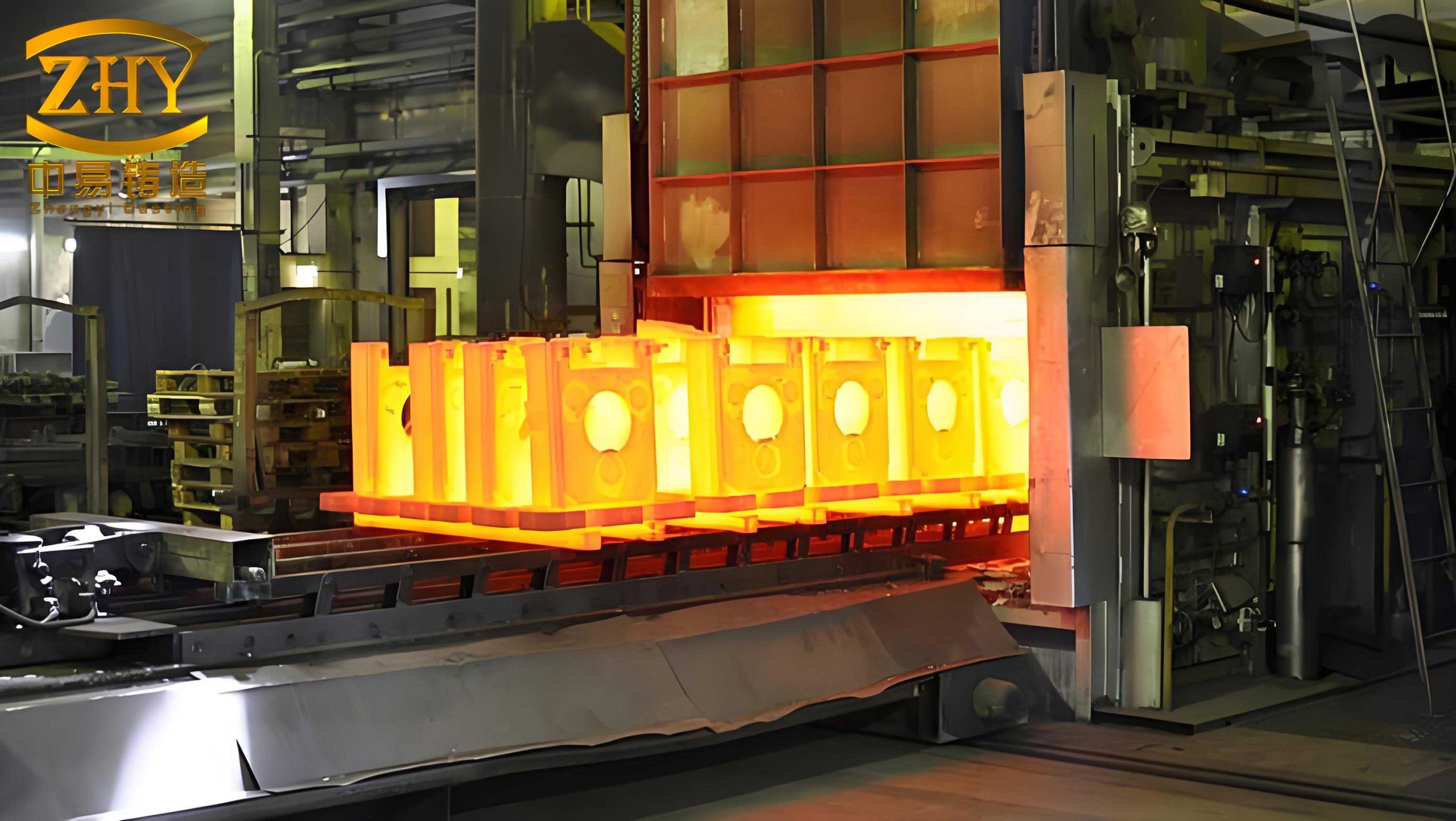
The response to aging treatments, as measured by hardness, followed classic precipitation hardening kinetics for both material states, but on different absolute scales. The hardness curves over time at a constant aging temperature (e.g., 170°C) could be modeled by an Avrami-type equation related to the volume fraction of precipitates, f:
$$ f = 1 – \exp(-k t^n) $$
where k is a temperature-dependent rate constant and n is the time exponent. While both materials showed an increase to peak hardness, the SSM material consistently achieved a higher peak value. This suggests a more effective precipitation sequence, likely due to more uniform solute distribution (Mg and Si) within the globular α-Al grains compared to the cored dendritic structure of LDC material, where micro-segregation can lead to inhomogeneous precipitation—another subtle form of heat treatment defects manifesting as inconsistent property distribution.
The most telling data comes from tensile properties before and after the T6 heat treatment (540°C/2h + 170°C/8h). The results are summarized comprehensively below, extending the analysis to include factors critical for heat treatment defects.
| Processing Route & State | Ultimate Tensile Strength (MPa) | Yield Strength (MPa) | Elongation (%) | Dominant Microstructural Features Affecting Heat Treatment | Associated Heat Treatment Defect Risk |
|---|---|---|---|---|---|
| LDC – As-Cast | ~180-200 | ~110-130 | ~3-5 | Fine dendrites, severe micro-porosity, eutectic network. | Very High (Porosity growth, blistering). |
| LDC – T6 Treated | ~220-240 | ~160-180 | ~1-3 | Dendritic skeleton remains; porosity enlarged; β-Si spheroidized. | High (Loss of ductility due to defect linkage). |
| SSM – As-Cast | ~220-240 | ~130-150 | ~6-9 | Globular α-Al, minimal porosity, refined eutectic. | Low. |
| SSM – T6 Treated | >330 | >250 | >10 | Globular structure retained; dense, homogeneous Mg2Si precipitation; discrete β-Si. | Very Low. |
The data is unequivocal. The LDC component shows marginal strength improvement but a drastic loss of elongation after T6 treatment. This embrittlement is a direct consequence of heat treatment defects; the pre-existing pores act as stress concentrators and crack initiation sites. The solution heat treatment often coarsens or interconnects these pores, making the material more brittle despite the precipitation strengthening. The SSM component, conversely, leverages its sound microstructure to fully benefit from precipitation hardening. The strength increase is substantial, and the ductility remains high because there are few internal defects to initiate failure. The globular structure provides a more uniform, tri-axial stress state compared to the stress-concentrating dendrite boundaries, delaying crack initiation and propagation.
Microstructural analysis post-T6 treatment reveals the mechanistic details. In both cases, the eutectic silicon undergoes spheroidization during solution treatment, but the morphology is more favorable in SSM material. More critically, TEM analysis confirms that the primary strengthening phase in the peak-aged condition is the metastable β” precipitate, a precursor to the equilibrium Mg2Si phase. The strengthening increment from precipitation, Δσppt, can be described by mechanisms like Orowan looping or shearing, depending on precipitate size and coherence. A simplified form of the Orowan stress for bypassing non-shearable particles is:
$$ \Delta \sigma_{ppt} \approx \frac{M G b}{L} $$
where M is the Taylor factor, G is the shear modulus, b is the Burgers vector, and L is the mean inter-precipitate spacing. The SSM material, with its more homogeneous solute distribution, achieves a finer and more uniform dispersion of these β” precipitates within the α-Al grains, minimizing L and maximizing Δσppt. The LDC material, suffering from micro-segregation, may form precipitate-free zones near dendritic boundaries or coarse, heterogenous precipitates, both of which are microstructural heat treatment defects that reduce effective strengthening and can become paths for easy crack propagation.
To systematically understand the battle against heat treatment defects, we can categorize them and see how the SSM microstructure provides inherent resistance.
| Category of Heat Treatment Defect | Root Cause | Effect on Properties | Why SSM Microstructure is Resistant |
|---|---|---|---|
| Porosity-Related (Blistering, Growth) | Expansion of trapped gas or shrinkage cavities during high-temperature solution treatment. | Catastrophic loss of ductility and fatigue strength; surface blisters. | Extremely low initial porosity level leaves no nuclei for defect growth. |
| Distortion & Quench Cracking | Thermal gradients and transformation stresses during rapid quenching. | Dimensional inaccuracy, scrap parts, stress corrosion cracking sites. | Globular, equiaxed structure promotes more isotropic thermal contraction, reducing internal stresses. Higher inherent ductility absorbs quench strains better. |
| Inhomogeneous Precipitation | Micro-segregation of Mg and Si in dendritic casting structure. | Inconsistent hardness/strength, localized weak zones, reduced peak strength. | Globular grains form from a roiling, semi-solid state that minimizes long-range segregation, leading to uniform solute distribution for homogeneous nucleation of Mg2Si. |
| Overaging / Incorrect Properties | Sensitivity to time-temperature parameters due to complex solute profiles. | Failure to meet specified mechanical properties. | More consistent and predictable precipitation kinetics due to uniform solute matrix, making process control more robust and reducing the risk of inadvertently falling into an overaged condition. |
The governing principle is that the non-dendritic, globular microstructure of SSM processed A356 is inherently more “forgiving” and optimized for subsequent thermal processing. It presents a clean, uniform canvas for the precipitation hardening reaction. The absence of significant porosity eliminates the most severe defect amplifiers. The equiaxed grain structure minimizes anisotropic behavior and stress concentrations. The reduced segregation ensures that the strengthening mechanism operates at peak efficiency uniformly throughout the component.
From a diffusion perspective, the homogenization during solution treatment is more effective in the SSM structure. The diffusion distance required to eliminate micro-segregation scales with the secondary dendrite arm spacing (SDAS) in LDC material. In SSM material, the “segmentation” of the eutectic and the globular morphology mean the diffusion distances for Si and Mg to achieve a uniform solid solution are shorter and less tortuous. Fick’s second law governs this homogenization:
$$ \frac{\partial C}{\partial t} = D \frac{\partial^2 C}{\partial x^2} $$
Where C is concentration, t is time, D is the diffusion coefficient, and x is distance. For a given solution treatment time, a smaller characteristic distance x (comparable to the inter-globular spacing vs. SDAS) leads to a more complete homogenization, setting the stage for a more effective and uniform age-hardening response and directly preventing the heat treatment defects stemming from incomplete solutionizing.
In conclusion, the superior heat treatment response of semi-solid molded A356 alloy, culminating in tensile strengths exceeding 330 MPa with over 10% elongation, is not a mere coincidence. It is the direct and logical consequence of an engineered microstructure that is fundamentally incompatible with the genesis and propagation of common heat treatment defects. The globular, non-dendritic morphology combined with exceptional casting soundness creates a material state that allows precipitation hardening theories to be realized in practice with minimal interference from processing artifacts. This study underscores that in high-performance aluminum casting alloys, the pursuit of property enhancement through heat treatment is intrinsically linked to the control of the initial microstructure. Minimizing heat treatment defects is not solely about optimizing furnace parameters; it is profoundly about selecting and controlling the primary shaping process to deliver a microstructure that is pre-disposed to benefit from, rather than be degraded by, the thermal cycles designed to strengthen it. The SSM process, therefore, represents a holistic manufacturing strategy where microstructural engineering for performance and microstructural engineering for defect minimization are one and the same.