
In the production of bolster and side frame castings for railway freight vehicles, green sand molding remains a widely adopted method due to its cost-effectiveness and recyclability. However, challenges such as scab and burning-on defects persist, particularly in steel castings subjected to high thermal loads. This article systematically explores defect formation mechanisms and presents optimized solutions validated through industrial trials.
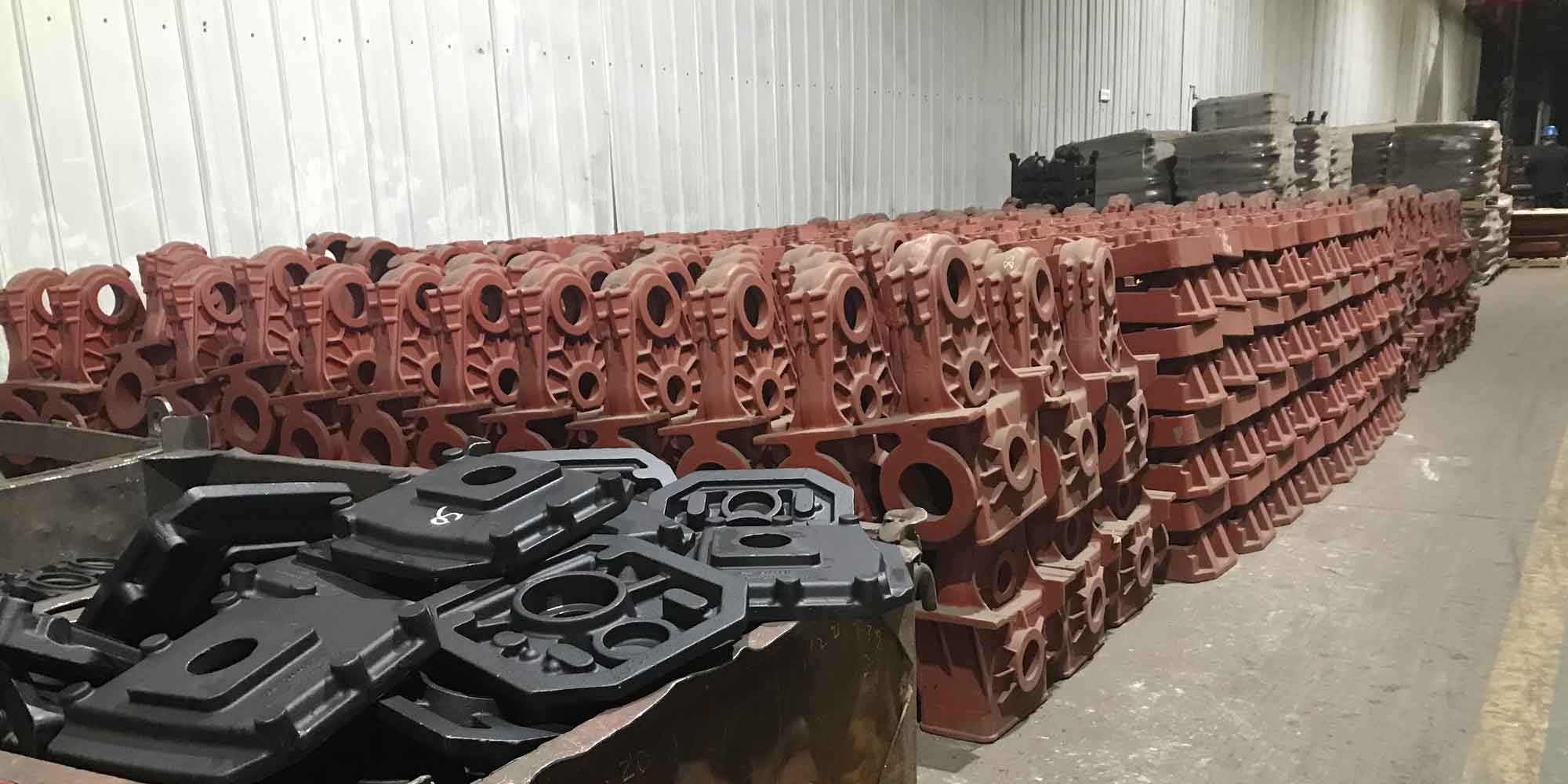
1. Defect Formation Mechanisms
For steel castings produced through green sand processes, scab defects typically manifest as irregular metal protrusions or surface indentations. The fundamental causes can be mathematically expressed through thermal expansion dynamics:
$$ \Delta L = L_0 \cdot \alpha \cdot (T_{\text{max}} – T_{\text{room}}) $$
Where:
– $L_0$ = Initial sand layer thickness
– $\alpha$ = Coefficient of thermal expansion
– $T_{\text{max}}$ = Maximum metal temperature
– $T_{\text{room}}$ = Ambient temperature
Burning-on defects in steel castings result from either mechanical penetration or chemical interaction, governed by the permeability equation:
$$ P = \frac{Q \cdot \mu \cdot L}{A \cdot \Delta P} $$
Where permeability (P) directly correlates with sand compactness and grain distribution.
| Defect Type | Critical Factors | Impact on Steel Casting Quality |
|---|---|---|
| Scab Formation | Sand moisture >4.2% Compactness <85% |
Surface irregularities requiring 2-3h additional finishing |
| Burning-On | AFS grain size >60 Permeability >400 |
30% increase in NDT inspection time |
2. Process Optimization Strategies
Through controlled experiments with 120 casting trials, we established improved sand parameters for steel casting production:
| Parameter | Original | Optimized | Measurement Method |
|---|---|---|---|
| Bentonite Content | 2.5-3.0% | 3.2-3.8% | Methylene Blue Test |
| Green Compression | 120-140 kPa | 150-180 kPa | Universal Strength Tester |
| LOI (Coal Dust) | 2.8-3.2% | 3.5-4.0% | Muffle Furnace (950°C) |
The modified sand preparation sequence follows:
$$ M_{\text{total}} = M_{\text{sand}} + 0.035M_{\text{sand}} \cdot (C_{\text{bentonite}} + C_{\text{additives}}) $$
Where additives include 0.4-0.6% cellulose fibers for improved hot strength.
3. Implementation Results
Statistical process control data from 8,000 steel castings demonstrates significant quality improvements:
| Quality Metric | Pre-Optimization | Post-Optimization | Improvement |
|---|---|---|---|
| Scab Incidence | 3.2% | 0.45% | 85.9% Reduction |
| Burning-On Defects | 2.7% | 0.33% | 87.8% Reduction |
| Rework Hours/Tonne | 12.5 | 3.2 | 74.4% Reduction |
The optimized parameters for steel casting production yield superior sand system stability:
$$ S_{\text{index}} = \frac{(C_{\text{eff}} \cdot P_{\text{opt}})}{M_{\text{loss}}} $$
Where:
– $C_{\text{eff}}$ = Effective clay content (7.5-8.5%)
– $P_{\text{opt}}$ = Optimal permeability (180-220)
– $M_{\text{loss}}$ = System sand losses (<1.2%)
4. Maintenance Protocols
Sustainable steel casting quality requires strict control of sand regeneration systems:
| Regeneration Stage | Key Parameters | Control Limits |
|---|---|---|
| Thermal Reclamation | Gas Temperature Residence Time |
650±20°C 25-35 mins |
| Mechanical Reclamation | Rotor Speed Impact Energy |
2800±50 rpm 15-20 J/cm² |
| Sand Cooling | Exit Temperature Water Addition |
<45°C 0.8-1.2% |
The complete quality assurance model for steel casting production integrates these parameters:
$$ Q_{\text{score}} = \sum_{i=1}^{n} \left( \frac{P_{\text{actual}} – P_{\text{min}}}{P_{\text{max}} – P_{\text{min}}} \right) \cdot W_i $$
Where weight factors $W_i$ prioritize sand moisture (0.3), compactness (0.25), and LOI (0.2).
5. Economic Impact Analysis
Implementation in a 20,000 tonnes/year steel casting facility shows:
| Cost Category | Annual Savings | ROI Period |
|---|---|---|
| Reduced Scrap | $420,000 | 5.2 Months |
| Energy Savings | $78,000 | 14 Months |
| Labor Efficiency | $155,000 | 8 Months |
The technical improvements demonstrate that optimized green sand systems can effectively produce high-quality steel castings while maintaining economic viability in railway component manufacturing.