
In my extensive experience within the foundry industry, particularly specializing in precision lost wax casting, I have frequently encountered the persistent and costly issue of surface porosity in complex castings. Precision lost wax casting, known for its ability to produce intricate, near-net-shape components with excellent dimensional accuracy, is nevertheless susceptible to certain metallurgical defects. Among these, surface porosity—manifesting as superficial or subsurface micro-shrinkage accompanied by gas pores and inclusions—poses a significant challenge for structural integrity and cosmetic finish. This article delves deeply into the mechanisms behind surface porosity formation in precision lost wax casting and presents a comprehensive, first-hand account of the practical control strategies developed through years of hands-on practice and problem-solving.
The specific incident that catalyzed this deep dive involved a critical component, designated here for reference as Part 8-1. This was a substantial ZG35Cr-MnSi low-alloy steel casting weighing approximately 3 kg, featuring a complex geometry with numerous undercuts and thin-walled sections. Produced via precision lost wax casting using high-strength ceramic shells and un-molded pouring, this part consistently exhibited high rejection rates—at times exceeding 34%—due to surface porosity detected during liquid penetrant or magnetic particle inspection. The defects appeared as foggy spots or linear indications, primarily near gate areas, in concave corners with poor heat dissipation, and at the centers of thin plates. This problem severely impacted production schedules and underscored the need for a fundamental understanding and robust control methodology within the precision lost wax casting process.
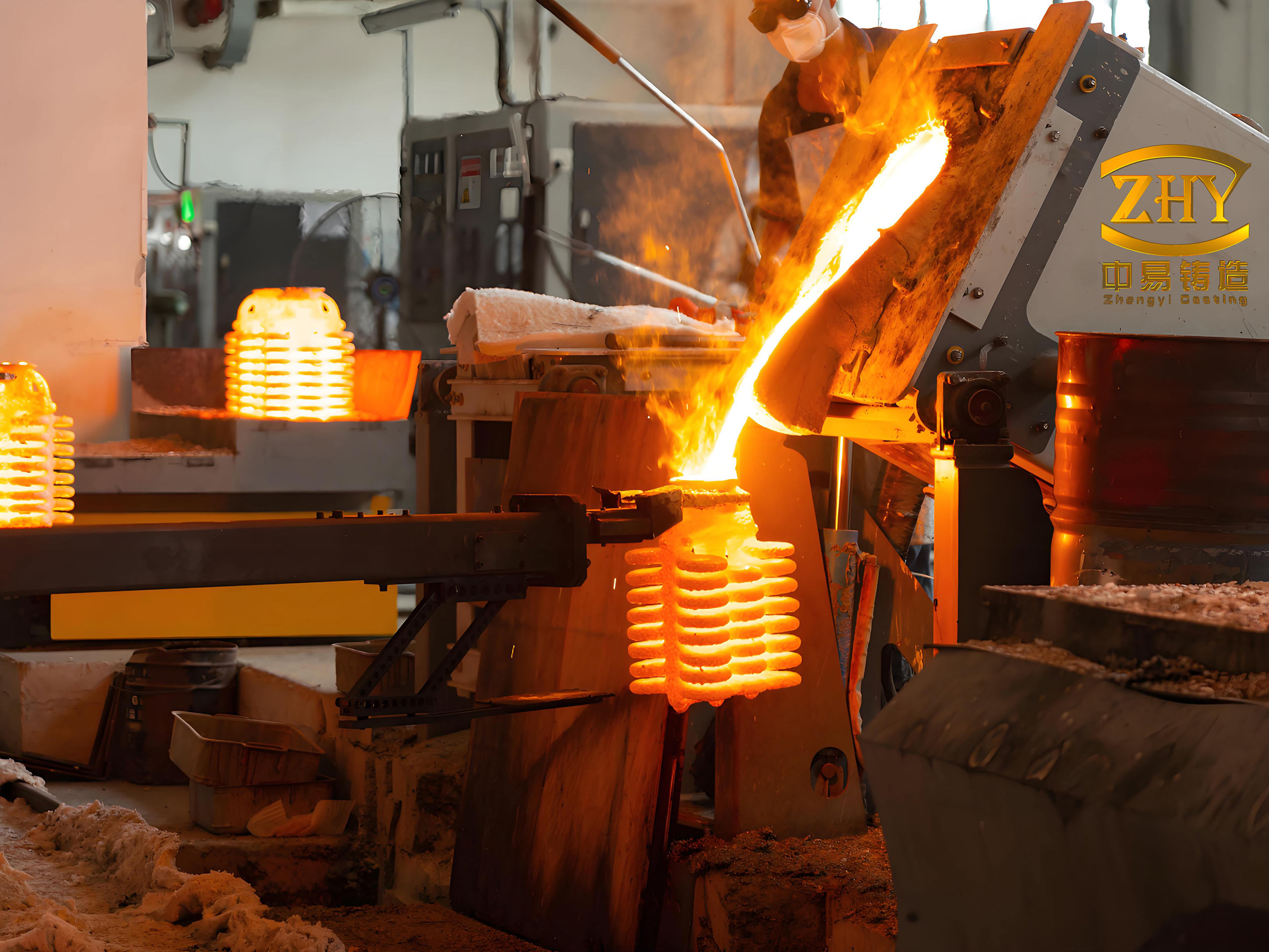
The formation mechanism of surface porosity in precision lost wax casting is multifaceted. It is fundamentally rooted in the solidification characteristics of the metal but is distinctly exacerbated by process-specific factors. While internal shrinkage porosity arises from inadequate feeding during the liquid-to-solid transition, surface porosity represents a case where this inadequacy is localized at or near the casting-mold interface. The primary driver is volumetric contraction during solidification. As dendritic networks form and interlock, isolated liquid pools are trapped, particularly in regions where thermal gradients are unfavorable for directional solidification towards the feeder. In precision lost wax casting, the use of high-strength, thermally insulating ceramic shells can sometimes lead to unfavorable thermal profiles in complex parts, reducing the temperature gradient ($\nabla T$) and promoting pasty or mushy zone solidification modes conducive to porosity. This can be described by the classic solidification time relationship, where the local solidification time $t_f$ is influenced by the modulus $m$:
$$ t_f \propto \frac{V}{A} = m $$
where $V$ is the volume of the section and $A$ is its surface area. A high modulus area (e.g., a hot spot or junction) solidifies slower, creating a sink for porosity if not properly fed. However, surface porosity in precision lost wax casting is not purely shrinkage; it is almost invariably associated with the entrapment of gases (e.g., hydrogen, nitrogen) and non-metallic inclusions. These act as nucleation sites for pore formation and worsen the situation by reducing the effective feeding capability of the remaining liquid. The presence of gases can be modeled by Sieverts’ Law for hydrogen solubility in steel, $[H] \propto \sqrt{P_{H_2}}$, where a drop in hydrogen partial pressure $P_{H_2}$ during solidification leads to gas precipitation. Furthermore, impurities with a higher wettability to the ceramic shell than the molten metal can adhere to the mold wall, creating barriers that impede liquid metal flow during the critical feeding stage, thereby fostering surface-connected porous regions.
Controlling surface porosity in precision lost wax casting requires a holistic approach targeting every stage of the process, from pattern assembly to melt treatment. Based on my practical work, the following strategies form the core of an effective control plan.
1. Controlled Solidification through Gating and Thermal Management
For intricate parts in precision lost wax casting, achieving perfect directional solidification is often impractical due to multiple thermal centers. The goal shifts towards creating a more favorable and uniform temperature field. This involves strategic gating design. We moved from concentrated gating to more open, distributed gating systems. This helps dissipate heat input more evenly, avoiding the creation of intense “suction zones” or localized low-pressure areas within the cavity during pouring that can draw in air or mold gases. The thermal profile can be approximated by the heat transfer equation through the shell:
$$ \frac{\partial T}{\partial t} = \alpha \nabla^2 T $$
where $\alpha$ is the thermal diffusivity. A thinner, more conductive shell promotes a steeper thermal gradient, favoring surface densification. Therefore, for large parts, we often pre-cool the ceramic shells to lower their initial temperature ($T_{shell}$), thereby increasing the initial chilling effect and the solidification rate at the surface.
2. Enhancement of Feeder Efficiency
A critical innovation in our precision lost wax casting practice was the immediate application of exothermic insulating powders to the feeder head after pouring, before a solidified skin forms. This practice serves two key functions: it significantly extends the feeder’s solidification time by providing supplemental heat, and more importantly, it keeps the shrinkage cavity in the feeder open to atmospheric pressure. This effectively adds approximately 0.1 MPa (1 atm) of additional feeding pressure to the system. The improved feeding pressure $\Delta P$ can be conceptualized as:
$$ \Delta P = \rho g h + P_{atm} $$
where $\rho$ is the molten metal density, $g$ is gravity, $h$ is the effective metallostatic height, and $P_{atm}$ is the atmospheric pressure harnessed by the open feeder. This simple yet powerful method markedly increased the feeding range and efficiency of our feeders in precision lost wax casting, directly reducing subsurface and surface porosity in adjacent casting sections.
3. Optimization of Ceramic Shell Quality
The ceramic shell is the very heart of the precision lost wax casting process. Its properties dictate the thermal and mechanical environment for solidification. We focused on developing shells with high high-temperature strength, uniform thickness, good permeability, and a smooth cavity surface. This involved moving to advanced binder systems like silica sol and ethyl silicate-based binders, which provide excellent ceramic bonding. For refractories, we shifted towards high-alumina materials such as bauxite or fused alumina instead of traditional silica flour. These materials offer better thermal conductivity (higher $k$ value in Fourier’s law, $q = -k \nabla T$), promoting faster heat extraction from the casting surface, which refines the grain structure and reduces the time available for pore formation. The shell’s role is summarized in the table below:
| Shell Property | Target for Porosity Control | Influence on Solidification |
|---|---|---|
| Thermal Conductivity (k) | High | Increases thermal gradient ($\nabla T$), promotes directional solidification. |
| High-Temperature Strength | High | Prevents mold wall movement, ensuring dimensional stability and consistent heat transfer. |
| Shell Thickness | Uniform & Optimal | Prevents local hot spots; thinner sections cool faster. |
| Surface Roughness | Low | Reduces friction for liquid metal flow, minimizes sites for inclusion adhesion. |
| Permeability | High | Allows gases generated during pouring to escape easily. |
4. Melt Purification and Treatment
The quality of the molten metal is paramount in precision lost wax casting. We implemented stringent melt handling protocols. All charge materials, especially rusty or oily scraps, were subjected to abrasive cleaning and pre-heating to remove moisture and volatiles. The refining period during melting was intensified to promote slag formation and removal. A strict deoxidation practice was followed, typically using a combination of aluminum and ferro-silicon to control oxygen activity, which is linked to inclusion formation. The use of a teapot-style ladle for pouring helped skim off slag. Perhaps most crucially, we instituted a practice of allowing the molten steel to “quiet” or settle in the ladle for a short period before pouring. This quiet period facilitates the flotation and removal of non-metallic inclusions based on Stokes’ law for particle rising velocity $v$:
$$ v = \frac{2 (\rho_m – \rho_p) g r^2}{9 \eta} $$
where $\rho_m$ and $\rho_p$ are the density of the melt and particle, $g$ is gravity, $r$ is the particle radius, and $\eta$ is the melt viscosity. Larger, lower-density inclusions rise and are trapped in the slag layer, leading to a cleaner melt less prone to initiating surface porosity in the final precision lost wax casting.
5. Selection of Casting Alloy with Favorable Solidification Characteristics
Within the constraints of mechanical property requirements, choosing an alloy with a narrower solidification temperature range ($\Delta T_s = T_{liquidus} – T_{solidus}$) can significantly reduce the susceptibility to pasty zone porosity. For the problematic Part 8-1, we evaluated alternative alloys and switched from ZG35Cr-MnSi to a grade with a modified composition, ZG20CrMnMo. The new alloy had a lower carbon and alloy content, which generally reduces the freezing range. The relationship between alloy composition and susceptibility to microporosity can be complex, but a simplified indicator is the “Casting Soundness Index,” often related to the ratio of specific elements. While proprietary, the principle is that alloys with shorter mushy zones solidify more directionally, improving feedability. This material change in our precision lost wax casting process resulted in a noticeable decrease in the incidence and severity of surface porosity indications.
6. Design of Optimal Fillet Radii
Geometric design details, often overlooked, play a critical role in precision lost wax casting. The radius at internal corners (fillet radii) must be optimized. Two common pitfalls exist: Firstly, a fillet radius that is too small at the junction of significantly differing wall thicknesses creates a severe hot spot and thermal stress concentration, making it a prime site for surface porosity formation. Secondly, an excessively large fillet radius at the junction of relatively uniform wall sections can inadvertently create a new, isolated thermal mass that also solidifies slowly and becomes difficult to feed. The optimal radius $R_{opt}$ can be empirically derived but is generally proportional to the average wall thickness of the joining sections. A useful guideline is:
$$ R_{opt} \approx k \cdot (t_1 + t_2)/2 $$
where $t_1$ and $t_2$ are the wall thicknesses, and $k$ is an empirical factor typically between 0.5 and 1.5, determined through simulation or trial for a specific precision lost wax casting geometry. Proper fillet design ensures smoother thermal transitions, promoting more uniform solidification and reducing the propensity for surface defects.
The interplay of all these factors in a precision lost wax casting operation can be quantitatively assessed using process windows. For instance, we can define a quality index $Q$ for surface soundness as a function of key variables:
$$ Q = f(T_{pour}, T_{shell}, \nabla T, [H], [O], m_{feed}) $$
where $T_{pour}$ is pouring temperature, $T_{shell}$ is mold preheat temperature, $\nabla T$ is the thermal gradient, $[H]$ and $[O]$ are hydrogen and oxygen content, and $m_{feed}$ is the feeder modulus. While deriving an explicit analytical function is challenging, response surface methodology based on designed experiments can map the region of optimal $Q$. The table below summarizes the primary control levers and their intended effects.
| Control Area | Specific Action in Precision Lost Wax Casting | Primary Mechanism for Porosity Reduction |
|---|---|---|
| Solidification Control | Distributed gating, shell pre-cooling. | Increases thermal gradient, directs solidification front. |
| Feeding Enhancement | Exothermic/insulating feeder covers. | Increases effective feeding pressure and time. |
| Shell Engineering | High-alumina refractories, silica sol binder. | Improves heat extraction and mold stability. |
| Melt Quality | Charge prep, deoxidation, ladle settling. | Reduces gas and inclusion content. |
| Alloy Selection | Choosing alloys with narrow freezing range. | Reduces width of mushy zone, improves feedability. |
| Geometric Design | Optimizing internal fillet radii. | Minimizes uncontrolled hot spots. |
In conclusion, mastering the control of surface porosity is essential for achieving high-integrity components through precision lost wax casting. It is not a challenge with a single solution but requires a systems-based approach that integrates thermal management, metallurgy, and ceramic engineering. From my first-hand experience, the synergistic application of controlled solidification via intelligent gating, the powerful yet simple technique of exothermic feeder topping, the relentless pursuit of superior shell quality, meticulous melt purification, judicious alloy selection, and careful attention to geometric details forms a comprehensive defense against this defect. Each precision lost wax casting project may present unique geometry-driven challenges, but the fundamental principles outlined here—rooted in the physics of solidification and the practical realities of foundry operations—provide a robust framework for diagnosis and remedy. The continuous refinement of these techniques ensures that precision lost wax casting remains a premier manufacturing method for producing complex, high-performance metal parts with exceptional surface quality and internal soundness.