
The production of as-cast, high-strength, and high-toughness ductile iron castings represents a significant advancement in foundry technology. By achieving the desired mechanical properties directly from the mold, the need for subsequent heat treatment is eliminated. This leads to substantial reductions in energy consumption, intermediate handling and transportation costs, and overall production lead time, thereby significantly enhancing product competitiveness. The challenge lies in simultaneously meeting the stringent requirements for both tensile strength (≥600 MPa) and elongation (≥10%) in the as-cast condition, a balance traditionally difficult to attain without thermal processing. Based on extensive practical experience, I will detail the comprehensive control methodology for producing as-cast QT600-10 grade ductile iron castings.
The fundamental principle guiding this process is that the mechanical properties of any casting alloy, including ductile iron, are determined by its microstructure. To achieve the target performance, one must control this microstructure, which in turn is governed by chemical composition, alloying, melting quality, spheroidization and inoculation treatments, casting wall thickness, and cooling conditions. For QT600-10, the objective is to obtain a matrix with a specific ratio of pearlite to ferrite, strengthened by strategic micro-alloying, to deliver the required combination of strength and ductility.
1. Strategic Selection of Chemical Composition
The chemical composition is the foundational blueprint for the final microstructure and properties of ductile iron castings. The target ranges are meticulously chosen based on the casting section thickness and the desired strengthening mechanism.
The base composition is critical. Carbon (C) is kept relatively high (3.6-3.8%) to improve fluidity, feeding characteristics, and graphitization potential. Silicon (Si) is controlled within a moderate range (2.5-2.8%); it is a potent ferritizer and solid solution strengthener, but excess silicon can embrittle the matrix. Manganese (Mn) is kept low (<0.3%) to minimize its segregation tendency to cell boundaries, which can promote carbides and reduce toughness. Phosphorus (P) and Sulfur (S) are strictly limited to low levels (<0.05% and <0.02% respectively) to avoid the formation of brittle phosphides and to ensure effective spheroidization.
The Carbon Equivalent (CE) is a crucial parameter for assessing the solidification behavior and is calculated as follows:
$$CE = \%C + \frac{\%Si + \%P}{3}$$
For these compositions, the CE is maintained in a moderate range, typically between 4.3 and 4.5, to avoid excessive undercooling and the risk of mottled or white iron structures, while ensuring good castability.
Micro-alloying with Copper (Cu) and Tin (Sn) is the key to achieving high strength in the as-cast condition. Copper (0.2-0.5%) is a strong pearlite promoter and provides solid solution strengthening without significantly affecting ductility at these levels. Tin (0.02-0.05%) is an even more potent pearlite stabilizer and is used judiciously, primarily in thicker sections, to counteract ferrite formation due to slower cooling. Excessive tin must be avoided as it can severely embrittle the matrix.
The following table summarizes the primary composition windows:
| Element | Target Range (wt.%) | Primary Function |
|---|---|---|
| C | 3.6 – 3.8 | Fluidity, Graphitization, CE control |
| Si | 2.5 – 2.8 | Ferritizer, Solid Solution Strengthener |
| Mn | < 0.3 | Kept low to preserve toughness |
| P | < 0.05 | Kept low to avoid brittle phosphides |
| S | < 0.02 | Kept low for effective spheroidization |
| Cu | 0.2 – 0.5 | Pearlite promoter, Solid Solution Strengthener |
| Sn | 0.02 – 0.05 | Potent Pearlite Stabilizer (for thick sections) |
2. Precise Melting and Alloying Practice
Consistent melting practice is non-negotiable for producing high-integrity ductile iron castings. A medium-frequency induction furnace is preferred for its excellent temperature control, stirring action, and atmospheric protection compared to cupolas.
Charge Materials: The use of high-purity raw materials is paramount. Pig iron should have low levels of trace elements (Ti, Pb, Bi, etc.) that interfere with graphite nodulization. Steel scrap should be clean, low in manganese (<0.3%), and free from rust and contaminants. Returns (gates, risers, scrap castings) should ideally be from the same grade to maintain compositional consistency and facilitate alloy recovery.
Alloy Addition Strategy: To ensure uniform distribution of alloying elements like Copper and Tin throughout the melt, they are added to the furnace charge early in the melting cycle. Since these elements have low oxidation losses, adding them to the furnace bottom guarantees maximum homogeneity. The base iron chemistry before treatment is aimed at “High Carbon, Low Silicon, Low Manganese, Sulfur, and Phosphorus,” typically targeting ~3.7% C and 1.1-1.5% Si, leaving room for the subsequent silicon additions from the spheroidizer and inoculant.
3. Spheroidization and Inoculation Treatment
This two-stage treatment is the heart of the process, transforming the flake graphite in the base iron into the spheroidal form essential for ductility, while simultaneously refining the matrix.
3.1 Spheroidizer Selection and Treatment: The choice of spheroidizing agent is tailored to the melt conditions. A low-rare-earth magnesium ferrosilicon alloy is typically used (e.g., FeSiMg6-8RE1-5). The exact rare-earth (RE) content is selected based on the sulfur level of the base iron:
- Base S > 0.03%: Use higher RE grade (e.g., FeSiMg8RE7) to counteract sulfur.
- Base S < 0.03%: Use medium RE grade (e.g., FeSiMg8RE5/3).
- Base S < 0.02% for thin-wall castings: Use low RE grade (e.g., FeSiMg6RE2/1).
The sandwich or open-ladle treatment method is commonly employed. The spheroidizer (1.0-1.2% of tap weight) with a controlled particle size (5-25 mm) is placed in a well at the bottom of the treatment ladle. It is covered with a portion of the inoculant (e.g., 0.4% of 75% FeSi, 3-8 mm) and then compacted with a steel plate to improve magnesium recovery. The ladle is filled rapidly, initiating a controlled reaction lasting 100-120 seconds. Immediately after reaction, slag coagulant is added to cover the surface, and the treated iron is quickly transferred to a pouring ladle to minimize magnesium fade and temperature loss. The total time from treatment to end of pouring should not exceed 8 minutes.
3.2 Inoculation Practice: Effective inoculation is critical for achieving a high nodule count, minimizing undercooling, preventing carbides (especially in thin sections), and ensuring a fine, uniform matrix. A double-inoculation technique is strongly recommended to combat inoculation fade:
- Primary Inoculation: The 0.4% FeSi placed over the spheroidizer acts as the primary inoculant during the treatment reaction.
- Post-Inoculation (Late Inoculation): As the iron is transferred from the treatment ladle to the pouring ladle, an additional 0.2-0.3% of fine-grade (1-3 mm) inoculant is added to the metal stream. This “late” addition provides fresh, active nuclei just before solidification, maximizing its effectiveness. For challenging thin sections, specialized long-lasting inoculants containing elements like Bismuth (Bi) or Barium (Ba) can be used to further suppress chill and carbides.
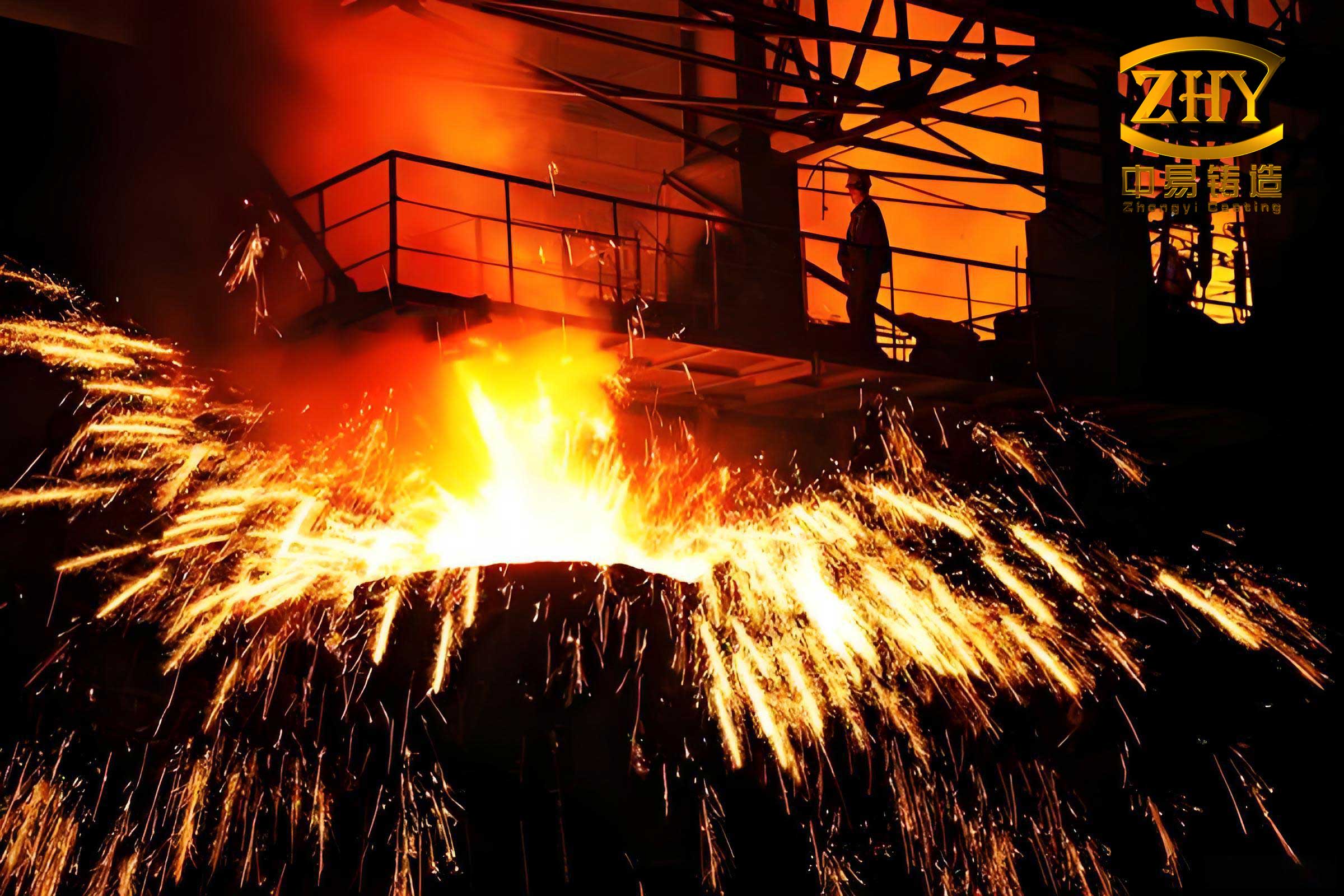
This careful control of the metallurgical treatments ensures a microstructure with well-formed, uniformly distributed graphite nodules, which is the prerequisite for developing the high-toughness aspect of these ductile iron castings.
4. Microstructure-Property Relationships and Control
The final as-cast properties of QT600-10 are a direct consequence of the meticulously controlled matrix structure. The matrix typically consists of a mixture of pearlite (providing strength) and ferrite (providing ductility). The goal is to achieve approximately 50-70% pearlite in a ferritic matrix, depending on the exact strength-elongation balance required.
Role of Alloying Elements:
- Copper and Tin: These are the primary agents for controlling pearlite fraction. They suppress the transformation of austenite to ferrite during cooling, stabilizing the pearlite. Their combined effect can be conceptually related to the pearlite fraction (Pf) as a function of alloy content and cooling rate (CR): $$P_f \propto f([Cu], [Sn], \frac{1}{CR})$$ Higher alloy content and slower cooling (thicker sections) promote higher pearlite fractions.
- Silicon: Beyond promoting ferrite, silicon dissolved in the ferritic matrix provides significant solid solution strengthening. The contribution of silicon to the yield strength (ΔσSi) of ferrite can be approximated by: $$Δσ_{Si} = K_{Si} \cdot (\%Si)^{n}$$ where KSi is a strengthening coefficient. This allows the ferrite phase itself to be strong, enabling high overall strength even with a significant ferrite fraction, which is key for achieving the 10% elongation.
The interaction of these elements in defining the final matrix is summarized below:
| Microstructural Feature | Controlling Factors | Effect on Properties |
|---|---|---|
| Graphite Nodules | Spheroidization (Mg, RE), Inoculation | High nodule count & count: Maximizes ductility and toughness. |
| Pearlite Fraction | Cu, Sn content; Cooling Rate (Section Size) | Increased fraction: Raises tensile strength, lowers elongation. |
| Ferrite Strength | Silicon Content (Solid Solution) | Increased Si: Raises yield & tensile strength of ferrite, helps maintain ductility. |
| Carbides | Low Mn, Effective Inoculation, Fast Cooling (thin walls) | Presence: Severely reduces machinability and ductility. Must be avoided. |
5. Tailored Strategies for Different Section Thicknesses
The cooling rate, dictated by casting wall thickness, has a profound impact on the as-cast microstructure. Therefore, the production strategy for ductile iron castings must be adapted accordingly. The following table outlines the modified approaches:
| Casting Type | Typical Wall Thickness | Key Composition Adjustments | Microstructure Goal & Rationale |
|---|---|---|---|
| Thin-Wall Castings | 6 – 12 mm | Lower Mn (0.15-0.20%). Cu: 0.2-0.5%. Sn: Generally omitted. | Fast cooling promotes pearlite naturally. Lower Mn avoids carbides. High inoculation is critical to suppress chill. Primary strength comes from fine pearlite and Si solid solution. |
| Thick-Wall Castings | 30 – 60 mm | Higher Mn acceptable (0.3-0.5%). Cu: 0.2-0.4%. Sn: 0.02-0.05% essential. | Slow cooling favors ferrite. Sn is crucial to counteract this and ensure sufficient pearlite fraction. Mn helps strengthen pearlite but is kept in check for toughness. |
| High-Si Solid Solution Strengthened | Thin to Medium | High Si (3.3-3.6%). Lower C (3.4-3.6%). No Cu/Sn. Very Low Mn (<0.2%). | Achieves QT600-10 properties primarily through a strong, high-silicon ferrite matrix with minimal pearlite. High Si also powerfully suppresses carbide formation during fast cooling of thin sections. |
The table below presents example chemical compositions for ductile iron castings with varying wall thicknesses, demonstrating the practical application of these strategies:
| Sample (Wall Thickness) | C (%) | Si (%) | Mn (%) | P (%) | Cu (%) | Sn (%) | S (%) |
|---|---|---|---|---|---|---|---|
| 1 (6 mm) | 3.52 | 2.50 | 0.15 | 0.036 | 0.25 | — | 0.016 |
| 2 (12 mm) | 3.55 | 2.60 | 0.35 | 0.035 | 0.50 | — | 0.015 |
| 3 (30 mm) | 3.53 | 2.68 | 0.30 | 0.035 | 0.20 | 0.020 | 0.016 |
| 4 (60 mm) | 3.60 | 2.80 | 0.50 | 0.037 | 0.40 | 0.049 | 0.013 |
| 5 (High-Si Type) | 3.45 | 3.55 | 0.18 | 0.034 | — | — | 0.014 |
6. Conclusion
The consistent production of as-cast QT600-10 ductile iron castings is a fully attainable goal through the integrated control of all process variables. The key lies in understanding and manipulating the factors that govern the as-cast microstructure: a balanced base composition, strategic micro-alloying with elements like copper and tin, the use of high-purity charge materials, precise and robust spheroidization and double-inoculation treatments, and tailoring the approach to the specific cooling conditions imposed by the casting geometry. The silicon solid solution strengthening mechanism provides a powerful alternative or complementary route, particularly for thin-section castings. By mastering this systematic control, foundries can reliably produce high-performance ductile iron castings that meet the demanding QT600-10 specifications directly from the mold, delivering significant economic and technical advantages.