
As a professional engaged in the research and development of chemical machinery, I have long been involved in the design and application of critical components for large-scale equipment. The chemical converter, a common reaction vessel in the chemical industry, relies on a robust support system. This system primarily consists of large-diameter rolling rings, which are ‘live-set’ on the rotary furnace shell, and the supporting wheels (or trunnions) that bear the entire weight of the furnace. The performance and interaction of these massive components—invariably manufactured as heavy steel castings—are paramount to operational reliability. However, persistent and sometimes severe wear issues in service, which appear inconsistently across different furnace sizes, have prompted a deep re-evaluation of the conventional design and material selection paradigms for these parts.
The design of such components has traditionally followed established specifications, such as the “Design Code for Chemical Rotary Kilns,” which provides foundational guidelines. These guidelines recommend specific grades of general engineering cast carbon steel, such as ZG 310-570 or ZG 340-640, for both supporting wheels and rolling rings. A key stipulation is that the hardness of the supporting wheel should exceed that of the rolling ring by approximately 30 to 40 HB. This is rationalized by the higher rotational speed and thus greater number of contact stress cycles experienced by the supporting wheel, demanding superior wear resistance. The standard provides allowable contact stresses and typical hardness ranges for various material pairings, as summarized below.
| Material Grade | Component | Typical Hardness (HB) | Allowable Contact Stress [σc] (MPa) |
|---|---|---|---|
| ZG 310-570 | Supporting Wheel | 170 | 375 |
| ZG 310-570 | Rolling Ring | 140 | |
| ZG 340-640 | Supporting Wheel | 190 | 400 |
| ZG 340-640 | Rolling Ring | 155 | |
| ZG 340-640 | Supporting Wheel | 210 | 450 |
| ZG 340-640 | Rolling Ring | 170 | |
| ZG 42CrMo | Supporting Wheel | 230 | 484 |
| ZG 42CrMo | Rolling Ring | 200 |
In practice, sizing is often done conservatively, increasing dimensions based on precedent when scaling up for larger furnaces. For instance, a Φ3.5×34m converter might use a ZG 340-640 supporting wheel paired with a ZG 310-570 rolling ring, while a larger Φ3.8×40m unit might use the same material pairing with larger dimensions. The contact stress is verified using the standard formula:
$$ \sigma_c = 0.0316 \sqrt{ \frac{q}{\pi(1 – \mu^2)} \cdot \frac{E_r E_t}{E_r + E_t} \cdot \frac{R_r + R_t}{R_r R_t} } \leq [\sigma_c] $$
Where \( q \) is the load per unit length on the rolling ring, \( \mu \) is Poisson’s ratio, \( E_r \) and \( E_t \) are the elastic moduli of the ring and wheel, and \( R_r \) and \( R_t \) are their radii.
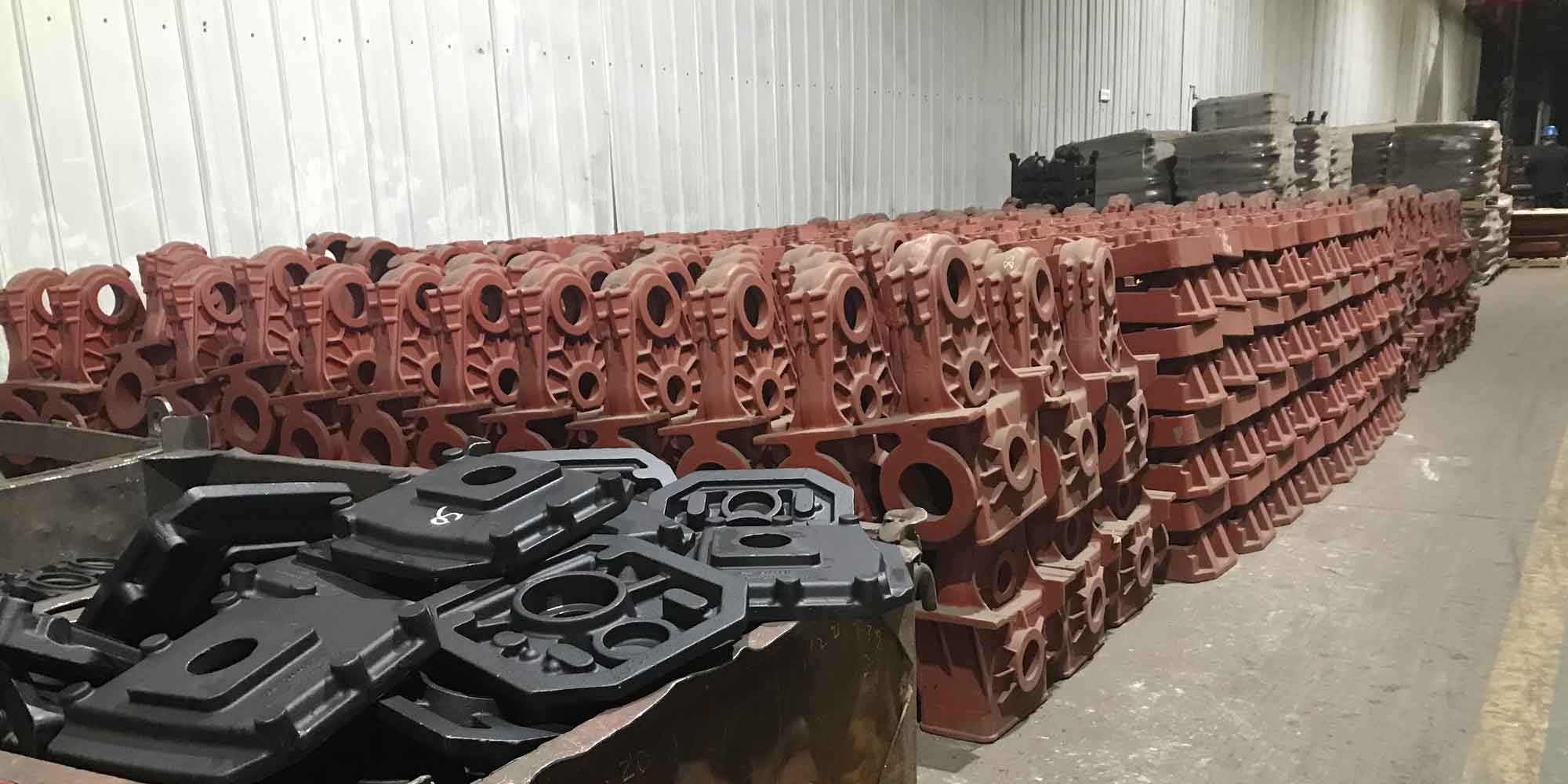
The manufacturing of these components is a specialized field of heavy steel casting. The process involves creating massive, defect-free castings that can withstand immense static and dynamic loads. After casting, components typically undergo normalizing heat treatment to achieve the specified hardness and microstructural properties. The challenge often lies not in the casting process itself, but in the precise control of final material properties to meet the nuanced demands of a wear application, which extends beyond basic mechanical strength.
Contrary to expectation, severe wear—manifesting as deep, ridged grooves up to 12 mm deep within months—was observed on the supporting wheels of some smaller (Φ3.5×34m) converters, while larger ones operated normally. This prompted a failure analysis ruling out common causes like excessive load (calculated stress was lower in the smaller unit), corrosion, overheating, or lubrication issues (graphite was used). Metallurgical investigation revealed a core controversy. The hardness of the failed supporting wheel (ZG 340-640), measured beneath the work-hardened surface layer, was only 170-180 HB. Its matching rolling ring (ZG 310-570) tested at ~198 HB. This inverted the critical hardness relationship. Examination of the chemical certificates and actual composition uncovered the root cause:
| Component (Material Spec.) | Element (wt.%) | Measured Value | Standard Max/Min for Spec. |
|---|---|---|---|
| Supporting Wheel (ZG 340-640) | C | 0.52 | ≤ 0.60 |
| Si | 0.40 | ≤ 0.60 | |
| Mn | 0.70 | ≤ 0.90 | |
| S | 0.02 | ≤ 0.035 | |
| P | 0.02 | ≤ 0.035 | |
| Rolling Ring (ZG 310-570) | C | 0.50 | ≤ 0.50 |
| Si | 0.41 | ≤ 0.60 | |
| Mn | 0.90 | ≤ 0.90 | |
| S | 0.02 | ≤ 0.035 | |
| P | 0.02 | ≤ 0.035 |
While chemically “conforming” to the broad limits of the general engineering cast carbon steel casting standard (GB/T 11352), the supporting wheel’s composition was tailored towards the lower bounds of carbon, silicon, and manganese to ostensibly improve castability and minimize defects. This resulted in a material whose hardenability and intrinsic wear resistance were inadequate, despite meeting the minimum tensile and yield strength requirements of the standard. The rolling ring, with a carbon content at the specification maximum and higher manganese, achieved better hardness after the same normalizing treatment. This case highlights a fundamental flaw: a general structural steel casting standard does not guarantee the specific performance needs of a wear-critical component. A part can be “certificate-conformant” yet functionally deficient, creating a significant technical and commercial controversy.
Addressing a severely worn supporting wheel required an effective repair strategy. Initial attempts using surface hard-facing with a Mn-containing wire (ER 60-G) were unsatisfactory. The resulting hardness was uneven (186-269 HB), the welded layer was thin after machining, and dimensional consistency with other supporting wheels could not be guaranteed, risking misalignment. The successful solution adopted was a “sleeve repair” method. The worn outer diameter of the existing ZG 340-640 steel casting was machined down to create an interference fit. A sleeve, manufactured not as a casting but as a forged ring from the superior alloy steel casting grade ZG 42Cr1Mo (equivalent to ZG 42CrMo), was heat-shrunk onto it. Forging ensures a more homogenous and defect-free structure, verifiable by ultrasonic testing. The sleeve was pre-machined, quenched, and tempered to a hardness of 235-265 HB. The design included locating steps and anti-rotation features like dowel pins and weld seams. This approach restored the precise diameter, ensured concentricity, and most importantly, provided a high-performance wear surface. After nearly a year of service, the wear on the sleeved wheel was minimal (<0.5 mm), and the corresponding rolling ring showed only uniform, slight wear, proving the repair’s success.
This experience leads to definitive design improvement recommendations. The primary recommendation is to upgrade the material specification for supporting wheels from general carbon steel castings to alloy steel castings governed by standards for large low-alloy steel castings (e.g., GB/T 6402). Specifically, ZG 42Cr1Mo should be the preferred choice. Its chemical composition is specified within tighter, more optimal ranges for hardenability and wear resistance, eliminating the ambiguity of the carbon steel grades.
| Material Grade | C (wt.%) | Si (wt.%) | Mn (wt.%) | Cr (wt.%) | Mo (wt.%) |
|---|---|---|---|---|---|
| ZG 42Cr1Mo | 0.38-0.45 | 0.30-0.60 | 0.60-1.00 | 0.80-1.20 | 0.15-0.25 |
Supporting wheels made from this material can be quenched and tempered (e.g., to 235-265 HB) for superior through-thickness properties. The rolling ring, due to its larger size and cost, can remain as a normalized ZG 310-570 or ZG 340-640 steel casting, but with its hardness range specified clearly below that of the supporting wheel (e.g., 175-210 HB for the ring vs. 235-265 HB for the wheel), ensuring a clear, non-overlapping hardness differential. A cost-effective alternative is to use a composite design: a main supporting wheel body of cheaper carbon steel casting for structural strength, with a thick (50-120 mm) outer ring sleeve of forged or cast ZG 42Cr1Mo to provide the wear-resistant running surface.
In conclusion, the wear performance of supporting wheels and rolling rings in chemical converters is not merely a function of design dimensions and generic hardness values. It is intrinsically linked to the specific metallurgical quality defined by the steel casting standard employed. The use of general engineering cast carbon steel grades, while historically common and cost-effective, introduces significant risk of performance shortfall due to permissible but sub-optimal chemical compositions. This creates a gap between conformance certification and functional adequacy. The proven repair method of sleeving with a high-grade alloy steel component and the subsequent design recommendation to specify low-alloy steel casting grades like ZG 42Cr1Mo for supporting wheels are direct responses to this identified technical controversy. This approach ensures definitive hardness control, superior wear resistance, and ultimately, greater reliability for these critical, heavy-duty components in demanding chemical processing applications.