
In the manganese steel casting foundry industry, the production of high-manganese steel castings is critical for wear-resistant applications, such as mining equipment, crusher parts, and railway components. However, cracks during manufacturing and service pose significant challenges, leading to high rejection rates and economic losses. As a foundry engineer with extensive experience, I have observed that understanding the root causes and implementing preventive measures is essential for producing high-quality castings. This article delves into the mechanisms behind crack formation in manganese steel castings, drawing from practical insights in the manganese steel casting foundry environment, and proposes comprehensive strategies to mitigate these issues. The discussion will cover structural, chemical, process, and thermal factors, supported by tables and formulas to enhance clarity and applicability.
The primary type of crack encountered in manganese steel castings is thermal cracking, which arises during solidification and cooling. The high free linear shrinkage of manganese steel, typically ranging from 2.4% to 3.0%, is a key contributor. This can be expressed as: $$\frac{\Delta L}{L_0} = 2.4\% \text{ to } 3.0\%$$ where $\Delta L$ is the change in length and $L_0$ is the original length. Compared to carbon steel, which has lower shrinkage values, this inherent property increases the susceptibility to hot tearing. Additionally, the low thermal conductivity of manganese steel, approximately one-fourth to one-sixth that of carbon steel, exacerbates thermal stresses. The thermal conductivity ratio can be represented as: $$\lambda_{\text{Mn steel}} = \left( \frac{1}{4} \text{ to } \frac{1}{6} \right) \lambda_{\text{carbon steel}}$$ where $\lambda$ denotes thermal conductivity. This low conductivity leads to significant temperature gradients within the casting, generating substantial thermal stresses that, when combined with shrinkage stresses, can initiate cracks. In a typical manganese steel casting foundry, these factors are often overlooked during initial design phases, resulting in defective parts.
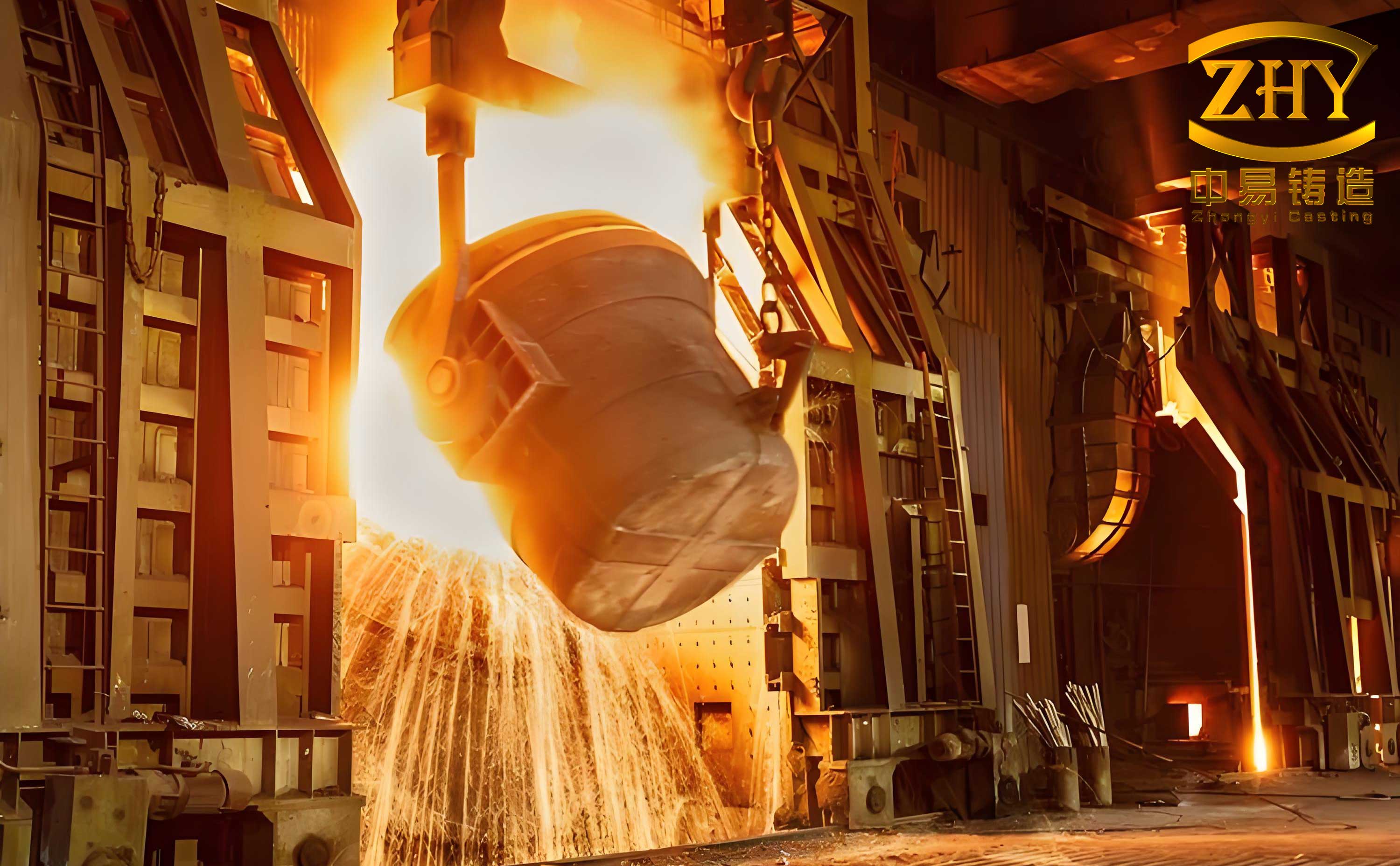
During solidification, the microstructure of manganese steel castings plays a pivotal role in crack formation. The alloy tends to form coarse grains and columnar crystals, which reduce mechanical strength. Moreover, brittle carbides precipitate along grain boundaries in the as-cast state, further embrittling the material. This creates an internal condition conducive to cracking. Stress concentration occurs at hot spots, such as sections with varying thickness, transition radii, and slow-solidifying areas, leading to initial fissures that may propagate inward. If these fissures are not filled by residual liquid metal, they evolve into permanent cracks. Internal cracks often accompany shrinkage porosity and voids, as dendritic solidification at these sites leaves intergranular spaces unfilled. Table 1 summarizes the key factors influencing crack formation during solidification in a manganese steel casting foundry:
| Factor | Description | Impact on Cracking |
|---|---|---|
| Grain Structure | Coarse grains and columnar crystals | Reduces strength, increases brittleness |
| Carbide Precipitation | Brittle carbides at grain boundaries | Lowers fracture toughness |
| Stress Concentration | Hot spots, uneven wall thickness | Initiates micro-cracks |
| Shrinkage Porosity | Voids from inadequate feeding | Provides sites for internal cracks |
| Surface Defects | Gas holes, slag inclusions | Leads to micro-cracks under stress |
In service, cracks in manganese steel castings often originate from pre-existing casting defects. For instance, shrinkage porosity or micro-shrinkage can act as stress raisers under impact loading, leading to crack initiation and fatigue propagation. Additionally, improper heat treatment can cause carbide precipitation along grain boundaries, while high phosphorus content promotes the formation of phosphide eutectics, both of which weaken grain boundaries. The relationship between phosphorus content and embrittlement can be described by the following empirical formula for crack susceptibility: $$CS = k_1 \cdot C_{\text{P}} + k_2 \cdot T_{\text{HT}}$$ where $CS$ is crack susceptibility, $C_{\text{P}}$ is phosphorus concentration, $T_{\text{HT}}$ is heat treatment temperature, and $k_1$, $k_2$ are material constants. In a manganese steel casting foundry, controlling these factors is crucial to ensure product reliability in demanding applications.
To prevent cracks, a holistic approach encompassing design, chemistry, and process control is essential. Starting with structural design, avoid abrupt changes in wall thickness and use generous fillet radii. For example, replacing cross-shaped sections with T-shaped designs can reduce stress concentration. In casting process design, mold and core退让性 (yieldability) are critical; rigid molds can hinder contraction and induce cracks. Gating system design should minimize obstruction to shrinkage—multiple ingates may cause cracking at junctions, so it’s advisable to use single ingates with risers for补缩 (feeding). Risers and chills are vital tools: side risers or knock-off risers are preferred over top risers to avoid cracking during removal, while chills help regulate solidification rates. However, improper chill placement, such as using bent chills or wide spacings, can lead to uneven cooling and cracks. Table 2 outlines preventive measures across different stages in a manganese steel casting foundry:
| Aspect | Measures | Rationale |
|---|---|---|
| Structural Design | Uniform wall thickness, large radii | Minimizes stress concentration |
| Casting Process | Yieldable molds, optimized gating | Reduces contraction resistance |
| Riser and Chill Use | Side risers, proper chill spacing | Ensures adequate feeding and cooling |
| Chemical Control | Limit carbon and phosphorus | Decreases brittleness |
| Melting Practice | Reduce FeO+MnO in slag | Prevents grain boundary oxidation |
| Pouring and Cooling | Control temperature, slow cooling | Lowers thermal stresses |
| Heat Treatment | Slow heating, proper soaking | Avoids thermal shock and carbide析出 |
Chemical composition is a cornerstone of crack prevention in manganese steel casting foundry practice. Carbon and phosphorus are particularly influential; higher carbon content increases crack propensity due to enhanced shrinkage and carbide formation. The effect of carbon on crack risk can be modeled as: $$R_{\text{crack}} = \alpha \cdot C_{\text{C}}^2 + \beta$$ where $R_{\text{crack}}$ is crack risk, $C_{\text{C}}$ is carbon percentage, and $\alpha$, $\beta$ are coefficients derived from empirical data. Phosphorus should be kept below 0.05% to avoid phosphide eutectics. During melting, slag control is vital—maintaining FeO+MnO levels below 1.2% minimizes oxide inclusions that embrittle grain boundaries. Pouring temperature and shakeout time also matter: excessive pouring temperatures coarsen grains, while early shakeout exposes castings to thermal shock. Recommended pouring temperatures range from 1420°C to 1480°C, with shakeout below 200°C to allow slow cooling in the mold.
Heat treatment processes in the manganese steel casting foundry must be meticulously controlled to prevent cracking. The heating phase is critical; castings should be charged into a furnace at a similar temperature to avoid thermal shock. A soaking period of 1 to 1.5 hours ensures uniform heating, followed by a slow heating rate below 650°C, typically not exceeding 50°C/h for complex castings. The temperature profile can be described by: $$T(t) = T_0 + \int_{0}^{t} r(\tau) d\tau$$ where $T(t)$ is temperature over time, $T_0$ is initial temperature, and $r(\tau)$ is heating rate. Rapid heating can induce stresses that surpass the material’s strength, leading to cracks. Furthermore, the solution treatment temperature, usually around 1050°C, must be maintained adequately to dissolve carbides, followed by rapid quenching in water to retain a tough austenitic matrix. Deviations from this protocol can result in residual carbides or thermal stresses, compromising integrity.
Beyond these measures, advanced techniques in the manganese steel casting foundry include simulation software for predicting solidification patterns and stress distributions. Using finite element analysis (FEA), engineers can model thermal gradients and shrinkage stresses to optimize designs before production. The governing equation for heat transfer during solidification is: $$\rho c_p \frac{\partial T}{\partial t} = \nabla \cdot (k \nabla T) + Q_{\text{latent}}$$ where $\rho$ is density, $c_p$ is specific heat, $k$ is thermal conductivity, $T$ is temperature, $t$ is time, and $Q_{\text{latent}}$ is latent heat release. Such tools help identify potential crack sites, allowing for proactive adjustments in riser placement, chill design, or gating layout. Additionally, non-destructive testing (NDT) methods like ultrasonic or radiographic inspection are employed to detect internal defects early, reducing the likelihood of in-service failures. In my experience, integrating these technologies into the manganese steel casting foundry workflow significantly enhances quality control.
The economic implications of crack prevention cannot be overstated in the manganese steel casting foundry sector. Rejected castings due to cracks lead to material waste, energy loss, and delayed deliveries. By implementing the strategies discussed, foundries can improve yield rates and customer satisfaction. For instance, a case study from a production run showed that optimizing chemical composition and heat treatment reduced crack incidence by over 30%. The cost savings can be estimated using: $$S = N \cdot (C_{\text{mat}} + C_{\text{proc}}) \cdot R_{\text{red}}$$ where $S$ is savings, $N$ is number of castings, $C_{\text{mat}}$ is material cost per casting, $C_{\text{proc}}$ is processing cost, and $R_{\text{red}}$ is reduction in rejection rate. This highlights the tangible benefits of a rigorous approach to crack mitigation.
In conclusion, cracks in manganese steel castings stem from a complex interplay of material properties, design flaws, and process variables. In the manganese steel casting foundry, addressing these requires a multifaceted strategy: optimizing structural design to minimize stress raisers, controlling化学成分 to reduce brittleness, refining铸造工艺 to ensure proper feeding and cooling, and executing precise heat treatment to avoid thermal stresses. Through continuous improvement and adoption of modern technologies, foundries can produce high-integrity castings that meet the demands of abrasive and impact environments. As the industry evolves, ongoing research into alloy modifications and process innovations will further enhance crack resistance, solidifying the role of manganese steel casting foundry operations in manufacturing durable components. By prioritizing these principles, we can transform challenges into opportunities for excellence in casting production.