
In the production of thick and complex high manganese steel castings, the occurrence of micro-cracks poses a significant challenge to product quality and service life. This article investigates the root causes of these cracks, focusing on the role of inclusions, carbides, and elemental segregation. Through microstructural analysis and thermodynamic calculations, we identify key factors contributing to crack initiation and propagation. The findings provide a foundation for improving manufacturing processes and enhancing the performance of high manganese steel casting components in demanding applications.
High manganese steel, particularly ZGMn13, is renowned for its exceptional wear resistance under impact loading, making it ideal for mining, railway, and military equipment. However, its high linear shrinkage (2.4%–3%) and low thermal conductivity (one-fourth to one-sixth that of carbon steel) lead to substantial thermal stresses during solidification and heat treatment. These stresses, combined with microstructural inhomogeneities, often result in crack formation in thick-section castings exceeding 120 mm. This study examines the mechanisms behind these cracks and proposes mitigation strategies.
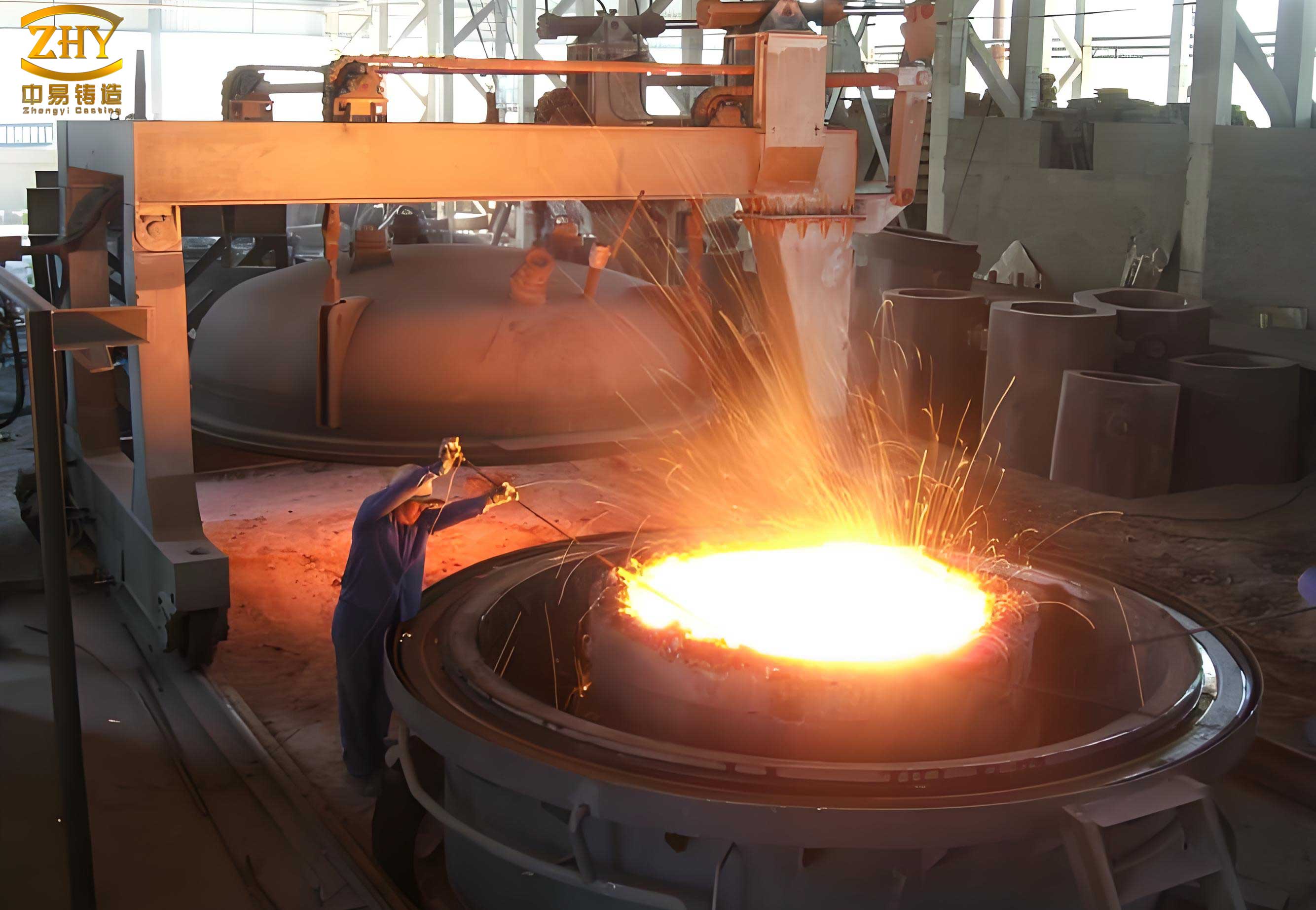
The chemical composition of the high manganese steel casting under investigation is critical to understanding crack susceptibility. Standard ZGMn13 compositions, as per GB/T 5680-1998, include carbon (0.90%–1.30%), silicon (0.30%–0.80%), manganese (11.0%–14.0%), and controlled levels of phosphorus (≤0.040%) and sulfur (≤0.070%). In our analysis, the actual composition was measured, revealing slight variations that influence phase formation. The equilibrium phase diagram for the Fe-Mn-C system can be described using thermodynamic models. For instance, the effect of carbon and manganese on austenite stability and carbide precipitation is governed by equations such as:
$$ \gamma \rightarrow \gamma + M_3C \quad \text{at lower temperatures} $$
where \( M_3C \) represents cementite-type carbides enriched with manganese and iron. The carbon equivalent (CE) for high manganese steel casting can be approximated as:
$$ \text{CE} = \%C + \frac{\%Mn}{6} + \frac{\%Mo}{4} $$
This CE value influences the tendency for carbide formation and crack initiation. Table 1 summarizes the typical composition ranges and observed values in problematic castings.
| Element | Standard Range | Observed Value |
|---|---|---|
| C | 0.90–1.30 | 0.98 |
| Si | 0.30–0.80 | 0.59 |
| Mn | 11.0–14.0 | 13.42 |
| P | ≤0.040 | 0.036 |
| S | ≤0.070 | 0.005 |
| Mo | — | 0.92 |
| Fe | Balance | Balance |
Micro-cracks in high manganese steel casting predominantly propagate along grain boundaries, where stress concentrations are amplified by brittle phases. The solidification process involves complex thermal gradients, leading to tensile stresses that exceed the cohesive strength of weakened boundaries. The following sections delve into specific microstructural features that exacerbate this issue.
Role of Inclusions in Crack Initiation
Inclusions, such as oxides and nitrides, act as stress concentrators in high manganese steel casting. During melting and pouring, oxidation reactions produce non-metallic particles that segregate to grain boundaries. Common inclusions include spherical Al₂O₃, complex oxides containing Al, Mg, and Cr, TiN, and minor MnS. These inclusions exhibit poor adhesion to the matrix, creating micro-voids under tensile stress. The stress intensity factor \( K_I \) near an inclusion can be expressed as:
$$ K_I = \sigma \sqrt{\pi a} $$
where \( \sigma \) is the applied stress and \( a \) is the inclusion size. Larger or irregularly shaped inclusions significantly reduce fracture toughness. Energy-dispersive X-ray spectroscopy (EDS) analysis of crack-adjacent regions reveals high oxygen and nitrogen content, confirming the presence of these detrimental phases. For instance, the volume fraction of inclusions \( V_f \) correlates with crack density \( \rho_c \) as:
$$ \rho_c = k \cdot V_f^{2/3} $$
where \( k \) is a material constant. Minimizing inclusion content through improved melting practices, such as vacuum degassing, is essential for enhancing the integrity of high manganese steel casting.
Carbide Precipitation and Its Impact
Carbides in high manganese steel casting form as M₃C-type phases, often enriched with manganese and molybdenum. Their morphology—ranging from blocky to needle-like—depends on cooling rates. Slow cooling promotes coarse, continuous networks along grain boundaries, while faster cooling results in finer, isolated particles. The driving force for carbide nucleation \( \Delta G \) is given by:
$$ \Delta G = \frac{16\pi \gamma^3}{3(\Delta G_v)^2} $$
where \( \gamma \) is the interfacial energy and \( \Delta G_v \) is the volume free energy change. Carbon and manganese segregation during solidification leads to localized enrichment, facilitating carbide growth. Table 2 outlines the characteristics of different carbide morphologies observed in high manganese steel casting.
| Morphology | Size (μm) | Fe/Mn Ratio | Common Locations |
|---|---|---|---|
| Blocky | ~10 | 2.2 | Grain boundaries |
| Needle-like | ~5 (width), ~30 (length) | 3.4–3.6 | Interdendritic regions |
| Chain-like | <2 | 4.7–4.8 | Throughout matrix |
Continuous carbide networks embrittle grain boundaries, reducing ductility and toughness. Under tensile stress, micro-cracks initiate at these sites and propagate rapidly. Heat treatment, such as solution annealing at 1050°C, can dissolve carbides, but improper cooling may lead to re-precipitation. The kinetics of carbide dissolution follow the Arrhenius equation:
$$ k = A \exp\left(-\frac{Q}{RT}\right) $$
where \( Q \) is the activation energy, \( R \) is the gas constant, and \( T \) is temperature. Optimizing heat treatment parameters is crucial for minimizing carbide-related cracks in high manganese steel casting.
Phosphorus Segregation and Low-Melting-Point Eutectics
Phosphorus, even at low concentrations (e.g., 0.036 wt%), severely impacts high manganese steel casting by forming low-melting-point eutectics like Fe-Fe₃P (melting point ~1005°C) and Fe-Fe₃C-Fe₃P (melting point ~950°C). During solidification, phosphorus segregates to grain boundaries due to its low solubility in austenite. The segregation coefficient \( k_P \) is defined as:
$$ k_P = \frac{C_s}{C_l} $$
where \( C_s \) and \( C_l \) are solid and liquid concentrations, respectively. Values of \( k_P < 1 \) indicate boundary enrichment. The resulting eutectics melt during heat treatment, creating liquid films that weaken grain boundaries. The stress required for crack initiation \( \sigma_c \) is reduced as:
$$ \sigma_c = \sigma_0 – \alpha \cdot \%P $$
where \( \sigma_0 \) is the base strength and \( \alpha \) is a constant. Micro-cracks associated with phosphorus eutectics often exhibit networked patterns, exacerbating failure risks. Controlling phosphorus levels through raw material selection and rapid cooling is vital for high manganese steel casting integrity.
Improvement Strategies for High Manganese Steel Casting
To mitigate cracks in high manganese steel casting, several measures are recommended. First, optimize chemical composition: maintain carbon at 1.15%–1.20% and manganese around 13% to balance austenite stability and carbide formation. Second, enhance melting and pouring practices to reduce inclusions—employ vacuum refining and filter systems. Third, adjust heat treatment: solution anneal at 1050°C–1100°C with sufficient holding time, followed by controlled cooling to prevent carbide re-precipitation. The critical cooling rate \( \dot{T}_c \) to avoid brittle phases is:
$$ \dot{T}_c = \frac{T_s – T_e}{t_c} $$
where \( T_s \) is the solution temperature, \( T_e \) is the eutectoid temperature, and \( t_c \) is the critical time. Fourth, implement rapid solidification techniques, such as chills or mold coatings, to minimize segregation. Finally, micro-alloying with elements like titanium or boron can refine grain structures and suppress phosphorus segregation. These strategies collectively enhance the performance and reliability of high manganese steel casting components.
Conclusion
The formation of micro-cracks in thick and complex high manganese steel casting is primarily driven by tensile stresses during solidification, amplified by inclusions, carbides, and phosphorus eutectics at grain boundaries. Through detailed microstructural analysis and thermodynamic modeling, we have identified key contributors to crack initiation. By controlling composition, optimizing thermal processes, and reducing impurity levels, manufacturers can significantly improve the quality and durability of high manganese steel casting products. Future work should focus on real-time monitoring and advanced simulation to predict crack susceptibility in diverse casting geometries.