
In my extensive experience with high-performance hydraulic systems, the plunger pump stands as a critical component, responsible for generating the necessary flow and pressure. The core of this pump is its aluminum alloy housing—a complex shell casting whose integrity is paramount. The production of these shell castings presents a significant challenge. They must possess excellent mechanical properties, maintain dimensional precision under stringent tolerances, and be completely free from internal discontinuities such as shrinkage porosity and gas holes, which are often detected via 100% real-time radiography. This narrative details a first-hand journey of analyzing persistent defects in a specific plunger pump shell and developing an optimized casting process that ultimately resolved these issues.
The subject shell casting is produced from ZL101 aluminum alloy (a near-equivalent to A356) in the T5 heat-treated condition. Its geometry is inherently challenging for foundry practice. The component features a central, thin-walled barrel section with a nominal thickness of only 6 mm, flanked by two massive, bulky ends. One end is a thick fluid port interface, while the opposite end is a large flange featuring three substantial mounting bosses. This configuration creates a stark thermal contrast: the ends act as heavy thermal masses, while the center cools rapidly. The key specifications of this shell casting are summarized below.
| Parameter | Specification |
|---|---|
| Alloy | ZL101 (Al-Si-Mg) |
| Heat Treatment | T5 (Solutionized & Artificially Aged) |
| Approximate Mass | 16 kg |
| Overall Dimensions | ~Ø180 mm x 177 mm |
| Critical Wall Thickness | Min: 6 mm, Max: 55 mm, Avg: ~15 mm |
| Quality Requirement | Porosity Level 2, No shrinkage/gas defects per radiography. |
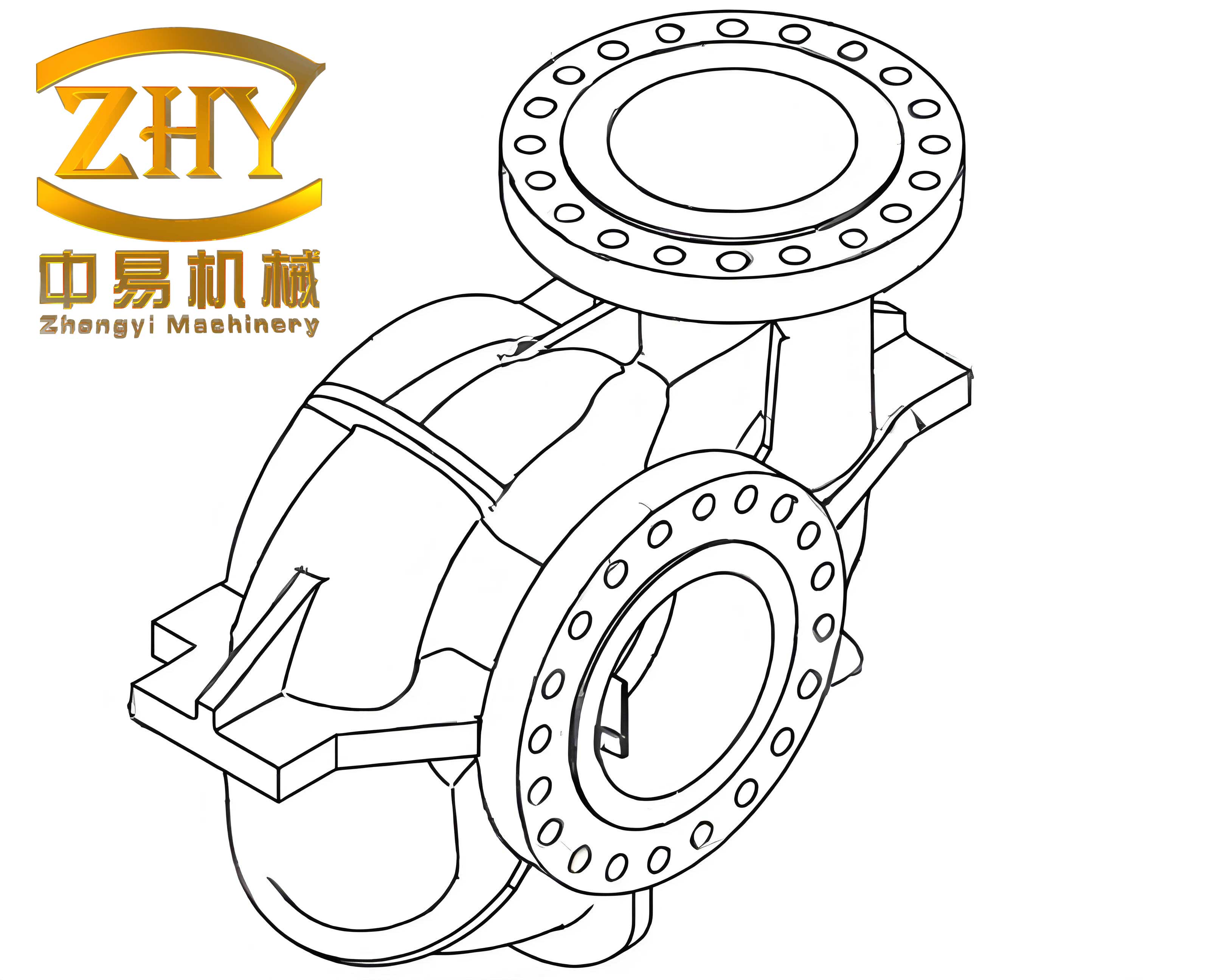
The initial production process employed a tilt-pour permanent mold (metal die) technique, which is generally well-suited for producing high-integrity aluminum shell castings. The original gating and feeding strategy was designed based on the principle of directional solidification towards a major feeder. Recognizing the fluid port end as the heaviest section, it was placed at the top of the tilted mold, acting as the main feeding point. On the lower flange end, the three thick bosses were each fitted with a horizontal blind feeder (side riser) coated with an insulating wash to enhance their efficiency. The pouring temperature was maintained between 710°C and 730°C, with a mold preheat of 280-300°C, and a controlled tilt-pour time of approximately 11 seconds.
Despite this seemingly logical setup, the yield rate for sound shell castings was dismally low, falling below 35%. Non-destructive testing, primarily computed tomography (CT), revealed a consistent pattern of defects. The dominant failure mode, accounting for over 68% of rejections, was shrinkage porosity concentrated in the three massive bosses on the flange face. The secondary issue, responsible for more than 25% of scrap, was the presence of dispersed gas porosity within the thin-walled barrel and other sections.
A root-cause analysis was conducted. For the shrinkage defects in the bosses, the problem was identified as premature isolation of these hot spots. Although horizontal feeders were attached, the geometry of the mold and machining allowances restricted their size and placement. Crucially, the solidification time of the boss itself ($t_{boss}$) was calculated to be longer than the solidification time at the neck of the horizontal feeder ($t_{neck}$). This meant the feeding path froze shut before the boss itself had fully solidified, trapping liquid metal that subsequently shrank and formed porosity. This can be conceptually framed by the condition for successful feeding:
$$ t_{boss} > t_{neck} + t_{feed} $$
where $t_{feed}$ is the effective feeding time. In the original design, $t_{neck}$ was too short relative to $t_{boss}$, making $t_{feed}$ effectively zero and violating the condition.
The gas porosity was attributed to turbulent mold filling. The original gating, entering at the thick port end, involved a relatively small ingate area filling a large, complex cavity. This combination, especially during the tilt-pour sequence, promoted turbulent flow, leading to air entrainment and the formation of gas pores upon solidification. The thin walls of the central shell section were particularly susceptible to this defect.
| Defect Type | Primary Location | Estimated Rejection Rate | Root Cause |
|---|---|---|---|
| Shrinkage Porosity | Flange Bosses | ~68% | Premature freezing of feeding channels; insufficient feeder efficiency. |
| Gas Porosity | Thin-wall Barrel & General | ~25% | Turbulent mold filling causing air entrainment. |
| Other (Cracks, etc.) | N/A | ~7% | Secondary factors. |
To overcome these challenges, a comprehensive redesign of the process for these critical shell castings was undertaken. The guiding principles were to enforce a more robust directional solidification pattern and to achieve a quiescent, laminar mold fill.
1. Reorientation and Gating: The entire casting orientation was reversed. The flange face, with its three problematic bosses, was positioned at the very top of the mold cavity. The thick fluid port end was placed at the bottom. This reorientation provided two major benefits: it allowed the use of large, open-top feeders on the flange bosses, and it offered a wider, calmer section of the mold cavity for introducing the metal. A new gating system was designed to fill the mold from a broader front along the simpler bottom section, promoting a more progressive and tranquil rise of the metal, thereby minimizing turbulence and air entrainment.
2. Redesigned Feeding System: The feeding strategy was completely overhauled to create a hierarchical and interconnected solidification sequence.
- Top Feeders (Flange): Substantial open-top feeders were placed directly on the three flange bosses. Their large volume and exposed top surface provided significant thermal mass and atmospheric pressure assist for effective feeding.
- Bottom Feeder (Port End): The thick port end at the bottom contained several isolated hot spots. A central blind feeder was strategically placed within the core to feed these areas. This internal feeder acts similarly to an exothermic sleeve, maintaining a liquid reservoir at the heart of this heavy section.
- Interconnected Feeding Channels: Critically, to link the solidification of the central thin-walled section to the feeding system, two vertical “padding” or “wash” channels were designed into the side walls of the barrel. These channels provided thermal and material pathways, ensuring the thin walls solidified directionally towards the bottom blind feeder and the top open feeders, preventing isolated hot spots in the shell structure itself.
This system aims to create a solidification gradient where the thin walls solidify first, followed by the heavier sections, with the liquid metal in the feeders remaining molten longest to compensate for solidification shrinkage throughout the shell casting. The effectiveness of a feeder can be related to its modulus (Volume/Surface Area ratio, $M=V/A$). A feeder must have a larger modulus than the section it feeds ($M_{feeder} > k \cdot M_{casting}$), where $k$ is a factor accounting for alloy shrinkage and feeder efficiency. The new design maximized the modulus of the top feeders and ensured the bottom feeder was thermally efficient.
Prior to committing to tooling modifications, the optimized process for the shell casting was rigorously analyzed using AnyCasting simulation software. The goal was to visualize filling behavior, predict solidification patterns, and locate potential shrinkage defects. The simulation parameters mirrored the planned production conditions.
| Simulation Parameter | Value |
|---|---|
| Pouring Temperature | 720 °C |
| Mold Preheat Temperature | 280 °C |
| Coating Thickness | 500 µm |
| Filling Time (Tilt-Pour) | 11 s |
The filling analysis confirmed a much smoother metal front advancement compared to the original scheme, with significantly reduced velocity and turbulence, thereby mitigating the risk of gas defects in the final shell castings. The core of the analysis lay in the solidification simulation.
The temperature field results clearly demonstrated the intended directional solidification. The coolest regions (blue) were the thin walls and edges, solidifying first. The hottest regions (red/yellow) were concentrated in the large open feeders on the flange and the internal blind feeder at the port end, confirming they were the last to solidify. The solid fraction analysis over time showed a progressive movement of the liquidus front from the casting extremities toward these feeders. The critical Niyama criterion (a derivative function of temperature gradient $G$ and cooling rate $R$, often expressed as $G/\sqrt{R}$), commonly used to predict shrinkage porosity, was calculated. The simulation results indicated that areas with a low Niyama value—signifying a high risk of microporosity—were almost entirely confined within the feeder heads themselves, not in the functional body of the shell casting. The total simulated solidification time was approximately 4 minutes, providing a benchmark for the process.
The optimized process for the plunger pump shell castings was put into production. An initial batch of 30 castings was poured. Every shell casting from this batch was subjected to real-time radiography, with particular scrutiny on the previously problematic flange bosses and the thin-walled central barrel.
The results were decisive. Radiographic inspection revealed no detectable shrinkage porosity in the flange bosses or any other part of the casting body. Surface inspection after shot blasting showed no evidence of subsurface gas blowholes or pinholes. After machining, only 2 castings from the batch were scrapped for reasons unrelated to the original shrinkage and gas defects (e.g., minor handling damage), resulting in a first-pass yield of 93.3%. This marked a dramatic improvement over the previous sub-35% yield.
| Process Stage | Quantity Produced | Quantity Accepted | Yield Rate | Primary Improvement |
|---|---|---|---|---|
| Original Process | 163 | 54 | ~33.1% | Baseline |
| Optimized Process | 30 | 28 | ~93.3% | Elimination of shrinkage & gas defects in shell castings. |
This case study underscores several critical principles in the manufacture of complex, high-integrity aluminum shell castings like those used in plunger pumps. First, a meticulous analysis of defect root cause is essential—distinguishing between shrinkage from inadequate feeding and porosity from turbulent filling. Second, the strategic use of padding or wash channels to connect thin and thick sections is a powerful tool for enforcing directional solidification in shell geometries that are not naturally progressive. Third, while horizontal side feeders have their place, their effectiveness for feeding isolated heavy sections on shell castings can be limited by geometry; top feeders often provide superior thermal and pressure conditions. Fourth, internal blind feeders situated within the core of a heavy section of a shell casting function exceptionally well as they are surrounded by hot metal, akin to a chunky insulated or exothermic sleeve. Finally, the integration of numerical simulation tools like AnyCasting provides invaluable foresight, allowing for the virtual testing and refinement of gating and feeding systems before incurring the cost of tooling changes, thereby de-risking the production of critical shell castings. The successful resolution of this issue confirms that through systematic analysis, innovative process design, and modern simulation validation, even the most stubborn casting defects in demanding aluminum components can be eliminated.