
In my experience working with complex thin-walled shell castings, such as those used in automotive components, I have encountered numerous challenges related to casting defects. Shell castings, due to their intricate internal geometries and performance requirements, demand precise process control to achieve high-quality outcomes. This article delves into the common defects found in shell castings, specifically focusing on porosity, sand inclusions, and core fractures, and outlines practical improvements based on firsthand analysis and implementation. The goal is to share insights that can enhance the production efficiency and reliability of shell castings in industrial applications.
Shell castings, like clutch housings or engine blocks, are critical in machinery where structural integrity and leak-proof performance are paramount. These components often feature thin walls, complex cores, and stringent quality checks, making defect prevention a key focus. In my work, I have observed that defects primarily arise from inadequate gating systems, improper venting, and core design flaws. Through systematic analysis and process modifications, significant improvements can be made, as demonstrated in the following sections.
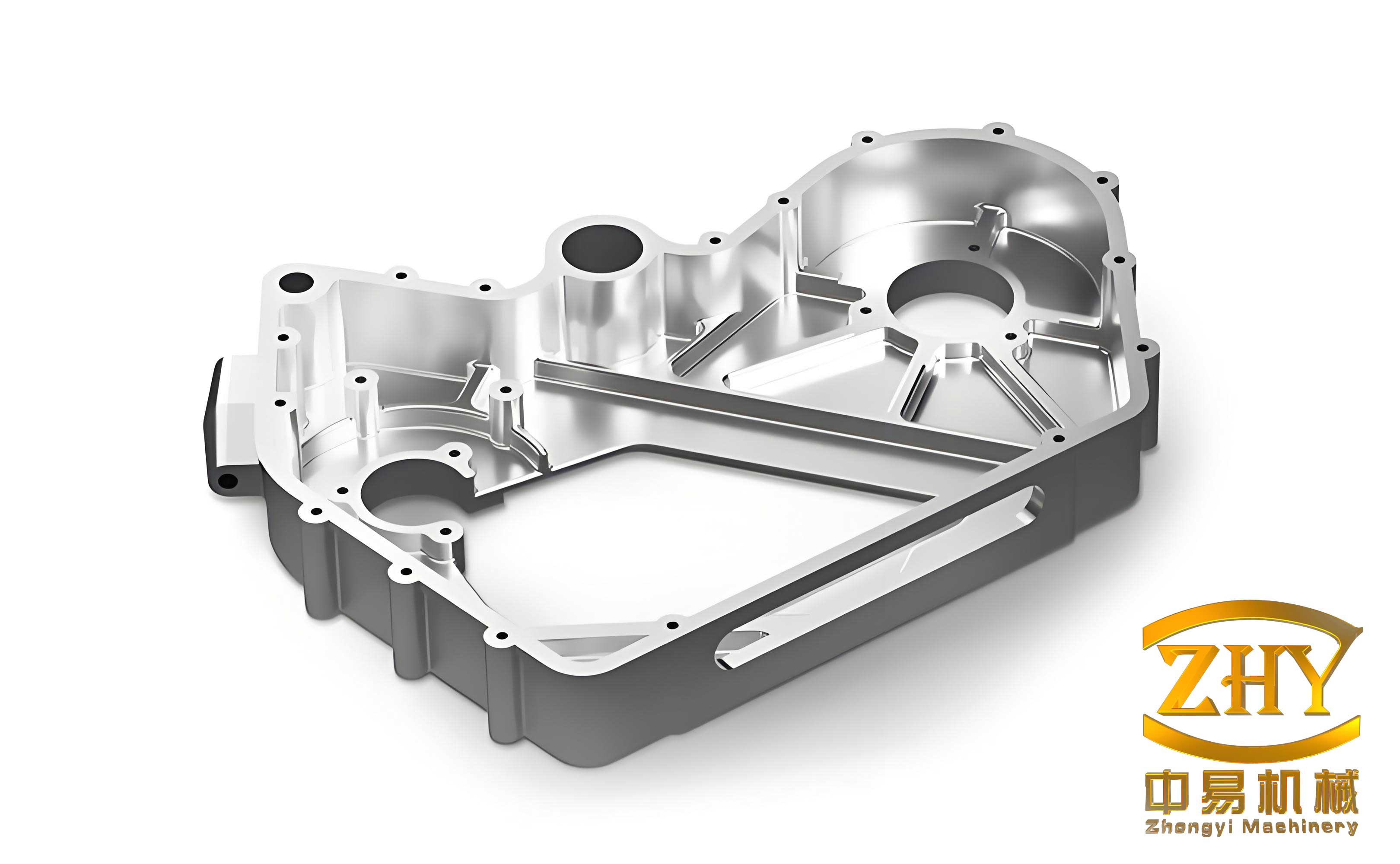
One of the most prevalent issues in shell castings is porosity, particularly gas porosity. This defect typically occurs when gases from sand cores or molds become trapped in the molten metal during solidification. For shell castings produced using resin-coated sand cores, the high gas evolution rate can lead to invasive porosity if not properly managed. From my analysis, the gas pressure buildup in the mold cavity can be modeled using the ideal gas law, which relates pressure, volume, and temperature:
$$ P V = n R T $$
Here, \(P\) represents the gas pressure, \(V\) the volume of the cavity, \(n\) the number of moles of gas, \(R\) the gas constant, and \(T\) the temperature. During pouring, the temperature \(T\) increases, causing gas expansion. If venting is insufficient, the pressure \(P\) rises, forcing gas into the metal. To mitigate this, adequate venting channels must be designed. For instance, in a multi-cavity mold for shell castings, each core should have dedicated vents to ensure timely gas escape. The cross-sectional area of vents can be calculated based on the gas generation rate, which depends on core material properties. A simplified formula for required vent area \(A_v\) is:
$$ A_v = \frac{Q_g}{v_g} $$
where \(Q_g\) is the gas flow rate and \(v_g\) is the allowable gas velocity. In practice, for shell castings, I have found that increasing vent areas by 20-30% significantly reduces porosity.
Another critical defect in shell castings is sand inclusion, where sand particles from the mold or core erode and become embedded in the casting. This often happens in areas with low mold hardness or turbulent metal flow. For wet sand molding processes, such as air-impulse molding, the compactness of sand near mold walls can be uneven, leading to weak spots. The erosion resistance of sand can be related to its compressive strength \(\sigma_c\), which for green sand is a function of moisture content and clay percentage. An empirical relation is:
$$ \sigma_c = k \cdot M^a \cdot C^b $$
with \(k\), \(a\), and \(b\) as constants, \(M\) as moisture content, and \(C\) as clay content. In shell castings, areas like flange edges are prone to sand wash due to high metal velocity. To address this, I modified core designs to form these surfaces using cores instead of mold sand, as cores typically have higher hardness and erosion resistance. This approach aligns with improving the overall integrity of shell castings.
Core fracture is a third major defect, especially in shell castings with elongated or cantilevered cores. When cores lack sufficient strength, they can break under the buoyant force of molten metal. The buoyant force \(F_b\) acting on a core is given by Archimedes’ principle:
$$ F_b = \rho_m \cdot g \cdot V_c – \rho_c \cdot g \cdot V_c $$
where \(\rho_m\) is the metal density, \(\rho_c\) is the core density, \(g\) is gravity, and \(V_c\) is the core volume. For shell castings, using resin-coated sand cores, the core strength \(\sigma_s\) must exceed the stress from \(F_b\). Core strength can be enhanced by adding internal reinforcements, such as iron core bones. The stress \(\sigma\) on a core print is:
$$ \sigma = \frac{F_b}{A_p} $$
with \(A_p\) as the print area. By increasing \(A_p\) or adding reinforcements, core fractures can be prevented, ensuring dimensional accuracy in shell castings.
To summarize these defects and solutions, I have compiled a table that correlates defect types, root causes, and corrective actions for shell castings:
| Defect Type | Primary Cause | Preventive Measure | Impact on Shell Castings |
|---|---|---|---|
| Porosity (Gas) | Inadequate venting of core gases | Design separate vent channels per core; increase vent area | Reduces leak-tightness and mechanical strength |
| Sand Inclusion | Low mold hardness and turbulent flow | Use cores to form critical surfaces; optimize gating for laminar flow | Improves surface finish and reduces rejection rates |
| Core Fracture | Insufficient core strength under buoyancy | Add iron core bones; enlarge core print areas | Enhances dimensional stability and reduces scrap |
| Shrinkage Porosity | Poor feeding design | Implement overflow risers and chills | Increases density and pressure resistance |
Based on my analysis, the original process for producing shell castings involved a horizontal gating system with shared vents among cores. This led to gas entrapment and defects. After improvements, such as individual venting and core redesign, defect rates dropped significantly. The following table compares key parameters before and after process optimization for shell castings:
| Parameter | Original Process | Improved Process | Benefit for Shell Castings |
|---|---|---|---|
| Vent Area per Core (mm²) | 150 | 200 | Better gas escape, reduced porosity |
| Core Print Size (mm) | 10 × 15 | 15 × 20 | Increased strength, fewer fractures |
| Mold Hardness at Critical Zones | 50-60 units | 70+ units (via core use) | Lower sand inclusion risk |
| Gas Pressure in Cavity (kPa) | Estimated 120 | Estimated 80 | Less invasive gas defects |
In terms of gating design for shell castings, I recommend a bottom or middle gating system to ensure平稳 filling. The flow rate \(Q\) of molten metal can be derived from Bernoulli’s equation, considering the height difference \(h\) and cross-sectional areas:
$$ Q = A_g \cdot \sqrt{2 g h} $$
where \(A_g\) is the gate area. For shell castings with thin walls, multiple gates are often needed to distribute flow evenly. The filling time \(t_f\) should be minimized to reduce gas pickup, but not too fast to avoid turbulence. An optimal range for shell castings is 3-5 seconds, depending on casting weight and geometry.
Additionally, the use of simulation software can aid in predicting defects in shell castings. For example, computational fluid dynamics (CFD) models can simulate gas flow and temperature distribution. The energy equation during solidification is:
$$ \frac{\partial T}{\partial t} = \alpha \nabla^2 T $$
with \(T\) as temperature, \(t\) as time, and \(\alpha\) as thermal diffusivity. By analyzing thermal gradients, hot spots prone to shrinkage in shell castings can be identified and addressed with risers or chills.
Another aspect I explored is the effect of core sand properties on shell castings quality. Resin-coated sands have a gas generation rate \(G\) that depends on temperature \(T\) and resin content \(R_c\). A linear approximation is:
$$ G = G_0 \cdot e^{-\frac{E_a}{R T}} \cdot R_c $$
where \(G_0\) is a constant and \(E_a\) is activation energy. For shell castings, selecting sands with lower \(G\) or using venting designs that accommodate high \(G\) is crucial. In my improvements, I maintained resin content for strength but enhanced venting, which proved effective.
Regarding core assembly for shell castings, precision is key to avoid misalignment and defects. The tolerance stack-up in multi-core systems can be calculated using statistical methods. If each core has a positional tolerance \(\delta_i\), the total tolerance \(\Delta\) for \(n\) cores is:
$$ \Delta = \sqrt{\sum_{i=1}^n \delta_i^2} $$
For shell castings with tight tolerances, reducing \(\delta_i\) through better tooling or adding alignment features improves quality.
In conclusion, the prevention of defects in shell castings requires a holistic approach combining design, material science, and process control. Through my work, I have demonstrated that modifications like dedicated venting, core reinforcement, and optimized gating can drastically improve the integrity of shell castings. The integration of formulas and tables, as shown above, provides a quantitative framework for decision-making. Future efforts could focus on advanced materials for cores or real-time monitoring during pouring to further enhance shell castings production. Ultimately, the goal is to achieve zero-defect manufacturing for these critical components, ensuring reliability in demanding applications.
To further elaborate, I have included a detailed analysis of the economic impact of these improvements on shell castings production. By reducing scrap rates, the overall cost per casting decreases, making shell castings more competitive. The cost savings \(S\) can be estimated as:
$$ S = N \cdot (C_s – C_i) $$
where \(N\) is the number of castings produced, \(C_s\) is the scrap cost per unit, and \(C_i\) is the implementation cost per unit. For high-volume production of shell castings, even minor improvements yield significant benefits.
Moreover, the mechanical properties of shell castings, such as tensile strength \(\sigma_t\) and hardness \(H\), are influenced by defect density. A correlation can be expressed as:
$$ \sigma_t = \sigma_0 – k_d \cdot D $$
with \(\sigma_0\) as defect-free strength, \(k_d\) a constant, and \(D\) defect density. By minimizing defects through the described measures, the performance of shell castings meets or exceeds specifications, supporting their use in safety-critical systems.
In summary, this comprehensive analysis underscores the importance of continuous improvement in foundry practices for shell castings. By leveraging engineering principles and empirical data, we can overcome common challenges and produce high-quality shell castings that drive industrial innovation.