
In the manufacturing of critical hydraulic components, the production of high-integrity aluminum alloy shell castings presents significant challenges. As someone deeply involved in foundry engineering, I have consistently encountered components where complex geometries, characterized by drastic variations in wall thickness, lead to persistent defects such as shrinkage porosity and gas entrapment. The pursuit of a reliable and repeatable process for such shell castings is paramount. This article details a comprehensive investigation and solution developed for a specific, yet representative, plunger pump shell casting, extrapolating the findings to broader principles applicable to the manufacture of demanding shell castings.
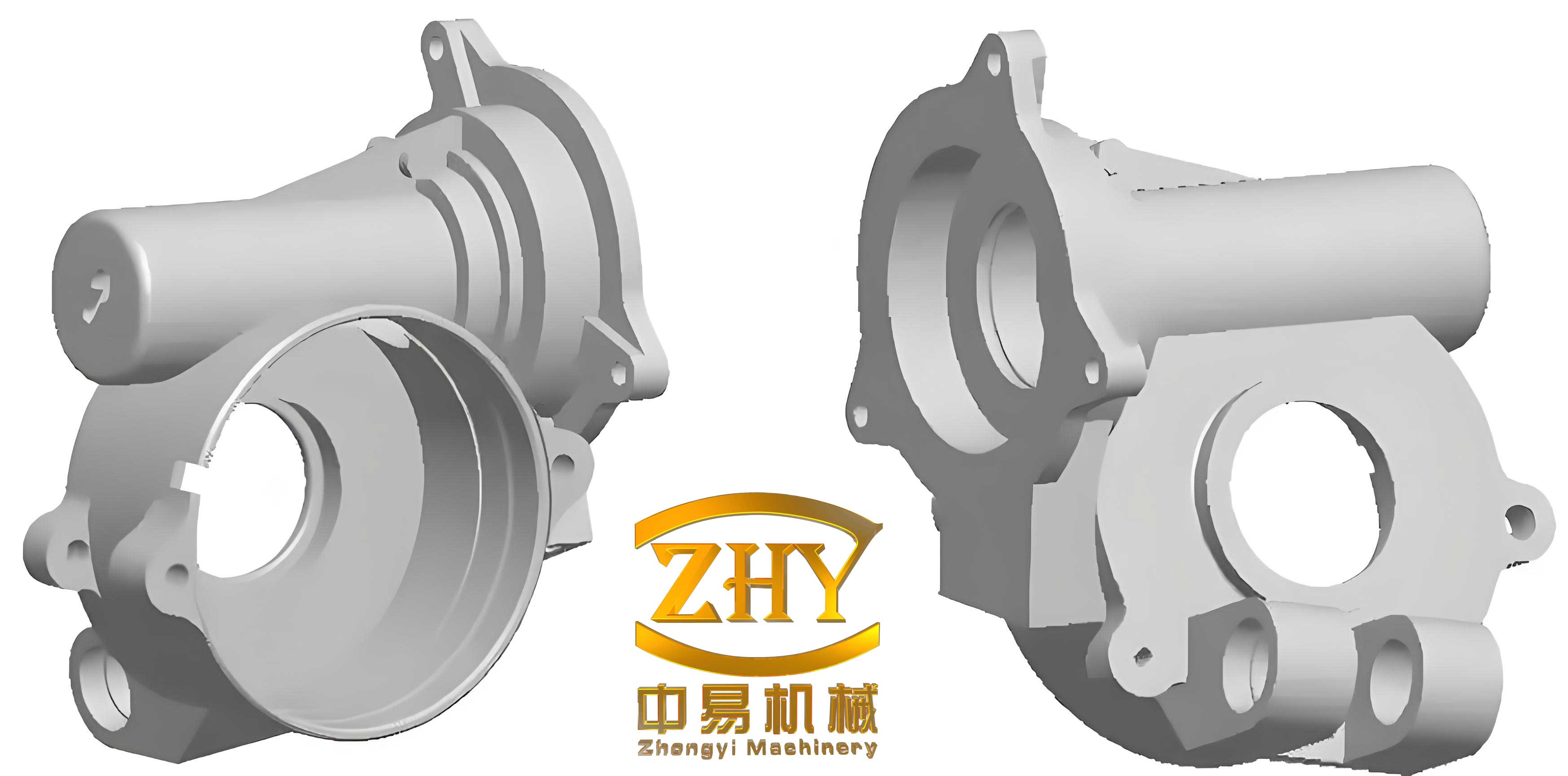
The core challenge in producing these shell castings lies in their inherent structural contradiction. They often integrate thin-walled sections for weight reduction and fluid dynamics with localized thick sections or bosses necessary for structural support and mounting. This non-uniformity disrupts directional solidification, creating isolated thermal centers that are difficult to feed. For the plunger pump shell casting in focus, the geometry featured a central thin-walled barrel (approximately 6 mm) sandwiched between a thick fluid port on one end and a flange with three massive bosses on the other. This configuration is a classic scenario prone to shrinkage defects in the heavy sections if the feeding system is not meticulously designed. Furthermore, the intricate internal passages of such shell castings can promote turbulent metal flow during mold filling, leading to oxide film entrainment and gas porosity, which is unacceptable for pressure-tight components.
Analysis of Prevalent Defects in Shell Castings
The initial manufacturing process for these aluminum alloy shell castings, while seemingly logical, resulted in an unacceptably low yield. A detailed failure analysis pinpointed two primary defect mechanisms, summarized in the table below:
| Defect Type | Primary Location | Root Cause Analysis | Impact on Yield |
|---|---|---|---|
| Shrinkage Porosity/Cavities | Thick bosses on the flange face. | Premature solidification at the neck of horizontal side risers, isolating the thermal center (boss) from the liquid metal source before its own solidification was complete. | >68% |
| Gas Porosity/Entrapped Air | Scattered, often in upper regions of the thin-wall sections. | Turbulent filling caused by a small gating area relative to the large, complex cavity volume, leading to air entrainment and oxide folding. | >25% |
The shrinkage problem fundamentally stemmed from a violation of Chvorinov’s rule for directional solidification. In a sound casting, the solidification time must increase progressively from the extremities of the casting toward the riser: $t_{casting} < t_{feeder neck} < t_{riser}$. In the initial design for these shell castings, the solidification sequence was disrupted:
$$ t_{boss} > t_{riser\ neck} $$
This meant the feeding path froze before the thermal center it was meant to feed, resulting in internal shrinkage within the boss of the shell casting. The gas defects were a direct consequence of fluid dynamics. The initial gate location and orientation caused the metal stream to impinge and splash within the cavity, encapsulating air bubbles within the rapidly solidifying thin walls of the shell casting.
Systematic Process Optimization Strategy
To overcome these challenges, a completely re-engineered approach was adopted, focusing on controlling both thermal gradients and flow dynamics. The strategy was built on three pillars:
- Reorientation for Thermal Management: The casting was flipped 180 degrees, positioning the thick flange face uppermost. This allowed the use of large, efficient top open risers directly on the three bosses, ensuring they remained the hottest part of the casting and the last to solidify.
- Strategic Feeding System Redesign: A combined riser system was implemented. While top risers fed the flange bosses, a strategically placed blind riser (acting as a chunky thermal mass) was positioned within the central cavity to feed the thick sections of the fluid port at the bottom. Additionally, “feed aids” or channels were designed from the top risers down along the side walls to assist in feeding intermediate sections, ensuring a continuous thermal gradient.
- Gating for Laminar Flow: The gating system was redesigned to utilize a larger, calmer filling surface. Metal was introduced in a way that promoted a gradual, progressive rise of the molten front within the cavity of the shell casting, minimizing turbulence and air entrainment.
The key process parameters before and after optimization are contrasted below:
| Process Parameter | Initial Process | Optimized Process | Rationale for Change |
|---|---|---|---|
| Casting Orientation | Flange down, Port up. | Flange up, Port down. | Enables use of large, efficient top risers on critical hot spots. |
| Primary Riser Type | Horizontal side risers on bosses. | Top open risers on bosses + Internal blind riser on port. | Ensures directional solidification toward major thermal masses. |
| Gating Approach | Bottom gating via thick port. | Side gating on calm, open face. | Promotes quiescent mold filling to reduce gas defects. |
| Thermal Control | Insulating wash on side risers only. | Risers designed as dominant thermal masses. | Relies on geometry and size rather than just coatings to control solidification. |
Numerical Simulation and Predictive Analysis
To validate the new design before committing to expensive tooling modifications, numerical simulation using AnyCasting software was employed. The model incorporated the precise geometry of the shell casting, the new gating and risering system, and the defined process parameters (pouring temperature = 720°C, mold preheat = 280°C). The simulation provided critical insights:
- Solidification Sequence: The temperature field analysis clearly showed the desired progressive solidification. The thin walls solidified first, followed by the thicker sections of the main body, with the liquid metal retreating toward the risers. The risers themselves (both top and blind) remained molten throughout the entire solidification of the shell casting, confirming their effectiveness as feeding sources.
- Shrinkage Prediction: The porosity prediction module indicated a high probability of shrinkage defects concentrated exclusively within the volumes of the risers. The critical sections of the actual shell casting—the bosses and the fluid port—were predicted to be sound. The solidification time ($t_f$) of the casting body was conclusively shorter than that of the riser necks, satisfying the condition: $t_{casting} << t_{riser}$.
- Filling Analysis: The velocity vector plots during mold filling demonstrated a smooth, wave-like advancement of the metal front. There were no significant vortices or impingement points that would typically be associated with gas entrainment in the production of shell castings.
The simulation mathematically confirmed the thermal efficacy. The solidification time of a section can be approximated by Chvorinov’s Rule:
$$ t = B \left( \frac{V}{A} \right)^n $$
where $t$ is solidification time, $V$ is volume, $A$ is cooling surface area, $B$ is a mold constant, and $n$ is an exponent (typically ~2). By designing the risers to have a significantly higher $V/A$ ratio (i.e., being more voluminous and chunky) than the sections they feed, their solidification time is extended, fulfilling their purpose in feeding the shell casting.
Production Validation and Results
The optimized process was implemented in production. A batch of 30 shell castings was manufactured using the new methodology. The results provided unequivocal validation:
- Non-Destructive Testing (NDT): Real-time radiography of all castings showed a complete absence of shrinkage porosity in the previously problematic boss areas and the fluid port section of the shell casting.
- Visual Inspection: After shot blasting, the surfaces of the shell castings were free from the surface-breaking gas holes that had plagued the previous process.
- Final Yield: After full machining, only 2 out of 30 castings were scrapped, resulting in a final yield of 93.3%. This represented a dramatic improvement from the initial yield of approximately 33%.
The quantitative outcome of the optimization is starkly evident in the following summary:
| Performance Metric | Initial Process | Optimized Process | Improvement Factor |
|---|---|---|---|
| Production Quantity (pcs) | 163 | 30 (evaluation batch) | – |
| Qualified Castings (pcs) | 54 | 28 | – |
| Yield Rate (%) | 33.1 | 93.3 | ~2.8x |
Generalized Principles for Shell Casting Design
The success of this project transcends the specific plunger pump and offers generalizable engineering principles for producing high-quality aluminum alloy shell castings:
- Dominance of Thermal Gradients: The orientation and riser placement must be chosen to establish a single, dominant thermal gradient. For shell castings with one heavy face, orienting that face upward to use top risers is often superior to relying on side risers, which have vulnerable feeding paths.
- The Internal Blind Riser as a Thermal Node: For shell castings with an internal cavity or cored space, a strategically placed blind riser within that cavity can act as an exceptionally efficient thermal mass, feeding surrounding thick sections more effectively than external risers could. Its efficacy can be approximated by treating it as a spherical heat source, where its cooling rate is minimized.
- Priority of Quiet Filling: For thin-walled, complex shell castings, achieving laminar flow is as critical as achieving sound feeding. The gating design must prioritize a large, calm metal entry that expands smoothly to fill the cavity, governed by the principle of maintaining a positive and rising metal pressure front. The flow rate should be controlled to avoid exceeding the critical Reynolds number that causes turbulence within the shell casting cavity.
- Verification via Simulation: Numerical simulation is an indispensable tool for modern shell casting production. It allows for the virtual testing of thermal gradients ($\nabla T$), feeding paths, and fluid flow patterns, reducing the time and cost associated with empirical trial-and-error on the foundry floor.
In conclusion, the defect-free production of complex aluminum alloy shell castings is achievable through a methodical approach that integrates geometric analysis, controlled solidification principles, and disciplined fluid dynamics. The case of the plunger pump shell casting demonstrates that by re-conceptualizing the feeding strategy to ensure unimpeded directional solidification and by meticulously designing the filling pattern to prevent turbulence, the seemingly intractable problems of shrinkage and gas porosity can be systematically eliminated. These principles form a robust foundation for the manufacture of a wide range of high-performance shell castings across aerospace, automotive, and hydraulic applications.