
In the production of intricate shell castings, such as clutch housings and transmission cases, achieving consistent, high-quality results free from internal defects is a paramount challenge. These components are typically characterized by complex geometries, thin walls, and stringent requirements for pressure tightness and mechanical integrity. My experience in a high-volume production foundry has provided significant insight into the recurring defects that plague such castings and the systematic engineering approaches required to mitigate them. This discussion will delve into the root cause analysis and subsequent process modifications implemented to resolve persistent issues of blowholes, sand inclusions, and core failures in a specific clutch housing shell casting. The principles outlined, however, are universally applicable to a wide range of similar shell castings.
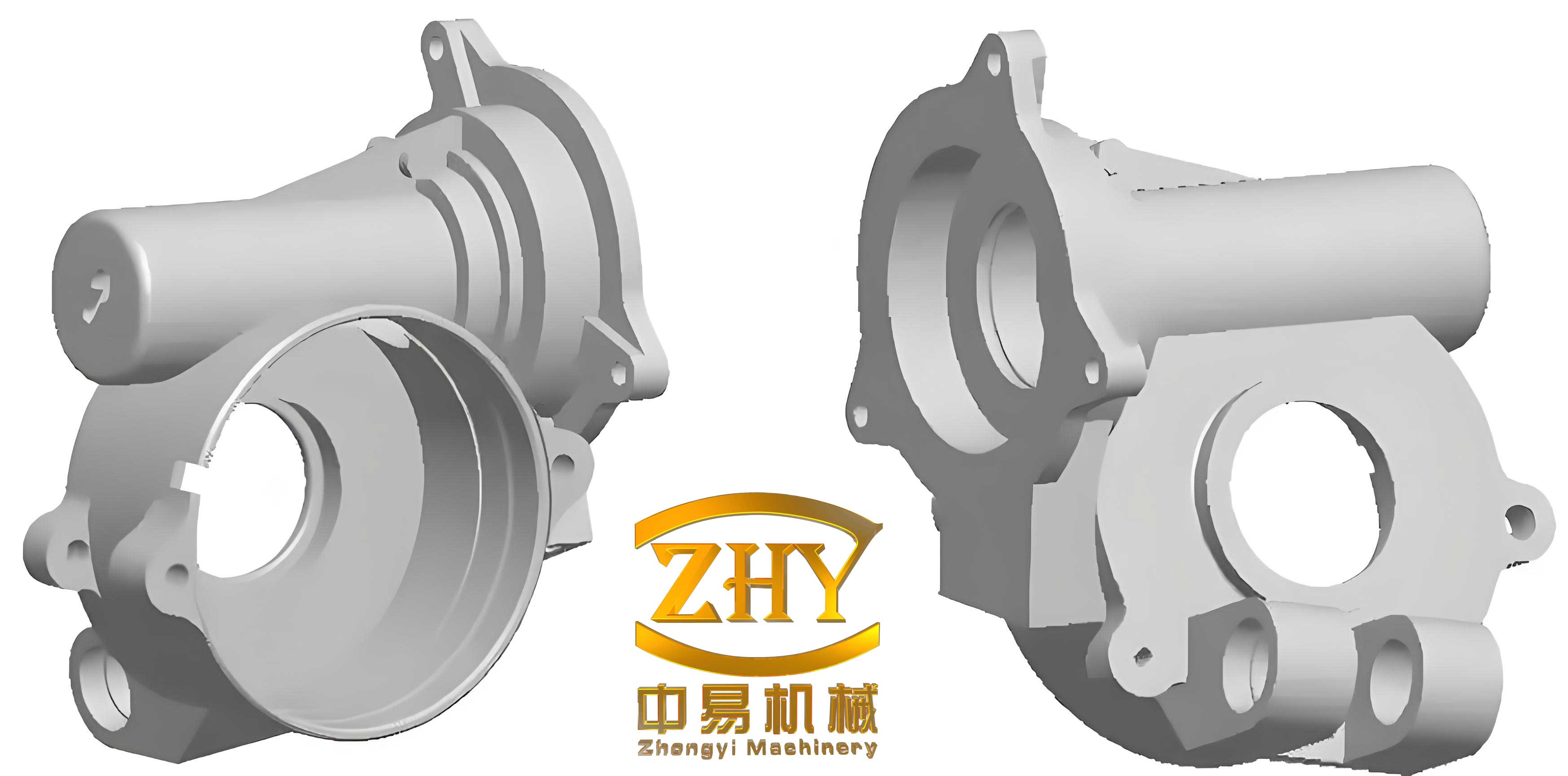
The subject shell casting was a clutch housing made from Grade HT250 gray iron. Its dimensions were approximately 363 mm x 384 mm x 220 mm, with a mass of 18 kg and a minimum wall thickness of only 5 mm, firmly classifying it as a complex thin-walled casting. The production line utilized high-pressure green sand molding with a horizontal parting line. To optimize productivity, a pattern layout of four castings per mold was employed. The initial gating system was a bottom-running design with gates positioned along the parting line, a choice made to promote smooth filling and minimize turbulence and core buoyancy. The cores were all produced using resin-coated sand (shell sand process), which offers excellent dimensional accuracy but introduces the challenge of high gas generation during pouring.
The initial process seemed sound on paper, incorporating several features aimed at defect prevention: exhaust vents in core prints, overflow risers at the top of the casting with vent pins, and additional vent pins on all bosses in the cope. Despite these measures, batch production revealed an unacceptably high scrap rate due to three specific defect types, each located in predictable zones of the shell castings.
Detailed Defect Analysis and Root Cause Investigation
A systematic failure analysis was conducted, mapping the defect locations against the process parameters and tooling design. The findings are summarized in the table below.
| Defect Type | Primary Location on Shell Casting | Initial Hypothesis |
|---|---|---|
| Blowholes (Subsurface Pinholes) | Highest point on the drag-side face (root of the exhaust sheet) | Insufficient venting of core gases. |
| Sand Inclusions (Scabs) | Vertical face of the top flange (near mold wall). | Erosion of poorly compacted mold sand. |
| Core Breakage | Three small connecting print areas between two major core segments. | Inadequate mechanical strength of the slim core prints. |
1. Blowhole Formation Mechanism: The blowholes were classic interior blowholes or core blows. The governing physics involves the rapid generation of gas from the resin binder in the shell cores upon contact with the molten iron. The pressure buildup within the core must be relieved through its permeable structure and designed vents. If the venting capacity is insufficient, the gas pressure ($P_{gas}$) at the core/metal interface can exceed the metallostatic pressure ($P_{metal}$) and the sand strength resisting bubble formation, leading to gas invasion.
$$P_{gas} > P_{metal} + \sigma_{sand}$$
Where $P_{metal} = \rho g h$, with $\rho$ as metal density, $g$ as gravity, and $h$ as the height of the metal head above the point in question. In our shell castings, the initial design had two large cores sharing a single vent path. This created a bottleneck. Furthermore, the vent cross-sectional area ($A_{vent}$) was likely inadequate for the total volumetric gas generation rate ($\dot{V}_{gas}$) from the shell cores over the filling and initial solidification time ($t$). The requirement for prevention can be conceptualized as:
$$A_{vent} \cdot v_{eff} \geq \frac{\dot{V}_{gas} \cdot t}{P_{atm}}$$
Where $v_{eff}$ is the effective velocity of gas expulsion and $P_{atm}$ is atmospheric pressure. Our setup failed this criterion, causing gas to be trapped at the last point to fill—the highest point in the drag.
2. Sand Inclusion Root Cause: Sand wash at the top flange was a direct consequence of mold integrity. In high-pressure green sand molding, intricate vertical faces adjacent to the mold wall are notoriously difficult to compact uniformly. A hardness test confirmed this: the mold hardness at the critical vertical face was 50-60, significantly below the specification of >70. The erosive force of the flowing metal ($F_{erosion}$) is proportional to the dynamic pressure of the stream:
$$F_{erosion} \propto \frac{1}{2} \rho v^2$$
Where $v$ is the local flow velocity. When this force exceeds the bond strength of the poorly compacted sand layer, particles are dislodged and carried into the casting cavity, resulting in sand inclusions in the final shell castings. Simply adjusting molding parameters could not reliably solve this deep-seated tooling limitation.
3. Core Breakage Analysis: The failure occurred at three small, round prints connecting two heavy core sections. This created a cantilevered load scenario. During handling, assembly, and most critically, during metal pouring, the core assembly is subjected to buoyancy forces and inertial loads. The bending stress ($\sigma_b$) on the cylindrical print can be estimated by:
$$\sigma_b = \frac{M \cdot c}{I} = \frac{(F \cdot L) \cdot r}{\frac{\pi r^4}{4}} = \frac{4 F L}{\pi r^3}$$
Where $F$ is the resultant force (e.g., from buoyancy), $L$ is the cantilever length, and $r$ is the radius of the print. This equation highlights a critical point: stress is inversely proportional to the cube of the print radius. The original small print radius created a highly stressed, fragile connection. The shell core material’s tensile strength was insufficient to withstand these operational stresses, leading to fracture.
Comprehensive Process Improvement Strategy
The analysis led to a multi-faceted improvement plan targeting each root cause without adversely affecting other aspects of the process for these shell castings.
1. Enhanced Venting System for Core Gases: The gas evacuation system was completely redesigned. The shared vent was eliminated. Instead, each major shell core was given its own dedicated, high-capacity vent channel routed directly to the outside of the mold. Critically, the vent intake was positioned at the absolute highest point of each core’s internal geometry to ensure no gas pockets could form. This redesign ensured that for every shell casting in the mold, the venting capability $A_{vent-total}$ was effectively doubled and optimized for direct flow, satisfying the gas expulsion requirement outlined earlier.
2. Redesign of Core Geometry to Eliminate Mold Weakness: To combat the sand inclusion problem, the solution was to eliminate the vulnerable green sand face altogether. The design of Core #2 was modified by extending its print to envelop the entire vertical face of the top flange. This transformed the defect-prone sand surface into a robust shell core surface. Shell cores, being cured and bonded, have a surface hardness and erosion resistance orders of magnitude higher than green sand. The erosive force $F_{erosion}$ from the metal flow was now acting on a surface with a dramatically higher bond strength, effectively eliminating the sand wash mechanism for these shell castings.
3. Structural Reinforcement of Slim Core Prints: Increasing the print radius was not feasible due to spatial constraints in the casting design. Therefore, internal reinforcement was the chosen path. A steel wire rod (core rod) was integrated into the vulnerable prints of Core #2 during the shell core shooting process. Simultaneously, a matching recess was created in Core #1. During core assembly, the rod from Core #2 is inserted into the recess of Core #1 with a high-temperature adhesive. This transforms the joint from a brittle sand-to-sand connection into a composite, steel-reinforced structural link. The bending stress equation is still valid, but the resisting moment $M_{resist}$ is now provided by the steel rod’s yield strength, which is vastly superior to that of the shell sand:
$$M_{resist-core} \approx \sigma_{y-sand} \cdot S_{sand}$$
$$M_{resist-reinforced} \approx \sigma_{y-steel} \cdot S_{steel} + \sigma_{y-sand} \cdot S_{sand}$$
Where $S$ is the section modulus. Since $\sigma_{y-steel} \cdot S_{steel} >> \sigma_{y-sand} \cdot S_{sand}$, the reinforced connection is immensely stronger, preventing breakage.
The table below contrasts the old and new approaches for producing these shell castings.
| Aspect | Initial Process | Optimized Process | Key Improvement Principle |
|---|---|---|---|
| Venting | Shared vent for two cores. | Dedicated, high-capacity vent per core. | Maximize vent cross-section and minimize flow path resistance for gases. |
| Flange Surface | Formed by green sand mold. | Formed by extended shell core. | Replace low-strength green sand with high-strength core material in erosion-prone areas. |
| Core Print Strength | Relied on shell sand strength. | Steel rod reinforcement integrated into print. | Use composite structure to handle cantilever stresses beyond sand’s capability. |
| Defect Outcome | High scrap from blowholes, sand, breakage. | Defects effectively eliminated. | Holistic design addressing gas dynamics, erosion mechanics, and structural strength. |
Quantitative Results and Broader Implications for Shell Castings
The implementation of these three coordinated improvements yielded immediate and sustainable results. The core breakage defect was completely eliminated (0% occurrence). The scrap rate due to blowholes and sand inclusions in the shell castings dropped by over 90%, moving well within acceptable quality limits. The success of this project underscores several critical principles for the manufacturing of complex shell castings:
1. Proactive Venting Design: For shell castings utilizing resin-bonded cores, venting cannot be an afterthought. The vent system must be calculated and designed with the same rigor as the gating system. It should be direct, large, and originate from the highest points of all cored cavities. A useful guideline is to ensure the total vent area is at least 20-30% of the total choke area in the gating system for ferrous shell castings.
2. Leveraging Core Geometry for Mold Integrity: In areas where the mold geometry leads to inherent weaknesses—deep pockets, vertical walls near the flask, or complex contours—the design should be reviewed to see if a core can form that surface. While cores add cost, they provide superior dimensional stability and surface integrity, often reducing overall scrap and machining cost for critical shell castings.
3. Structural Design of Core Assemblies: Core prints, especially those acting as cantilevers or connecting heavy segments, are structural components. When the sand’s strength is insufficient, reinforcement with metal inserts (wires, rods, or arbors) is a highly effective solution. The design must ensure the insert is securely anchored and does not create a local chilling problem or fusion defect in the final shell casting.
4. Systems Thinking: It is vital to consider interactions. For instance, increasing resin in the shell core to improve strength would have worsened gas defects. Raising pouring temperature to help gas escape would have increased core buoyancy and erosion potential. The optimal solution addressed each defect independently without creating negative trade-offs.
The production of reliable, high-integrity shell castings demands a deep understanding of the interplay between fluid dynamics, gas evolution, heat transfer, and material strength. By applying fundamental engineering principles and a rigorous root-cause analysis methodology, chronic defects can be systematically resolved, leading to robust and economical manufacturing processes for these essential components.