
In my experience with high manganese steel casting for electrolytic aluminum equipment, I have encountered significant challenges in producing defect-free components. The clip hook seat, a critical non-magnetic part, is manufactured using high manganese steel to prevent magnetization in magnetic field environments, ensuring stable operation of electrode holders. Initially, the production process involved green sand molding with jolt-squeeze machines in a continuous line, but defects like shrinkage porosity at the ingate and surface burn-on emerged, leading to excessive cleaning workloads and delays. Through systematic analysis and process optimization, I successfully addressed these issues, improving quality and efficiency.
The high manganese steel casting of the clip hook seat exhibits a tapered structure, with wall thickness increasing from 15 mm to 40 mm. This geometry necessitates directional solidification principles in process design. In the initial setup, two castings were arranged per mold with a single riser feeding both, and a flat ingate was used to act as a slag trap. However, post-shakeout inspection revealed shrinkage porosity at the ingate in over 95% of castings, indicating inadequate riser design. I analyzed that the thermal section at the ingate, with a maximum thickness of 40 mm, solidified slower than the riser, causing metal back-suction and porosity. The riser’s modulus was insufficient, leading to premature solidification and lack of feed metal.
To resolve this, I recalculated the riser dimensions using the modulus method. For flat castings in high manganese steel casting, the modulus $ M_c $ is given by $ M_c = 0.5 \times \delta $, where $ \delta $ is the wall thickness. With $ \delta = 40 \text{mm} $, $ M_c = 20 \text{mm} $. For a blind side riser, the riser modulus $ M_r $ should exceed the casting modulus by a factor of 1.1, so $ M_r = 1.1 \times M_c = 22 \text{mm} $. Consulting casting handbooks, a modulus of 2.26 cm corresponds to a riser diameter of 120 mm and height of 180 mm. Given the non-uniform thickness, I empirically reduced this to a diameter of 110 mm and height of 160 mm, and adjusted the ingate neck height to 12 mm for smoother filling. After implementation, shrinkage porosity was eliminated, and the riser showed significant shrinkage concavity, confirming effective feeding.
| Parameter | Symbol | Value | Equation |
|---|---|---|---|
| Casting Wall Thickness | $ \delta $ | 40 mm | – |
| Casting Modulus | $ M_c $ | 20 mm | $ M_c = 0.5 \times \delta $ |
| Riser Modulus Factor | – | 1.1 | – |
| Required Riser Modulus | $ M_r $ | 22 mm | $ M_r = 1.1 \times M_c $ |
| Selected Riser Diameter | – | 110 mm | Based on empirical adjustment |
| Selected Riser Height | – | 160 mm | Based on empirical adjustment |
Surface burn-on was another prevalent defect in high manganese steel casting, manifesting as rough surfaces after shot blasting, particularly on the cope side. This mechanical burn-on resulted from sand penetration due to low mold hardness, coarse sand grains, and high pouring temperatures. Initial use of forsterite sand as facing sand, with its angular grains and coarse size distribution, exacerbated the issue. I identified that the mold compaction, specified at 60-70 for the cope and 70-80 for the drag on a hardness scale, was inconsistently achieved due to manual operation, while the pouring temperature ranged from 1450°C to 1480°C, promoting metal fluidity and infiltration.
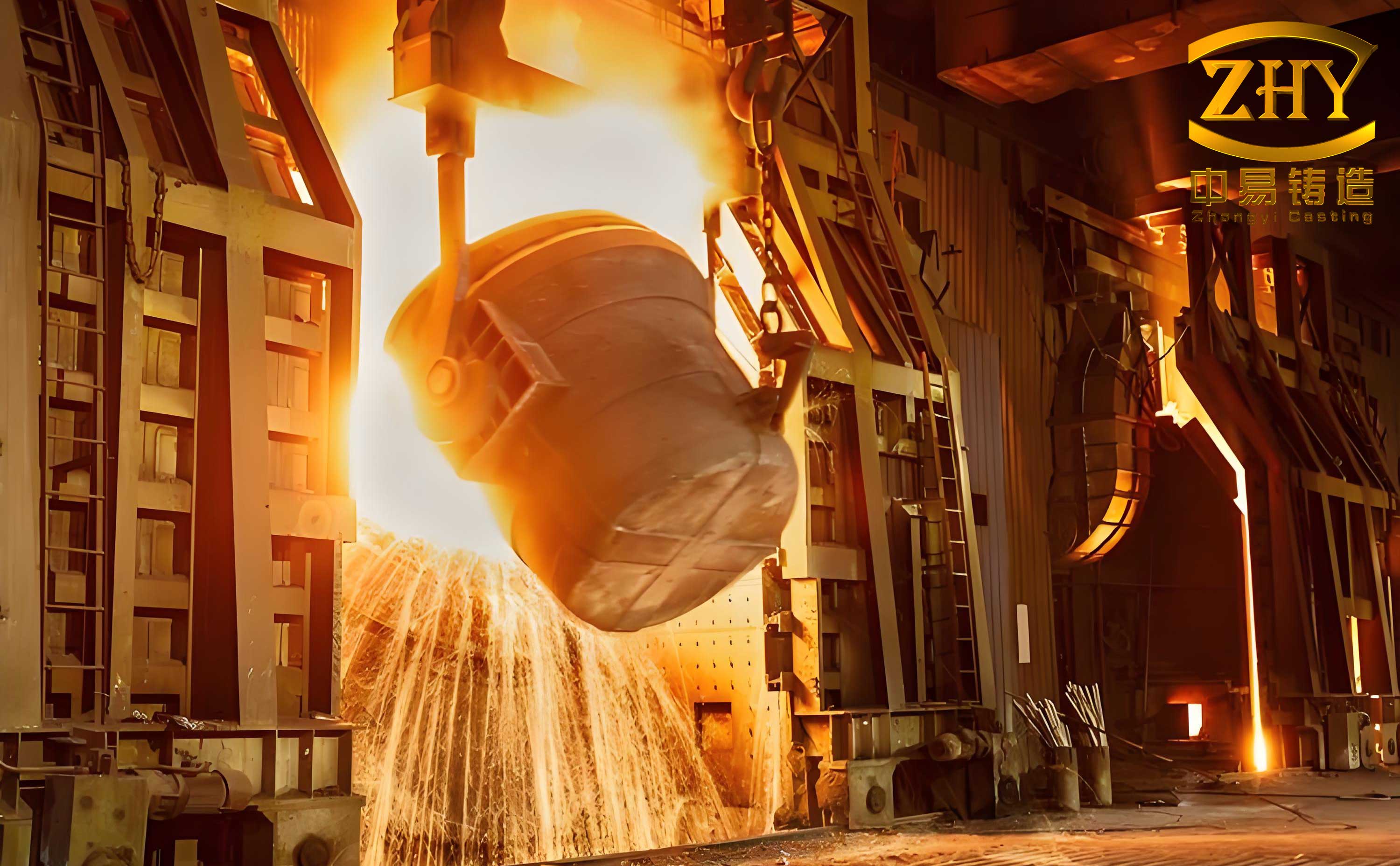
I implemented several corrective measures. First, I enforced strict control over jolt counts and mold hardness checks, rejecting substandard molds. Second, I revised the facing sand composition: for the drag, I switched to silica sand with finer grains (50-100 mesh) to reduce permeability, while for the cope, I blended forsterite sand with silica sand to fill interstices and minimize metal penetration. The sand mixtures were optimized as shown in the tables below. Additionally, I reduced the pouring temperature range to 1420°C–1450°C and ensured ladle preheating to 600°C–800°C, using insulating slag covers to maintain temperature during transfer. These changes significantly improved surface finish, reduced cleaning effort, and cut material costs by 55.1 per ton of casting, as calculated from sand consumption savings.
| Material | Quantity (kg per batch) | Properties |
|---|---|---|
| Silica Sand | 700 | 50-100 mesh grain size |
| Bentonite | 80 | Binder for strength |
| Water | 35 | For plasticity and compactability |
| Pulp | 4 | Organic additive for moldability |
| Heavy Oil | 8 | Lubricant and moisture retention |
| Material | Quantity (kg per batch) | Properties |
|---|---|---|
| Forsterite Sand | 600 | Angular grains, coarse base |
| Silica Sand | 100 | Fines to fill gaps |
| Bentonite | 80 | Binder for cohesion |
| Water | 35 | Optimal moisture content |
| Pulp | 4 | Enhances green strength |
| Heavy Oil | 8 | Reduces sticking and improves surface |
The modulus-based approach for riser design in high manganese steel casting can be generalized using the formula for solidification time $ t $, derived from Chvorinov’s rule: $ t = k \times \left( \frac{V}{A} \right)^2 $, where $ V $ is volume, $ A $ is surface area, and $ k $ is a constant. For the clip hook seat, ensuring the riser solidifies after the casting requires $ M_r > M_c $. The modulus ratio $ R_m $ is critical: $ R_m = \frac{M_r}{M_c} \geq 1.1 $. In practice, I verified this through thermal analysis, where the riser’s volumetric heat capacity must compensate for the casting’s thermal demand. The improved riser dimensions satisfied $ \frac{\pi \times (110/2)^2 \times 160}{\pi \times (110/2)^2 + \pi \times 110 \times 160} > 22 \text{mm} $, confirming adequacy.
For burn-on prevention, the mechanical interlocking theory explains sand penetration: the metal pressure $ P_m $ must exceed the sand’s resistance, which depends on grain size and compaction. The critical grain size $ d_c $ for preventing penetration can be estimated as $ d_c = \frac{2 \sigma \cos \theta}{\rho g h} $, where $ \sigma $ is surface tension, $ \theta $ is contact angle, $ \rho $ is metal density, $ g $ is gravity, and $ h $ is metal head. In high manganese steel casting, with $ \sigma \approx 1.5 \text{N/m} $ and $ \theta \approx 110^\circ $ for steel-sand, reducing grain size and increasing compaction raised the resistance threshold. The revised sand mixes lowered permeability, quantified by the permeability number $ P_n $, from an initial 100-150 to below 80, minimizing metal ingress.
Temperature control is vital in high manganese steel casting to balance fluidity and solidification. The pouring temperature $ T_p $ affects fluidity length $ L_f $, approximated by $ L_f = k_f (T_p – T_l) $, where $ T_l $ is liquidus temperature and $ k_f $ is a constant. Initially, high $ T_p $ near 1480°C increased $ L_f $, promoting burn-on. By lowering $ T_p $ to 1420°C–1450°C and using preheated ladles, I maintained adequate fluidity while reducing penetration risk. The thermal gradient $ \nabla T $ across the mold wall also influences burn-on; it is given by $ \nabla T = \frac{T_p – T_m}{x} $, where $ T_m $ is mold temperature and $ x $ is wall thickness. Better sand properties stabilized $ \nabla T $, curtailing metal solidification delays and infiltration.
The economic impact of these improvements in high manganese steel casting was substantial. By optimizing sand compositions, I reduced forsterite sand usage by 145 kg per ton of castings. With forsterite sand at 640 per ton and silica sand at 260 per ton, the cost saving per ton $ C_s $ is calculated as: $ C_s = 145 \times \left( \frac{640 – 260}{1000} \right) = 55.1 $. This, combined with reduced welding and cleaning, enhanced overall productivity. The process changes also aligned with sustainable practices by minimizing waste and energy consumption in post-processing.
In summary, through meticulous analysis and iterative refinement, I eliminated defects in high manganese steel casting. The modulus-based riser design ensured sound feeding, while sand composition adjustments and temperature control eradicated surface burn-on. These steps not only improved the aesthetic and functional quality of castings but also delivered cost savings and operational efficiency. The principles applied here—such as modulus calculations, sand engineering, and thermal management—are universally applicable to similar high manganese steel casting projects, underscoring the importance of a systematic approach in foundry operations.