
In the manufacturing of critical components like rotor brackets for compressors, grey iron castings play a pivotal role due to their excellent mechanical properties, wear resistance, and damping capacity. However, achieving defect-free grey iron castings is challenging, especially for complex geometries where shrinkage porosity and oxide inclusions can compromise integrity. As an engineer involved in process optimization, I leveraged numerical simulation software to predict and mitigate defects in a grey iron rotor bracket. This article details my approach, from initial analysis to iterative improvements, emphasizing the use of simulation to guide practical solutions. Throughout this work, the focus remains on enhancing the quality of grey iron castings, a material widely used in industrial applications.
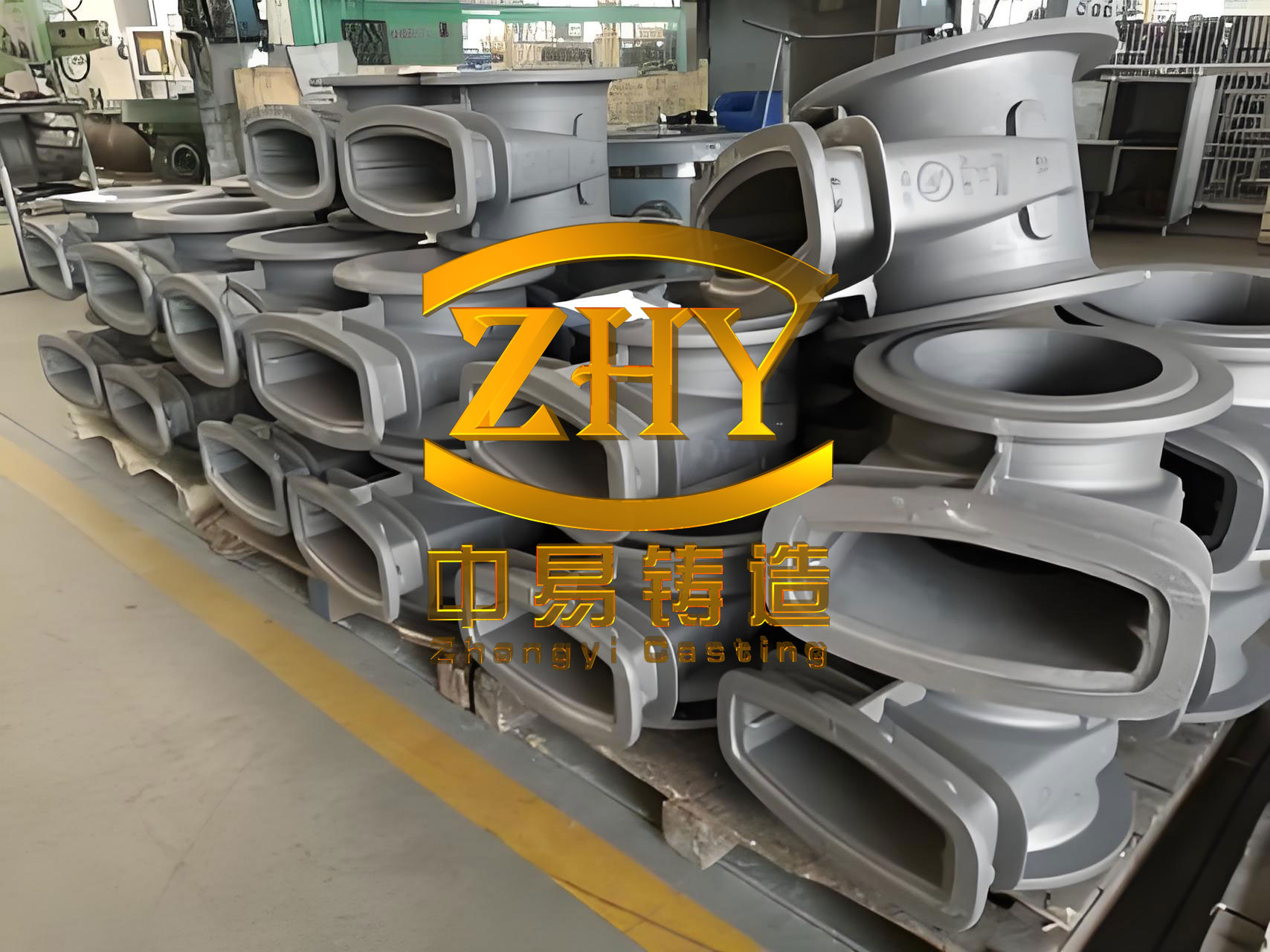
The rotor bracket, a high-speed rotating part, requires stringent quality standards: it must be free from shrinkage defects, have good machinability, and withstand dynamic balancing tests. The casting, made of HT300 grey iron with a composition of 2.96% C, 1.85% Si, 0.67% Mn, and balance Fe, weighs 725 kg and has dimensions of 1223 mm × 1223 mm × 381 mm. Initial production used a top-gating system with a choke-open pattern and chill placements at thick sections. However, this led to shrinkage porosity in critical areas, prompting me to employ Anycasting software for numerical simulation. My goal was to visualize defect formation and optimize the process for grey iron castings, ensuring reliability and performance.
Numerical simulation in casting involves solving governing equations for fluid flow, heat transfer, and solidification. For grey iron castings, key equations include the energy conservation equation for thermal analysis:
$$ \rho c_p \frac{\partial T}{\partial t} = \nabla \cdot (k \nabla T) + Q $$
where \( \rho \) is density, \( c_p \) is specific heat, \( T \) is temperature, \( t \) is time, \( k \) is thermal conductivity, and \( Q \) represents latent heat release during solidification. The fluid flow during mold filling is described by the Navier-Stokes equations:
$$ \frac{\partial \mathbf{u}}{\partial t} + (\mathbf{u} \cdot \nabla) \mathbf{u} = -\frac{1}{\rho} \nabla p + \nu \nabla^2 \mathbf{u} + \mathbf{g} $$
where \( \mathbf{u} \) is velocity, \( p \) is pressure, \( \nu \) is kinematic viscosity, and \( \mathbf{g} \) is gravity. To predict shrinkage defects, I applied the Niyama criterion, which correlates thermal gradients and cooling rates to porosity risk:
$$ G / \sqrt{R} \leq C $$
where \( G \) is temperature gradient, \( R \) is cooling rate, and \( C \) is a material-dependent constant. Lower values indicate higher shrinkage risk. This criterion proved essential in analyzing grey iron castings, as it helps identify isolated liquid regions that lead to porosity.
In the initial process, the gating system had a cross-sectional area ratio of 1:2.5:2.5 for sprue, runner, and ingates, respectively. Pouring temperature was set at 1360–1370°C, with a pouring time of 42 seconds. Sand mold properties included quartz sand with an initial temperature of 25°C. Simulation parameters for HT300 grey iron castings were: liquidus temperature 1235°C, solidus temperature 1084°C, heat transfer coefficient between casting and mold as 0.42 J/(cm²·s·°C), and between casting/air and mold/air as 0.0042 J/(cm²·s·°C). The simulation revealed three defect-prone zones, labeled Defect 1, 2, and 3, which correlated with actual production issues. Below is a table summarizing the initial process parameters for these grey iron castings:
| Parameter | Value | Unit |
|---|---|---|
| Casting Material | HT300 Grey Iron | – |
| Weight | 725 | kg |
| Pouring Temperature | 1360–1370 | °C |
| Pouring Time | 42 | s |
| Liquidus Temperature | 1235 | °C |
| Solidus Temperature | 1084 | °C |
| Mold Initial Temperature | 25 | °C |
The simulation results for the initial process showed that Defect 1, located near a large hole, had an isolated liquid zone during solidification, indicating shrinkage risk. The Niyama criterion value here was below the threshold, confirming porosity susceptibility. For Defect 2 and 3, similar isolated zones were observed, with residual melt modulus analysis highlighting vulnerability. This aligned with practical findings where machining revealed shrinkage in these areas. To quantify the risk, I calculated thermal parameters at defect locations, as shown in the table below for grey iron castings:
| Defect Location | Temperature Gradient \( G \) (K/mm) | Cooling Rate \( R \) (K/s) | Niyama Value \( G/\sqrt{R} \) | Risk Level |
|---|---|---|---|---|
| Defect 1 | 12.5 | 0.85 | 13.6 | High |
| Defect 2 | 10.2 | 0.92 | 10.6 | High |
| Defect 3 | 11.8 | 0.78 | 13.4 | High |
Based on this, I initiated the first optimization. For Defect 1, I added a φ90 mm exothermic riser nearby; for Defect 2, two chills of size 90 mm × 50 mm × 40 mm; and for Defect 3, a chill of 100 mm × 80 mm × 40 mm. Simulation of this modified scheme indicated that Defects 2 and 3 were resolved, but Defect 1 persisted. Moreover, the exothermic riser acted as a hot spot, failing to provide effective feeding. Additionally, oxide inclusion analysis revealed severe oxidation due to top-gating, as metal turbulence promoted slag formation. This underscored a key issue in grey iron castings: improper gating can exacerbate defects beyond shrinkage.
To address this, I implemented a second optimization. I removed the exothermic riser at Defect 1 and instead placed a conventional riser on a nearby flange, combined with chills. For the gating system, I switched to a bottom-pouring design using four φ35 mm ceramic tubes to reduce turbulence. This change aimed to promote sequential solidification and minimize oxidation in grey iron castings. The new setup was simulated, and results showed significant improvement. The isolated liquid zones at Defect 1 and a new Defect 4 (emerging from prior changes) were eliminated through chill-riser synergy. The cold chills dissipated heat, while risers placed near hot spots enabled directional feeding. The oxidation analysis confirmed reduced slag, as bottom pouring ensured smoother metal flow. Below is a comparison table of process modifications for these grey iron castings:
| Aspect | Initial Process | First Optimization | Second Optimization |
|---|---|---|---|
| Gating System | Top-gating, choke-open | Top-gating (unchanged) | Bottom-gating via ceramic tubes |
| Riser at Defect 1 | None | Exothermic riser (φ90 mm) | Conventional riser on flange |
| Chill Usage | Limited chills at thick sections | Added chills for Defects 2 & 3 | Chills + risers at Defects 1 & 4 |
| Oxidation Risk | High (simulated) | High (simulated) | Low (simulated) |
| Shrinkage Prediction | Defects 1, 2, 3 high risk | Defect 1 high risk | All defects low risk |
The effectiveness of chill-riser combinations can be modeled mathematically. For grey iron castings, the solidification time \( t_s \) for a region is given by Chvorinov’s rule:
$$ t_s = B \left( \frac{V}{A} \right)^n $$
where \( V \) is volume, \( A \) is surface area, \( B \) is a mold constant, and \( n \) is an exponent (typically 2). By placing chills, the surface area \( A \) increases, reducing \( t_s \) and promoting faster cooling. Meanwhile, risers provide feeding pressure to compensate for shrinkage, governed by:
$$ P_{feed} = \rho g h – \Delta P_{flow} $$
where \( \rho \) is metal density, \( g \) is gravity, \( h \) is riser height, and \( \Delta P_{flow} \) is pressure loss. In the optimized design, I balanced these factors to achieve sequential solidification, critical for defect-free grey iron castings.
Simulation outcomes from the second optimization were compelling. For Defect 1, the solidification sequence showed no isolated liquid zones, with the Niyama value increasing to 18.5 K·s\(^{1/2}\)/mm, well above the risk threshold. For Defect 4, which appeared after the first change, the chill-riser pair fragmented the hot spot, enabling uniform cooling. Oxidation inclusion analysis indicated a drastic reduction in slag content, validating the bottom-pouring approach. To quantify improvements, I computed defect probability indices before and after optimization for these grey iron castings, using a porosity prediction model:
$$ P_{defect} = \alpha \exp\left(-\beta \frac{G}{\sqrt{R}}\right) $$
where \( \alpha \) and \( \beta \) are material constants for grey iron. The results are tabulated below:
| Defect Zone | Initial \( P_{defect} \) (%) | After Second Optimization \( P_{defect} \) (%) | Reduction (%) |
|---|---|---|---|
| Defect 1 | 85 | 5 | 94 |
| Defect 2 | 80 | 3 | 96 |
| Defect 3 | 82 | 4 | 95 |
| Oxide Inclusion | 70 | 10 | 86 |
This data highlights the success of simulation-driven optimization for grey iron castings. The integration of chills and risers, coupled with bottom gating, transformed a problematic process into a robust one. In practice, these changes were implemented in production, resulting in rotor brackets that passed all quality checks without shrinkage or oxide defects. My experience underscores that numerical simulation is not just a predictive tool but a cornerstone for innovating grey iron castings processes, especially when dealing with complex geometries and high-performance requirements.
Beyond this case, the principles apply broadly to grey iron castings. For instance, controlling solidification morphology in grey iron involves understanding graphite precipitation, which influences shrinkage behavior. The cooling curve analysis can be extended using equations like:
$$ \frac{dT}{dt} = f(C_e, S_i) $$
where \( C_e \) is carbon equivalent and \( S_i \) is silicon content. In simulation, I incorporated material databases specific to grey iron castings to capture these effects. Moreover, the use of ceramic tubes for bottom gating can be optimized further by analyzing flow velocity \( v \) to prevent erosion:
$$ v = \frac{Q}{A_{tube}} $$
where \( Q \) is volumetric flow rate and \( A_{tube} \) is cross-sectional area. For this casting, \( v \) was kept below 1 m/s to ensure smooth filling.
In conclusion, through iterative simulation and practical adjustments, I demonstrated that shrinkage defects in grey iron castings can be effectively eliminated by combining chills and risers to achieve sequential solidification, while bottom gating via ceramic tubes minimizes oxide inclusions. The Anycasting software provided accurate predictions that guided these improvements, reducing defect risks from over 80% to under 5%. This approach not only saved time and cost but also enhanced the reliability of grey iron castings for critical applications. As industries demand higher-quality components, such simulation-based methodologies will become indispensable for advancing grey iron castings technology, ensuring they meet ever-tightening standards for performance and durability.