
As a seasoned steel castings manufacturer, I have been involved in the design and operation of numerous foundries, focusing on efficiency, sustainability, and adaptability. The challenges in today’s market, such as labor shortages and environmental regulations, demand innovative approaches. In this article, I will share insights from a recent project where we designed a new casting workshop, emphasizing principles that can benefit any steel castings manufacturer. Our goal was to create a facility capable of producing 10,000 tons of castings annually, including steel components, though our initial focus was on ductile and gray iron. The design integrates advanced automation, energy-efficient melting, and robust management systems. Throughout this discussion, I will highlight key aspects using tables and formulas to summarize data, ensuring clarity for fellow professionals in the steel castings manufacturer industry.
The design principles for this facility were rooted in practicality and foresight. We aimed to balance current needs with future expansion, maximize equipment utilization, and address labor and environmental concerns. As a steel castings manufacturer, it is crucial to plan for scalability while maintaining operational efficiency. Below is a table summarizing our core design principles:
| Principle | Description | Impact on Steel Castings Manufacturer |
|---|---|---|
| Phased Overall Design | Implement design in stages based on funding, allowing for future growth and flexibility. | Reduces initial capital outlay and enables adaptation to market changes. |
| Maximized Equipment Utilization | Optimize melting and processing equipment to reduce downtime and energy consumption. | Lowers per-unit cost and enhances competitiveness for a steel castings manufacturer. |
| Automation for Labor Shortages | Incorporate automated molding and sand handling systems to mitigate workforce challenges. | Improves productivity and reduces reliance on manual labor. |
| Environmental Compliance | Integrate dust collection and emission controls to ensure clean, safe production. | Meets regulatory standards and promotes sustainable practices. |
These principles guided every aspect of our layout and equipment selection, ensuring that our facility remains competitive as a steel castings manufacturer. For instance, we allocated space for future expansion, which is vital given the dynamic nature of the steel castings manufacturer sector. Now, let’s delve into the production纲领, where we defined our output targets and capacity planning.
The production纲领 outlined an annual output of 10,000 tons of castings, ranging from small components to large pieces up to 1 ton. As a steel castings manufacturer, we had to account for diverse materials, including steel, ductile iron, and gray iron. To break this down, we developed a monthly production plan based on molding methods. The table below details the planned capacities:
| Molding Method | Planned Capacity (tons/month) | Production Personnel | Notes for Steel Castings Manufacturer |
|---|---|---|---|
| Resin Sand Production Line | 150 | 20 (two shifts) | Suitable for complex steel castings with high dimensional accuracy. |
| AMF Automatic Molding Line (One Line Operative) | 300 | 12 (two shifts) | Ideal for high-volume production of steel castings. |
| AMF Automatic Molding Line (Reserved) | 300 | 12 (two shifts) | Future expansion to double capacity for steel castings. |
| Machine Molding Line | 150 | 40 (two shifts) | Flexible for small batches of steel castings. |
| Total | 900 | 84 | Monthly output target for the steel castings manufacturer. |
To support this production, we calculated the melting capacity. We installed four medium-frequency induction furnaces: two 1-ton and two 1.5-ton units. The melting efficiency can be expressed using the formula for daily melting output: $$ D = (N_1 \times C_1 + N_2 \times C_2) \times S $$ where \(N_1\) and \(N_2\) are the number of furnaces of each capacity, \(C_1\) and \(C_2\) are their respective melting rates per shift, and \(S\) is the number of shifts. For our setup: $$ D = (2 \times 12 + 2 \times 15) \times 2 = 54 \text{ tons/day} $$ Assuming 25 working days per month, the monthly melting capacity is: $$ M = D \times 25 = 1350 \text{ tons/month} $$ With a comprehensive yield rate of 70% for steel and iron castings, the合格铸件 output is: $$ O = M \times 0.7 = 945 \text{ tons/month} $$ This aligns with our target of 900-1000 tons per month, ensuring that as a steel castings manufacturer, we have sufficient molten metal for production. The yield rate formula is critical for any steel castings manufacturer to optimize resource use: $$ Y = \frac{W_c}{W_m} \times 100\% $$ where \(W_c\) is the weight of合格铸件 and \(W_m\) is the weight of molten metal.
Moving to the工艺设计与设备选择, we focused on a layout that promotes smooth material flow and minimizes handling. The casting workshop spanned 6,000 m² within a total building area of 24,000 m². Our design included distinct areas for melting, molding, sand processing, and auxiliary functions. Below is a summary of the key equipment selections, essential for any steel castings manufacturer aiming for efficiency:
| Department | Equipment | Specifications | Role in Steel Castings Manufacturing |
|---|---|---|---|
| Melting Department | Medium-Frequency Induction Furnaces | 2 x 1-ton, 2 x 1.5-ton; independent power supplies | Provides flexible melting for steel and iron, with energy savings up to 20% compared to traditional methods. |
| Melting Department | Air-Cooled Cupola | KQDL-type, 5 tons/hour capacity | Backup for duplex melting, though currently idle due to environmental constraints. |
| Molding Department | Resin Sand Production Line | S528 system, 10 tons/hour capacity | Produces high-quality molds for precision steel castings, with 90% sand reclamation. |
| Molding Department | AMF Automatic Molding Line | AMF-Ⅲ-05, 80-90 molds/hour | Enables high-speed production of steel castings with minimal labor. |
| Molding Department | Machine Molding Line | F-series造型机s (e.g., F-124, F-145) | Handles small batches and complex geometries for steel castings. |
| Sand Processing Department | Clay Sand Treatment System | S1422D mixer, 60 tons/hour capacity | Automated sand preparation, reducing new sand consumption by 10%. |
The melting department was designed with dual capabilities: induction furnaces for primary melting and a cupola for potential duplex operations. As a steel castings manufacturer, we prioritize temperature control and alloy consistency. The induction furnaces offer precise temperature management, which is vital for steel castings. The melting rate for each furnace can be modeled as: $$ R = \frac{P \times \eta}{E} $$ where \(P\) is the power input, \(\eta\) is the thermal efficiency, and \(E\) is the energy required per ton of metal. For our 1.5-ton furnaces, with \(P = 1000 \text{ kW}\) and \(\eta = 0.75\), the melting rate is approximately: $$ R = \frac{1000 \times 0.75}{500} = 1.5 \text{ tons/hour} $$ This supports our production targets. The cupola, while efficient, was phased out due to environmental concerns, highlighting the need for steel castings manufacturers to adopt cleaner technologies.
The molding department integrated multiple systems to cater to varied production needs. The resin sand line, with its PLC-controlled regeneration system, ensures consistent mold quality for steel castings. The automatic molding line boosts productivity, a key advantage for any steel castings manufacturer facing labor shortages. The machine molding line provides flexibility. To evaluate the overall molding efficiency, we use the formula: $$ E_m = \frac{N_m}{T_m \times L} $$ where \(E_m\) is molding efficiency, \(N_m\) is the number of molds produced, \(T_m\) is the time, and \(L\) is the labor input. For the AMF line, with \(N_m = 90 \text{ molds/hour}\) and \(L = 12 \text{ workers}\), \(E_m = 7.5 \text{ molds/worker-hour}\), demonstrating high automation benefits.
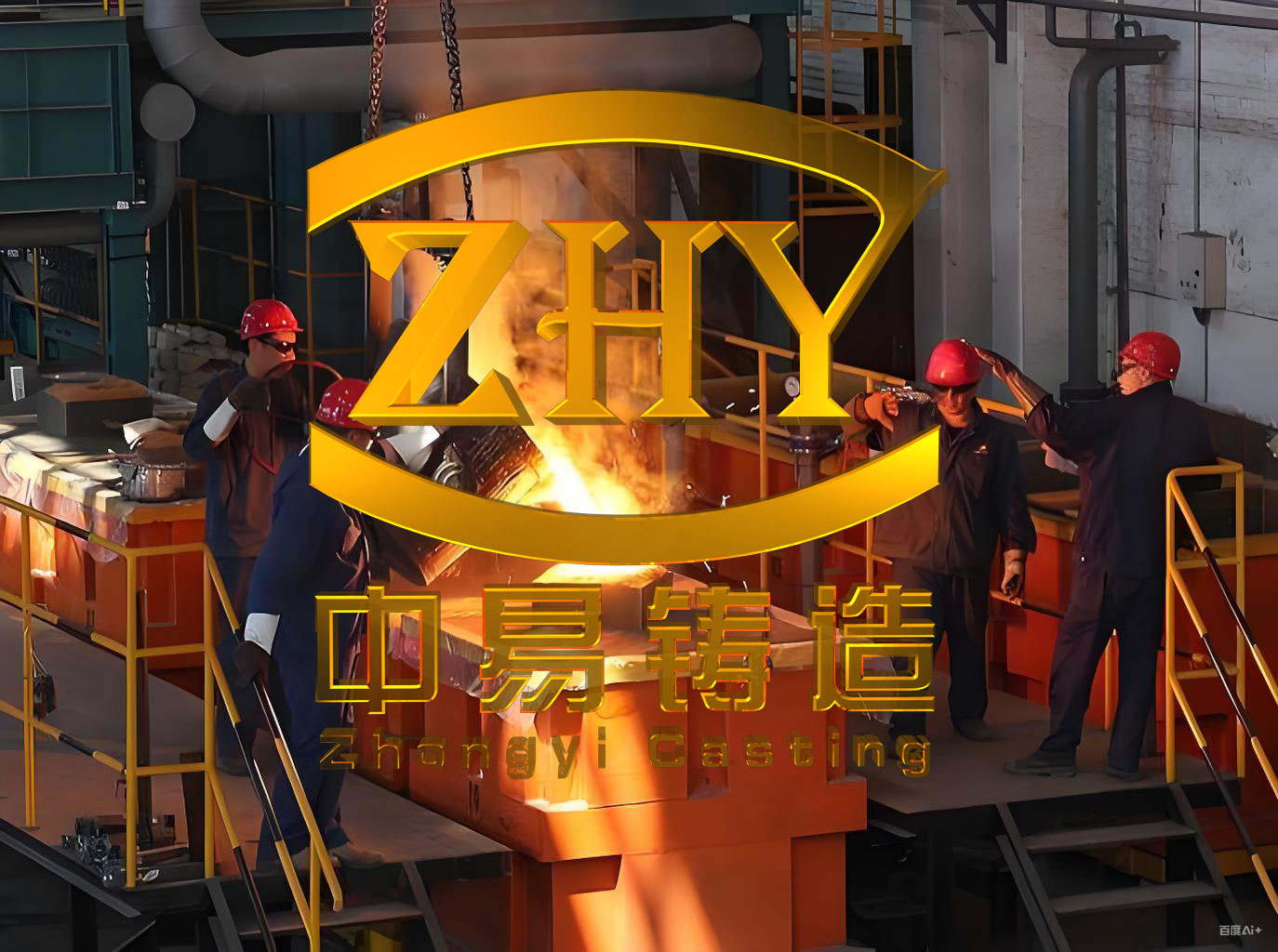
The sand processing department was designed for sustainability, with a closed-loop system that recycles 90% of used sand. This reduces waste and costs, a critical consideration for a steel castings manufacturer. The sand mix formula is: $$ S_m = S_r \times (1 – R_r) + S_n \times R_n $$ where \(S_m\) is the final sand mix, \(S_r\) is reclaimed sand, \(R_r\) is the reclamation rate, \(S_n\) is new sand, and \(R_n\) is the new sand ratio. In our case, \(R_r = 0.9\) and \(R_n = 0.1\), so: $$ S_m = S_r \times 0.9 + S_n \times 0.1 $$ This ensures consistent properties for molding steel castings. The cooling and screening processes are governed by heat transfer equations, such as: $$ Q = m \times c \times \Delta T $$ where \(Q\) is the heat removed, \(m\) is the sand mass, \(c\) is the specific heat, and \(\Delta T\) is the temperature change.
Environmental and safety design was paramount. We installed dust collectors at key points, such as furnace outlets and sand processing areas. The emission concentration was targeted below 50 mg/m³, compliant with regulations. The dust collection efficiency can be calculated as: $$ \eta_d = \left(1 – \frac{C_o}{C_i}\right) \times 100\% $$ where \(C_o\) is the outlet concentration and \(C_i\) is the inlet concentration. For our systems, with \(C_i = 300 \text{ mg/m³}\) and \(C_o = 50 \text{ mg/m³}\), \(\eta_d = 83.3\%\). This commitment to cleanliness reinforces the reputation of a responsible steel castings manufacturer. Additionally, we enhanced lighting and installed safety barriers in high-risk zones, ensuring worker protection.
The foundry cleaning department, located in a separate building, handles shot blasting, grinding, and inspection. This segregation prevents cross-contamination and improves workflow. As a steel castings manufacturer, we implement statistical quality control methods, such as using the process capability index \(C_p\): $$ C_p = \frac{USL – LSL}{6\sigma} $$ where \(USL\) and \(LSL\) are the upper and lower specification limits, and \(\sigma\) is the standard deviation. For our steel castings, we target \(C_p \geq 1.33\) to ensure high quality. Reject rates are monitored using: $$ R_r = \frac{N_{rej}}{N_{total}} \times 100\% $$ where \(N_{rej}\) is the number of rejected castings and \(N_{total}\) is the total produced. Our goal is to keep \(R_r\) below 2% for steel castings.
Advanced工艺技术装备 requires advanced management modes. We adopted a承包 system to enhance accountability and motivation. Under this model, the casting workshop is treated as a profit center, with bonuses tied to performance metrics. The profit formula for the承包者 is: $$ P_b = B + (A – T) \times 0.1 – (T – A) \times 0.1 $$ where \(P_b\) is the bonus, \(B\) is the base salary, \(A\) is the actual profit, and \(T\) is the target profit. This incentivizes efficiency. For production teams, we use a piece-rate system based on合格铸件 tonnage: $$ I_t = W_t \times R_t $$ where \(I_t\) is team income, \(W_t\) is the weight of合格铸件, and \(R_t\) is the rate per ton. This aligns worker interests with output goals, crucial for a steel castings manufacturer aiming to maximize throughput.
To further elaborate on the technical aspects, let’s consider the metallurgical controls for steel castings. As a steel castings manufacturer, we must manage composition and microstructure. The carbon equivalent (CE) formula for steel is: $$ CE = C + \frac{Mn}{6} + \frac{Cr + Mo + V}{5} + \frac{Ni + Cu}{15} $$ We maintain CE within 0.4-0.5 to ensure weldability and strength. For heat treatment, the cooling rate affects hardness, described by the Jominy end-quench test: $$ H = f(C, \text{alloy content}, t) $$ where \(H\) is hardness, \(C\) is carbon content, and \(t\) is time. We optimize these parameters to meet client specifications.
Energy management is another critical area. The total energy consumption for a steel castings manufacturer can be modeled as: $$ E_{total} = E_m + E_p + E_a $$ where \(E_m\) is melting energy, \(E_p\) is processing energy, and \(E_a\) is auxiliary energy. For our induction furnaces, \(E_m\) is calculated as: $$ E_m = \frac{W_m \times e_m}{\eta_f} $$ where \(W_m\) is the metal weight, \(e_m\) is the specific energy (e.g., 500 kWh/ton for steel), and \(\eta_f\) is furnace efficiency (0.75). This helps us track and reduce costs. We also employ heat recovery from exhaust gases, with efficiency: $$ \eta_h = \frac{Q_{rec}}{Q_{total}} \times 100\% $$ where \(Q_{rec}\) is recovered heat and \(Q_{total}\) is total heat generated.
In terms of capacity planning, we use linear programming to optimize resource allocation. The objective function for a steel castings manufacturer might be: $$ \text{Maximize } Z = \sum_{i=1}^n p_i x_i $$ subject to constraints like: $$ \sum_{i=1}^n a_{ij} x_i \leq b_j $$ where \(p_i\) is profit per product \(i\), \(x_i\) is production quantity, \(a_{ij}\) is resource usage, and \(b_j\) is resource availability. This ensures we meet demand while maximizing profitability. For example, balancing production between resin sand and automatic lines for steel castings.
Supply chain logistics are integral to our operations. We maintain raw material inventories based on economic order quantity (EOQ): $$ Q^* = \sqrt{\frac{2DS}{H}} $$ where \(D\) is annual demand, \(S\) is ordering cost, and \(H\) is holding cost. For steel scrap, a key input for a steel castings manufacturer, we optimize \(Q^*\) to minimize costs. Lead times for模具 are managed using critical path method (CPM), ensuring timely production.
Training and skill development are emphasized to handle advanced equipment. We assess workforce competency using performance indices: $$ I_p = \frac{T_a}{T_s} $$ where \(T_a\) is actual throughput and \(T_s\) is standard throughput. Regular training boosts \(I_p\), enhancing overall efficiency for the steel castings manufacturer. Safety metrics, such as accident frequency rate (AFR), are monitored: $$ AFR = \frac{N_{acc} \times 200,000}{T_{hours}} $$ where \(N_{acc}\) is number of accidents and \(T_{hours}\) is total hours worked. We aim for AFR < 2.0.
Looking ahead, we plan to integrate IoT sensors for predictive maintenance. This will reduce downtime and improve reliability, key for a steel castings manufacturer. The overall equipment effectiveness (OEE) formula guides this: $$ OEE = A \times P \times Q $$ where \(A\) is availability, \(P\) is performance, and \(Q\) is quality. Our target OEE is 85%, which would significantly boost output for steel castings.
In conclusion, designing and managing a modern foundry as a steel castings manufacturer involves a holistic approach. From phased construction and automation to environmental controls and innovative management, every element must align with efficiency and sustainability goals. The use of tables and formulas, as shown throughout this article, helps in planning and optimization. By sharing these experiences, I hope to contribute to the broader community of steel castings manufacturers, fostering advancements in our industry. The journey requires continuous adaptation, but with sound principles and a focus on technology, any steel castings manufacturer can thrive in today’s competitive landscape.