
In the automotive industry, shell castings play a critical role in ensuring the safety and performance of vehicle components. As a key security part, the steering gear housing must meet stringent requirements for surface quality, internal integrity, and mechanical strength. This article explores the casting process design for an aluminum alloy integral steering gear shell casting, focusing on overcoming defects through advanced methodologies. We employ CAE simulation and comparative analysis to evaluate two casting techniques: gravity casting and tilt-pour casting. The goal is to enhance the quality and reliability of shell castings, which are essential for durable automotive systems.
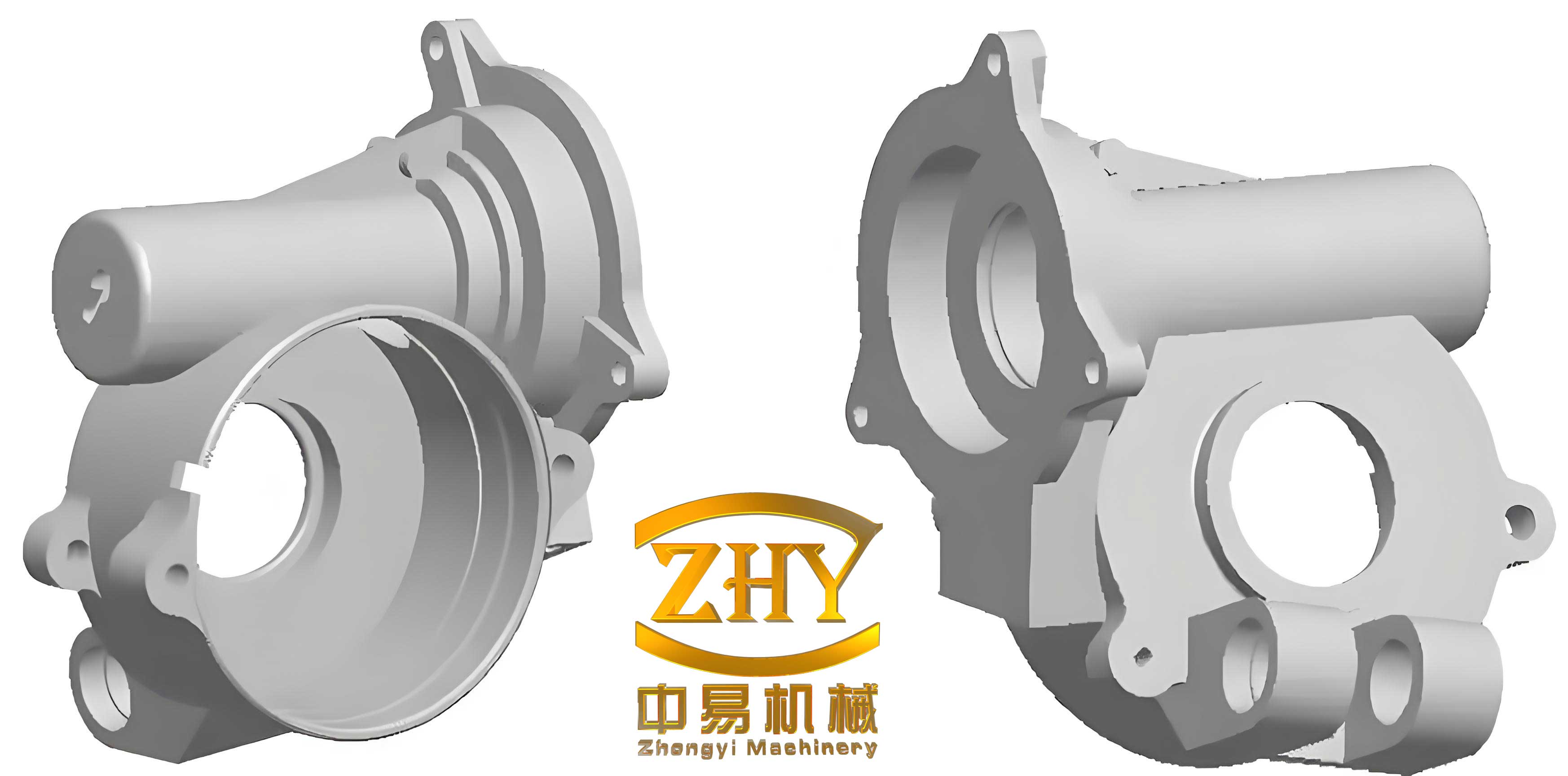
The steering gear shell casting discussed here is a complex thin-walled structure with a net weight of 1.70 kg and a theoretical wall thickness of 6–7 mm. It must withstand a pressure test of 7 MPa for 2 minutes without leakage. Machining allowances are 2 mm per side for pressure-bearing sections and 1 mm for non-pressure-bearing sections. Such shell castings require precise control over solidification and feeding to prevent defects like shrinkage porosity and cold shuts. The geometry includes multiple thermal hotspots, which are critical areas prone to defects during solidification. Identifying these hotspots is vital for effective process design in shell castings.
To analyze the thermal behavior, we performed a hotspot analysis using simulation software. The hotspots are concentrated at junctions and thick sections, where heat dissipation is slower. For shell castings, these regions necessitate adequate risering and gating design to ensure proper feeding. The hotspot distribution guides the placement of risers and gates, which is fundamental to achieving sound shell castings. In this study, we identified four primary hotspots, labeled as Hotspot 1 to Hotspot 4, each requiring specific attention in the casting process design for shell castings.
We developed two casting process schemes: metal mold gravity casting and metal mold tilt-pour casting. Both aim to produce high-quality shell castings, but they differ in approach and outcomes. The gravity casting scheme involves traditional pouring with a stationary mold, while the tilt-pour scheme uses a mold that rotates during pouring to control fluid flow and solidification. Each scheme was designed with detailed gating and risering systems tailored for shell castings.
For the gravity casting process, the design focused on dispersing gates to shorten filling distances and placing risers at major hotspots. The gating system ratio was set as follows: $$ F_{\text{inner}} : F_{\text{transverse}} : F_{\text{straight}} = 1 : 2.20 : 2.90 $$ where \( F_{\text{inner}} \) is the cross-sectional area of the ingate, \( F_{\text{transverse}} \) is the transverse gate area, and \( F_{\text{straight}} \) is the sprue area. From this ratio, we calculated the specific areas: $$ F_{\text{inner}} = 1358 \, \text{mm}^2, \quad F_{\text{transverse}} = 1046 \, \text{mm}^2, \quad F_{\text{straight}} = 476 \, \text{mm}^2. $$ The total casting weight, including risers and gating, was 2.17 kg, with a pouring time of 6 seconds and a filling speed of 15 cm/s. The process yield was 42.7%, computed as: $$ \text{Yield} = \frac{\text{Casting Weight}}{\text{Total Weight}} \times 100\% = \frac{1.70}{2.17 + 1.78} \approx 42.7\%. $$ This low yield indicates significant material usage in risers and gates, which is a concern for economical production of shell castings.
Simulation parameters for gravity casting included a pouring temperature of 730°C, sand core temperature of 80°C, and mold temperature of 300°C. The solidification analysis revealed high-risk areas at hotspots, with prolonged solidification times leading to potential shrinkage defects in shell castings. The time to reach 30% solid fraction, denoted as \( t_{30} \), was used to assess solidification uniformity. For shell castings, a uniform \( t_{30} \) distribution is desirable to minimize defects. In gravity casting, the \( t_{30} \) varied significantly, with hotspots solidifying later, as shown in the simulation results.
In contrast, the tilt-pour casting process was designed with gates positioned at the lower plane of the mold to ensure stable filling. Risers were placed at Hotspots 1, 2, and 4, along with the pipe opening, to enhance feeding. The same gating ratio was applied, but the mold tilt during pouring promoted a smoother flow field, reducing turbulence and oxide inclusion in shell castings. The process yield improved to 54.1%, with a riser weight of 1.91 kg and a total casting weight of 2.25 kg. The yield calculation is: $$ \text{Yield} = \frac{1.70}{2.25} \times 100\% \approx 54.1\%. $$ This higher yield makes tilt-pour casting more efficient for producing shell castings.
Simulation for tilt-pour casting used identical temperature parameters. The results showed fewer high-risk areas and more uniform solidification. The \( t_{30} \) distribution was tighter, indicating better thermal management. The solidification time \( t_s \) for a location can be modeled using Chvorinov’s rule: $$ t_s = k \left( \frac{V}{A} \right)^n $$ where \( V \) is volume, \( A \) is surface area, \( k \) is a constant, and \( n \) is an exponent. For shell castings, a lower \( t_s \) variation across the casting reduces defect propensity. In tilt-pour casting, the modified fluid dynamics helped achieve this, critical for quality shell castings.
We conducted a comparative analysis of the two processes based on key metrics relevant to shell castings. The table below summarizes the findings:
| Metric | Gravity Casting | Tilt-Pour Casting | Importance for Shell Castings |
|---|---|---|---|
| Process Yield (%) | 42.7 | 54.1 | High – affects material efficiency and cost |
| CAE Simulation Risk | Multiple high-risk locations | Few high-risk locations | High – indicates defect probability |
| Process Stability | Highly dependent on operator skill | Relies on equipment consistency | High – impacts repeatability of shell castings |
| Labor Intensity | Moderately high | Moderately high | Medium – influences production ergonomics |
| Shift Output (pieces) | 75 | 75 | Medium – relates to productivity of shell castings |
From the table, tilt-pour casting outperforms gravity casting in yield and defect risk, both crucial for shell castings. The process stability, while equipment-dependent, offers better control over casting parameters, leading to more consistent shell castings. Although both processes have similar shift outputs, the higher yield of tilt-pour casting reduces material waste, enhancing sustainability in manufacturing shell castings.
To quantify the filling behavior, we used the Reynolds number \( Re \) to assess flow characteristics: $$ Re = \frac{\rho v L}{\mu} $$ where \( \rho \) is density, \( v \) is velocity, \( L \) is characteristic length, and \( \mu \) is dynamic viscosity. For aluminum alloy shell castings, maintaining \( Re \) below critical thresholds minimizes turbulent flow. In tilt-pour casting, the controlled pouring reduces \( v \), thereby lowering \( Re \) and promoting laminar flow, which is beneficial for surface quality of shell castings.
Furthermore, the solidification modeling involved solving the heat transfer equation: $$ \frac{\partial T}{\partial t} = \alpha \nabla^2 T + \frac{Q}{\rho c_p} $$ where \( T \) is temperature, \( t \) is time, \( \alpha \) is thermal diffusivity, \( Q \) is heat source, \( \rho \) is density, and \( c_p \) is specific heat. For shell castings, accurate simulation of this equation helps predict shrinkage and porosity. The tilt-pour process showed a more uniform temperature gradient, reducing thermal stresses in shell castings.
In practice, the tilt-pour casting process was implemented for producing the steering gear shell castings. The results demonstrated a first-pass pressure test qualification rate of 98%, significantly higher than traditional methods. This improvement underscores the effectiveness of tilt-pour technology for complex shell castings. The stable flow field and enhanced feeding capabilities address common defects, making it a viable approach for high-integrity shell castings in automotive applications.
In conclusion, the design and optimization of casting processes for aluminum alloy shell castings require careful consideration of gating, risering, and pouring techniques. Through comparative analysis, tilt-pour casting emerges as a superior method, offering higher yield, lower defect risk, and better process stability. These advantages are essential for producing reliable shell castings that meet automotive safety standards. Future work could explore advanced simulation models and material innovations to further enhance the quality of shell castings. This study contributes to the broader field of casting technology, providing insights for manufacturing high-performance shell castings efficiently and economically.