
In the realm of foundry engineering, the selection of casting shrinkage rates for large thin-walled shell castings is a pivotal aspect of process design. As an engineer involved in the development of such components, I have observed that deformation during casting and heat treatment phases frequently poses significant challenges. Accurately predicting the locations and magnitudes of deformation, along with implementing effective preventive and corrective measures, constitutes a critical focus in advancing casting technology. This article delves into the intricacies of process design for large aluminum alloy shell castings, drawing from extensive trial production and research. We explore the relationship between shrinkage rates and the geometry, structure, and wall thickness of shell castings, uncover patterns of deformation, and present innovative solutions for rapid and stable mold filling. The insights shared here aim to enhance the manufacturability and quality of complex shell castings.
The core of our investigation centers on a specific large aluminum oil pan—a quintessential example of a thin-walled shell casting. This component measures 2042 mm in length, 480 mm in width, and 649 mm in height, with an average wall thickness of 12 mm and a thickness variation of up to 70 mm. Fabricated from ZL104 aluminum alloy, the casting weighs 202 kg, requiring a molten metal charge of 296 kg. The mold assembly comprises 17 cores, including base, intermediate, sidewall, end, sump, and cover plate cores. The casting process employs PEPSET self-setting resin for core making, followed by gravity pouring using resin sand assembled cores. Understanding the structural nuances of such shell castings is fundamental to optimizing their production.
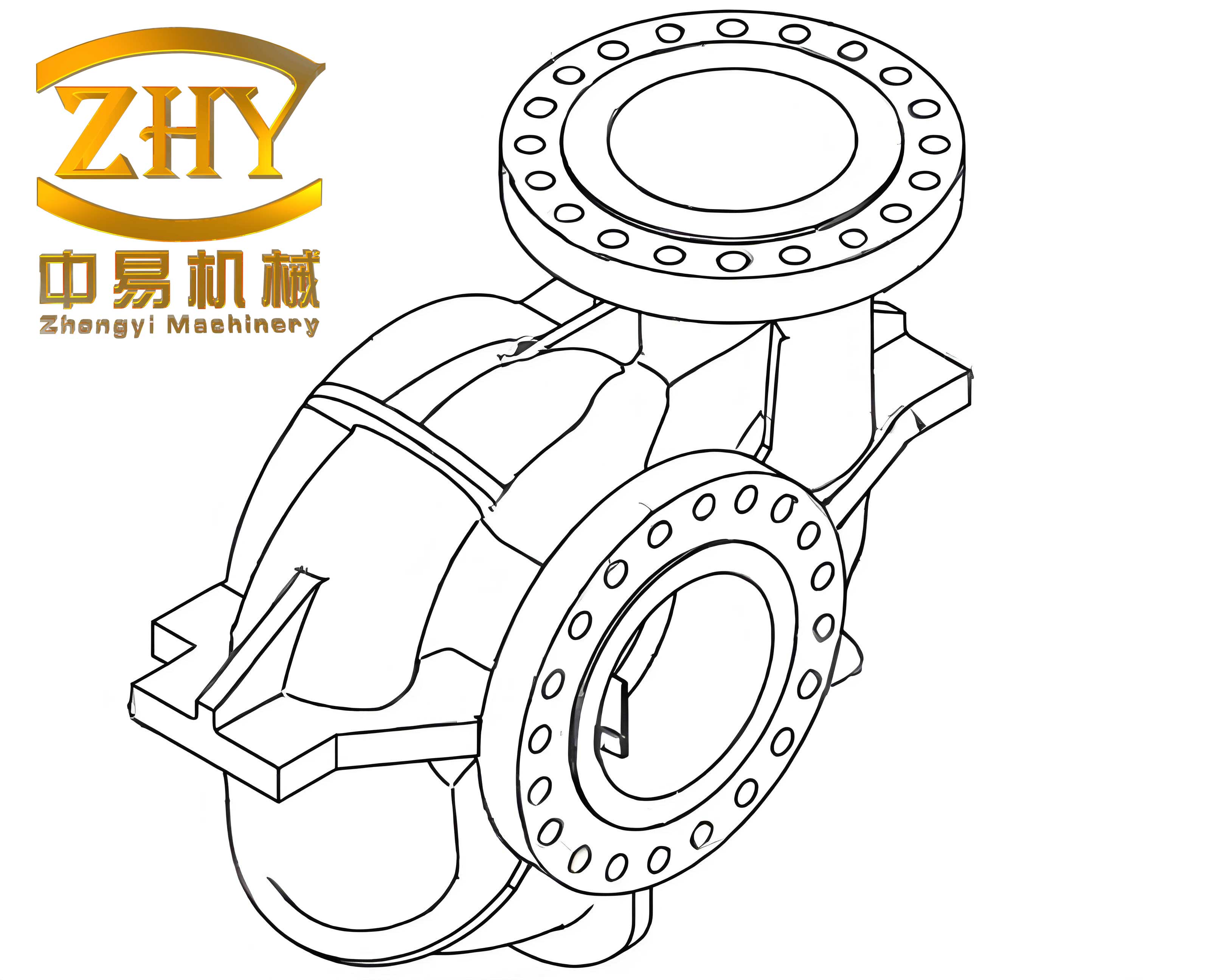
Initial trials for these shell castings utilized wooden patterns and core boxes. The casting shrinkage rate was uniformly set at 1% across all dimensions—length, width, and height. Post-casting inspection and layout analysis, however, revealed significant discrepancies. The total length of the casting was less than the theoretically calculated value, with both ends bulging inward. Furthermore, dimensional deviations in features like oil passage holes and connection flange holes on the sidewalls followed a pattern: deviations increased with distance from the datum points. This indicated that the actual shrinkage in the length direction exceeded the preset rate. Conversely, the width direction showed actual dimensions slightly larger than calculated, suggesting hindered contraction due to core obstruction. The height direction exhibited free contraction, aligning closely with the set shrinkage rate. These findings underscore that shrinkage in shell castings is not isotropic but highly dependent on geometric constraints and thermal gradients.
To systematically address these variations, we analyzed the underlying causes. In the length direction, the discrepancy arose not only from an underestimated shrinkage rate but also from the convention of applying shrinkage linearly from one end. For large shell castings exceeding 2000 mm, contraction effectively occurs from the center toward both ends, influenced by the thermal field during solidification. The governing relation for thermal contraction can be expressed as:
$$
\Delta L = \alpha \cdot L_0 \cdot \Delta T
$$
where $\Delta L$ is the length change, $\alpha$ is the coefficient of thermal expansion for the alloy, $L_0$ is the initial length at the solidus temperature, and $\Delta T$ is the temperature drop during cooling. However, for shell castings, mechanical hindrance from cores and molds modifies this free contraction. The effective shrinkage rate $S_{\text{eff}}$ in a constrained direction can be modeled as:
$$
S_{\text{eff}} = S_{\text{free}} – \frac{\sigma_{\text{constraint}}}{E}
$$
where $S_{\text{free}}$ is the free shrinkage rate, $\sigma_{\text{constraint}}$ is the stress due to constraint, and $E$ is the elastic modulus of the alloy at elevated temperatures. For width direction, constraint from the central core reduced actual shrinkage. Height direction experienced minimal constraint, approximating free shrinkage.
| Direction | Initial Shrinkage Rate | Observed Behavior | Revised Shrinkage Rate | Key Consideration |
|---|---|---|---|---|
| Length | 1.0% | Actual shrinkage > set rate; contraction from center outward | 1.2% (applied from center datum) | Thermal gradient and core geometry |
| Width | 1.0% | Actual shrinkage < set rate due to core hindrance | 0.8% | Mechanical constraint from cores |
| Height | 1.0% | Free contraction aligned with set rate | 1.0% | Minimal obstruction in vertical direction |
Implementing these directional shrinkage rates in metal mold design, with the length datum set at the geometric center, significantly improved dimensional accuracy. Subsequent inspections confirmed deviations within 2 mm in length and under 1 mm in width and height, meeting stringent tolerances for large shell castings.
Gating system design profoundly impacts the quality of shell castings. Initially, a single sprue at one end with lateral runners led to prolonged filling times, reduced velocity at the far end, increased oxide inclusion formation, and cold shuts on upper surfaces. To overcome these issues, we redesigned the system to incorporate two sprues for bilateral filling, which enhanced filling uniformity. Furthermore, the substantial drop height of nearly 800 mm from the pouring cup to the mold cavity caused severe metal splashing and dross entrapment. Although filters were used, some inclusions still penetrated, leading to leakage defects in pressure tests. The solution involved transforming the straight sprue into a serpentine configuration. The serpentine sprue’s sinuous path dissipates kinetic energy, reducing splash and turbulence. The pressure loss along a serpentine channel can be approximated using the Darcy-Weisbach equation for non-circular ducts:
$$
\Delta P = f \cdot \frac{L}{D_h} \cdot \frac{\rho v^2}{2}
$$
where $\Delta P$ is the pressure drop, $f$ is the friction factor, $L$ is the path length, $D_h$ is the hydraulic diameter, $\rho$ is the molten metal density, and $v$ is the flow velocity. For aluminum alloys, this reduction in $\Delta P$ minimizes velocity spikes that cause oxidation.
Despite these improvements, filling speed diminished as metal approached the top of the cavity, especially with conventional pouring cups. This resulted in cold shuts. Simply increasing metal head height or pour volume was inefficient and exacerbated dross formation. We adopted a high-pressure head filling cup, which maintains a consistent metallostatic pressure throughout the pour without elevating the cup height excessively. The principle relies on Bernoulli’s equation applied to the gating system:
$$
P_1 + \frac{1}{2} \rho v_1^2 + \rho g h_1 = P_2 + \frac{1}{2} \rho v_2^2 + \rho g h_2
$$
By designing the cup to sustain a higher $h_1$ relative to the cavity, velocity $v_2$ at the ingate remains sufficient for complete filling. This innovation enabled rapid, tranquil filling of large shell castings, virtually eliminating cold shuts and reducing inclusion defects.
| Configuration | Filling Characteristics | Defect Incidence | Recommended for Shell Castings |
|---|---|---|---|
| Single end sprue | Slow, non-uniform fill; velocity decay | High (cold shuts, inclusions) | No |
| Dual side sprues | Faster, more symmetrical fill | Moderate (improved but splash issues) | Yes, with modifications |
| Serpentine sprue + high-pressure cup | Rapid, smooth fill; controlled turbulence | Low (minimal cold shuts, inclusions) |
Deformation in shell castings manifests both during solidification and subsequent heat treatment. Initial trials with wooden patterns exhibited combined warping and twisting, notably at the ends, with magnitudes reaching 7–8 mm. This localized deformation correlates with section thickness variations; the ends feature massive sections like sealing bosses, up to 70 mm thick, which solidify last. The thermal stress driving deformation can be quantified via the temperature gradient during cooling. The induced stress $\sigma_{\text{thermal}}$ is given by:
$$
\sigma_{\text{thermal}} = E \cdot \alpha \cdot (T_{\text{hot}} – T_{\text{cold}})
$$
where $T_{\text{hot}}$ and $T_{\text{cold}}$ are temperatures in thicker and thinner regions, respectively. For shell castings, this stress often exceeds the yield strength at elevated temperatures, causing plastic deformation.
To counteract casting deformation, we employed a multi-pronged strategy. Merely increasing machining allowance proved ineffective for deformations over 3 mm, as added mass exacerbates distortion. Instead, we integrated anti-deformation measures into the metal mold design. Pre-deformation, or reverse distortion, was applied to the pattern based on predicted deformation patterns. The pre-deformation offset $\delta_{\text{pre}}$ is empirically derived but can be estimated as:
$$
\delta_{\text{pre}} = k \cdot \delta_{\text{predicted}}
$$
where $k$ is a factor (typically 0.8–1.2) accounting for spring-back effects, and $\delta_{\text{predicted}}$ is the estimated deformation from thermal simulation. Additionally, we incorporated process ribs at the vulnerable ends of the shell castings. These ribs, designed with thickness matching adjacent casting walls (approximately 12 mm), solidify earlier or concurrently with the casting. They provide mechanical restraint: resisting tensile forces during outward warping and compressive forces during inward sinking. The rib’s effectiveness hinges on its solidification time $t_{\text{rib}}$ relative to the casting’s $t_{\text{cast}}$. Ideally, $t_{\text{rib}} \leq t_{\text{cast}}$ to avoid hot tearing or adverse pulling.
Heat treatment introduces further distortion risks, especially when shell castings are positioned with mating faces upward. Thermal expansion and stress relief can amplify existing deformations. Our preventive approach involved supporting the casting ends with fixtures and applying counter-deformation forces via bolt-tightening devices during solution treatment. The applied force $F$ helps counteract the thermally induced bending moment $M_{\text{thermal}}$:
$$
M_{\text{thermal}} = \int \sigma_{\text{thermal}} \cdot y \, dA
$$
where $y$ is the distance from the neutral axis. By applying $F$ at strategic points, we generate a compensating moment $M_{\text{applied}} = F \cdot d$, where $d$ is the moment arm. This combination of support and force application reduced post-heat-treatment deformation to under 2 mm, ensuring dimensional stability for large shell castings.
| Deformation Phase | Mechanism | Preventive Measure | Key Parameter / Formula | Outcome |
|---|---|---|---|---|
| Casting (Solidification) | Differential cooling thick vs. thin sections | Pre-deformation in mold design | $\delta_{\text{pre}} = k \cdot \delta_{\text{predicted}}$ | Compensates shrinkage distortion |
| Casting (Solidification) | Thermal stress exceeding yield strength | Process ribs at critical locations | $t_{\text{rib}} \leq t_{\text{cast}}$ for effectiveness | Provides mechanical restraint |
| Heat Treatment | Stress relief and thermal expansion | End supports + bolt counter-forces | $M_{\text{applied}} = F \cdot d$ to offset $M_{\text{thermal}}$ | Minimizes distortion amplification |
In conclusion, the successful production of large aluminum alloy shell castings hinges on a nuanced understanding of directional shrinkage and deformation control. Through methodical analysis and innovation, we have demonstrated that tailored shrinkage rates—differentiated by axis based on structural constraints—are essential for dimensional accuracy. Moreover, advanced gating systems like serpentine sprues coupled with high-pressure head pouring cups facilitate rapid, stable filling, critical for thin-walled shell castings. Proactive deformation management via pre-deformation, process ribs, and heat treatment fixtures further ensures geometric integrity. These principles, synthesized from hands-on experience, provide a robust framework for the casting process design of complex shell castings, ultimately enhancing yield, quality, and performance in demanding applications.