
In the realm of modern manufacturing, the machining of large thin-walled castings for machine tools presents significant challenges due to their structural complexity, dimensional instability, and stringent precision requirements. As an engineer specializing in advanced machining systems, I have extensively studied the design of transfer machine tools for such components, focusing on optimizing processes for enhanced accuracy and productivity. Machine tool castings, particularly those with expansive surfaces and minimal wall thickness, are critical in applications like textile machinery, where components such as loom side frames (or wall plates) serve as essential support structures. These machine tool castings must exhibit high dimensional stability and surface quality to ensure proper assembly, reduce operational noise, and maintain long-term reliability. In this article, I will delve into the comprehensive design approach for machining a large thin-walled wall plate, emphasizing solutions for positioning, clamping, tooling, and process sequencing that address the inherent difficulties of machine tool castings.
The specific component under consideration is a wall plate from a PQPQ-type loom, which exemplifies the typical issues associated with machine tool castings. This wall plate features a substantial area of approximately 1,100 mm × 520 mm, with a minimum wall thickness of only 1.5 mm, classifying it as a large thin-walled casting. It requires machining on 11 surfaces, involving operations such as milling, boring, expanding, reaming, and drilling. Key machining features include two bottom foot surfaces with a surface roughness requirement of Ra ≤ 1.6 μm, two diamond-shaped mounting pads on Ø120 mm holes with Ra ≤ 1.6 μm, two symmetrical Ø120 mm holes with Ra ≤ 0.8 μm, and one Ø25 mm hole with Ra ≤ 0.8 μm. The Ø120 mm holes are crucial for installing the loom’s main and drive shafts, demanding tight positional tolerances: a center distance of 606 ± 0.05 mm and specific relations to the Ø25 mm hole. These requirements underscore the precision needed in machining machine tool castings, where even minor deviations can lead to assembly issues or performance degradation.
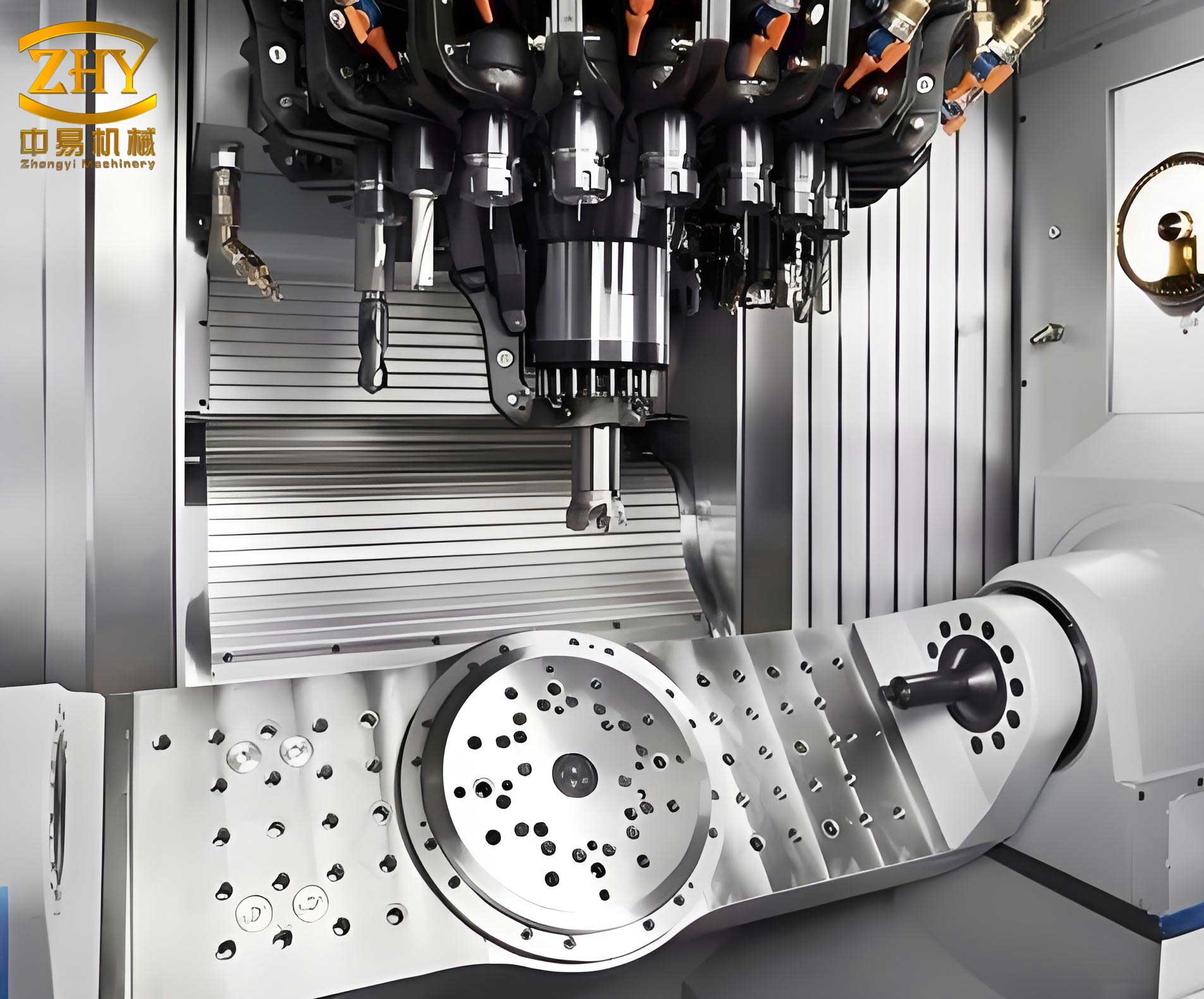
To tackle these challenges, the first step involves devising a robust positioning and clamping scheme. Given the thin-walled nature of machine tool castings, minimizing distortion during machining is paramount. I adopted a six-point complete positioning method, which constrains all degrees of freedom. However, due to the large surface area and localized cutting forces, additional supports were integrated. For instance, two spherical self-aligning supports were placed beneath the Ø120 mm hole regions to counteract Z-direction cutting forces during boring. Similarly, an auxiliary support was added under the Ø25 mm hole area to bolster rigidity during reaming. Clamping is executed via a pneumatic system, ensuring uniform force distribution across multiple points and preventing localized deformation common in thin-walled machine tool castings. The use of pads at clamping points increases contact area, further enhancing stability. This approach reduces setup time and improves repeatability, which is vital for high-volume production of machine tool castings.
The design of machining stations is a cornerstone of this transfer machine tool. For machine tool castings with numerous machining features, combining mobile and fixed stations optimizes workflow and accuracy. Here, the milling of bottom foot surfaces and diamond pads is performed on a mobile station, where the workpiece is fixed on a table that slides along a mechanical slide. This allows continuous milling as the table moves, effectively creating a moving station that processes multiple surfaces in one pass. Once the table reaches a predetermined position, it engages a dead stop to form a fixed station for boring the Ø120 mm holes and reaming the Ø25 mm hole. This hybrid station design eliminates repeated repositioning errors, thereby enhancing the overall precision of machine tool castings. The layout of the machine, including the arrangement of cutting heads, is summarized in Table 1, which outlines the station types and corresponding operations.
| Station Type | Machining Operations | Key Features | Benefits for Machine Tool Castings |
|---|---|---|---|
| Mobile Station | Milling of bottom foot surfaces and diamond pads | Continuous sliding motion, simultaneous milling | Reduces positioning errors, improves efficiency |
| Fixed Station | Boring of Ø120 mm holes, reaming of Ø25 mm hole | Precise positioning via dead stop, combined tools | Ensures dimensional accuracy and surface finish |
Tooling innovation plays a pivotal role in simplifying processes for machine tool castings. For the Ø25 mm hole, which requires both expanding and reaming, I designed a combined expander-reamer tool made from material equivalent to YG8 (a common carbide grade). This tool performs both operations in a single continuous feed, avoiding the need for multiple setups that could introduce errors in thin-walled components. The tool geometry is optimized to minimize cutting forces, with the expander section preparing the hole and the reamer section achieving the final Ra ≤ 0.8 μm surface finish. For the Ø120 mm holes, a composite boring tool is employed, integrating both roughing and finishing inserts on one boring bar. The roughing uses a double-edged insert for balanced radial forces, while finishing employs a single-edged insert for precise size control. The boring tool features an adjustable mechanism to compensate for wear, ensuring consistent accuracy over time. These tooling strategies are crucial for maintaining the integrity of machine tool castings during machining.
Cutting force management is essential to prevent vibration, displacement, and deformation in thin-walled machine tool castings. I implemented several measures to control these forces. First, symmetric cutting is used for milling the diamond pads: two milling heads rotate in opposite directions (one clockwise, one counterclockwise), canceling out lateral forces in the X-direction and stabilizing the workpiece. Second, graded machining is applied for boring the Ø120 mm holes. The process is divided into rough and finish stages, with reduced cutting parameters to lower forces. The radial force during boring can be approximated using the formula: $$F_r = C_F \cdot a_p^{x_F} \cdot f^{y_F} \cdot v_c^{n_F} \cdot K_{F}$$ where \(F_r\) is the radial force, \(C_F\) is a material constant, \(a_p\) is the depth of cut, \(f\) is the feed rate, \(v_c\) is the cutting speed, and \(K_{F}\) is a correction factor. By minimizing \(a_p\) and \(f\) during finishing, we reduce \(F_r\), thereby enhancing precision. Additionally, the use of double-edged inserts for roughing distributes forces evenly, as shown in Table 2, which compares cutting parameters for different operations.
| Operation | Tool Type | Depth of Cut \(a_p\) (mm) | Feed Rate \(f\) (mm/rev) | Cutting Speed \(v_c\) (m/min) | Estimated Radial Force \(F_r\) (N) |
|---|---|---|---|---|---|
| Rough Boring (Ø120 mm) | Double-edged insert | 1.5 | 0.2 | 80 | ~500 |
| Finish Boring (Ø120 mm) | Single-edged insert | 0.2 | 0.05 | 100 | ~50 |
| Milling (Diamond Pads) | Face mill | 2.0 | 0.1 (per tooth) | 60 | ~300 (net near zero due to symmetry) |
| Expanding-Reaming (Ø25 mm) | Combined tool | 0.5 (expand), 0.1 (ream) | 0.15 | 30 | ~100 |
The machining sequence must be meticulously planned to integrate diverse operations seamlessly. For this transfer machine tool, I designed a T-shaped production line comprising a main slide and a side mechanical slide. The main line handles the bottom foot surfaces, Ø120 mm holes, diamond pads, and Ø25 mm hole via the mobile and fixed stations. The side slide processes small side pads and threaded holes, as per the original design. The timing sequence, illustrated in Figure 1 (referring to the original text’s timing diagram), ensures efficient workflow without interference. This sequencing minimizes idle time and maintains consistent quality across batches of machine tool castings. The overall cycle time is optimized to enhance productivity while adhering to precision constraints.
Precision control is further achieved through meticulous machine adjustment and process validation. For the Ø120 mm holes, the center distance of 606 ± 0.05 mm is guaranteed by precisely setting the two boring heads on the transfer machine. I used copper adjustment blocks for fine-tuning, followed by trial cuts and micro-adjustments via scraping rather than grinding, as copper’s softness prevents wheel clogging. The positional accuracy between the Ø120 mm and Ø25 mm holes is ensured by the fixed station’s inherent rigidity. Surface finish requirements are met by selecting appropriate tool geometries and cutting fluids. For instance, the Ra ≤ 0.8 μm for the Ø25 mm hole is achieved through the combined expander-reamer tool with polished edges. The stiffness of the overall system, critical for machining thin-walled machine tool castings, can be modeled using the formula: $$K_{total} = \frac{1}{\frac{1}{K_{machine}} + \frac{1}{K_{workpiece}} + \frac{1}{K_{fixture}}}$$ where \(K_{total}\) is the total stiffness, and each term represents the stiffness of the machine structure, workpiece, and fixture, respectively. By maximizing \(K_{fixture}\) through robust clamping and supports, we enhance \(K_{total}\), reducing vibrations and improving accuracy.
In conclusion, the design of a transfer machine tool for large thin-walled machine tool castings, as exemplified by the loom wall plate, requires a holistic approach that addresses positioning, tooling, force control, and sequencing. By employing a combination of mobile and fixed stations, innovative composite tools, and symmetric cutting strategies, we can overcome the challenges associated with these delicate components. The result is a compact, efficient machining system that significantly boosts manufacturing precision and productivity for machine tool castings. This methodology is adaptable to other similar castings in industries like aerospace or automotive, where thin-walled structures are prevalent. Future work could involve integrating real-time monitoring systems to further enhance accuracy and adapt to variations in casting properties, ensuring that machine tool castings meet ever-tightening industrial standards.