
The pursuit of durable, cost-effective materials for abrasive wear applications has long been a central focus in industrial research. Among the various candidates, chromium alloyed white cast irons stand out due to their exceptional hardness and wear resistance imparted by hard eutectic carbides embedded within a metallic matrix. For decades, high-chromium white cast irons, typically containing over 15% Cr, have been considered the benchmark for demanding high-stress and impact-abrasion conditions. Their superior performance is intrinsically linked to the predominance of the M7C3-type eutectic carbides in their microstructure. These carbides exhibit a desirable, isolated rod-like or hexagonal morphology, which contributes to good fracture toughness and wear resistance.
In contrast, traditional medium-chromium (roughly 5-10% Cr) and low-chromium white cast irons primarily contain the M3C-type carbides. These carbides typically form a continuous, interconnected network, often described as a ledeburitic structure. This skeletal network acts as a ready path for crack propagation, leading to poor impact toughness and inferior performance under high-stress abrasion. Consequently, these materials have been largely confined to low-stress sliding abrasion applications. The fundamental reason for this dichotomy lies in the thermodynamics of carbide formation, traditionally dictated by the ratio of chromium to carbon (Cr/C) in the alloy.
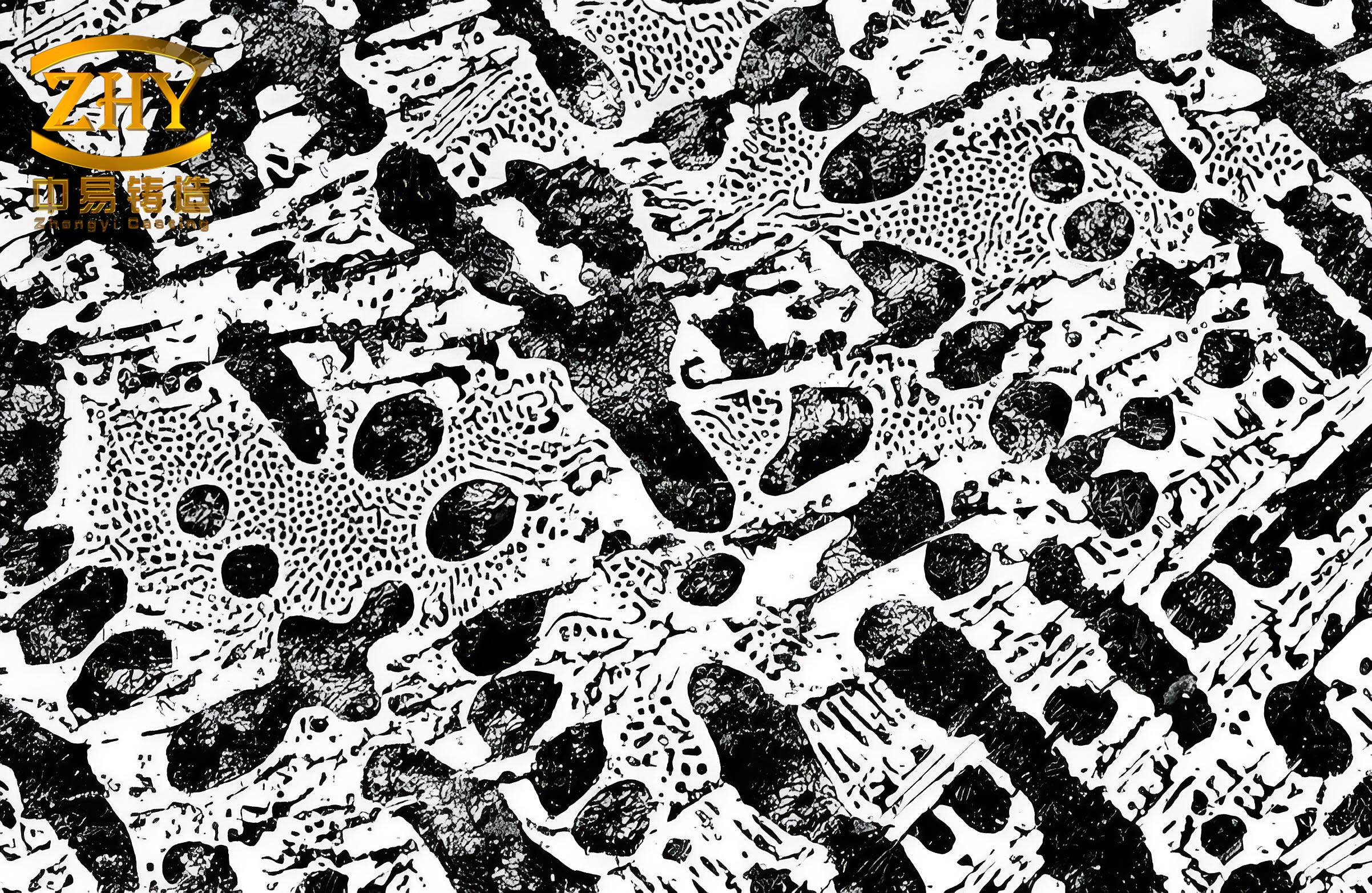
The thermodynamic condition favoring the formation of M7C3 over M3C in white cast iron can be approximated by considering the stability regions of these phases. A simplified representation of the critical Cr/C ratio is often used. It has been widely accepted and documented in numerous studies that to secure a predominantly M7C3 carbide structure, the chromium content must be sufficiently high, often summarized by the rule: for a given carbon content, the chromium level must exceed a threshold to achieve a Cr/C ratio greater than approximately 5. This relationship can be conceptually expressed as:
$$ \text{Primary Carbide Type} = \begin{cases} \text{M}_7\text{C}_3, & \text{if } \frac{\text{Cr}}{\text{C}} \geq k \\ \text{M}_3\text{C}, & \text{if } \frac{\text{Cr}}{\text{C}} < k \end{cases} $$
where \( k \) is a constant typically around 5-6 for standard cooling conditions. In medium-chromium white cast irons with Cr contents between 6% and 10%, achieving this ratio without excessively lowering carbon (and thus hardness) is challenging under conventional composition design and solidification conditions. This thermodynamic hurdle has historically limited the development of high-performance medium-chromium white cast iron grades.
However, the high cost of chromium has driven a persistent need to develop alternative materials that offer comparable performance to high-chromium white cast iron at a lower alloying cost. Our research was initiated with the hypothesis that the strict thermodynamic boundary for M7C3 formation could be circumvented or shifted through a synergistic combination of strategic alloying and process control. We focused on manipulating not just the thermodynamics but, crucially, the kinetics of solidification to promote the nucleation and growth of the desirable M7C3 carbides in a medium-chromium white cast iron system.
The core of our approach was a novel compositional design for a medium-chromium white cast iron, centered on the intentional and significant addition of molybdenum (Mo). The base composition range targeted was: C: 2.8-3.3%, Cr: 8-12%, Mo: 3-5%, with balanced additions of Si, Mn, and other elements to control the matrix structure. Molybdenum plays a multifaceted role. Firstly, it is a strong carbide former and partitions strongly into the carbide phase during solidification. This effectively increases the local “Cr-equivalent” in the liquid ahead of the growing carbide front, thereby thermodynamically stabilizing the M7C3 structure even at a lower overall chromium content. This effect can be modeled by an equivalent factor for Mo, modifying the critical ratio:
$$ \text{Effective Ratio} = \frac{\text{Cr} + \alpha \cdot \text{Mo}}{\text{C}} $$
where \( \alpha \) is a partitioning coefficient (greater than 1), indicating Mo’s potent effect on carbide stabilization. When this effective ratio is sufficiently high, the formation of M7C3 is favored.
Secondly, and equally important, is the application of a specific inoculating or modifying treatment just before casting. We introduced a proprietary complex inoculant containing elements such as titanium (Ti), vanadium (V), and nitrogen (N) into the molten metal. These elements form stable, high-melting-point nitrides and carbonitrides (e.g., TiN, V(C,N)) that act as potent heterogeneous nucleation sites for the eutectic carbides. This kinetic intervention dramatically alters the solidification path. Instead of the austenite dendrites forming first and the carbide eutectic filling the last liquid channels (often leading to a continuous network), the inoculated particles promote a more simultaneous, coupled eutectic growth. This results in the nucleation of M7C3 carbides at numerous, dispersed sites, encouraging them to grow in a more isolated, globular, or vermicular (short-rod) form.
The microstructural outcomes of this integrated alloying and processing strategy were profound and quantitatively verified. The characteristics of the carbides in our developed high-molybdenum medium-chromium white cast iron were compared with traditional medium-chromium and standard high-chromium white cast irons, as summarized in the table below.
| Type of White Cast Iron | Predominant Carbide Type | Carbide Volume Fraction (%) | Carbide Morphology & Distribution | Average Carbide Perimeter (μm) | Microhardness (HV) |
|---|---|---|---|---|---|
| Traditional Medium-Cr | M3C | ~28-32 | Continuous network, lamellar | — | ~1100-1300 |
| Our Developed High-Mo Medium-Cr | M7C3 (~80% of total) | ~28-31 | Isolated globules & vermicular rods | ~25-30 | ~1400-1600 |
| Standard High-Cr (15-20% Cr) | M7C3 | ~25-30 | Isolated rods/hexagons | ~15-20 | ~1500-1800 |
As evident from the data, our developed white cast iron achieved a carbide structure remarkably similar to that of high-chromium white cast iron. Approximately 80% of the total eutectic carbides were of the M7C3 type. They were distributed as discrete, isolated particles within the matrix, breaking the harmful continuous network. While the individual M7C3 particles were slightly larger (higher average perimeter) and had a marginally lower microhardness than those in high-chromium iron—attributed to the lower overall Cr content in the carbide—their fundamental beneficial characteristics were retained.
The impact of the inoculant on carbide morphology was quantitatively significant. Image analysis on as-cast samples revealed that the total perimeter of carbides per unit area (a measure of connectivity) was drastically reduced in the inoculated white cast iron compared to an uninoculated melt of similar base composition. This confirms the transition from a interconnected net to a dispersed phase.
The mechanical properties of this new grade of white cast iron were consequently enhanced to levels meeting or exceeding those of standard high-chromium grades. The isolated carbide morphology presents a much less favorable path for crack propagation. Under impact loading, a crack initiated at a brittle carbide is likely to be arrested at the carbide/matrix interface or deflected, rather than propagating unimpeded through a connected network. This translates directly to superior impact toughness. Furthermore, the hard M7C3 carbides provide excellent resistance to microcutting and deformation by abrasive particles.
Wear performance is the ultimate validation for any anti-abrasion white cast iron. Testing was conducted using both laboratory wear testers (like high-stress impact-abrasion testers) and field trials with actual components. The results consistently demonstrated that the wear resistance of our high-molybdenum medium-chromium white cast iron was not only significantly better than traditional medium-chromium irons but was, in many cases, comparable to and sometimes superior to that of high-chromium white cast iron. The following table summarizes key comparative wear test results.
| Test Method / Condition | Material A | Material B | Relative Wear Resistance (B/A) | Notes |
|---|---|---|---|---|
| Laboratory Impact-Abrasion (Wet Sand) | High-Cr White Cast Iron (15% Cr) | Our High-Mo Med-Cr White Cast Iron | 1.0 – 1.2 | Our material showed equal or slightly better performance. |
| Field Trial: Grinding Balls (Gold Ore, Φ2.5m mill) | Medium-Cr White Cast Iron (Traditional) | Our High-Mo Med-Cr White Cast Iron | > 2.0 | Life more than doubled. |
| Field Trial: Grinding Balls (Gold Ore, Φ2.5m mill) | High-Cr White Cast Iron (15% Cr) | Our High-Mo Med-Cr White Cast Iron | ~1.1 | Comparable performance at lower alloy cost. |
An interesting metallurgical observation that may contribute to the excellent wear behavior is the ability of the M7C3 carbides in our white cast iron to undergo limited plastic deformation in the immediate sub-surface region during abrasion. Under the high compressive and shear stresses imposed by passing abrasive particles, these carbides can align and flow slightly, rather than fracturing and spalling off immediately. This characteristic, hinted at in microstructural analysis of worn surfaces, helps maintain a protective, work-hardened layer at the surface, further enhancing durability. This phenomenon is less pronounced in the more brittle M3C network carbides.
In conclusion, the development of a high-molybdenum, inoculated medium-chromium white cast iron successfully challenges the conventional paradigm that high chromium content is an absolute necessity for obtaining the beneficial M7C3 carbide structure. By intelligently manipulating alloy chemistry—specifically with substantial molybdenum additions—and controlling solidification kinetics through potent inoculation, we have created a new class of white cast iron. This material achieves a microstructure characterized by isolated, globular-vermicular M7C3 carbides, leading to a combination of high hardness, improved toughness, and outstanding wear resistance that rivals traditional high-chromium grades. This breakthrough provides a cost-effective and high-performance alternative for a wide range of demanding abrasive wear applications, extending the utility of medium-chromium white cast irons into realms previously dominated by their higher-alloyed counterparts. The principles established here—balancing thermodynamics with kinetic control—offer a powerful framework for the continued innovation and optimization of abrasion-resistant white cast iron materials.