
In the automotive industry, turbocharger housing castings represent a critical component with complex geometries and stringent technical requirements. The development of such castings often poses significant challenges, including the control of defects like micro-shrinkage and porosity. As an engineer involved in foundry processes, I have leveraged numerical simulation tools to streamline the design and optimization of these castings, particularly for shell castings. Shell castings, known for their precision and surface finish, are ideal for high-volume production using automated lines. This article details my firsthand experience in utilizing simulation to develop a turbocharger housing, focusing on the iterative process from initial design to final validation. Throughout this discussion, I will emphasize the role of shell castings in achieving dimensional accuracy and performance, while incorporating tables and formulas to summarize key data.
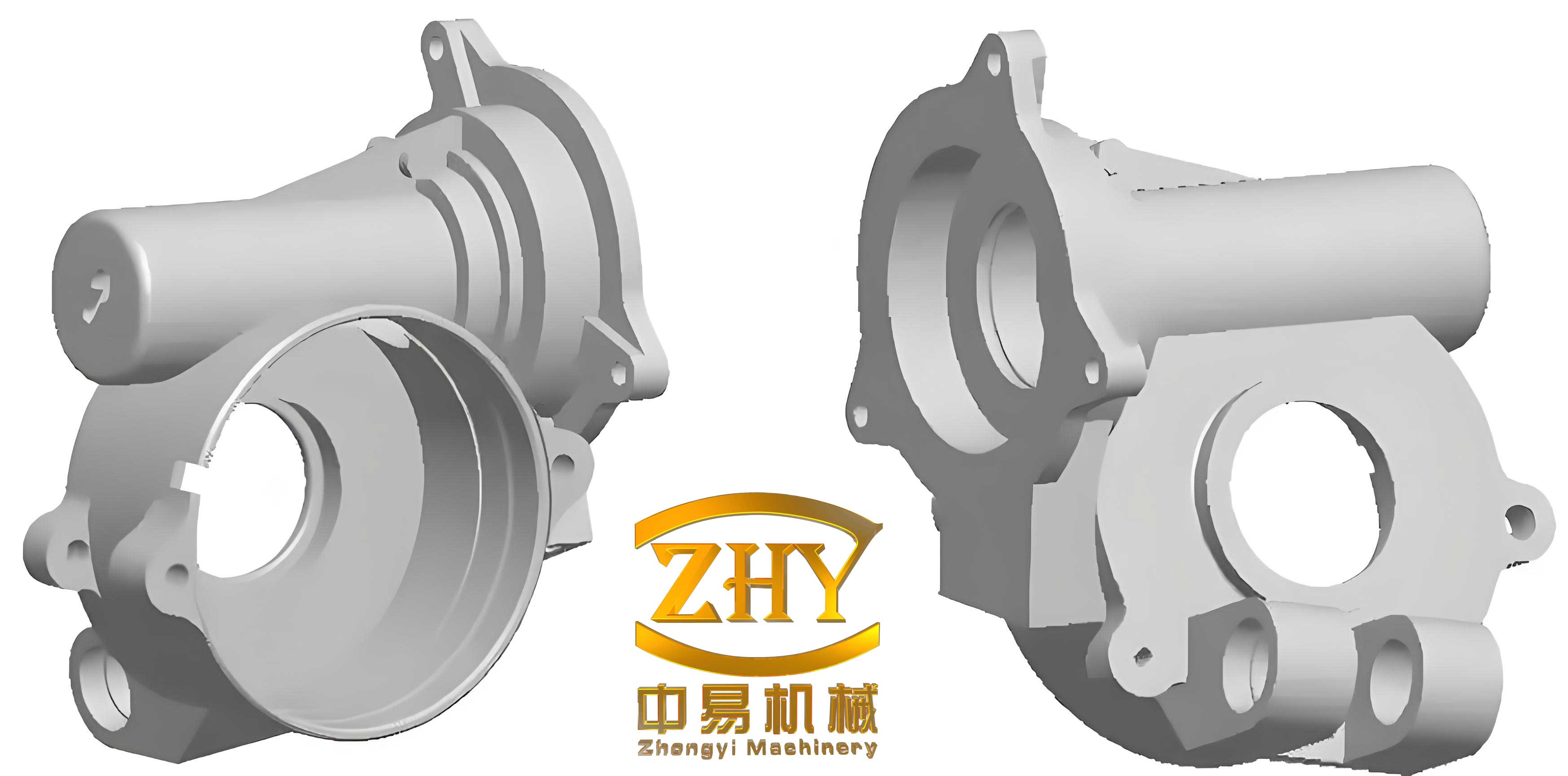
The turbocharger housing, as shown in the structural diagram, has a mass of approximately 4 kg with overall dimensions of 170 mm × 160 mm × 100 mm. Its minimum wall thickness is 4 mm, featuring intricate internal passages and isolated liquid zones that necessitate careful thermal management during solidification. The material specified is vermicular graphite iron (GJV-450), which requires a defect-free functional surface. According to technical specifications, on critical benchmark surfaces, only up to four micro-pores are permitted, each not exceeding 2 mm in size, with a minimum edge distance of 3 mm between them. Pores smaller than 0.5 mm can be ignored. This demands a robust casting process to minimize shrinkage and porosity, common issues in shell castings.
For production, we employed an automated shell molding line, which is well-suited for shell castings due to its ability to produce high-quality molds with excellent reproducibility. The pattern was designed for two castings per mold with a horizontal parting line. To ensure smooth metal flow and controlled solidification, a choked gating system was implemented. The gating ratio was set as follows: total sprue area : total runner area : total ingate area = 2 : 1.5 : 1. Specifically, the sprue cross-sectional area was 1,200 mm², the runner area was 900 mm², and the ingate area was 600 mm². This ratio promotes a non-turbulent fill, reducing the risk of gas entrapment and oxide formation, common concerns in shell castings. The feeding system included a hot side riser and a top riser to compensate for shrinkage in isolated liquid regions. The hot side riser had a diameter of 65 mm and a height of 100 mm, with a neck size of 23 mm × 33 mm. The top riser measured 50 mm in diameter and 70 mm in height, with a neck of 10 mm × 25 mm. Additionally, a chill with dimensions of 50 mm × 15 mm × 15 mm was placed on the circular plane inside the turbine chamber to enhance localized cooling. This comprehensive design aimed at achieving directional solidification, crucial for integrity in shell castings.
Prior to physical prototyping, numerical simulation was conducted using MAGMA software to predict potential defects and optimize the process. The pre-processing phase involved importing the STL file of the gating system and discretizing it into approximately 5 million finite difference meshes. Material properties were assigned from the database: GJV-450 with a solidus temperature of 1,165 °C, liquidus temperature of 1,168 °C, and latent heat of crystallization of 200 kJ/kg. The average pouring temperature was set to 1,400 °C. The mold was defined as Green-Sand, while cores used Furan resin. Interfacial heat transfer coefficients were specified: TempIron for metal-mold and metal-core interfaces, C1000 for core-mold contact, and C1200 for the chill-metal interface. A filter (FC-156-22, 50 mm × 50 mm × 22 mm) was included to simulate flow resistance. These settings are critical for accurate simulation of shell castings, as they account for the unique thermal properties of shell molds.
The filling simulation revealed a smooth metal flow without turbulence, as indicated by the sequential advancement of the liquid front. Temperature fields showed that the risers remained the hottest zones throughout filling, ensuring their effectiveness as feeders. The solidification simulation further confirmed that thin-walled sections of the housing solidified first, followed by progressive solidification toward the risers, achieving the desired directional pattern. However, upon closer inspection, the simulation predicted a small isolated liquid zone near the neck of the hot side riser during the final stages of solidification. This was attributed to the blocking effect of the internal flow passage, which increased the feeding distance and limited riser action. The predicted porosity in this region aligned with initial trial results, where slice inspection showed a porosity rate of 2.805% near the riser neck, exceeding the allowable limit. This discrepancy highlighted the need for process refinement, particularly in managing thermal gradients in shell castings.
To address the micro-shrinkage issue, the process was modified by incorporating a conformal chill within the turbine chamber. This chill, sized at 50 mm × 15 mm × 15 mm, was positioned on the internal circular plane to accelerate cooling and alter the solidification sequence. The updated simulation demonstrated the elimination of the isolated liquid zone, as the chill promoted faster solidification in the problematic area, thereby reducing the feeding demand. The effectiveness of this adjustment was validated through actual production, where subsequent castings exhibited no micro-shrinkage at the riser neck, confirming the simulation’s accuracy. This iterative approach underscores the value of numerical simulation in optimizing shell castings, as it allows for virtual testing without costly physical trials.
Throughout this development, several key parameters were instrumental in achieving success. Below, I summarize the gating system and riser details in tabular form to provide a clear overview:
| Component | Dimensions/Area | Ratio Contribution |
|---|---|---|
| Sprue | 1,200 mm² | ΣFsprue = 2 |
| Runner | 900 mm² | ΣFrunner = 1.5 |
| Ingate | 600 mm² | ΣFingate = 1 |
| Hot Side Riser | Diameter: 65 mm, Height: 100 mm | Neck: 23 mm × 33 mm |
| Top Riser | Diameter: 50 mm, Height: 70 mm | Neck: 10 mm × 25 mm |
| Chill | 50 mm × 15 mm × 15 mm | Plane: Internal circular area |
In addition to tabular data, mathematical formulations help quantify the thermal behavior during solidification. For instance, the heat transfer between the casting and the chill can be described using Fourier’s law, considering the interfacial heat transfer coefficient. The rate of heat extraction by the chill can be approximated as:
$$ q = h_c \cdot A \cdot (T_c – T_m) $$
where \( q \) is the heat flux (W/m²), \( h_c \) is the heat transfer coefficient (set as C1200 in simulation), \( A \) is the contact area, \( T_c \) is the casting surface temperature, and \( T_m \) is the chill temperature. This equation emphasizes the chill’s role in enhancing cooling, which is vital for modifying solidification patterns in shell castings. Furthermore, the solidification time for a section can be estimated using Chvorinov’s rule:
$$ t_s = B \cdot \left( \frac{V}{A} \right)^n $$
where \( t_s \) is the solidification time, \( B \) is a mold constant, \( V \) is volume, \( A \) is surface area, and \( n \) is an exponent (typically around 2 for sand molds). In shell castings, the mold constant \( B \) may vary due to the insulating properties of shell molds, affecting the solidification kinetics. By applying such formulas, we can predict how design changes, like adding chills, impact solidification times and defect formation.
The simulation also provided insights into temperature gradients, which drive feeding efficiency. The temperature distribution during solidification can be modeled using the heat conduction equation:
$$ \rho c_p \frac{\partial T}{\partial t} = \nabla \cdot (k \nabla T) + \dot{q}_l $$
where \( \rho \) is density, \( c_p \) is specific heat, \( T \) is temperature, \( t \) is time, \( k \) is thermal conductivity, and \( \dot{q}_l \) is the latent heat source term. Numerical solutions of this equation, as performed by MAGMA, allow for visualizing isotherms and identifying hot spots. For shell castings, the low thermal conductivity of shell molds can lead to steeper gradients, necessitating careful riser placement. The table below summarizes key material properties used in the simulation for vermicular graphite iron:
| Property | Value | Units |
|---|---|---|
| Solidus Temperature | 1,165 | °C |
| Liquidus Temperature | 1,168 | °C |
| Latent Heat | 200 | kJ/kg |
| Thermal Conductivity (approx.) | 40 | W/m·K |
| Density | 7,100 | kg/m³ |
Through iterative simulation, we optimized the process parameters to ensure that the risers remain liquid longest, fulfilling their feeding role. The final design yielded castings that met all technical specifications, with no detectable micro-shrinkage on critical surfaces. This success demonstrates the power of numerical simulation in reducing development time and cost for complex shell castings. Moreover, the integration of simulation into routine practice enables continuous improvement, as virtual models can be easily adjusted for different geometries or materials.
In conclusion, the development of turbocharger housing castings via numerical simulation has proven highly effective. By combining automated shell molding with advanced simulation tools, we achieved a robust process that minimizes defects and ensures quality. Shell castings, with their inherent advantages in precision and surface finish, benefit greatly from such simulation-driven approaches, as thermal management is crucial for their integrity. The use of tables and formulas, as presented here, facilitates a deeper understanding of the underlying principles. Moving forward, I anticipate further adoption of simulation in foundries to enhance the reliability and efficiency of shell castings for various automotive applications. This experience underscores that numerical simulation is not merely a supplementary tool but a cornerstone in modern casting development, enabling predictive optimization and sustainable production.