
In the landscape of industrial wear-resistant materials, the quest for an optimal balance between performance, cost, and manufacturability is perpetual. My focus has been directed towards the field of grinding media, where the demands for high hardness, sufficient toughness, and economic viability are particularly acute. While high-manganese steels, alloy steels, and various specialized white cast irons have their established niches, limitations often arise from either inadequate wear resistance under low-impact conditions or prohibitively high costs associated with complex alloying and processing. This drove the development of a novel low-chromium alloy white cast iron, engineered specifically to fulfill the requirements for grinding balls in industries such as power generation, mining, and cement production. The core philosophy was to harness the inherent wear resistance of white cast iron while meticulously minimizing alloy content to dramatically reduce cost and simplify production, making it accessible for widespread industrial adoption.
The fundamental design principle centered on the carbide network inherent to white cast iron structures. While carbon is crucial for forming hard carbides, excessive levels can embrittle the material. Therefore, the carbon content was carefully moderated to ensure a dense, supportive carbide phase without compromising bulk toughness excessively. The key alloying element, chromium, was selected for its dual role: it promotes the formation of harder, more stable carbides compared to plain iron carbides and enhances the hardenability of the metallic matrix. Crucially, its content was restricted to the minimal effective amount, achieving significant performance benefits without the cost penalty associated with high-chromium white cast iron variants. The target chemical composition is summarized in Table 1.
| Element | C | Si | Mn | Cr | P, S | Fe |
|---|---|---|---|---|---|---|
| Content (wt.%) | 2.0 – 2.8 | ≤ 1.0 | 0.5 – 1.5 | 1.5 – 3.0 | ≤ 0.10 | Balance |
The experimental and production methodology was kept intentionally straightforward to mirror typical foundry conditions. Melting was conducted in a standard industrial cupola furnace, with a tapping temperature of approximately 1450°C and a pouring temperature around 1380°C. The melt was cast into standard molds for producing grinding balls of Φ60mm and Φ100mm diameters, as well as into keel block molds for subsequent machining of impact and metallographic specimens. This approach ensures the findings are directly relevant to commercial-scale production.
A critical phase of the investigation involved exploring heat treatment to modify the as-cast microstructure and unlock superior mechanical properties. Treatments included normalizing, quenching from various temperatures (850°C, 900°C, 950°C, 1000°C), tempering, and austempering. Quenching was performed in oil, and tempering temperatures ranged from 200°C to 600°C. Austempering involved heating to 950°C followed by isothermal holding at 280°C. Microstructural analysis was performed using optical and scanning electron microscopy, while mechanical properties were assessed via Rockwell hardness tests and Charpy impact tests.
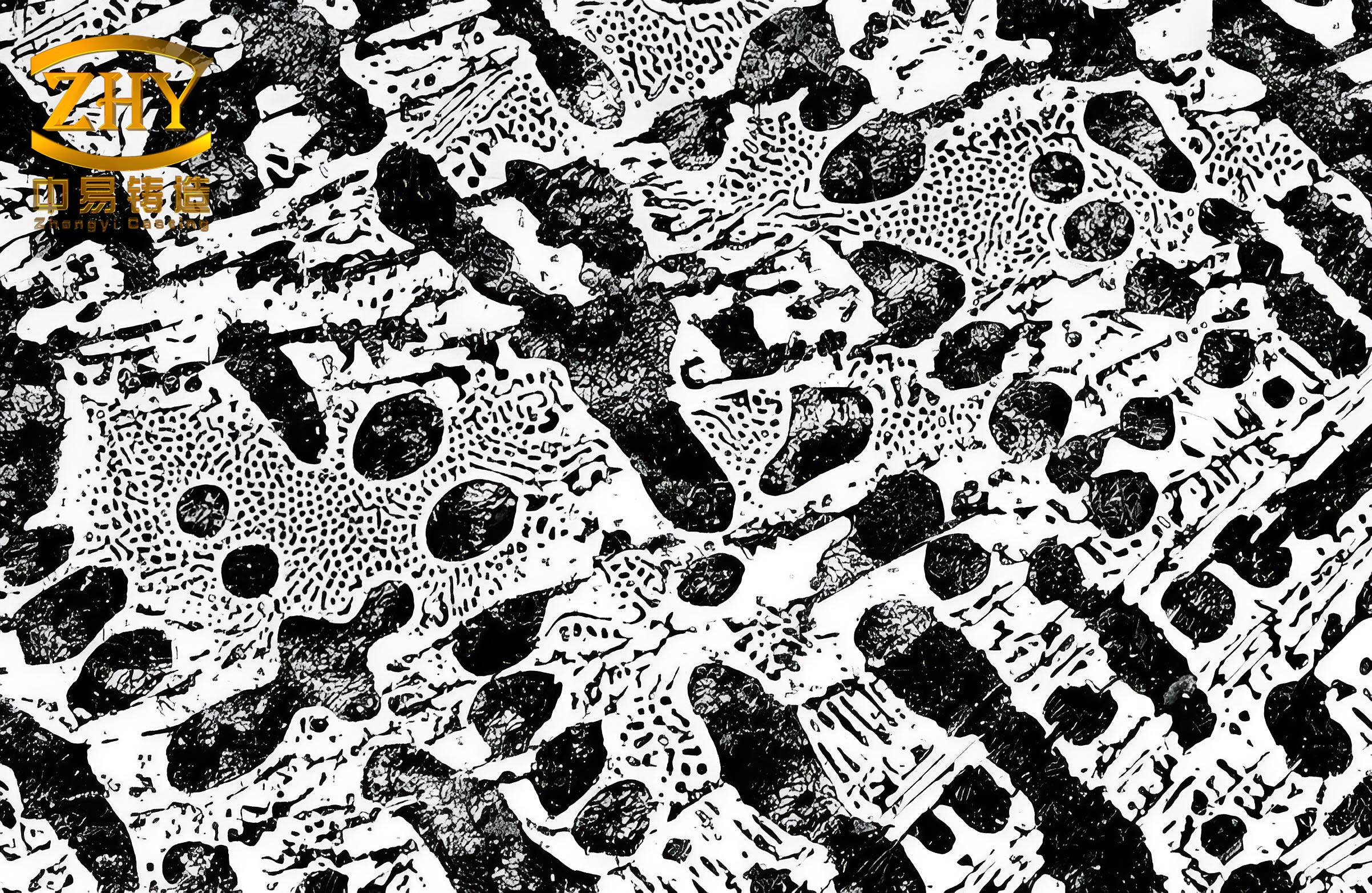
The as-cast microstructure of this low-chromium white cast iron is characterized by a network of eutectic carbides (ledeburite) embedded within a matrix of relatively coarse pearlite. Secondary carbides precipitate in a needle-like morphology within the pearlitic regions or adjacent to the eutectic carbide network. This structure provides good wear resistance but limited toughness. Heat treatment dramatically alters this matrix. Upon quenching from temperatures like 950°C, the pearlitic matrix transforms to martensite, while the eutectic carbide network remains largely unchanged, though some dissolution of secondary carbides occurs. The resulting structure is a composite of hard martensite and even harder carbides. At higher quenching temperatures, austenite grain growth and increased retained austenite can become factors. Austempering produces a matrix of lower bainite, known for a favorable combination of strength and toughness.
The mechanical properties are a direct consequence of these microstructural changes. Data for the as-cast, normalized, and quenched states are consolidated in Table 2. The as-cast material exhibits a hardness of approximately 48 HRC and an impact toughness of about 3.5 J/cm². Normalizing causes negligible change. Quenching, however, induces a significant transformation. Hardness initially increases with quenching temperature as more martensite forms, peaking at around 62 HRC for 950°C quenching, before potentially decreasing due to retained austenite. Interestingly, impact toughness shows a different trend: quenching from lower temperatures (e.g., 850°C) can actually improve toughness over the as-cast state, likely due to the formation of fine, low-carbon martensite and carbides replacing the coarse pearlite. Toughness then generally decreases with higher quenching temperatures as the martensite becomes more alloyed and coarse.
| Condition | Hardness (HRC) | Impact Toughness (J/cm²) |
|---|---|---|
| As-Cast | 48 | 3.5 |
| Normalized (950°C) | 49 | 3.8 |
| Quenched 850°C | 55 | 5.2 |
| Quenched 900°C | 59 | 4.5 |
| Quenched 950°C | 62 | 4.0 |
| Quenched 1000°C | 60 | 3.8 |
| Austempered (950°C/280°C) | 58 | 5.8 |
The effect of tempering on quenched samples is systematic. Hardness gradually decreases with increasing tempering temperature, with a more pronounced drop above 400°C as the martensite decomposes into troostite and sorbite. Impact toughness shows a modest improvement with low-temperature tempering and stabilizes thereafter. This behavior can be modeled approximately by an empirical relationship for hardness decay, though the presence of the stable carbide network modifies the response compared to a fully martensitic steel. A simplified representation of the tempering effect on hardness ($H$) could be:
$$ H(T_q, T_t) \approx H_0(T_q) \cdot e^{-k \cdot (T_t – T_0)} $$
where $H_0(T_q)$ is the as-quenched hardness from temperature $T_q$, $T_t$ is the tempering temperature, $T_0$ is a reference temperature (e.g., 200°C), and $k$ is a material constant. The superior toughness of the austempered condition is clearly reflected in its high impact value, making it an excellent choice for applications demanding better fracture resistance.
For industrial application, the hardenability and bulk toughness of actual grinding balls are paramount. A sectioned Φ100mm ball, quenched from 950°C and tempered at 250°C, revealed a surface hardness of 60 HRC, with a effective hardened depth of about 20mm and a gradual hardness gradient towards the core, which retained the as-cast hardness. This indicates sufficient hardenability for typical grinding ball sections. Hammer blow tests, simulating severe impact, provided compelling evidence for improved durability. As shown in Table 3, heat-treated balls sustained significantly more blows before failure compared to their as-cast counterparts, confirming the crucial role of microstructural optimization in enhancing the service life of this white cast iron.
| Treatment Condition | Average Hammer Blows to Failure (Φ60mm) | Average Hammer Blows to Failure (Φ100mm) |
|---|---|---|
| As-Cast | 5 | 18 |
| Heat-Treated (950°C Quench + 250°C Temper) | 15 | 45 |
The ultimate validation of this low-chromium alloy white cast iron comes from extensive field trials. The performance data, summarized in Table 4, demonstrates its clear superiority over traditional forged steel balls. In coal pulverizing at a thermal power plant, the white cast iron balls reduced wear consumption by 77% and maintained a breakage rate below 1%. In copper ore processing plants, the reduction in consumption per ton of ore processed ranged from 37% to 45%. In cement production, a 33% reduction in consumption per ton of cement was achieved. These figures consistently translate to substantially longer service life and reduced frequency of ball replenishment.
| Application Site | Material Compared | Wear Consumption (kg/t material) | Reduction vs. Forged Steel Ball | Breakage Rate |
|---|---|---|---|---|
| Coal Pulverizing (Thermal Plant) | Low-Cr White Cast Iron | 0.050 | 77% | < 1% |
| Forged Steel Ball | 0.220 | – | – | |
| Copper Ore Processing (Plant A) | Low-Cr White Cast Iron | 0.230 | 45% | ~0% |
| Forged Steel Ball | 0.420 | – | – | |
| Cement Grinding | Low-Cr White Cast Iron | 0.080 | 33% | Low |
| Forged Steel Ball | 0.120 | – | – |
The economic calculus is decisive. The lower alloy content makes the raw material cost of this white cast iron significantly cheaper than high-alloy alternatives. For end-users, the dramatically lower wear rate directly reduces media costs. A detailed analysis for a thermal power plant, presented in Table 5, illustrates the comprehensive benefits. Per ton of coal ground, using the white cast iron balls saves approximately 170 grams of media, which translates to a cost saving of about 1.2 CNY per ton. Scaling this to an annual coal consumption of 2 million tons results in savings of nearly 1.4 million CNY in grinding media costs alone. Furthermore, the extended service life reduces downtime for ball charging, saving labor and increasing equipment availability, while the lower mass of balls consumed also implies marginal energy savings in the grinding process itself.
| Economic Factor | Low-Cr White Cast Iron Ball | Forged Steel Ball | Notes & Calculation Basis |
|---|---|---|---|
| Ball Consumption (kg/t coal) | 0.050 | 0.220 | From field data |
| Media Cost per ton coal (CNY) | ~0.35 | ~1.55 | Based on relative ball unit price |
| Savings per ton coal (CNY) | ~1.20 | Direct cost difference | |
| Annual Media Cost Saving (2M tons coal) | ~1,400,000 CNY | 1.2 CNY/t * 2,000,000 t | |
| Annual Ball Mass Saving (tons) | 340 tons | (0.220 – 0.050) kg/t * 2,000,000 t | |
| Indirect Benefits | Reduced downtime for charging, lower labor, slightly reduced grinding power. | ||
The wear resistance advantage can be conceptually linked to the material’s microstructure. The high volume fraction of hard carbides in the white cast iron provides the primary abrasion resistance. The role of heat treatment is to provide a strong, supportive matrix that holds these carbides firmly in place under stress, preventing premature fracture or pull-out. The wear rate ($W$) in an abrasive environment can be thought of as inversely related to a composite hardness term and a toughness term that mitigates fracture-induced wear:
$$ W \propto \frac{1}{f(H_{carbide}, H_{matrix}) \cdot g(K_{IC})} $$
where $H_{carbide}$ and $H_{matrix}$ are the hardness of the carbide phase and metallic matrix respectively, and $K_{IC}$ represents fracture toughness. The heat-treated low-chromium white cast iron optimizes both factors: the martensitic or bainitic matrix provides high $H_{matrix}$ and reasonable support, while the inherent $H_{carbide}$ is very high. Forged steel balls, lacking this dense network of primary carbides, rely solely on the hardness of their metallic matrix, which is inherently lower than that of carbides, leading to higher wear rates even with a tougher matrix.
In conclusion, the developed low-chromium alloy white cast iron successfully addresses the core challenges in grinding media design. It delivers exceptional wear resistance and low breakage rates, stemming from its optimized microstructure of hard carbides within a strong, heat-treated matrix. Its composition minimizes cost, and its processing aligns with standard foundry and heat treatment practices, ensuring excellent manufacturability. Comprehensive field trials across multiple industries have irrefutably demonstrated its superior performance and economic benefits over traditional forged steel balls. This material stands as a compelling, high-performance, and cost-effective solution, enabling significant advancements in production efficiency and cost management for mining, cement, and power generation operations reliant on grinding processes. The success of this alloy underscores the significant potential that remains in innovating within the family of white cast irons through intelligent, minimalistic alloy design and process control.