
In my extensive work within the cement and mining industries, I have consistently observed a significant challenge: the premature failure of wear parts, particularly mill liners. Traditionally, high-manganese steel (Hadfield steel) has been the material of choice for such applications, prized for its high toughness and work-hardening capability. However, through practical analysis and comparative testing, I concluded that the use of high-manganese steel for liners in cement grinding mills is often不合理. The operational conditions in a cement mill involve predominantly low-stress, high-abrasion grinding with minimal significant impact. Under these conditions, the high-manganese steel liner fails to work-harden sufficiently to achieve its theoretical maximum hardness. Instead, it undergoes plastic deformation and abrasive wear, leading to rapid material loss, pronounced grooves, and a short service life. This realization prompted my research into a more suitable, cost-effective alternative: a specially designed and heat-treated white cast iron.
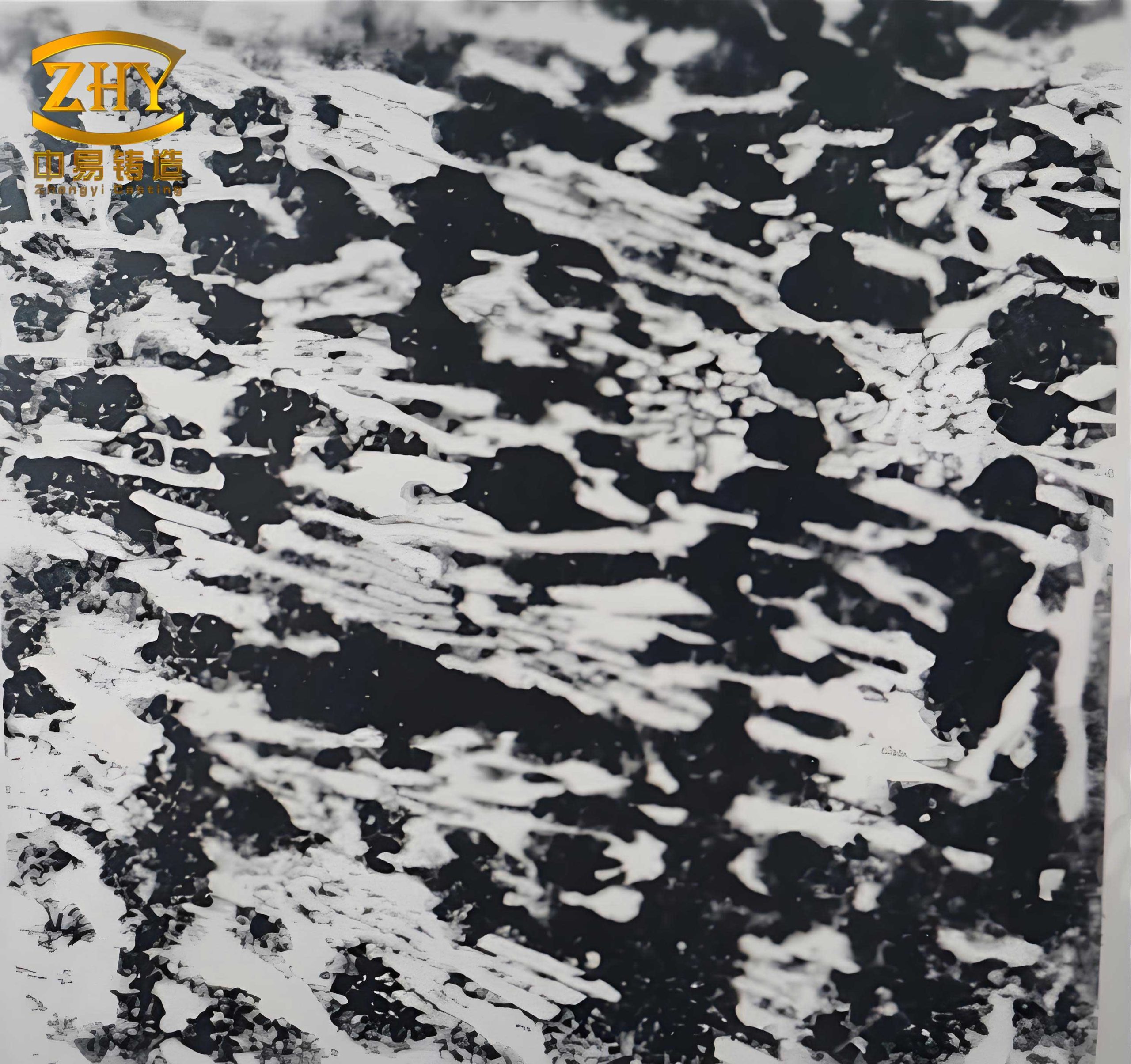
The fundamental issue with conventional white cast iron is its inherent brittleness, stemming from the continuous network of hard, brittle cementite (Fe3C) in its microstructure. My objective was to modify this microstructure through compositional design and precise heat treatment to disrupt this network, thereby improving toughness while retaining the exceptional abrasion resistance inherent to white cast iron. The core philosophy was to transform the cementite morphology and produce a matrix with an optimal combination of hardness and toughness. The matrix phase, I hypothesized, should ideally be lower bainite—a structure renowned for its excellent综合 mechanical properties of high strength, good hardness, and respectable ductility and toughness.
Compositional Design of the White Cast Iron
The first critical step was defining the chemical composition. Carbon is the most influential element in white cast iron, dictating the volume fraction of primary austenite (which transforms upon cooling) versus the brittle eutectic cementite. A lower carbon content increases the amount of transformable primary austenite, subsequently allowing for a greater volume of toughening phases like bainite after heat treatment. While higher carbon increases hardness, it does so at a severe penalty to toughness. For an application like a liner that must withstand some level of impact and fatigue, sacrificing impact韧性 for marginal gains in hardness is counterproductive.
My experimental matrix involved several heats of white cast iron with systematically varied carbon contents. Other alloying elements like chromium (for carbide stability and hardenability) and molybdenum/silicon (for bainitic transformation control) were added in moderate amounts. The target composition range I established is summarized below:
| Element | Target Composition (wt.%) | Primary Function |
|---|---|---|
| C | 2.4 – 2.8 | Controls carbide volume; primary determinant of hardness & toughness balance. |
| Si | 0.6 – 1.2 | Suppresses pearlite formation; promotes bainite. |
| Mn | 0.5 – 1.0 | Enhances hardenability; stabilizes austenite. |
| Cr | 1.5 – 2.5 | Promotes carbide formation; increases hardenability and wear resistance. |
| Mo | 0.3 – 0.8 | Powerful hardenability agent; retards pearlite formation; refines bainite. |
The relationship between carbon content (C) and the theoretical volume fraction of eutectic carbide (Vcarb) in white cast iron can be approximated for hypoeutectic compositions by considering the lever rule relative to the eutectic point (~4.3 wt.% C). A simplified expression highlighting the trend is:
$$ V_{carb} \propto \frac{C_{eutectic} – C_{alloy}}{C_{eutectic} – C_{carbide}} $$
where (C_{eutectic} \approx 4.3) and (C_{carbide} \approx 6.7) (for Fe3C). This clearly shows that lowering (C_{alloy}) significantly reduces the brittle phase fraction.
The Critical Role of Isothermal Heat Treatment
As-cast white cast iron, regardless of composition, possesses limited toughness. The key to unlocking its potential lies in austempering—an isothermal heat treatment. The process involves three stages:
- Austenitization: Heating the white cast iron to a temperature where the matrix dissolves carbon to become austenite, typically in the range of 880-950°C, and holding for sufficient time to achieve homogeneity.
- Rapid Quench: Quickly transferring the component into a molten salt bath held at a temperature within the bainitic transformation range (typically 250-400°C), avoiding pearlite formation.
- Isothermal Hold: Holding at the salt bath temperature for an extended period (e.g., 60-120 minutes) to allow the austenite to transform isothermally to bainite.
For this white cast iron, the precise isothermal temperature is paramount. My experiments varied this temperature while keeping austenitization constant (e.g., 920°C for 90 minutes). The microstructural evolution and resulting mechanical properties were dramatically different:
- At ~280°C: The transformation product is primarily lower bainite. This structure consists of fine, needle-like ferrite laths with a high dislocation density and fine ε-carbide precipitates within them. The cementite from the eutectic is also modified and more isolated.
- Below 280°C: The matrix becomes a mixture of very fine lower bainite and martensite, increasing hardness but also internal stress, reducing toughness.
- Above 300°C: The transformation shifts towards upper bainite, characterized by ferrite laths with inter-lath cementite. This structure is softer and generally less tough than lower bainite.
The mechanism behind the toughness improvement in austempered white cast iron is twofold. First, the isothermal transformation breaks up the continuous cementite network. The carbide particles become more nodular and evenly distributed, preserving better continuity in the metallic matrix. Second, the lower bainite matrix itself is intrinsically tough and strong. Furthermore, the process often retains 10-20% of stable, high-carbon retained austenite, which is a ductile phase. This retained austenite, dispersed within the microstructure, acts to blunt propagating micro-cracks and provides a “cushioning” effect, inhibiting the spalling of brittle carbides.
Quantitative Performance Analysis
I conducted a systematic study on white cast iron samples with varying carbon contents subjected to austempering at different temperatures. The mechanical properties—hardness (HRC), impact toughness (ak, J/cm²), and transverse rupture strength (TRS, MPa)—were measured. The data unequivocally demonstrates the optimization point.
Table 1: Mechanical Properties of White Cast Iron vs. Heat Treatment
| Sample ID (C wt.%) | Condition | Austempering Temp. (°C) | Hardness (HRC) | Impact Toughness, ak (J/cm²) | Transverse Rupture Strength (MPa) |
|---|---|---|---|---|---|
| A (~2.5%) | As-Cast | – | 48 | 4.5 | 550 |
| Austempered | 250 | 58 | 9.5 | 1050 | |
| Austempered | 280 | 56 | 18.5 | 1350 | |
| Austempered | 320 | 51 | 12.0 | 1150 | |
| Austempered | 380 | 45 | 8.0 | 950 | |
| B (~3.1%) | As-Cast | – | 55 | 3.0 | 400 |
| Austempered | 250 | 62 | 5.0 | 750 | |
| Austempered | 280 | 60 | 8.5 | 980 | |
| Austempered | 320 | 55 | 6.0 | 820 |
The peak in综合 properties at 280°C is evident. The improvement in toughness (ak) for the lower-carbon white cast iron (Sample A) is particularly dramatic—a fourfold increase over the as-cast state. The relationship between hardness (H) and wear resistance is not linear for these materials under abrasive-fatigue conditions. Wear resistance (W) can be thought of as a function of both hardness (resistance to cutting/ploughing) and a fatigue-related toughness parameter (Tf), resisting crack initiation and propagation:
$$ W \propto H^{\alpha} \cdot T_{f}^{\beta} $$
where for high-stress abrasion with impact, (\beta) can be significant. Lower bainite maximizes this product for white cast iron.
The following graph synthesizes the effect of both composition and heat treatment temperature on the key mechanical properties of this white cast iron system.
Figure 1: Influence of Carbon Content and Austempering Temperature on Mechanical Properties
[Graph would show three overlaid curves for ak, TRS, and HRC vs. Austempering Temp., with separate lines for low-C and high-C white cast iron, showing peaks at ~280°C].
Field Application and Economic Justification
The ultimate validation for this novel white cast iron came from field trials. I arranged for a side-by-side comparison in an operating cement mill (specifically a Ø2.2m ball mill). New liners made from the optimized white cast iron (austempered at 280°C) were installed alongside traditional high-manganese steel liners. The trial ran for over 5,000 hours, producing more than 50,000 tons of slag Portland cement. The results were conclusive.
Table 2: Field Trial Results – Wear Performance Comparison
| Material | Average Initial Weight per Liner (kg) | Average Final Weight after Trial (kg) | Total Weight Loss (kg) | Relative Wear Rate (High-Mn Steel = 1.0) | Visual Observations Post-Trial |
|---|---|---|---|---|---|
| High-Manganese Steel | 85.5 | 68.2 | 17.3 | 1.0 (Baseline) | Deep grooves, rounded edges, severe plastic deformation. |
| Austempered White Cast Iron | 81.8 | 71.5 | 10.3 | ~0.60 | Uniform wear surface, sharper retained edges, no cracking or spalling. |
The white cast iron liners exhibited approximately 40% lower wear loss, translating to a service life 1.6-1.7 times longer than the high-manganese steel counterparts. More importantly, they failed gracefully by uniform wear rather than by deformation or fracture.
The economic impact is substantial. Consider a cement plant with an annual output of 200,000 tons, consuming roughly 40 tons of liner material annually. Using high-manganese steel at a market price of approximately $1,500 per ton, the annual liner cost is about $60,000. Switching to this white cast iron, with a material cost of around $1,000 per ton and a 1.6x longer life, changes the calculus. The annual consumption drops to roughly 40/1.6 ≈ 25 tons. The annual cost becomes 25 tons * $1,000/ton = $25,000. This represents a direct cost saving of $35,000 per year for this single, mid-sized plant. For larger plants or groups of plants, the savings scale dramatically. The formula for annual savings (S) can be generalized as:
$$ S = (C_{Mn} \cdot Q) – (C_{WCI} \cdot \frac{Q}{L_{ratio}}) $$
where (C_{Mn}) and (C_{WCI}) are the cost per ton of manganese steel and white cast iron, respectively, (Q) is the annual consumption in tons of manganese steel, and (L_{ratio}) is the life ratio of white cast iron to manganese steel (>1).
Conclusions and Recommendations
Based on my comprehensive analysis, laboratory testing, and successful field application, I draw the following firm conclusions:
- The substitution is technically sound: High-manganese steel is suboptimal for cement mill liner applications due to insufficient work-hardening under prevailing low-impact, high-abrasion conditions. An austempered, lower-carbon white cast iron is a superior material choice, offering a better match of properties to the service environment.
- The optimal processing route is defined: The white cast iron should have a controlled composition, notably a carbon content in the range of 2.4-2.8%. The critical heat treatment is austempering with an isothermal hold in the range of 270-300°C (with 280°C being ideal) for 1-2 hours, following austenitization at 900-950°C. This consistently produces a lower bainite matrix with refined and isolated carbides.
- Performance and economics are compelling: This developed white cast iron provides significantly higher abrasion resistance (≥1.6x life) compared to high-manganese steel liners, while maintaining sufficient toughness for reliable service. The raw materials are readily available and less expensive than high-manganese steel, leading to substantial reductions in annual liner costs for cement producers.
Therefore, I assert that this novel austempered white cast iron is not merely a viable alternative but a clearly superior and economically advantageous material for cement mill liners. Its adoption represents a straightforward opportunity for the industry to improve operational efficiency and reduce maintenance costs. The principles developed here for white cast iron—targeted compositional design coupled with precise isothermal heat treatment to achieve a high-performance lower bainitic matrix—are broadly applicable to a range of abrasive wear components beyond mill liners.