
In the field of manufacturing, machine tool castings play a critical role in ensuring the structural integrity and performance of machine tools. As a developer involved in this project, I have focused on creating a comprehensive Computer-Aided Design (CAD) system tailored for machine tool casting processes. This system addresses the challenges of traditional manual design methods, which often lead to inconsistencies, delays, and inefficiencies in producing machine tool castings. The development of this software package aims to streamline the entire process, from initial design to documentation, thereby enhancing the quality and speed of production for machine tool castings. Through this article, I will share insights into the system’s functionalities, underlying algorithms, and practical applications, emphasizing how it revolutionizes the approach to designing machine tool castings.
The core of this system is built around a modular architecture that integrates various aspects of casting process design. Traditional methods for machine tool castings relied heavily on manual calculations and empirical knowledge, resulting in variations in工艺 parameters and extended lead times. Our software package, developed using C language within a CAD environment, automates key steps such as weight calculation, process analysis, and gating system design. By leveraging databases and interactive interfaces, it ensures standardization and repeatability in producing high-quality machine tool castings. Below, I will delve into the specific modules, supported by tables and formulas, to illustrate how each component contributes to the overall efficiency and accuracy in handling machine tool castings.
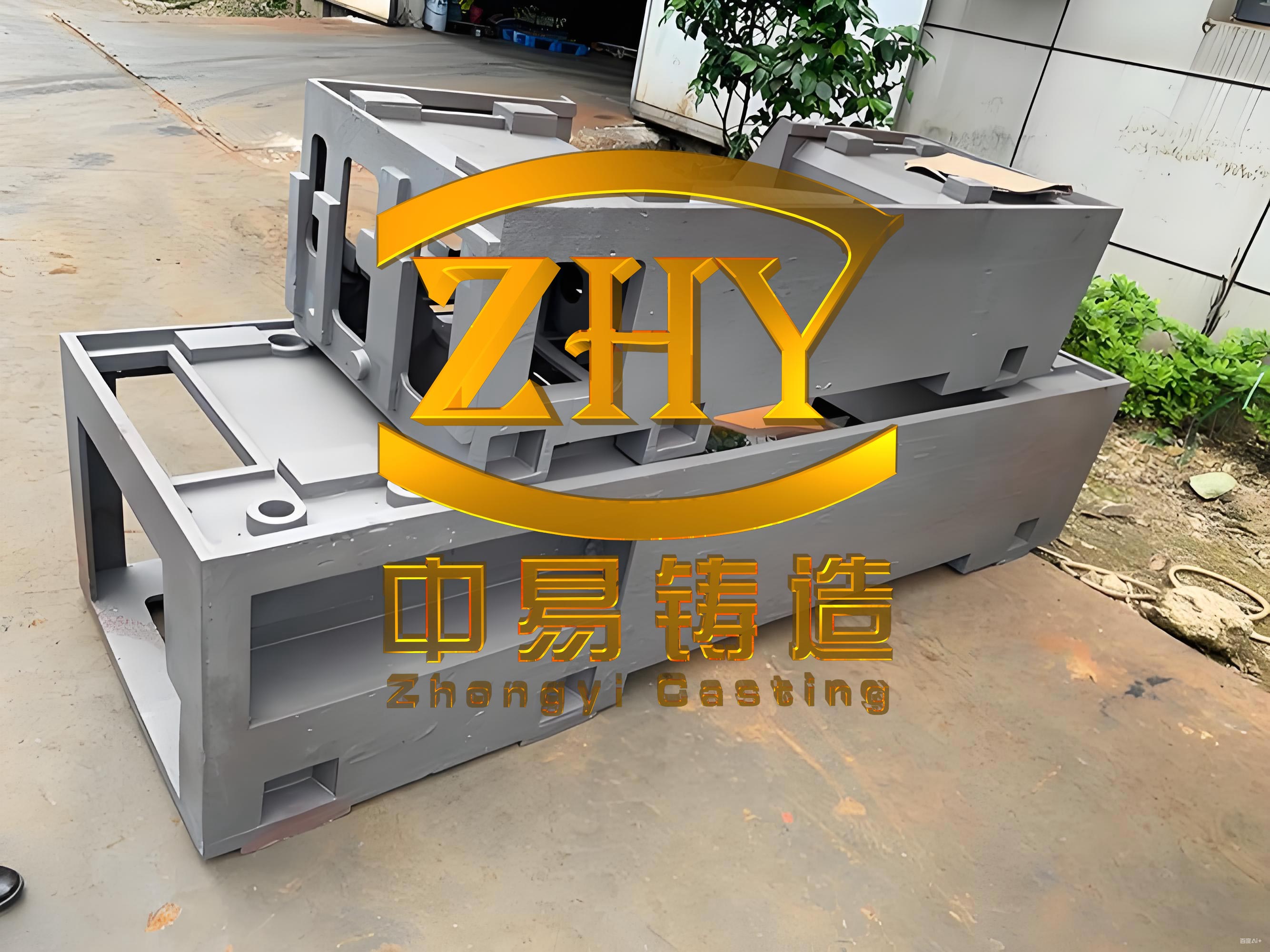
One of the fundamental aspects of designing machine tool castings is calculating the weight accurately, as it influences material usage and process parameters. The weight calculation module in our system handles both simple geometric shapes and complex combinations common in machine tool castings. For instance, the volume of a cylindrical component can be computed using the formula: $$V = \pi r^2 h$$ where \( r \) is the radius and \( h \) is the height. The weight \( W \) is then derived as: $$W = V \times \rho$$ where \( \rho \) represents the density of the casting material, typically around 7.2 g/cm³ for cast iron used in machine tool castings. For composite shapes, the system decomposes them into basic elements, such as cubes and spheres, and sums their volumes. This approach ensures that weight calculations for machine tool castings are precise, with errors below 5% for large castings, which is critical for cost estimation and process planning.
| Module Name | Primary Function | Key Features |
|---|---|---|
| Document Management | Handles drawing number queries and process standard access | Slide-based query system for easy navigation |
| Process Design | Automates weight calculation, parting line selection, and gating design | Interactive menus and parameter input |
| Graphical Output | Generates process drawings and symbols automatically | Integration with CAD for seamless plotting |
| Sand Box Design | Optimizes sand box selection based on casting dimensions | Database-driven size recommendations |
| Template Design | Supports mold pattern creation and customization | Standardized templates for consistency |
The process design module is the heart of our system, enabling detailed planning for machine tool castings. It begins with process analysis, where the system evaluates the casting’s material, weight, and structural type to suggest optimal工艺 schemes. For example, when dealing with complex machine tool castings like bases or columns, the module identifies potential issues such as shrinkage or distortion and recommends solutions like controlled cooling or reinforcement. This is achieved through a rule-based system that encodes decades of expert knowledge, ensuring that even novice designers can produce reliable plans for machine tool castings. The parting line determination sub-module allows users to select from various parting surface types, with the system automatically drawing the symbols based on input parameters. This eliminates subjective variations and accelerates the initial setup phase for machine tool castings.
In the machining allowance annotation sub-module, the system addresses a common pitfall in manual design: overlooking machining symbols. It automatically scans the drawing for all machining symbols, prompts the user to confirm if an allowance is needed, and then retrieves the appropriate values from a database. The machining allowance \( MA \) for a surface is calculated based on the casting’s maximum轮廓尺寸 \( L_{\text{max}} \) and the surface orientation (e.g., top, bottom, or side). For instance, the allowance for a top surface might be given by: $$MA = k_t \times L_{\text{max}}$$ where \( k_t \) is a coefficient derived from empirical data for machine tool castings. Similarly, for side surfaces: $$MA = k_s \times L_{\text{max}}$$ The values of \( k_t \) and \( k_s \) are stored in a database and adjusted according to the casting size and material, as shown in Table 2. This automated approach ensures that all necessary allowances are applied consistently across different machine tool castings.
| Casting Size Range (mm) | Top Surface Coefficient \( k_t \) | Side Surface Coefficient \( k_s \) | Bottom Surface Coefficient \( k_b \) |
|---|---|---|---|
| 0-500 | 0.005 | 0.004 | 0.003 |
| 500-1000 | 0.006 | 0.005 | 0.004 |
| 1000-2000 | 0.007 | 0.006 | 0.005 |
| >2000 | 0.008 | 0.007 | 0.006 |
The core design sub-module supports multiple core types commonly used in machine tool castings, such as cylindrical or rectangular cores. Users can select from a predefined list, and the system calculates core dimensions, including head size and clearance, based on input parameters like core length \( L_c \) and diameter \( D_c \). For example, the core head volume \( V_h \) might be estimated using: $$V_h = \pi \left( \frac{D_c}{2} \right)^2 h_h$$ where \( h_h \) is the head height. The system also automates the drawing of core symbols and sequences, ensuring that complex internal geometries in machine tool castings are accurately represented. This modularity allows the software to handle a wide range of machine tool castings, from simple brackets to intricate housings.
Gating and riser system design is another critical area where our system excels. Based on the calculated weight of the machine tool casting and its structural characteristics, the module selects appropriate gating types (e.g., sprue, runner, ingate) and dimensions. The cross-sectional area \( A_g \) of a gate can be determined using the formula: $$A_g = \frac{W}{\rho \cdot v \cdot t}$$ where \( W \) is the casting weight, \( \rho \) is the metal density, \( v \) is the flow velocity, and \( t \) is the pouring time. For risers, the modulus method is often applied, where the riser volume \( V_r \) is designed to satisfy: $$V_r \geq \frac{V_c \cdot \alpha}{1 – \alpha}$$ with \( V_c \) being the casting volume and \( \alpha \) the solidification shrinkage factor. This ensures that machine tool castings are free from defects like porosity, enhancing their mechanical properties.
| Core Type ID | Description | Typical Applications | Key Parameters |
|---|---|---|---|
| Type 1 | Cylindrical core with flat ends | Holes and bores in bases | Diameter, length, clearance |
| Type 2 | Rectangular core with tapered heads | Slots and grooves in columns | Width, height, taper angle |
| Type 3 | Complex shaped core for internal cavities | Intricate parts like saddles | Custom dimensions based on CAD model |
| Type 4 | Stackable core for deep sections | Large machine tool castings | Modular segments, alignment features |
Sand box selection is optimized through a database query that considers the casting’s maximum轮廓尺寸, along with additional space for gating and cores. The system calculates the required sand box dimensions \( L_b \times W_b \times H_b \) by adding allowances for shake-out and ventilation to the casting dimensions. For instance, if a machine tool casting has dimensions \( L_c \times W_c \times H_c \), the sand box length might be computed as: $$L_b = L_c + 2 \cdot A_s$$ where \( A_s \) is the shake-out allowance, typically 50-100 mm for large machine tool castings. This prevents issues like insufficient sand coverage and reduces material waste, leading to more economical production of machine tool castings.
To illustrate the practical application, let’s consider the design process for a saddle-type machine tool casting. Starting with weight calculation, the system decomposes the saddle into basic volumes—such as a central block and side wings—and computes the total weight using the formulas mentioned earlier. Next, process analysis identifies potential hot spots, and the parting line is set along the saddle’s symmetry plane. Machining allowances are automatically applied to all top and side surfaces, with values retrieved from Table 2 based on the saddle’s maximum尺寸 of 1200 mm. Core design involves selecting Type 2 cores for the saddle’s grooves, and the system generates the core drawings with precise dimensions. The gating system is designed using a bottom-gate approach, with sprue and runner sizes calculated to ensure smooth metal flow. Finally, the sand box is selected as 1500 mm × 1000 mm × 800 mm from the database, and the process summary table is auto-generated, listing all parameters for documentation.
The benefits of this system are manifold. Firstly, it significantly reduces the time required for designing machine tool castings—what used to take days can now be accomplished in hours. Secondly, it standardizes the process, minimizing human errors and ensuring that every machine tool casting meets quality standards. Moreover, the integrated documentation management allows for easy retrieval and comparison of past designs, facilitating continuous improvement. However, limitations exist, such as the reliance on accurate input data and the need for further AI integration to handle highly irregular shapes. Future work will focus on enhancing the system’s intelligence, perhaps incorporating machine learning to predict optimal工艺 parameters for novel machine tool castings.
In conclusion, the development of this CAD system marks a significant advancement in the field of machine tool castings. By automating key aspects of the design process, it not only improves efficiency but also empowers designers to tackle complex projects with confidence. As the industry evolves, such tools will become indispensable for producing high-performance machine tool castings that meet the demands of modern manufacturing. The integration of tables, formulas, and interactive modules ensures that the system remains versatile and user-friendly, paving the way for broader adoption in the production of machine tool castings worldwide.