
In recent years, the automotive industry has increasingly demanded high-performance exhaust manifolds for medium- and high-end engines, particularly under “China VI” emission standards. These engines operate at exhaust temperatures ranging from 800°C to 820°C, requiring materials that withstand such extreme conditions without deformation or cracking. Traditionally, high-nickel austenitic nodular cast iron has been used for these applications due to its superior temperature resistance up to 880°C. However, this material involves high manufacturing costs, primarily due to the significant nickel content, which impacts overall product affordability. As a result, we embarked on a research initiative to develop a new, cost-effective material that meets the technical requirements for exhaust manifolds at temperatures up to 820°C, specifically targeting a tensile strength of ≥70 MPa and yield strength of ≥50 MPa at 780°C. Our goal was to optimize existing silicon-molybdenum nodular cast iron by incorporating trace alloying elements, thereby creating a medium silicon molybdenum niobium nodular cast iron that could replace high-nickel austenitic nodular cast iron in this temperature range. This article details our first-person perspective on the material development, experimental validation, and industrial application of this innovative nodular cast iron.
The development process began with a thorough analysis of current materials. We evaluated two primary candidates: conventional silicon-molybdenum nodular cast iron (designated as Material 1) and a variant with added nickel (Material 2), comparing them against high-nickel austenitic nodular cast iron (Material 3). Our initial focus was on setting technical targets based on engine specifications. The material needed to endure exhaust temperatures of 820°C, pass rigorous bench tests including 400-hour high-temperature endurance tests and 2000-hour variable load cycle tests without failure, and achieve specific mechanical properties at both room and elevated temperatures. We formulated a dual approach: first, reducing the nickel content in high-nickel austenitic nodular cast iron to lower costs, and second, enhancing silicon-molybdenum nodular cast iron through micro-alloying to improve its thermal stability and high-temperature performance. This involved extensive literature review and preliminary calculations to predict element interactions. For instance, we considered the role of silicon in improving oxidation resistance and molybdenum in enhancing strength at high temperatures, while nickel and niobium were explored for their effects on microstructure stabilization and precipitation strengthening.
To quantify our approach, we derived a formula to estimate the high-temperature strength contribution from alloying elements. The combined effect can be expressed as:
$$ \sigma_{HT} = \sigma_0 + \sum_i (\alpha_i \cdot C_i) $$
where $\sigma_{HT}$ is the high-temperature strength (e.g., at 780°C), $\sigma_0$ is the base strength of unalloyed nodular cast iron, $\alpha_i$ are coefficients representing the strengthening contribution per unit concentration, and $C_i$ are the mass percentages of alloying elements such as Si, Mo, Ni, and Nb. This linear model helped guide our initial composition adjustments, though we acknowledged that real-world interactions are more complex due to synergistic effects. Additionally, we applied an Arrhenius-type equation to model temperature dependence of strength:
$$ \sigma(T) = \sigma_{ref} \exp\left(-\frac{Q}{R} \left(\frac{1}{T} – \frac{1}{T_{ref}}\right)\right) $$
where $\sigma(T)$ is strength at temperature $T$ (in Kelvin), $\sigma_{ref}$ is strength at reference temperature $T_{ref}$, $Q$ is the activation energy for deformation, and $R$ is the universal gas constant (8.314 J/mol·K). This informed our expectations for performance degradation at elevated temperatures and set benchmarks for improvement.
Our experimental phase involved multiple trials with varying compositions. We used a 300 kg medium-frequency induction furnace for melting, incorporating materials like high-purity pig iron, silicon carbide (SiC), and ferroalloys. The melting process was carefully controlled: high-purity pig iron was melted first, followed by SiC addition, then scrap steel, returns, and ferromolybdenum. Carbon raiser was added in batches, and after full melting, nickel plate, ferrosilicon, ferroniobium, and ferrovanadium were introduced. The pouring temperature was maintained between 1360°C and 1480°C depending on the material variant. For each trial, we analyzed chemical composition, room-temperature mechanical properties, and high-temperature mechanical properties at 780°C and 820°C (880°C for high-nickel material). The results from early trials are summarized in the tables below.
| Element | Material 1 (%) | Material 2 (%) | Material 3 (%) |
|---|---|---|---|
| C | 3.25 | 3.38 | 2.03 |
| Si | 4.28 | 4.01 | 5.06 |
| Mn | 0.0121 | 0.135 | 0.54 |
| P | 0.0337 | 0.0294 | 0.0223 |
| S | 0.00486 | 0.0475 | 0.0142 |
| Mo | 0.823 | 0.816 | 0.355 |
| Ni | — | 0.559 | 34.49 |
| Cr | 0.0532 | 0.0392 | 1.74 |
Table 1: Chemical composition of initial material variants (mass fraction). Material 1 is silicon-molybdenum nodular cast iron, Material 2 adds nickel, and Material 3 is high-nickel austenitic nodular cast iron.
| Material | Tensile Strength (MPa) | Yield Strength (MPa) | Elongation (%) |
|---|---|---|---|
| Material 1 | 599, 601 | 509, 501 | 7.5, 7.5 |
| Material 2 | 615, 610 | 500, 505 | 9.5, 9.5 |
| Material 3 | 420, 418 | 240, 240 | 22, 22 |
Table 2: Room-temperature mechanical properties of initial materials. Values show replicates for consistency.
| Material | 780°C Tensile (MPa) | 780°C Yield (MPa) | 780°C Elong. (%) | 820°C Tensile (MPa) | 820°C Yield (MPa) | 820°C Elong. (%) |
|---|---|---|---|---|---|---|
| Material 1 | 55, 55, 54 | 33, 33, 33 | 41.5, 42, 46.5 | 45, 46, 44 | 27, 28, 26 | 50, 48.5, 49 |
| Material 2 | 57, 56, 57 | 36, 33, 35 | 47, 46, 42 | 44, 46, 46 | 26, 28, 27 | 48.5, 49, 40.5 |
| Material 3 | 149, 146, 136 | 82, 82, 75 | 23.5, 25, 28.5 | 84, 79, 76 | 48, 45, 53 | 25.5, 24.5, 25 |
Table 3: High-temperature mechanical properties. For Material 3, 820°C data is replaced with 880°C values as per its capability. Triplicates indicate test variability.
From this data, we observed that Material 2 showed slight improvements over Material 1 in both room- and high-temperature properties, but neither met the target of ≥70 MPa tensile strength at 780°C. Material 3 exceeded high-temperature requirements but had lower room-temperature strength and high cost. This prompted further optimization. We conducted over ten iterations, adjusting silicon, molybdenum, nickel, and adding vanadium. The optimized compositions and their properties are shown below.
| Element | Optimized Batch 1 (%) | Optimized Batch 2 (%) |
|---|---|---|
| C | 2.94 | 3.22 |
| Si | 4.31 | 4.08 |
| Mn | 0.162 | 0.131 |
| P | 0.0216 | 0.0393 |
| S | 0.0076 | 0.00668 |
| Mo | 0.837 | 0.867 |
| Ni | 0.789 | 0.836 |
| V | 0.198 | 0.205 |
Table 4: Chemical composition after optimization with vanadium addition.
| Condition | Tensile Strength (MPa) | Yield Strength (MPa) | Elongation (%) |
|---|---|---|---|
| Room Temperature | 645, 660 | 535, 540 | 1.0, 2.0 |
| 780°C | 68, 73 | 53, 55 | 26, 29 |
Table 5: Mechanical properties after optimization. High-temperature strength approached but still showed variability around the target.
These results indicated progress, but inconsistency remained, particularly in high-temperature performance. We hypothesized that this was due to microstructural inhomogeneities exacerbated by the complex geometry of exhaust manifolds, which feature thin walls and thick sections like flanges. To address this, we developed a novel rapid sampling device for furnace-front analysis. This device allowed us to cast specimens that mimic the product’s structural characteristics—thick sections representing flanges, transitions, and thin walls representing pipe sections. By analyzing these specimens, we could monitor composition and microstructure in real-time during pouring and make adjustments to ensure consistency between standard test samples and actual product bodies. This was crucial because discrepancies often arose due to cooling rate differences in nodular cast iron components, affecting graphite nodule count and matrix structure. The sampling device improved our control over the casting process, leading to more reliable material properties.
Concurrently, we further refined the material by adding niobium (Nb) based on its known benefits in nodular cast iron. Niobium forms stable carbides and nitrides that pin grain boundaries and enhance high-temperature strength through precipitation hardening. We also standardized the melting and casting procedures to minimize variability. The final composition range for our medium silicon molybdenum niobium nodular cast iron was established as follows.
| Element | Target Range (mass %) |
|---|---|
| C | 2.7–3.2 |
| Si | 4.1–4.3 |
| Mn | 0.1–0.2 |
| P | ≤0.04 |
| S | ≤0.01 |
| Mo | 0.8–0.9 |
| Ni | 0.7–0.9 |
| Nb | 0.6–0.7 |
| V | 0.19–0.23 |
Table 6: Final chemical composition control for medium silicon molybdenum niobium nodular cast iron.
The enhanced nodular cast iron exhibited excellent performance in exhaust manifold applications. We applied it to various products for clients such as FAW Jiefang and Faurecia, conducting rigorous tests including 400-hour high-temperature endurance tests, 250-hour thermal shock tests, and 2000-hour variable load cycle bench tests. All products passed without fracture, deformation, or cracking. The mechanical properties consistently met or exceeded targets, as summarized below.
| Condition | Tensile Strength Range (MPa) | Yield Strength Range (MPa) | Elongation Range (%) | Hardness (HBW) |
|---|---|---|---|---|
| Room Temperature | 630–746 | 530–580 | 1–4 | 220–295 |
| 780°C | 70–79 | 51–57 | 24–36 | — |
Table 7: Mechanical properties of medium silicon molybdenum niobium nodular cast iron exhaust manifolds. Data compiled from multiple product batches.
To quantify the improvement, we modeled the strengthening effect of niobium and vanadium using a precipitation hardening equation:
$$ \Delta \sigma_{ppt} = \frac{M \cdot G \cdot b}{\pi \cdot L} \cdot \sqrt{f} $$
where $\Delta \sigma_{ppt}$ is the strength increment from precipitates, $M$ is the Taylor factor (≈3 for nodular cast iron), $G$ is the shear modulus, $b$ is the Burgers vector, $L$ is the mean inter-precipitate spacing, and $f$ is the volume fraction of precipitates. For niobium carbides (NbC) in nodular cast iron, this contributed significantly to high-temperature stability. Additionally, we observed that the combined presence of silicon and molybdenum improved oxidation resistance, which is critical for longevity at 820°C. The oxidation kinetics can be described by the parabolic rate law:
$$ \frac{\Delta m}{A} = k_p \cdot t^{1/2} $$
where $\Delta m$ is mass gain, $A$ is surface area, $k_p$ is the parabolic rate constant, and $t$ is time. Our material showed a lower $k_p$ compared to conventional silicon-molybdenum nodular cast iron, indicating better protection against scale formation.
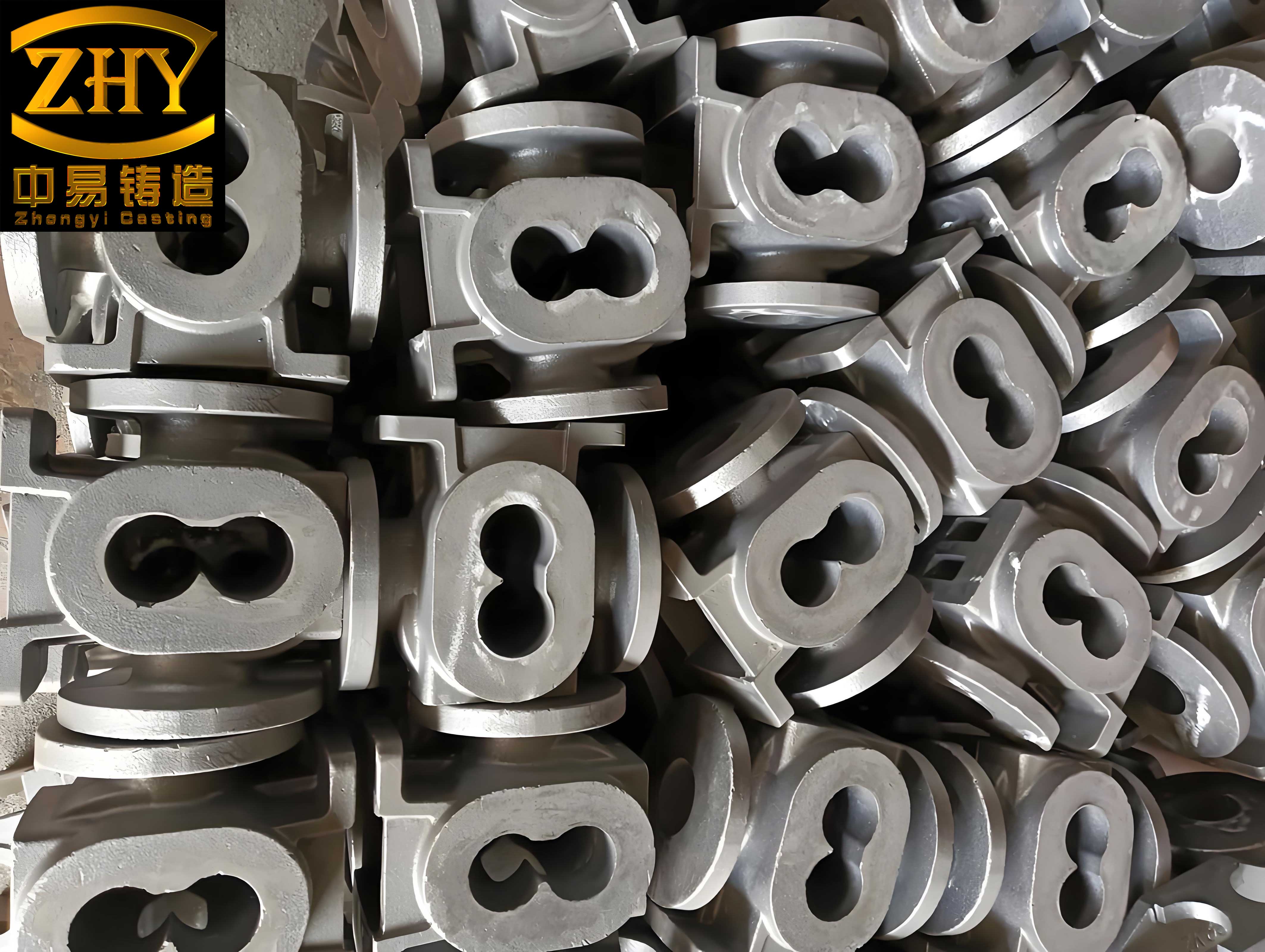
The image above illustrates the typical microstructure of our developed nodular cast iron, showcasing well-distributed graphite nodules in a ferritic-pearlitic matrix with fine precipitates, which contribute to its superior properties. This microstructure is key to achieving balanced mechanical performance at both room and high temperatures.
In terms of casting process optimization, we addressed defects like shrinkage porosity in isolated hot spots of complex thin-walled manifolds. By employing a combination of exothermic risers, chills, and vent pins, we effectively mitigated these issues. The solidification behavior was analyzed using Chvorinov’s rule for riser design:
$$ t = B \cdot \left( \frac{V}{A} \right)^n $$
where $t$ is solidification time, $B$ is a mold constant, $V$ is volume, $A$ is surface area, and $n$ is an exponent typically around 2. This ensured proper feeding and reduced defects, enhancing product reliability. The overall manufacturing process for medium silicon molybdenum niobium nodular cast iron manifolds involved precise control from melting to pouring, with pouring temperatures maintained at 1390–1440°C to avoid misrun or gas entrapment while ensuring complete filling of thin sections.
The economic impact of this development has been substantial. By replacing high-nickel austenitic nodular cast iron with our medium silicon molybdenum niobium nodular cast iron, we reduced material costs by over two-thirds, as nickel is a major cost driver. This cost reduction made high-performance exhaust manifolds more accessible for medium- and high-end engines, aligning with market demands for affordability without compromising quality. To date, we have successfully developed over 40 types of exhaust manifold products using this material, catering to more than 10 engine series. The annual production value exceeds 300 million yuan, demonstrating significant economic and social benefits through resource efficiency and enhanced product performance.
In conclusion, our research has yielded a novel medium silicon molybdenum niobium nodular cast iron that meets the stringent requirements of exhaust manifolds for “China VI” engines operating at up to 820°C. This nodular cast iron offers excellent thermal fatigue resistance, high-temperature strength, and cost-effectiveness compared to traditional high-nickel austenitic nodular cast iron. Through systematic optimization of composition, incorporation of trace elements like niobium and vanadium, and innovations in casting process control such as the rapid sampling device, we achieved consistent and reliable material properties. The successful industrial application across multiple client projects validates the material’s superiority and paves the way for broader adoption in high-temperature automotive components. Future work may explore further refinements, such as adjusting silicon and molybdenum ratios for even higher temperature capabilities or extending this nodular cast iron to other applications like turbocharger housings. Overall, this development underscores the potential of micro-alloying strategies in advancing nodular cast iron technology for demanding engineering applications.