
In the pursuit of enhancing the design and manufacturing quality of motorcycle frames, I embarked on a project to develop an integrated frame using precision investment casting. Traditional welded frames, often composed of multiple aluminum alloy components, face issues such as reduced strength in heat-affected zones and susceptibility to fatigue failure at weld joints. By leveraging precision investment casting, I aimed to create a monolithic frame that eliminates welds, improves structural integrity, and reduces weight. This approach not only enhances performance but also streamlines production, offering significant cost benefits. The core of this work lies in the application of advanced precision investment casting techniques to produce large, thin-walled complex geometries with high dimensional accuracy and superior mechanical properties.
The original frame, as analyzed, was constructed from eight separate parts joined by welding, with a total mass of 12.4 kg and an average wall thickness of 4 mm. Fatigue failures typically occurred at weld locations due to material discontinuity and thermal degradation. To address this, I redesigned the frame as a single integrated component. Key modifications included replacing weld joints with smooth transitional regions, reinforcing critical areas with optimized rib patterns, and converting closed tubular sections into open configurations to facilitate casting. The redesign maintained all mounting interfaces and external contours while reducing mass by 5% to 11.7 kg. The material selected was ZL101A aluminum alloy, known for its good castability and strength. The integration of multiple parts into one via precision investment casting minimizes stress concentrations and improves load distribution, which is critical for dynamic applications like motorcycles.
To validate the redesign, I conducted finite element analysis (FEA) under extreme loading conditions. The primary scenario evaluated was the maximum front load condition, simulating emergency braking where the rear wheel lifts off. The forces were calculated based on a mechanical model. Let the total vehicle mass be \( G \), the horizontal braking force at the front wheel center be \( F_0 \), the ground reaction force be \( F_1 \), and the braking force from ground friction be \( F_r \). Using moment equilibrium about the steering head bearing, the equations are:
$$ M = F_0 d_1 $$
$$ M = F_r d_2 – F_1 e $$
$$ F_r = G \phi_p $$
$$ F_1 = G $$
$$ G = (W_1 + W_2 + W_3 + W_4) g $$
where \( d_1 = 0.456 \, \text{m} \) (vertical distance from front wheel center to bearing), \( d_2 = 0.748 \, \text{m} \) (vertical distance from ground to bearing), \( e = 0.223 \, \text{m} \) (horizontal distance from front wheel center to bearing), \( \phi_p = 0.9 \) (ground adhesion coefficient), \( W_1 = 75 \, \text{kg} \) (rider mass), \( W_2 = 75 \, \text{kg} \) (passenger mass), \( W_3 = 50 \, \text{kg} \) (cargo mass), \( W_4 = 150 \, \text{kg} \) (vehicle curb mass), and \( g = 9.81 \, \text{m/s}^2 \). Solving these yields \( F_0 = 3,386 \, \text{N} \). This load was applied in FEA simulations to compare the original welded frame and the new integrated design.
The FEA model used linear elastic material properties with high-order tetrahedral elements (5 mm mesh size). Boundary conditions constrained the rear suspension connection points and front wheel center appropriately. Results showed significant improvements for the integrated frame. The maximum stress and deformation under limit static analysis were reduced, and free modal frequencies increased, indicating enhanced stiffness. The following table summarizes the key comparisons:
| Parameter | Original Welded Frame | Integrated Cast Frame | Improvement |
|---|---|---|---|
| Maximum Stress (MPa) | 577.7 | 134.0 | 76.8% reduction |
| Maximum Deformation (mm) | 2.09 | 1.68 | 19.6% reduction |
| First Torsional Modal Frequency (Hz) | 184.12 | 197.48 | 7.3% increase |
| Y-direction Bending Frequency (Hz) | 246.28 | 256.69 | 4.2% increase |
| Z-direction Bending Frequency (Hz) | 283.43 | 296.05 | 4.5% increase |
These improvements stem from the continuous material flow and optimized geometry enabled by precision investment casting, which avoids weld-induced weaknesses. The stress concentrations near welds in the original frame were eliminated, as seen in the FEA contour plots, where the integrated design showed more uniform stress distribution. The modal analysis further confirmed that the monolithic structure provides higher natural frequencies, reducing resonance risks during operation.
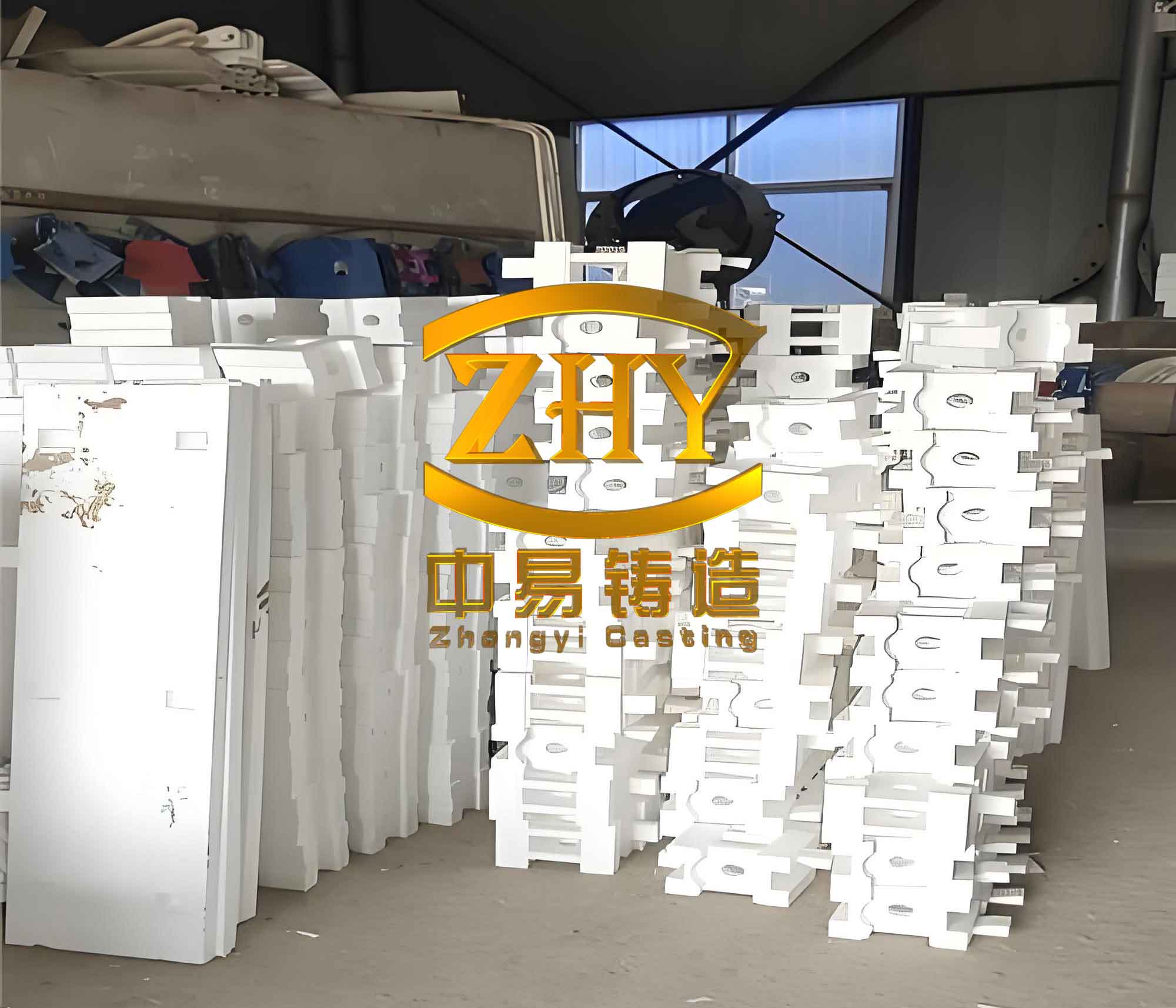
The manufacturing process relied heavily on precision investment casting, a technique ideal for producing complex, thin-walled parts with fine details. The frame dimensions were 742 mm × 687 mm × 335 mm, with a nominal wall thickness of 4 mm. Key challenges included controlling dimensional accuracy across large spans, ensuring internal quality in narrow cavities, and achieving a smooth surface finish. To address these, I implemented several process controls. The wax pattern was split into left and right halves for easier production using metal molds, then assembled with a jig to maintain precision. The gating system was designed to promote sequential solidification and minimize defects; all gates were placed on internal or mounting surfaces to preserve external aesthetics. The following formula describes the Chvorinov’s rule for solidification time, which guided riser design:
$$ t = k \left( \frac{V}{A} \right)^2 $$
where \( t \) is solidification time, \( k \) is a mold constant, \( V \) is volume, and \( A \) is surface area. By optimizing \( V/A \) ratios through rib layout and gate positioning, I ensured sound casting with minimal shrinkage. The precision investment casting process involved creating ceramic shells via repeated dipping and stuccoing, followed by dewaxing and firing. Molten ZL101A aluminum was poured at approximately 720°C, with careful control of cooling rates to achieve desired microstructure. Heat treatment in T6 condition (solution treatment and aging) was applied to enhance mechanical properties, targeting tensile strength ≥275 MPa and elongation ≥2%.
Quality verification involved extensive testing. The cast frame underwent 100% X-ray inspection, meeting Grade I and II standards per GB/T 9438-2013 for specified and non-specified areas, respectively. Mechanical tests on separately cast samples confirmed properties: tensile strength averaged 280 MPa, elongation 3%, and hardness 85 HB. Dimensional checks using coordinate measuring machines showed compliance with CT8 tolerance levels (per HB 6103-2004), with deviations within ±0.5 mm for critical features. Fatigue testing on a rig simulated maximum front loading for over 1 million cycles—a fourfold increase from the original frame’s 250,000-cycle failure point. No cracks or deformations were observed, underscoring the durability gained through precision investment casting. Additionally, road trials confirmed fitment with body panels, with seamless surface continuity after painting.
The success of this project highlights the transformative potential of precision investment casting for automotive structures. By integrating multiple components into a single casting, I achieved weight reduction, improved stiffness, and extended fatigue life. The elimination of welds removes inherent weak points, while the design freedom of precision investment casting allows for topology-optimized geometries that enhance performance. From a production standpoint, this method reduces assembly steps, lowers labor costs, and increases consistency. However, challenges remain in scaling up for high-volume manufacturing, such as mold costs and process cycle times. Future work could explore hybrid approaches combining casting with additive manufacturing for further optimization.
In conclusion, the development of this large thin-walled motorcycle frame demonstrates that precision investment casting is a viable and superior alternative to traditional welding. The FEA results validated the structural enhancements, while physical tests proved the casting’s integrity and longevity. As industries push for lighter and stronger components, precision investment casting will play a pivotal role in enabling complex, integrated designs. My experience shows that with careful design and process control, this technique can deliver significant gains in product quality and efficiency, paving the way for broader adoption in transportation and beyond.