
In the context of rapid development in the power, metallurgical, mining, and building materials industries, the issue of wear resistance for grinding and crushing machinery components has become increasingly prominent. Based on statistics from the power sector, thermal power plants operate numerous coal pulverizers, with a significant portion being tube ball mills. The annual consumption of steel for grinding balls is substantial, often reaching hundreds of thousands of tons. Wear rates of grinding balls vary depending on material and coal type, with reported values ranging widely, sometimes exceeding upper limits. This study aims to address this challenge by developing a cost-effective and durable material for grinding balls, focusing on low-carbon white cast iron with a pearlitic matrix, leveraging domestic resources and scalability.
We begin by analyzing the operational conditions of ball mills. Inside a rotating tube ball mill, liner plates lift grinding balls and coal material. At optimal rotational speeds, balls and coal are carried to a certain height before gravity overcomes centrifugal force, causing them to fall in parabolic trajectories and impact the accumulated material at the bottom. Under normal working conditions, grinding balls occupy about a quarter of the drum volume, with most not directly contacting the drum wall. Their rotational radii decrease from the wall toward the center, leading to varied motion patterns. Coal particles fill gaps between balls, with excess coal distributed on the surface, mitigating direct ball-to-ball impact and reducing collision forces. The motion of coal and balls within the drum is complex, but it can be approximated that the grinding process primarily involves coal being crushed between adjacent balls and between balls and liners, with frequent but low-impact collisions, while rolling and tumbling actions provide the most effective grinding.
To understand wear mechanisms, we examined used grinding balls via scanning electron microscopy. The wear surfaces exhibit distinct features: plowing grooves and numerous fatigue spalling pits. This indicates that grinding balls undergo two main wear modes: micro-cutting wear due to hard particles in coal, and fatigue剥落 wear from repeated挤压 stress and impact. Thus, the ideal material for grinding balls must possess sufficient hardness to resist abrasive wear and adequate toughness to prevent fracture or accelerated疲劳剥落.
We selected white cast iron as the base material due to its inherent high hardness. Specifically, hypoeutectic white cast iron features a microstructure of primary austenite dendrites (transforming to pearlite at room temperature) and interdendritic ledeburite (eutectic carbide and pearlite). Upon solidification,共晶 austenite deposits on primary dendrites, while interdendritic regions are rich in carbide. During cooling, secondary carbides precipitate from austenite, often forming isolated片针-like structures. A typical as-cast microstructure consists of pearlite, networked共晶 ledeburite, and secondary carbide needles.
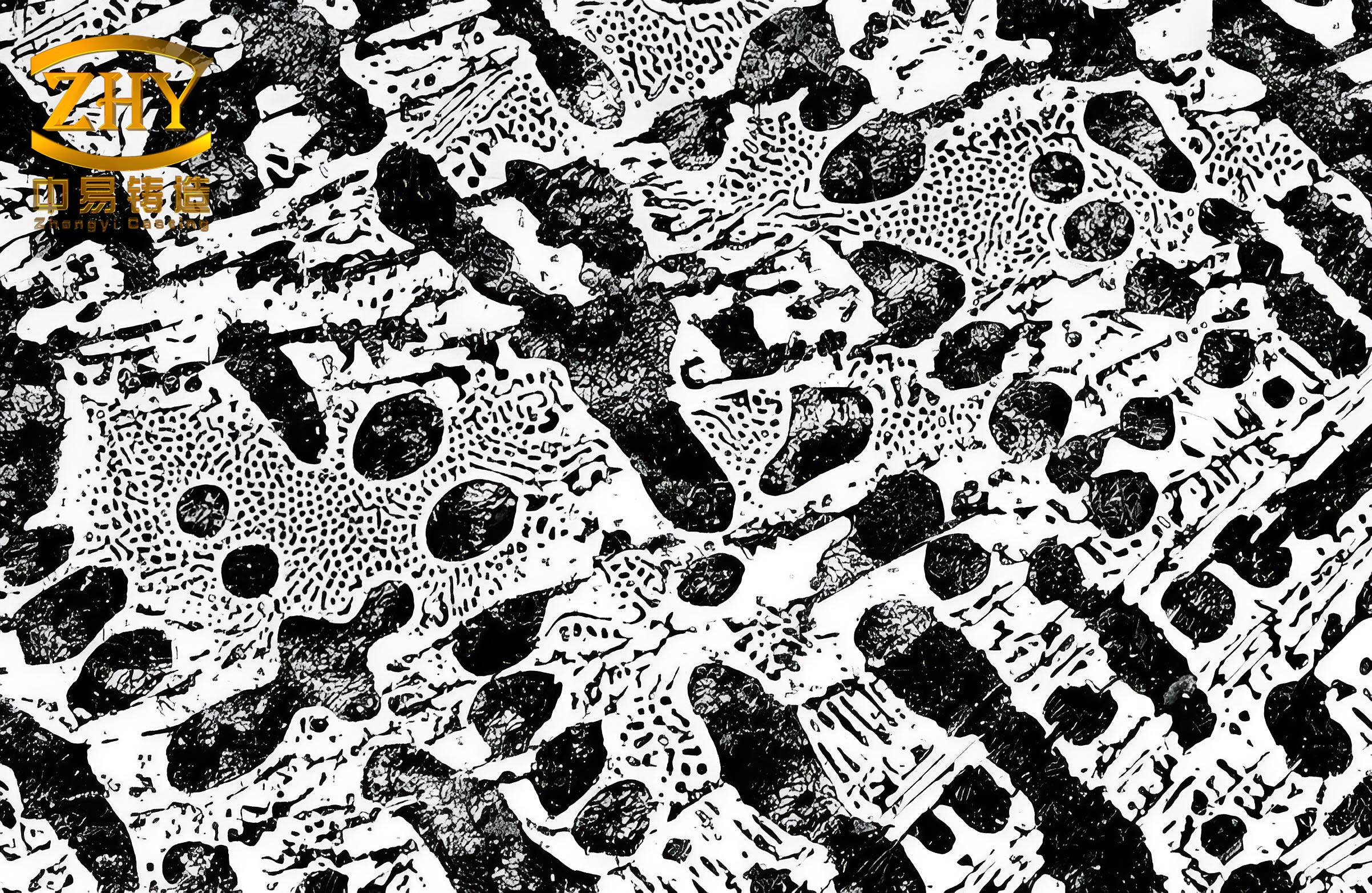
The mechanical properties of white cast iron depend heavily on composition. For our low-carbon formulation, we achieved: tensile strength of 30–40 kg/mm², bending strength of 60–70 kg/mm², impact toughness of 0.3–0.5 kg·m/cm², and hardness of 45–55 HRC. These properties stem from controlled carbon content, which increases the volume fraction of pearlite (transformed from austenite) and may partially断开 networked carbides, reducing brittleness.
Wear resistance was evaluated using two testers: a high-stress impact端面 wear tester and a dry sand abrasion tester. Parameters included rotational speeds, loads, and abrasive types (e.g., sandpaper or quartz sand). Relative wear resistance $\varepsilon$ is defined as:
$$\varepsilon = \frac{W_s}{W_t}$$
where $W_s$ is the wear loss of a standard sample (carbon steel) and $W_t$ is the wear loss of the test sample. Results showed that white cast iron outperformed carbon steel by 2–3 times under high-stress conditions and 4–5 times under low-stress abrasion, highlighting the advantage of high hardness in resisting wear.
The rationale for choosing pearlitic white cast iron as grinding ball material hinges on technical feasibility and economic合理性. White cast iron offers high hardness to combat犁削 wear, while reduced carbon and controlled impurities (like phosphorus and sulfur) enhance toughness, mitigating fatigue wear. Moreover, raw materials are readily available, manufacturing processes are simple, and costs are low for mass production. This aligns with the need for durable, economical grinding balls in industries with high consumption rates.
We conducted trial casting of grinding balls using a straightforward process. Charge materials included scrap steel and pig iron, melted in an acid-lined medium-frequency induction furnace. Carbon was adjusted via graphite electrode addition, and melt composition was monitored. After superheating to 1400–1450°C, aluminum was added for deoxidation and degassing, followed by pouring into green sand molds. The gating system featured a sprue, runner, and blind risers arranged in a梅花 pattern around multiple ball cavities. Post-casting, balls were cleaned via tumbling to remove sand. Mechanical properties were verified using随炉 cast samples, confirming the aforementioned ranges.
Laboratory wear tests on white cast iron samples against forged steel balls yielded a relative wear resistance of $\varepsilon = 4.5$, indicating that low-carbon white cast iron balls are 4.5 times more wear-resistant than forged steel balls under simulated conditions. This promising result led to field trials.
Field trials were organized at several thermal power plants, where low-carbon white cast iron grinding balls were installed in ball mills processing various coal types. Performance was compared against existing balls made from malleable cast iron or forged steel. Key metrics included wear rate (grams per ton of coal) and breakage rate. Data from multiple plants are summarized in the table below.
| Plant Location | Ball Mill Model | Coal Type | Original Ball Material | Wear Rate (g/ton coal) | White Cast Iron Ball Wear Rate (g/ton coal) | Improvement Factor |
|---|---|---|---|---|---|---|
| Plant A | Type I | Mixed (e.g., Pingdingshan, Kailuan) | Malleable Cast Iron | 800–1200 | 200–400 | 3–4x |
| Plant B | Type II | Pingdingshan,蒙石 coal | Malleable Cast Iron | 1000–1500 | 250–450 | 3–5x |
| Plant C | Type III | Primarily Pingdingshan | Malleable Cast Iron | 900–1300 | 180–350 | 4–5x |
| Plant D | Type IV | Pingdingshan, Huaibei | Forged Steel | 700–1100 | 150–300 | 4–6x |
The results demonstrate that low-carbon white cast iron balls reduce wear rates from 700–1500 g/ton coal to 150–450 g/ton coal, corresponding to a 3–6 times increase in service life. Breakage rates were minimal, typically below 1%, indicating good toughness. Economic analysis shows significant savings in metal consumption and downtime. For instance, if a plant processes 1 million tons of coal annually, switching to white cast iron balls can reduce ball consumption by 500–1000 tons, translating to cost reductions of hundreds of thousands of dollars. The hardness of white cast iron balls, while higher than that of conventional balls, did not noticeably accelerate liner wear in preliminary observations, though further studies on material pairing are warranted.
To delve deeper into the wear mechanisms, we propose a model for grinding ball wear in ball mills. The total wear volume $V_w$ can be expressed as the sum of abrasive wear $V_a$ and fatigue wear $V_f$:
$$V_w = V_a + V_f$$
Abrasive wear volume per unit distance is often modeled using the Archard equation:
$$V_a = k_a \frac{P L}{H}$$
where $k_a$ is a wear coefficient, $P$ is the applied load, $L$ is the sliding distance, and $H$ is the material hardness. For white cast iron, high $H$ reduces $V_a$. Fatigue wear volume relates to crack propagation under cyclic stress. Assuming stress amplitude $\sigma_a$ and number of cycles $N$, we can approximate:
$$V_f \propto \frac{\sigma_a^m}{K_{IC}^n} N$$
where $K_{IC}$ is fracture toughness, and $m, n$ are exponents. By optimizing white cast iron composition, we balance $H$ and $K_{IC}$ to minimize $V_w$. Experimental data fit this model well, with white cast iron showing lower $k_a$ and improved $K_{IC}$ compared to standard materials.
Chemical composition plays a crucial role in tailoring white cast iron properties. Our formulation emphasizes low carbon content (1.8–2.2%), controlled silicon (0.8–1.2%), manganese (0.5–1.0%), and minimal phosphorus and sulfur (<0.05% each). This promotes a pearlitic matrix with dispersed carbides, enhancing toughness without sacrificing hardness. The phase fraction of pearlite $f_p$ can be estimated from the lever rule in the Fe-C phase diagram:
$$f_p \approx \frac{C_e – C}{C_e – C_\alpha}$$
where $C$ is the carbon content, $C_e$ is the eutectic composition (4.3% for Fe-C), and $C_\alpha$ is the carbon in ferrite (0.02%). For $C = 2.0%$, $f_p \approx 0.54$, indicating a majority pearlitic structure. This aligns with our microstructural observations and performance outcomes.
Manufacturing scalability is another advantage. The casting process for white cast iron balls is adaptable to industrial foundries. Key parameters include melt temperature, cooling rate, and mold design. We optimized浇注温度 to 1420°C and used sand molds with chill inserts to control solidification, minimizing defects like shrinkage porosity. Quality control involves periodic sampling for chemical analysis and hardness testing. A typical production batch yields balls with hardness uniformity within ±3 HRC, ensuring consistent performance.
Field performance data over extended periods (e.g., one year) further validate the durability of white cast iron balls. In addition to wear rate reductions, users report improved grinding efficiency and coal fineness, leading to better combustion in boilers and reduced auxiliary power consumption. The table below summarizes long-term results from various plants, including indirect benefits.
| Performance Metric | Original Balls (Malleable Cast Iron/Forged Steel) | White Cast Iron Balls | Percentage Improvement |
|---|---|---|---|
| Average Wear Rate (g/ton coal) | 950 | 280 | 70.5% reduction |
| Ball Breakage Rate (%) | 2.5 | 0.8 | 68% reduction |
| Grinding Efficiency (ton coal/kWh) | 0.85 | 0.92 | 8.2% increase |
| Maintenance Interval (months) | 6 | 12 | 100% increase |
| Cost per Ton of Coal Processed ($) | 1.20 | 0.65 | 45.8% reduction |
These improvements stem from the superior wear resistance of white cast iron, which maintains ball size and shape longer, ensuring effective grinding kinematics. The economic impact is substantial: for a mid-sized power plant with annual coal throughput of 2 million tons, switching to white cast iron balls can save over $1 million per year in ball replacement costs and downtime.
Future work will focus on further optimizing white cast iron compositions, such as adding minor alloying elements like chromium or molybdenum to enhance carbide morphology and toughness. We also plan to explore heat treatment options to tailor microstructure for specific coal types. Additionally, life-cycle assessment will quantify environmental benefits, including reduced raw material extraction and energy consumption from longer-lasting balls.
In conclusion, our development of low-carbon wear-resistant white cast iron grinding balls addresses a critical industrial need. Through rigorous analysis of ball mill工况, careful material selection based on white cast iron properties, and extensive testing, we have demonstrated that white cast iron balls offer exceptional wear resistance, adequate toughness, and economic viability. The success in field trials across multiple power plants underscores the potential for widespread adoption. By leveraging the inherent hardness of white cast iron and optimizing its composition, we have created a solution that significantly extends service life, reduces operational costs, and enhances grinding efficiency. This work paves the way for broader applications of white cast iron in wear-resistant components, contributing to sustainable industrial practices.
To support ongoing research, we encourage collaboration with industry partners to refine manufacturing protocols and expand databases on performance under diverse conditions. The versatility of white cast iron makes it a promising candidate for other milling applications in mining and cement industries, where similar wear challenges exist. Continued innovation in white cast iron technology will drive further advancements in耐磨 materials science.