
With the advancement of modern industry, traditional high manganese steel, primarily composed of Fe-Mn-C systems, has faced limitations in meeting contemporary demands for mechanical properties, hardness, wear resistance, and corrosion resistance. The integration of nitrogen as an alloying element has emerged as a pivotal strategy to enhance these properties, extending the service life of steel components. Nitrogen alloying facilitates improvements through mechanisms such as solid solution strengthening, precipitation hardening, and grain refinement, leading to the development of high-performance nitrogen-containing high manganese steel. This article delves into the alloying effects of nitrogen, explores冶炼 and casting processes, examines the impact of heat treatment, and provides insights into future directions for high manganese steel casting.
The fundamental composition of traditional high manganese steel includes approximately 1.0–1.4% carbon, 10–15% manganese, and trace amounts of silicon, phosphorus, and sulfur, with iron constituting the remainder. Represented symbolically as ZGMn13, this steel features a face-centered cubic crystal structure and is renowned for its exceptional work-hardening capability. It finds extensive applications in mining, vehicle engineering, marine infrastructure, and railway construction. However, under low-stress impact conditions, traditional high manganese steel often fails to exhibit significant work hardening, leading to severe wear and reduced durability. Nitrogen alloying addresses these shortcomings by stabilizing the austenitic phase and enhancing overall performance.
The influence of nitrogen on high manganese steel casting is multifaceted, primarily involving grain refinement, solid solution strengthening, and precipitation hardening. Nitrogen atoms, with their smaller atomic radius compared to iron, occupy interstitial sites in the crystal lattice, inducing lattice distortion. This distortion impedes dislocation movement, thereby increasing strength and toughness. The interaction between nitrogen and other alloying elements, such as chromium, promotes the formation of nitrides like CrN, which further refine microstructures and inhibit coarsening. The synergistic effect of nitrogen and carbon transforms coarse carbides into fine carbonitrides, enhancing mechanical properties. For instance, the yield strength and tensile strength can increase by 20–30% due to nitrogen addition. The relationship between stress and strain in nitrogen-containing high manganese steel can be described by the following empirical formula for work hardening: $$\sigma = K \epsilon^n$$ where $\sigma$ is the true stress, $\epsilon$ is the true strain, $K$ is the strength coefficient, and $n$ is the work-hardening exponent. Nitrogen alloying typically increases $n$, improving ductility and toughness.
In terms of corrosion resistance, nitrogen significantly enhances the performance of high manganese steel casting in aggressive environments. The addition of nitrogen promotes the formation of a stable passive film, reducing corrosion rates. Studies have shown that nitrogen-containing steels exhibit lower corrosion currents and higher pitting potentials compared to conventional grades. For example, in artificial acid rain environments, the corrosion rate of nitrogen-alloyed high manganese steel can be as low as one-fourth that of traditional Mn13 steel. The electrochemical behavior can be modeled using the Tafel equation: $$E = E_{corr} + b \log(i/i_0)$$ where $E$ is the potential, $E_{corr}$ is the corrosion potential, $b$ is the Tafel slope, $i$ is the current density, and $i_0$ is the exchange current density. Nitrogen reduces $i_0$, indicating improved corrosion resistance.
| Steel Type | Yield Strength (MPa) | Tensile Strength (MPa) | Elongation (%) | Impact Toughness (J) |
|---|---|---|---|---|
| Traditional High Manganese Steel | 361 | 594 | 40 | 120 |
| Nitrogen-Containing High Manganese Steel | 433 | 685 | 45 | 150 |
The冶炼 of nitrogen-containing high manganese steel casting involves complex processes due to nitrogen’s tendency to escape from molten steel. Two primary methods are employed: converter冶炼 and electric furnace冶炼. Converter冶炼 typically follows a route of blast furnace → hot metal pretreatment → converter → secondary refining (e.g., LF, RH). However, this method faces challenges such as significant alloy element loss and difficulty in controlling nitrogen dissolution. In contrast, electric furnace冶炼, including high-power arc furnaces or vacuum induction furnaces coupled with electroslag remelting, allows precise temperature control and minimizes nitrogen loss. The solubility of nitrogen in steel is governed by Sieverts’ law: $$[N] = K_N \sqrt{P_{N2}}$$ where $[N]$ is the nitrogen concentration, $K_N$ is the equilibrium constant, and $P_{N2}$ is the partial pressure of nitrogen. To enhance nitrogen absorption, processes like bottom blowing of nitrogen gas or addition of nitrogen-bearing alloys are optimized. For instance, in electric arc furnaces, increasing pressure during冶炼 can significantly boost nitrogen solubility, making high-pressure nitrogen alloying a promising approach for high manganese steel casting.
Secondary refining techniques, such as ladle furnace (LF) and vacuum oxygen decarburization (VOD), play a crucial role in achieving desired nitrogen levels. During VOD processing, nitrogen gas is often used for stirring to promote homogeneity. The kinetics of nitrogen dissolution can be expressed as: $$\frac{d[N]}{dt} = k A (C^* – [N])$$ where $k$ is the mass transfer coefficient, $A$ is the interfacial area, $C^*$ is the equilibrium concentration, and $[N]$ is the current nitrogen content. Optimizing parameters like gas flow rate and temperature ensures efficient nitrogen uptake in high manganese steel casting.
| Parameter | Range | Effect on Nitrogen Content |
|---|---|---|
| Nitrogen Pressure (MPa) | 0.2–0.4 | Increases solubility by 20–40% |
| Temperature (°C) | 1500–1600 | Higher temperature reduces solubility |
| Stirring Intensity (m³/h) | 0.1–0.2 | Enhances homogeneity and dissolution rate |
Casting processes for nitrogen-containing high manganese steel casting include mold casting and continuous casting. Mold casting, often using sand molds, requires careful selection of molding materials to prevent defects like sand sticking and shrinkage porosity. Neutral or basic sands, such as magnesia or olivine sand, are preferred due to their chemical stability. The design of gating systems and risers is critical to ensure sound castings. For example, low pouring temperatures and optimized feeder dimensions minimize nitrogen loss and void formation. The solidification behavior can be analyzed using the Chvorinov’s rule: $$t = B (V/A)^2$$ where $t$ is the solidification time, $B$ is the mold constant, $V$ is the volume, and $A$ is the surface area. Rapid cooling techniques can reduce solidification time by over 50%, mitigating nitrogen segregation.
Continuous casting offers advantages in productivity and uniformity for high manganese steel casting. However, challenges such as breakout and segregation arise due to the high thermal expansion coefficient and low thermal conductivity of high manganese steel. Electromagnetic stirring (EMS) and dynamic soft reduction are employed to improve internal quality. EMS induces fluid flow that breaks dendrites and promotes equiaxed grain growth, reducing centerline segregation. The electromagnetic force can be calculated as: $$F = J \times B$$ where $F$ is the Lorentz force, $J$ is the current density, and $B$ is the magnetic flux density. Soft reduction compensates for solidification shrinkage by applying mechanical pressure at the strand end, enhancing density and reducing porosity. The reduction amount $\Delta$ is given by: $$\Delta = \alpha L \Delta T$$ where $\alpha$ is the thermal expansion coefficient, $L$ is the length, and $\Delta T$ is the temperature drop.
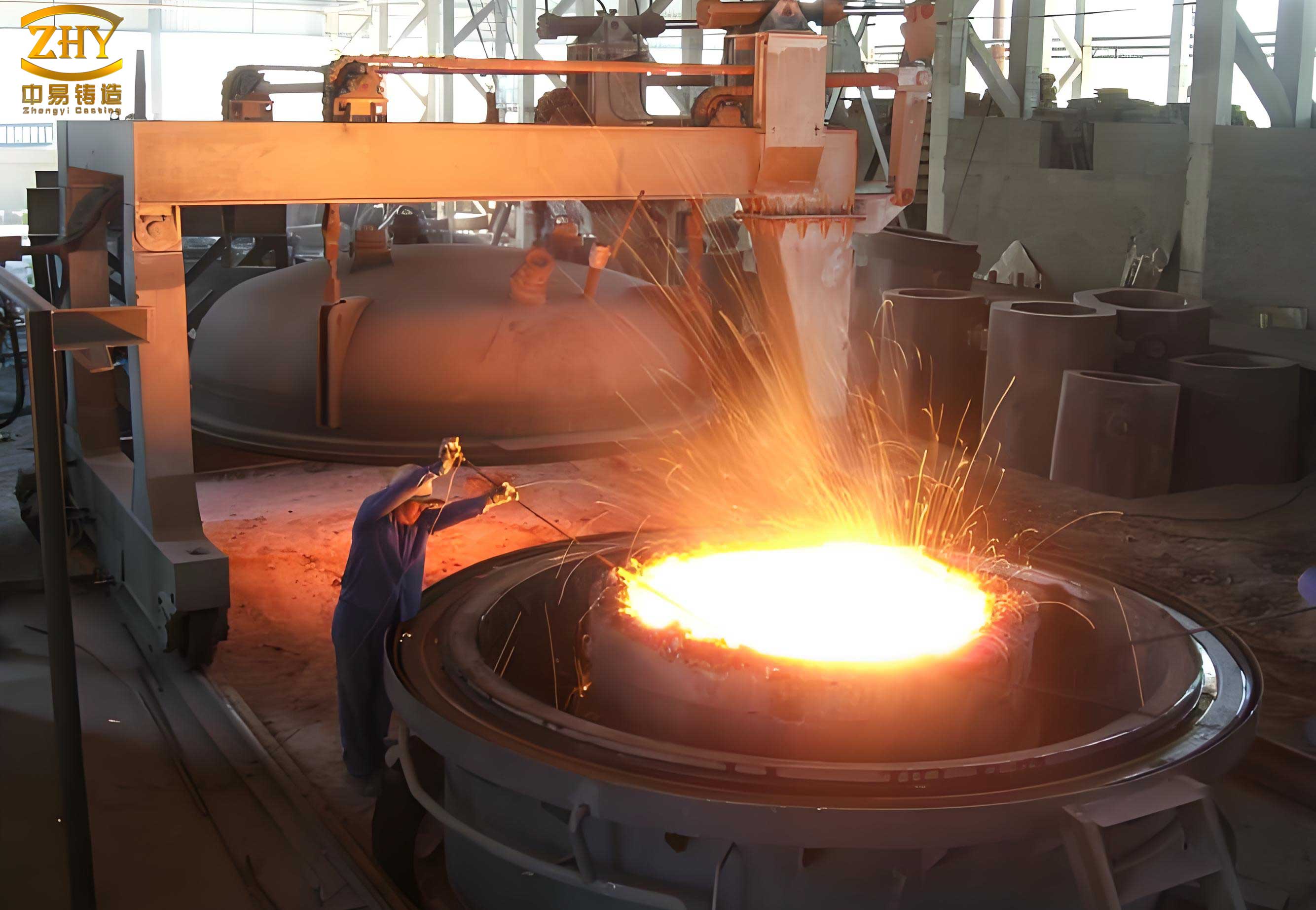
Heat treatment profoundly influences the microstructure and properties of nitrogen-containing high manganese steel casting. The as-cast structure typically consists of austenite, carbides, and some pearlite, which impair toughness. Solution treatment, or water quenching, involves heating to 1050–1100°C to dissolve carbides and nitrides, followed by rapid cooling to obtain a supersaturated austenitic matrix. This process enhances toughness and work-hardening capacity. Aging treatment at 400–500°C precipitates fine nitrides, further strengthening the steel. The precipitation kinetics follow the Avrami equation: $$X = 1 – \exp(-k t^n)$$ where $X$ is the fraction transformed, $k$ is the rate constant, $t$ is time, and $n$ is the time exponent. Prolonged aging, however, may coarsen precipitates, reducing hardness. Optimized heat treatment parameters, such as temperature and holding time, are crucial for balancing strength and toughness in high manganese steel casting.
| Treatment | Hardness (HV) | Yield Strength (MPa) | Impact Energy (J) |
|---|---|---|---|
| As-Cast | 200 | 350 | 50 |
| Solution Treated | 220 | 400 | 80 |
| Aged (400°C, 2h) | 250 | 450 | 70 |
Future prospects for nitrogen-containing high manganese steel casting focus on advancing冶炼 and casting technologies to achieve higher nitrogen levels and improved homogeneity. High-pressure冶炼 and electromagnetic stirring in continuous casting are key areas for development. Additionally, alloy design incorporating elements like chromium and vanadium with nitrogen can further enhance precipitation hardening and corrosion resistance. The integration of computational modeling for process optimization and the adoption of eco-friendly practices will drive innovation. As industries demand materials with superior performance under extreme conditions, nitrogen-alloyed high manganese steel casting is poised to play a pivotal role in applications ranging from heavy machinery to marine structures.
In summary, nitrogen alloying significantly enhances the performance of high manganese steel casting through microstructural refinement and strengthening mechanisms. Challenges in冶炼 and casting can be overcome with optimized processes, while heat treatment tailors properties for specific applications. Continued research and technological advancements will expand the capabilities of nitrogen-containing high manganese steel, ensuring its relevance in future material engineering.