
In my extensive experience working with manganese steel casting foundries, I have observed that the heat treatment process for high manganese steel castings, particularly ZG Mn13, is a critical factor determining their performance in abrasive and impact environments. The standard water-quenching (water toughening) treatment aims to achieve a single austenitic structure, but practical challenges often arise due to the material’s poor thermal conductivity, high coefficient of thermal expansion, and sensitivity to decarburization and oxidation. This article explores these issues from my first-hand perspective, integrating experimental data and industrial practices to propose optimized methodologies. I will delve into the transformations during direct heating, the role of preheating and soaking, and the optimization of quenching parameters, all while emphasizing the importance of tailored approaches for different casting geometries in a manganese steel casting foundry.
Historically, heat treatment protocols for high manganese steel castings have evolved based on empirical findings. Early literature, such as referenced studies, indicated that re-heating quenched specimens to temperatures between 400°C and 700°C leads to a severe embrittlement zone, where tensile strength and elongation drop precipitously, reaching minima around 550°C. This is attributed to the precipitation of carbides and sorbitic structures. Consequently, some practices advocated eliminating the soaking stage at 650-700°C, instead directly heating from below 600°C to the solutionizing temperature of 1050-1200°C at a rate of about 260°C per hour. Other rapid-heating methods were introduced, with heating rates up to 200-270°C per hour, reportedly reducing processing time and cracking tendencies for certain components like liner plates. However, I argue that such approaches often overlook the inherent characteristics of manganese steel casting foundry operations, especially for large, complex, or heavily sectioned castings. Blindly applying fast heating or prolonged high-temperature holds can exacerbate thermal stresses, promote surface decarburization, demanganization, and oxidation, and ultimately increase scrap rates due to quenching cracks or reduced service life.
To understand the core issue, I conducted investigations on the direct heating transformation of as-cast high manganese steel. The as-cast structure typically contains a network of coarse blocky carbides within an austenitic matrix. Upon heating, the behavior differs significantly from that of re-heated quenched steel. In the quenched condition, the austenite is supersaturated with carbon, leading to extensive precipitation of brittle carbides in the embrittlement range. For as-cast material, however, much of the carbon has already precipitated during solidification, resulting in a lower carbon concentration in the austenite. My observations, supported by metallographic analysis, reveal that below the Ac1 temperature (approximately 620-630°C for typical compositions), precipitation of fine secondary carbides occurs, intensifying near Ac1. However, just above Ac1, around 650-700°C, these newly formed carbides and associated transformation products dissolve rapidly. This is a key insight: for as-cast pieces, soaking in the 650-700°C range does not increase brittleness but rather enhances plasticity by dissolving fine precipitates, thereby reducing the driving force for crack initiation during subsequent heating.
The following table summarizes the microstructural evolution of as-cast ZG Mn13 during heating, based on my experimental work with specimens of composition: 1.28% C, 12.6% Mn, 0.65% Si, 0.075% P, 0.0095% S.
| Heating Temperature (°C) | Cooling Method | Resultant Microstructure | Implications for Heat Treatment |
|---|---|---|---|
| 400 | Air Cool | Austenite + coarse network carbides; no significant new precipitation. | Minimal embrittlement; safe for slow heating. |
| 500 | Air Cool | Austenite + coarse carbides + few fine granular carbides. | Onset of secondary precipitation. |
| 600 | Air Cool | Austenite + coarse carbides + abundant fine lamellar/granular carbides and troostite. | Near Ac1, maximum secondary precipitation occurs, increasing brittleness. |
| 650 | Water Quench | Austenite + coarse carbides + dissolved troostite; most secondary carbides dissolved. | Above Ac1, plasticity recovers. Soaking here is beneficial. |
| 700 | Water Quench | Austenite + coarse carbides (showing dissolution signs) + minimal troostite. | Further dissolution, enhancing homogeneity. |
| 800 | Water Quench | Austenite + partially dissolved coarse carbides + residual troostite at prior boundaries. | Significant carbide dissolution; safe for rapid heating. |
| 950 | Water Quench | Austenite + few undissolved fine carbide particles/aggregates. | Near-complete dissolution; only high-stability carbides remain. |
| 1050-1100 | Water Quench | Single-phase austenite with negligible carbides. | Ideal solutionized state for water toughening. |
This behavior can be modeled using kinetics for carbide dissolution. The rate of carbide dissolution during heating can be approximated by an Arrhenius-type equation:
$$ \frac{dx}{dt} = -A e^{-\frac{Q}{RT}} (x – x_{eq}) $$
where \( x \) is the volume fraction of undissolved carbides, \( x_{eq} \) is the equilibrium fraction at temperature \( T \), \( Q \) is the activation energy for diffusion, \( R \) is the gas constant, and \( A \) is a pre-exponential factor. For (Fe,Mn)3C carbides in a manganese steel casting foundry context, \( Q \) is relatively low, explaining their rapid dissolution above Ac1. Prolonged holding at high temperatures, however, accelerates detrimental surface reactions. The depth of decarburization \( d \) can be estimated by a parabolic growth law:
$$ d^2 = k_p t $$
where \( k_p \) is the parabolic rate constant dependent on temperature and atmosphere, and \( t \) is time. For high manganese steel, \( k_p \) increases sharply above 900°C, justifying minimized high-temperature exposure.
Based on these principles, I advocate for a revised approach to preheating and soaking. For most castings produced in a manganese steel casting foundry—especially those that are complex, heavy, variable in section thickness, or densely packed in furnaces—I recommend a deliberate soak in the 650-700°C range. This practice ensures uniform through-thickness temperature, minimizing thermal gradients and the associated thermal stresses when ramping to the solutionizing temperature. Contrary to some literature, this soak does not promote embrittlement in as-cast pieces; instead, it dissolves the fine secondary carbides that form during heating below Ac1, thereby improving ductility and reducing the risk of cracking during subsequent rapid heating. Moreover, oxidation, decarburization, and demanganization are markedly less severe at 650-700°C compared to temperatures above 1000°C, as shown in classic studies on manganese steel forging. Preserving the surface integrity is crucial for wear resistance, as a decarburized surface layer behaves like a low-carbon, low-manganese steel with poor hardness and abrasion resistance.
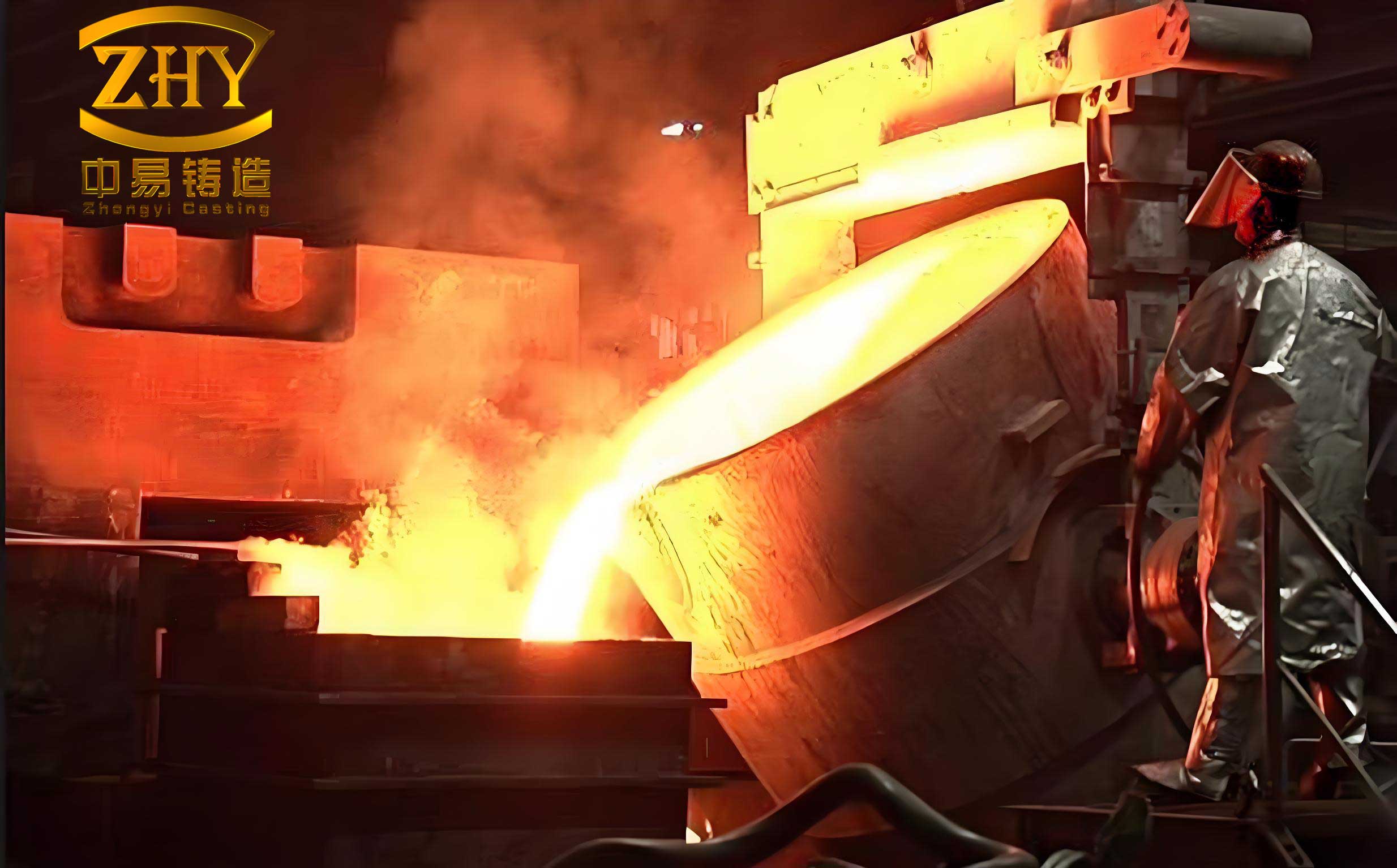
The optimization of quenching process parameters is the next critical step. The key variables are furnace entry temperature, heating rate, soaking time at intermediate and high temperatures, and the final quenching medium (always water for manganese steel). My recommendations, derived from both controlled experiments and production trials in a manganese steel casting foundry, are summarized in the table below. These parameters balance the need for complete carbide solution with the minimization of thermal stress and surface degradation.
| Casting Type | Recommended Entry Temperature | Heating to 650-700°C | Soak at 650-700°C | Heating Rate to 1050-1100°C | Soak at Solution Temperature | Quenching |
|---|---|---|---|---|---|---|
| Simple, thin, uniformly sectioned, non-packed | <750°C | Direct heating acceptable | Not required | Medium to high (200-400°C/h in flame furnace; 300-650°C/h in electric) | Short: 0.5-0.8 min/mm (flame/electric) or 0.3-0.4 min/mm (salt bath) | Agitated water |
| Medium complexity, heavy, variable sections, packed loads | ~650°C | Controlled heating | Essential: ~1.5 min/mm (adjust for packing) | Fast: 250-400°C/h (flame); 300-650°C/h (electric) | Short: 0.5-1.2 min/mm (flame/electric); salt bath not typical for large loads | Agitated water |
| Extremely large, heavy, complex, severe thickness variations | <400°C | Very slow: 60-80°C/h | Essential: prolonged, ~3 min/mm | Moderate: 100-135°C/h | Moderate: 1.5-2.5 min/mm, but total time should not exceed 3-4 hours | Agitated water, ensure uniform cooling |
The high-temperature soaking time is particularly contentious. Traditional guidelines often prescribe 1 hour per 20-25 mm, which I find excessive for manganese steel. The (Fe,Mn)3C carbides dissolve relatively easily. My experiments, such as on 50 mm thick liner plates, show that a salt bath hold of just 15 minutes at 1070°C yields a fully austenitic structure. Prolonged high-temperature exposure, besides worsening decarburization, leads to excessive grain growth and can induce martensite or troostite formation at the surface upon quenching due to lowered Mn and C content, increasing crack susceptibility. Therefore, I propose a general high-temperature soaking coefficient \( k_{soak} \) of 0.5 to 1.5 min/mm for flame or electric furnaces, and 0.3 to 0.5 min/mm for salt baths. This can be expressed as:
$$ t_{soak} = k_{soak} \times T_{max} $$
where \( t_{soak} \) is the soaking time in minutes, \( k_{soak} \) is the coefficient (min/mm), and \( T_{max} \) is the maximum section thickness in mm. For very heavy sections (e.g., >150 mm), the time may be capped at 180-240 minutes to limit damage.
To illustrate the impact, consider the case of large jaw crusher cheek plates weighing 900 kg with sections from 50 to 100 mm. Initial trials with direct heating from 400°C or 450°C to 1080°C resulted in 100% cracking. A successful protocol involved loading below 300°C, soaking at 300°C for 2 hours, heating at 60°C/h to 650-700°C for a 3-hour soak, then heating at 100°C/h to 1050-1100°C for a 6-hour soak before quenching. While successful, the 6-hour high-temperature soak is, in my opinion, too long. Based on the dissolution kinetics, I believe a soak of 2.5 to 3.5 hours (using a \( k_{soak} \) of ~1.2-1.5 min/mm for the thickest section) would be sufficient, reducing energy consumption and surface degradation while still achieving a homogeneous austenite. This underscores the need for rational calculation rather than rule-of-thumb in a manganese steel casting foundry.
The role of alloy composition cannot be overlooked. The stability of austenite and the precipitation behavior are influenced by the carbon and manganese balance. A simplified empirical relation for the approximate Ac1 temperature (°C) in high manganese steels is:
$$ A_{c1} \approx 750 – 100(\%C) – 20(\%Mn) + 10(\%Si) $$
This highlights that higher carbon lowers the transformation temperature, affecting the embrittlement range. Therefore, heat treatment schedules should be adjusted based on the specific melt analysis from the manganese steel casting foundry.
In conclusion, my investigation into the heat treatment of high manganese steel castings emphasizes a nuanced approach that respects the material’s metallurgy and the practical realities of foundry production. The widespread practice of eliminating the 650-700°C soak for fear of embrittlement is misguided for as-cast components. Instead, I have demonstrated that a controlled soak in this range is beneficial for dissolving secondary precipitates, reducing thermal stress, and minimizing surface damage. Coupled with optimized heating rates and significantly shortened high-temperature soaking times, this methodology can dramatically reduce cracking scrap rates, improve wear life by preserving surface chemistry, and enhance energy efficiency. For the manganese steel casting foundry, adopting these evidence-based parameters—tailored to casting geometry and loading—represents a path to higher quality, lower cost, and more reliable performance in demanding applications. Future work should focus on real-time monitoring and modeling of temperature distribution and phase transformation during heating to further refine these protocols.