
In the context of rapidly expanding nuclear power generation worldwide, the management of spent nuclear fuel has emerged as a critical challenge. As a researcher focused on materials engineering for nuclear applications, I find that ductile cast iron presents a compelling solution for spent fuel storage and transportation containers. This article explores the extensive role of ductile cast iron in nuclear spent fuel reprocessing, delving into its material characteristics, processing challenges, and future potential. The inherent properties of ductile cast iron—such as high integrity, excellent shielding capacity, and cost-effectiveness—make it a prime candidate for containing radioactive materials. Throughout this discussion, I will emphasize the technological nuances and advancements that underscore the importance of ductile cast iron in ensuring safe and efficient nuclear waste management.
The spent fuel reprocessing cycle involves several stages: initial cooling in storage pools, transportation to reprocessing plants, extraction of reusable elements, and final disposal of solidified waste in geologically stable repositories. Given the current limitations in reprocessing capacity and pool storage space, interim dry storage solutions have gained prominence. Dry storage systems, which utilize metal or metal-concrete containers, offer flexibility, easier management, and economic advantages over wet storage. Among metal containers, those made from ductile cast iron stand out due to their monolithic design, which provides superior radiation shielding and structural robustness. The development of multifunctional containers that integrate storage, transport, and disposal capabilities is particularly relevant, especially for regions where nuclear plants are distant from reprocessing facilities. However, the production of large-scale ductile cast iron containers involves significant technical hurdles, primarily related to their thick-section geometry and the need for precise control over material properties.
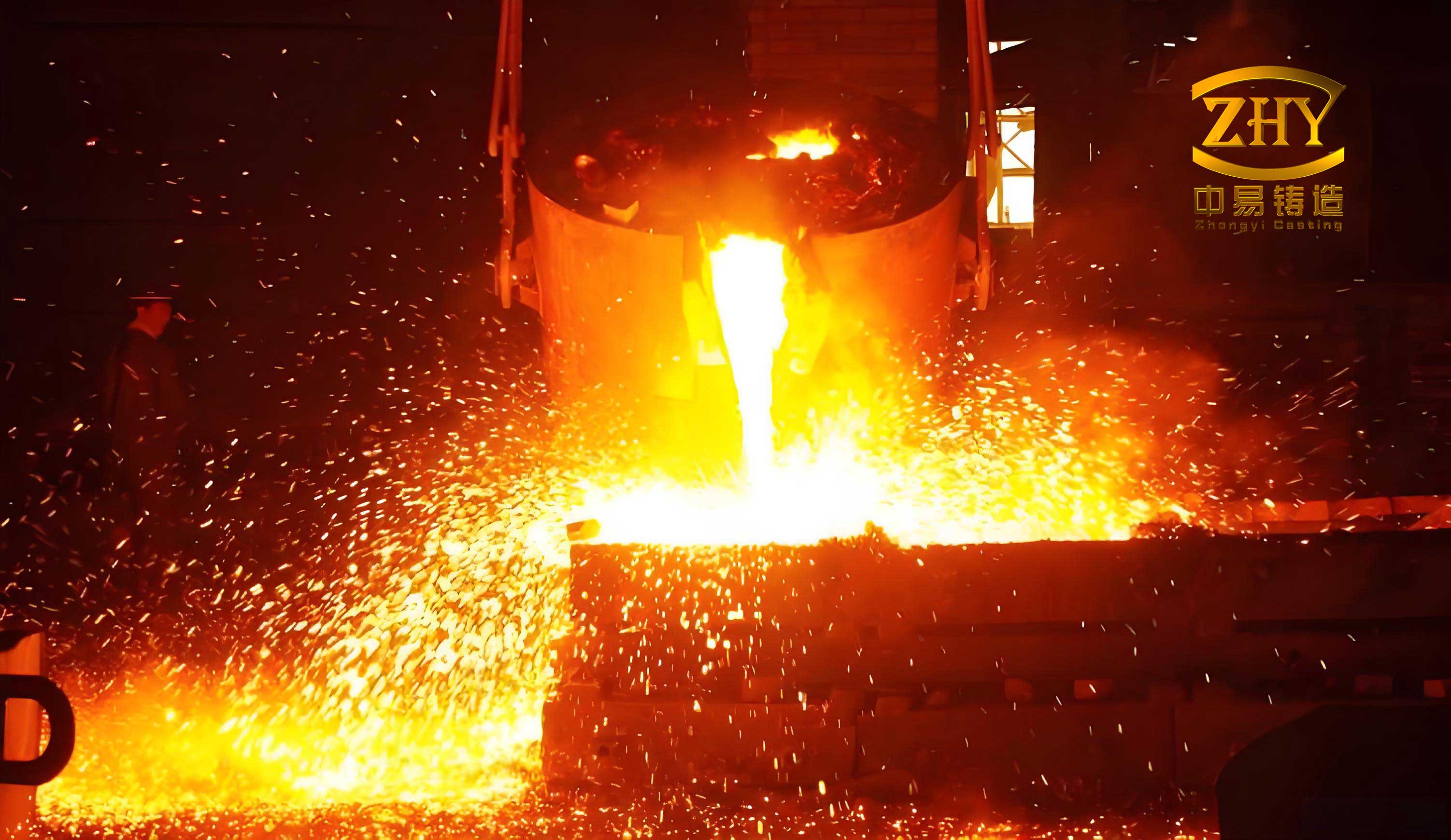
From my perspective, the technical requirements for ductile cast iron containers in nuclear applications are exceptionally stringent. International standards, such as GB/T11806-2019 and JIS G5504-2005, mandate rigorous testing protocols to ensure container integrity under accident conditions. These include a 9-meter drop test, a 1-meter puncture test, a 30-minute fire test at 800°C, and a 15-meter water immersion test. The ductile cast iron must maintain its leak-tightness and shielding performance throughout these extreme scenarios. The mechanical properties are thus critical; for instance, the material typically requires a tensile strength exceeding 300 MPa, a yield strength above 200 MPa, an elongation of at least 12%, and adequate low-temperature impact toughness (e.g., at -40°C). The following table summarizes the mechanical property specifications for ductile cast iron used in spent fuel containers, based on various standards and industrial practices.
| Source/Standard | Wall Thickness (mm) | Tensile Strength (MPa) | Yield Strength (MPa) | Elongation (%) | Low-Temperature Impact Toughness (Condition) |
|---|---|---|---|---|---|
| JIS G5504-2005 | ≤550 | ≥300 | ≥200 | ≥12 | ≥4 J at -40°C |
| Industrial Example A | 480 | ≥300 | ≥220 | ≥10 | ≥10 J/cm² at -20°C |
| Industrial Example B | 500 | ≥320 | ≥220 | ≥12 | ≥10 J/cm² at -40°C |
| Industrial Example C | 630 | ≥360 | ≥258 | ≥9 | ≥8 J at -20°C |
Achieving these properties in thick-section ductile cast iron necessitates meticulous control over chemical composition. The presence of certain elements can profoundly influence microstructure and performance. For example, silicon enhances strength but must be limited to avoid brittleness, while manganese tends to segregate and impede graphite formation. Impurity elements like lead, bismuth, and antimony can promote the formation of deleterious graphite morphologies, such as flake or vermicular graphite, particularly in slow-cooling regions. Therefore, high-purity raw materials and carefully selected inoculants are essential. The table below outlines the maximum allowable ranges for trace elements in ductile cast iron for nuclear containers, as derived from industry practices.
| Element | Maximum Control (wt%) | Element | Maximum Control (wt%) |
|---|---|---|---|
| Chromium (Cr) | ≤0.05 | Tin (Sn) | ≤0.02 |
| Vanadium (V) | ≤0.03 | Antimony (Sb) | ≤0.002 |
| Molybdenum (Mo) | ≤0.01 | Lead (Pb) | ≤0.002 |
| Bismuth (Bi) | ≤0.001 | Arsenic (As) | ≤0.02 |
| Boron (B) | ≤0.002 | Aluminum (Al) | ≤0.02 |
| Tellurium (Te) | ≤0.003 | Nitrogen (N) | 80-120 ppm |
The solidification process of thick-section ductile cast iron is a critical area of study. Due to the large wall thickness—often exceeding 500 mm—the cooling rate is slow, leading to prolonged solidification times. This can result in issues like graphite degeneration, element segregation, and the formation of undesirable microstructures (e.g., pearlite or irregular graphite shapes). The solidification time \( t \) can be approximated using Chvorinov’s rule:
$$ t = k \left( \frac{V}{A} \right)^2 $$
where \( V \) is the volume of the casting, \( A \) is its surface area, and \( k \) is a constant dependent on mold material and thermal properties. For a cylindrical container with wall thickness \( w \) and height \( H \), the modulus \( \frac{V}{A} \) simplifies to approximately \( \frac{w}{2} \) for thick sections. Thus, solidification time scales quadratically with wall thickness:
$$ t \propto w^2 $$
This relationship highlights the challenge: doubling the wall thickness quadruples the solidification time, exacerbating metallurgical issues. To mitigate this, foundries employ techniques such as using chills, zircon sand molds, or even metal molds to accelerate cooling. For instance, simulations and physical modeling have shown that incorporating external chills can reduce the solidification time significantly, promoting a finer graphite structure and more uniform matrix. The graphite nodule count \( N \) and nodule diameter \( d \) are inversely related to cooling rate \( \dot{T} \), which can be expressed empirically as:
$$ N \propto \dot{T}^n, \quad d \propto \dot{T}^{-m} $$
where \( n \) and \( m \) are positive exponents typically between 0.5 and 1. Higher cooling rates yield more nodules and smaller diameters, improving mechanical properties. Therefore, process optimization focuses on enhancing heat extraction, especially in the core regions of thick-section ductile cast iron components.
Mechanical performance of ductile cast iron is intrinsically linked to its microstructure, which comprises spheroidal graphite embedded in a metallic matrix (ferritic or pearlitic). For nuclear containers, a ferritic matrix is preferred due to its superior toughness and radiation resistance. The yield strength \( \sigma_y \) of ferritic ductile cast iron can be modeled using a Hall-Petch type relationship combined with contributions from solid solution strengthening:
$$ \sigma_y = \sigma_0 + k_y d^{-1/2} + \sum_i K_i C_i $$
where \( \sigma_0 \) is the lattice friction stress, \( k_y \) is a constant, \( d \) is the ferrite grain size, \( K_i \) are strengthening coefficients, and \( C_i \) are concentrations of solute elements like silicon and manganese. Maintaining a fine ferrite grain size and controlling silicon content are thus crucial for achieving the desired strength-toughness balance. Additionally, impact toughness at low temperatures is vital for containers that may be stored in diverse environments. The ductile-to-brittle transition temperature (DBTT) must be kept well below service temperatures, which is achievable through high-purity chemistry and proper heat treatment.
Heat treatment plays a pivotal role in tailoring the microstructure of ductile cast iron for nuclear applications. As-cast structures may contain mixed phases or residual stresses, so annealing is commonly employed to produce a fully ferritic matrix. A typical annealing cycle involves heating to 900°C, holding for several hours, and slowly cooling to room temperature. This process dissolves any pearlite and promotes carbon diffusion into graphite nodules, resulting in a matrix with over 90% ferrite. The kinetics of ferritization can be described by the diffusion-controlled growth of ferrite zones around graphite nodules:
$$ r(t) = \sqrt{D t} $$
where \( r(t) \) is the ferrite zone radius, \( D \) is the diffusion coefficient of carbon in iron, and \( t \) is time. Prolonged annealing ensures complete transformation, enhancing ductility and impact resistance. In some cases, subcritical annealing at around 780°C is used to refine the microstructure without excessive grain growth. It is noteworthy that some manufacturers utilize ductile cast iron containers in the as-cast condition, but heat treatment remains a reliable method to guarantee consistent properties, especially for thick sections where microstructural heterogeneity is a concern.
Casting process simulation has become an indispensable tool for developing large-scale ductile cast iron containers. Numerical models predict fluid flow, solidification, and stress distribution, allowing for optimization of gating systems, riser placement, and cooling aids. For example, studies using 45° test blocks—which simulate the thermal conditions of thick sections—have validated the effectiveness of metal molds and chills. These blocks, with dimensions tailored to replicate container walls, are instrumented to monitor cooling curves and subsequently evaluated for microstructure and mechanical properties. Results from such simulations often show that with optimized processing, ductile cast iron can meet all required specifications, as demonstrated in the table below from a representative study.
| Property | Test Result | Requirement |
|---|---|---|
| Tensile Strength (MPa) | ≥233 | ≥200 |
| Yield Strength (MPa) | ≥371 | ≥300 |
| Elongation (%) | ≥19 | ≥12 |
| Room-Temperature Impact Toughness (J/cm²) | ≥17.6 | ≥12 |
| -40°C Impact Toughness (J/cm²) | ≥5.4 | ≥4 |
The application of ductile cast iron extends beyond spent fuel transport containers to include disposal containers for intermediate- and low-level radioactive waste generated during reprocessing. For instance, the MOSAIK series of containers, designed with ductile cast iron bodies and shielding lids, can accommodate various waste forms such as activated components, ion-exchange resins, and evaporated concentrates. The corrosion resistance of ductile cast iron is a key advantage; studies estimate a maximum corrosion depth of only 22.5 mm over 300 years under repository conditions, ensuring long-term containment integrity. This durability minimizes maintenance needs, typically limited to surface inspections. The versatility of ductile cast iron containers thus supports a holistic waste management strategy, from initial storage to final disposal.
Looking ahead, the prospects for ductile cast iron in nuclear spent fuel reprocessing are promising. Advances in metallurgy, such as the development of high-purity charges and novel inoculation techniques, continue to improve the consistency and performance of thick-section castings. Additionally, research into alloyed ductile cast iron—with controlled additions of nickel or copper—may further enhance radiation stability and mechanical properties at elevated temperatures. The integration of digital twins and artificial intelligence in foundry processes could optimize casting parameters in real-time, reducing defects and ensuring compliance with stringent nuclear standards. Moreover, as the global inventory of spent fuel grows, the demand for reliable, cost-effective containers will intensify, positioning ductile cast iron as a material of choice for future storage and transport solutions.
In conclusion, ductile cast iron demonstrates exceptional suitability for nuclear spent fuel reprocessing applications due to its unique combination of properties. The material’s high integrity, excellent shielding capability, and economic viability make it ideal for containers that must withstand severe accident conditions. Overcoming the challenges associated with thick-section casting—through precise chemical control, accelerated cooling, and appropriate heat treatment—has enabled the production of large-scale containers that meet rigorous international standards. Furthermore, the adaptability of ductile cast iron for waste disposal containers underscores its role in the entire back-end of the nuclear fuel cycle. As technology progresses, ongoing innovations in ductile cast iron manufacturing will likely expand its applications, contributing to safer and more sustainable nuclear waste management. The continued emphasis on research and development in this field is essential to harness the full potential of ductile cast iron in addressing one of the most pressing issues in the nuclear industry.