
In our research on high precision investment casting for turbine blades, the ceramic shell plays a critical role in ensuring dimensional accuracy, surface finish, and overall casting quality. Traditional shell systems often suffer from a trade-off between strength and permeability, leading to defects such as gas porosity and incomplete filling. To address this, we investigated the addition of aluminum fluoride trihydrate (AlF₃·3H₂O) to the back layer slurry of a silica sol‑fused corundum system. Our goal was to induce in‑situ formation of mullite whiskers during sintering, thereby enhancing permeability while maintaining adequate strength. This paper presents our experimental design, material characterization, and performance evaluation, demonstrating the potential of this approach for high precision investment casting applications.
In high precision investment casting, the shell must possess high temperature strength, low thermal expansion, sufficient permeability, and good collapsibility. The use of fused corundum and silica sol as binder is common due to their excellent thermal stability. However, the dense structure often limits gas escape. Inspired by prior work on mullite whisker synthesis using AlF₃ as a catalyst, we incorporated AlF₃·3H₂O powder into the back layer slurry. During sintering at 1200 °C, the fluoride compound promotes a vapor‑phase reaction between Al₂O₃ (from corundum) and SiO₂ (from silica sol) to form mullite whiskers. This reaction increases the porosity and modifies the pore structure, thereby improving permeability without drastically reducing mechanical integrity. Our study systematically evaluated the microstructure, phase composition, high‑temperature permeability, thermal diffusivity, thermal expansion, high‑temperature strength, and deformation resistance of the shells. The results confirm that adding AlF₃·3H₂O is a viable method to optimize shell performance for high precision investment casting of directionally solidified turbine blades.
Experimental Procedure
Materials and Slurry Formulation
We used low‑sodium silica sol (SiO₂ content 30 wt%), low‑sodium fused corundum powder (325 mesh), and corundum sand of various sizes (90 mesh for face coat, 54 mesh for transition coat, 24 mesh for back coat). Additionally, we added latex, wetting agent, dispersant, defoamer, kaolin (1600 mesh), and AlF₃·3H₂O powder (240 mesh). Two types of shells were prepared: a blank group (without AlF₃·3H₂O) and an experimental group (with AlF₃·3H₂O). The slurry compositions for the face coat, transition coat, and back coat are given in the following tables.
| Component | Mass (g) |
|---|---|
| Silica sol | 500 |
| Al₂O₃ | 1600 |
| Latex | 5 |
| Kaolin | 32 |
| Wetting agent | 2.1 |
| Dispersing agent | 2.1 |
| Defoamer | 2.1 |
| Component | Blank group (g) | Experimental group (g) |
|---|---|---|
| Silica sol | 300 | 321 |
| Al₂O₃ | 958 | 958 |
| Kaolin | 19.2 | 19.2 |
| AlF₃·3H₂O | 0 | 69.2 |
| Dispersing agent | 1.3 | 1.3 |
| Defoamer | 1.3 | 1.3 |
Shell Fabrication
We fabricated ceramic shells using a conventional dip‑coat and stucco process. The shell structure comprised one face coat, one transition coat, five back coats, and one seal coat. The face coat used a fine sand (90 mesh) and the back coat used coarse sand (24 mesh). After each coating, the shell was air‑dried. Finally, the shells were sintered in a muffle furnace at 1200 °C for 5 h (unless otherwise specified) with a heating rate of 5 °C/min.
Characterization Methods
Phase analysis was performed by X‑ray diffraction (XRD, D8 DaVinci). Microstructure was observed with a scanning electron microscope (SEM, RISE‑MAGNA) equipped with energy‑dispersive spectroscopy. High‑temperature permeability was measured according to HB 5352.4‑2004 using a DTQ‑II tester. Density was determined by Archimedes’ method. Thermal diffusivity was measured via laser flash (LFA 467, 25–500 °C). Thermal expansion coefficient was obtained with a dilatometer (DIL 402 Expedis, 25–1500 °C). High‑temperature self‑weight deformation was evaluated per HB 5352.2‑2004 using a TBK tester. Room‑temperature and high‑temperature (1500 °C) flexural strength were tested on a TKW tester following HB 5352.1‑2004.
Results and Discussion
Phase Composition and Microstructure
XRD patterns of the sintered shells (1200 °C, 5 h) clearly show distinct mullite peaks in the experimental group, while only weak mullite signals appear in the blank group. This confirms that AlF₃·3H₂O effectively catalyzes the reaction between Al₂O₃ and SiO₂ to form mullite. The reaction mechanism involves the formation of AlOF and SiF₄ intermediate species, as described by:
$$
6\text{AlF}_3 + 3\text{O}_2 \rightarrow 6\text{AlOF} + 12\text{F}
$$
$$
\text{Al}_2\text{O}_3 + 2\text{F} \rightarrow 2\text{AlOF} + \frac{1}{2}\text{O}_2
$$
$$
2\text{SiO}_2 + 8\text{F} \rightarrow 2\text{SiF}_4 + 2\text{O}_2
$$
$$
6\text{AlOF} + 2\text{SiF}_4 + \frac{7}{2}\text{O}_2 \rightarrow 3\text{Al}_2\text{O}_3 \cdot 2\text{SiO}_2 + 14\text{F}
$$
SEM images reveal that the experimental group contains abundant mullite whiskers with length ~10 µm and diameter ~1 µm (aspect ratio ~10:1). These whiskers are predominantly located where AlF₃·3H₂O particles originally resided. In contrast, no whiskers are observed in the blank group. The whisker size and density depend on sintering temperature and holding time; for example, a shorter hold of 0.5 h at 1200 °C yields only sparse, shorter whiskers (~1 µm length).
In the context of high precision investment casting, the controlled growth of mullite whiskers offers a means to tailor the shell’s pore structure without compromising the integrity of the dense corundum matrix. The whiskers bridge between particles, creating additional porosity that enhances gas permeability while still providing mechanical support.
High‑Temperature Permeability
Permeability was calculated using the standard formula:
$$
K = \frac{V}{t} \cdot \frac{\delta}{P_e A}
$$
where \(K\) is permeability (m⁴/(N·min)), \(V/t\) is gas flow rate (m³/min), \(P_e\) is applied pressure (Pa), \(\delta\) is shell thickness (m), and \(A\) is internal surface area (m²). The results for temperatures from 800 °C to 1000 °C are shown in the table below.
| Temperature (°C) | Blank group (m⁴/(N·min)) | Experimental group (m⁴/(N·min)) |
|---|---|---|
| 800 | 8.12 | 16.35 |
| 900 | 9.28 | 18.72 |
| 1000 | 10.47 | 20.04 |
The experimental group consistently exhibits about double the permeability of the blank group. This improvement is attributed to the increased porosity and larger inter‑whisker voids formed during mullitization. The density of the experimental shell (3.36 g/cm³) is slightly lower than that of the blank (3.41 g/cm³), corroborating the increase in pore volume. In high precision investment casting, higher permeability facilitates rapid removal of gas from the mold cavity, reducing the risk of blowholes and incomplete filling, especially for thin‑walled turbine blades.
Thermal Diffusivity and Expansion
Thermal diffusivity measurements (25–500 °C) are summarized in Table 4. The experimental group shows higher thermal diffusivity throughout the tested range, likely due to air‑filled pores, which have higher thermal diffusivity than the ceramic matrix. Although the difference is modest, improved thermal diffusivity can aid in heat dissipation during solidification, promoting finer grain structures in high precision investment casting.
| Temperature (°C) | Blank group | Experimental group |
|---|---|---|
| 25 | 2.95 | 3.14 |
| 200 | 1.82 | 1.98 |
| 500 | 0.52 | 0.61 |
Thermal expansion coefficients (CTE) over 25–1500 °C are shown in Table 5. Both groups exhibit similar CTE values up to 1485 °C, with the experimental group slightly higher. However, above 1485 °C, the CTE of the experimental group becomes lower than that of the blank. This behavior may be related to the softening of glass phases that fill pores at high temperatures, reducing further expansion. The overall CTE remains below 14 × 10⁻⁶ K⁻¹, which is favorable for dimensional stability in high precision investment casting.
| Temperature range (°C) | Blank group | Experimental group |
|---|---|---|
| 25–1000 | 7.8 | 8.1 |
| 25–1485 | 12.4 | 13.2 |
| 25–1500 | 13.8 | 12.9 |
High‑Temperature Deformation Resistance
Self‑weight deformation at 1500 °C was measured according to:
$$
\delta_{t-\tau} = \frac{B – C}{B} \times 100\%
$$
where \(B\) is the original outer diameter and \(C\) the deformed outer diameter. For the blank group, the average deformation was 0.20 mm (range 0.14–0.24 mm). For the experimental group, the average was 0.19 mm (range 0.16–0.22 mm). Both groups show very low deformation, indicating excellent rigidity at high temperatures. The experimental group’s slight reduction in deformation is consistent with its lower CTE in the highest temperature interval. Such low deformation is critical for maintaining the precise geometry of complex turbine blade cavities in high precision investment casting.
Flexural Strength
Room‑temperature (RT) and high‑temperature (1500 °C) flexural strengths were measured using the three‑point bending formula:
$$
\sigma_w = \frac{3PL}{2ah^2}
$$
where \(P\) is the load at fracture, \(L\) the span, \(a\) the width, and \(h\) the thickness. Results are given in Table 6.
| Condition | Blank group (MPa) | Experimental group (MPa) |
|---|---|---|
| Room temperature | 9.05 | 7.91 |
| 1500 °C | 21.76 | 13.89 |
At room temperature, the experimental group shows slightly lower strength, which is expected because mullite whiskers are not yet formed; the presence of AlF₃·3H₂O particles may act as defects. At 1500 °C, the blank group exhibits a significant strength increase due to sintering densification, whereas the experimental group retains a moderate strength of 13.89 MPa. This value is still adequate for withstanding the thermal and mechanical stresses during mold filling and solidification in high precision investment casting. Moreover, the lower high‑temperature strength of the experimental shell enhances its collapsibility after casting, facilitating shell removal without damaging the cast part.
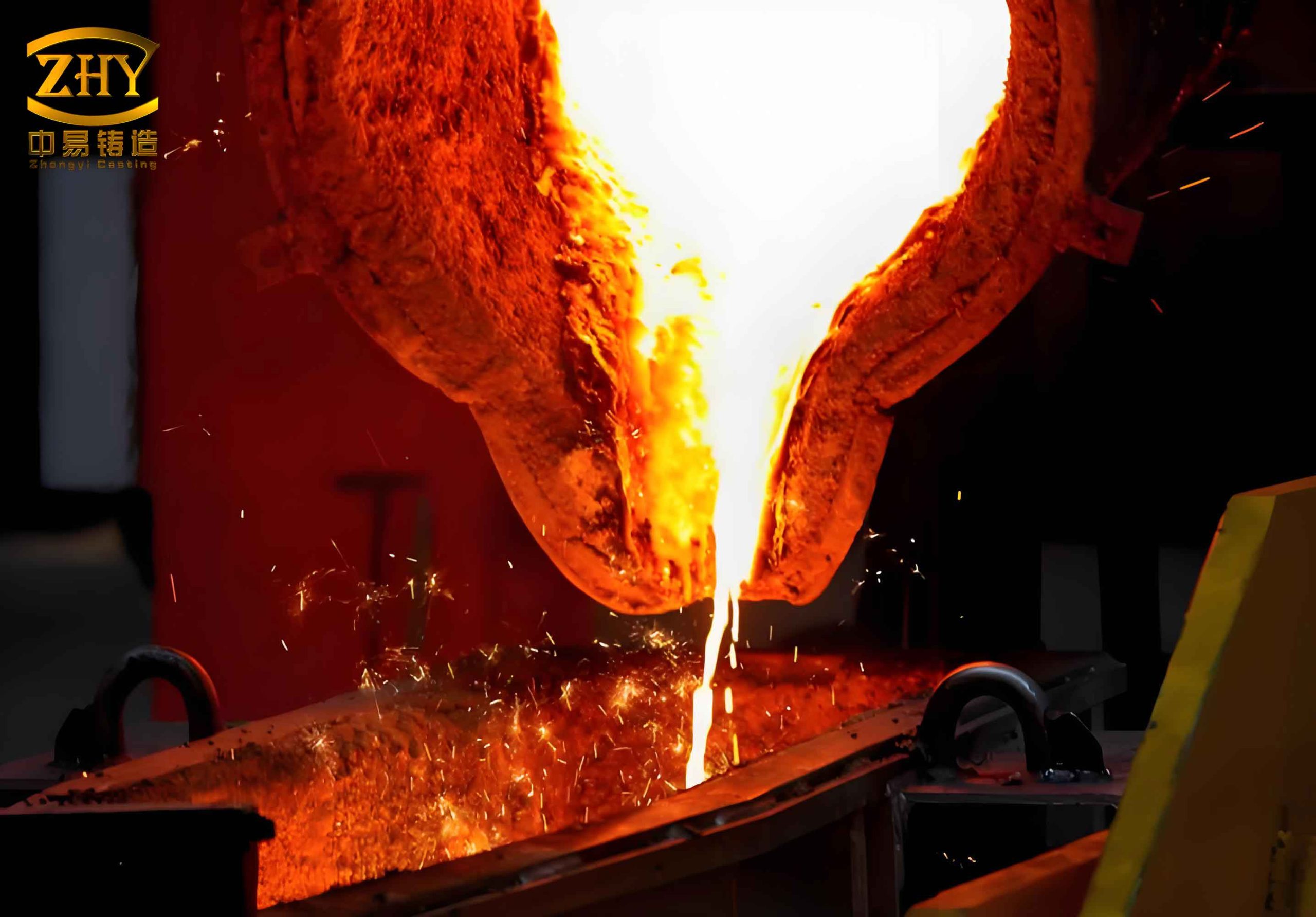
The image above illustrates a typical high precision investment casting produced using the optimized shell technology described in this work.
Conclusion
We have demonstrated that the addition of AlF₃·3H₂O to the back layer slurry of a fused corundum‑silica sol system effectively induces in‑situ growth of mullite whiskers during sintering at 1200 °C. The whiskers, with a length of about 10 µm and aspect ratio of 10:1, create additional porosity that significantly improves the high‑temperature permeability of the ceramic shell—approximately doubling the permeability compared to the blank shell. This enhancement facilitates gas escape during mold filling, a critical advantage for high precision investment casting of complex components such as turbine blades.
Furthermore, the experimental shells exhibit increased thermal diffusivity, slightly reduced thermal expansion at very high temperatures, and low deformation under self‑weight at 1500 °C, all of which contribute to improved dimensional accuracy and heat dissipation. Although the high‑temperature flexural strength decreases from 21.76 MPa to 13.89 MPa, it remains sufficient for structural integrity during casting while offering better collapsibility. The combination of improved permeability, adequate strength, and good thermal properties makes the AlF₃·3H₂O‑modified shell a promising candidate for advanced high precision investment casting processes, particularly for directionally solidified single‑crystal and columnar‑grain turbine blades.
Our results highlight that controlling the formation of mullite whiskers through fluoride additives can tailor the trade‑off between strength and permeability in ceramic shells. Future work will focus on optimizing the whisker morphology and distribution by varying sintering parameters and AlF₃·3H₂O content, and on evaluating the shell performance under actual casting conditions of high‑temperature superalloys.