
The pursuit of enhancing the mechanical properties and service life of abrasion-resistant cast irons has led to significant research into microstructural engineering. Low-chromium white cast iron, a cost-effective material for applications requiring good wear resistance, often suffers from inherent brittleness due to the continuous network of hard carbides within its matrix. My research focuses on employing a strategic compound modification process to fundamentally alter the solidification structure, thereby overcoming these limitations. The core philosophy involves utilizing the synergistic effects of multiple modifying elements under carefully controlled kinetic conditions to purify the melt, refine the microstructure, and most critically, control the morphology and distribution of carbides.
The inherent challenge with as-cast low-chromium white cast iron lies in its ledeburitic structure, where the hard, brittle M3C-type carbides form a continuous, interconnected network. This network acts as a preferred path for crack propagation, severely compromising toughness and impact resistance. The primary metallurgical objectives for modification are therefore clear: to disrupt this carbide network, promote the formation of isolated or granular carbides, refine the austenitic grains (and its subsequent transformation products), and reduce the volume and detrimental impact of non-metallic inclusions. Achieving this requires more than a simple inoculation; it demands a compound approach where different elements perform specific, sequential functions during solidification.
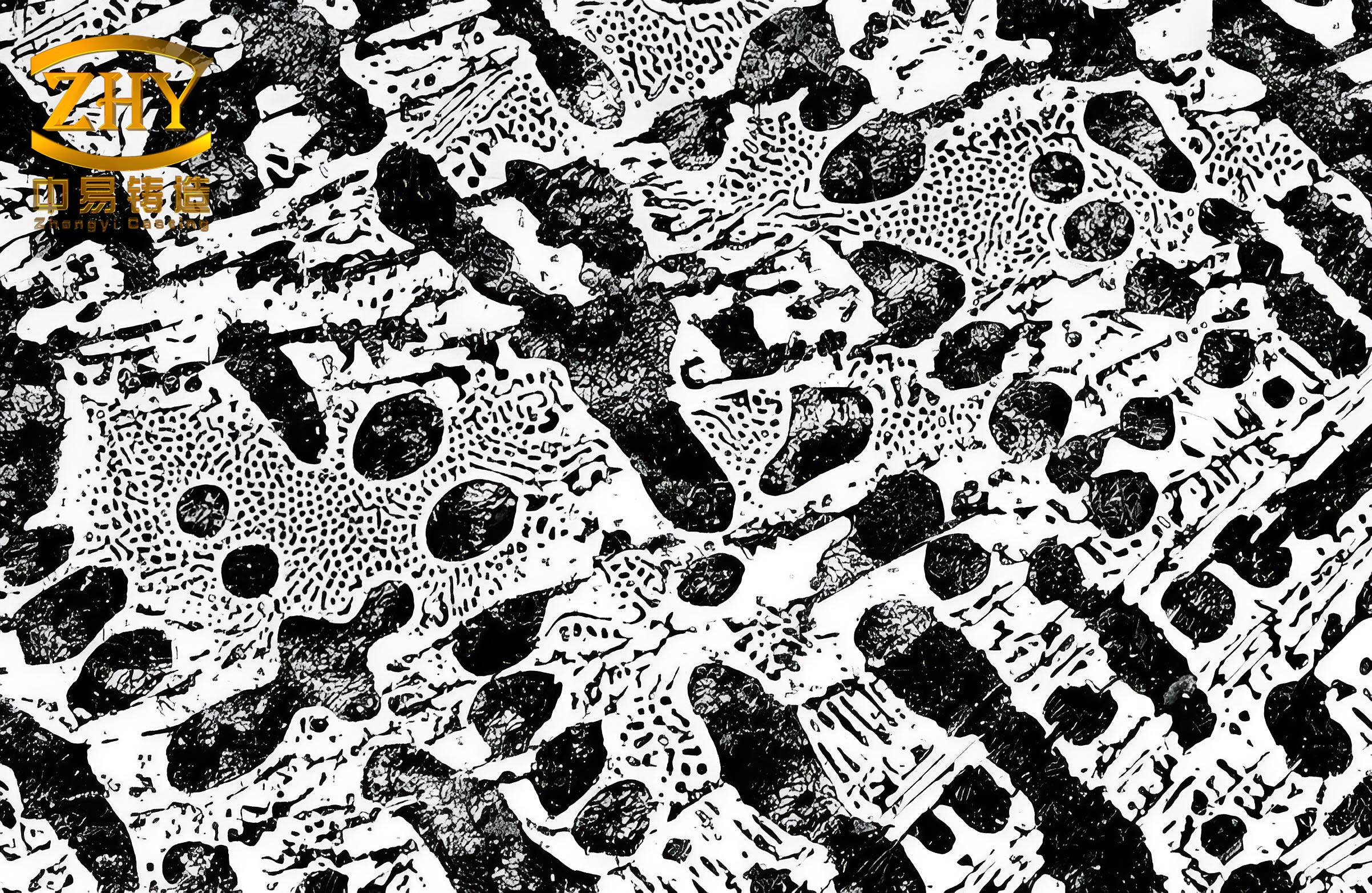
The modification system I employ is based on a RE-Al-Bi-Mg combination. The process is deliberately structured as a “two-step” treatment, conducted both inside the furnace and in the ladle. The sequence is designed according to the heterogeneous nucleation potency of the different alloying elements, initiating nucleation with the most potent agents first to maximize grain refinement and processing stability. This method is not merely additive; it creates a series of kinetic conditions that govern the dissolution, diffusion, and reaction of elements, ultimately dictating the final microstructure of the white cast iron.
Mechanisms of Compound Modification
The beneficial effects of compound modification on white cast iron are multifaceted, stemming from the physical chemistry of the melt and the dynamics of solidification.
1. Control and Refinement of Carbide Morphology
Rare earth (RE) elements are powerful surface-active agents in molten iron. During the solidification of white cast iron, they preferentially adsorb onto the growing surfaces of the primary M3C carbide crystals. This adsorption layer creates a diffusion barrier, impeding the transport of Fe, C, and Cr atoms to the carbide lattice, particularly along its preferred fast-growth direction [001]. The result is a significant reduction in the anisotropic growth rate, preventing the carbides from easily linking up to form the deleterious continuous network. Instead, they are encouraged to grow as shorter, rod-like, or granular forms, effectively dispersing the hard phase within the matrix. The modification alters the fundamental growth kinetics of the carbide, which can be conceptually related to a reduced growth velocity (G) under a given interfacial undercooling ($\Delta T$). The relationship between growth velocity and driving force is often expressed in a simplified form for faceted growth:
$$G = \mu (\Delta T)^n$$
where $\mu$ is a kinetic coefficient and $n$ is an exponent often greater than 1 for such phases. The adsorption of RE modifies $\mu$, effectively slowing growth at the interface.
2. Purification of the Melt and Modification of Inclusions
Unmodified white cast iron melt typically contains various inclusions such as complex oxides (Al2O3, FeO, MnO) and sulfides (FeS, MnS). These inclusions are often irregular, angular, and brittle, with low melting points that cause them to segregate at the austenite grain boundaries during final solidification, severely weakening the boundary cohesion.
The compound modifier acts as a powerful scavenger. Elements like RE, Al, and Mg have a high affinity for oxygen and sulfur. They react to form new inclusion compounds, such as RE-oxysulfides, MgO, and Al2O3. These newly formed inclusions have several advantageous characteristics: they generally have a higher melting point, a lower density compared to the melt, and a more spherical morphology. The lower density and spherical shape significantly increase their buoyancy velocity, governed by Stokes’ law:
$$v = \frac{2 (\rho_m – \rho_i) g r^2}{9 \eta}$$
where $v$ is the rising velocity, $\rho_m$ and $\rho_i$ are the densities of the melt and inclusion, respectively, $g$ is gravity, $r$ is the inclusion radius, and $\eta$ is the melt viscosity. The RE treatment also reduces melt viscosity, further enhancing inclusion removal. Consequently, a large fraction of these inclusions float to the slag layer and are removed. The few residual inclusions that remain are typically fine, globular compounds like (MgO+SiO2·Al2O3·CeS·Ce2O3), which are relatively harmless and can even act as potential nucleation sites for austenite.
3> Grain Refinement of the Matrix
Grain refinement is achieved through two primary mechanisms facilitated by the compound modification of white cast iron. First, the purification effect itself plays a crucial role. By drastically reducing the oxygen and sulfur content in the melt, the compound modifier eliminates many potential sites that could poison heterogeneous nucleation. More importantly, some of the high-melting-point RE-containing complex inclusions that remain dispersed in the melt can serve as effective substrates for the heterogeneous nucleation of primary austenite ($\gamma$). According to classical nucleation theory, the efficacy of a substrate depends on the lattice mismatch. The presence of these compatible substrates lowers the critical energy barrier for nucleation ($\Delta G^*$):
$$\Delta G^* = \frac{16 \pi \sigma^3}{3 (\Delta G_v)^2} f(\theta)$$
where $\sigma$ is the interfacial energy, $\Delta G_v$ is the volume free energy change, and $f(\theta)$ is a function of the contact angle $\theta$ between the nucleus and the substrate. A good match reduces $\sigma$ and $\theta$, thus reducing $\Delta G^*$ and increasing the nucleation rate ($I$). Second, elements like RE, which are strong segregating elements (low equilibrium partition coefficient $k$), accumulate in the liquid ahead of the growing $\gamma$ dendrite. This creates a significant constitutional undercooling zone that destabilizes the planar growth front and promotes the formation of new grains, further refining the microstructure.
4> Stabilization of Alloying Elements and Hierarchical Modification
The sequence of addition is critical. The process begins with elements like Ti and primary RE additions in the furnace. These are strong deoxidizers and desulfurizers that create a clean melt environment. This “clean” environment is essential before introducing more reactive but beneficial elements like V (often added via ferrovanadium slag for both microalloying and inoculation). Vanadium is a potent grain refiner and hardens the matrix, but it is easily re-oxidized in a melt containing residual oxygen. The pre-purification by the initial modifiers stabilizes the reduced vanadium in solution, ensuring its intended metallurgical function. Subsequently, elements like Al, Mg, and Bi are added in the ladle. These elements have specific roles: Al and Mg further deoxidize and help shape inclusions, while Bi is known to influence graphite morphology but in white cast iron can promote undercooling and refine the eutectic structure. This hierarchical approach ensures each element acts effectively without interference, maximizing the overall synergy of the compound modification on the white cast iron.
The Governing Kinetic Conditions
The success of compound modification in white cast iron is not guaranteed by chemistry alone; it is governed by the kinetic conditions present during treatment and solidification. These conditions determine the rates of diffusion, reaction, and nucleation.
1> Kinetics of Carbide Modification
Altering carbide morphology is a diffusion-controlled process. The growth of M3C carbide depends on the long-range diffusion of carbon through the adjacent austenite or liquid. The diffusion coefficient of carbon in austenite ($D_C^\gamma$) is itself influenced by the alloy composition of the white cast iron. For instance, $D_C^\gamma$ increases with additions of Si and Ni but decreases with Cr, Mo, V, and Ti. Therefore, the base composition sets a fundamental kinetic parameter. The modification process adds another layer: the adsorption of RE at the carbide/liquid interface introduces an additional interfacial kinetic barrier. The net growth rate is thus a function of both the bulk diffusion rate and the interface kinetics. The thermal conditions, primarily the cooling rate ($\dot{T}$), directly impact the available time for diffusion and the degree of undercooling, making precise process control essential.
2> Kinetics of Inclusion Removal and Spheroidization
The removal of inclusions is governed by buoyancy and coalescence kinetics, as described by Stokes’ law. The compound modifier improves every variable in this equation for the detrimental inclusions: it increases the size ($r$) by forming larger compound inclusions, increases the density difference ($\rho_m – \rho_i$), and decreases the melt viscosity ($\eta$). Furthermore, the change in inclusion morphology to a spherical shape minimizes the drag coefficient, allowing for faster ascent. The spheroidization of residual inclusions is a result of the interfacial energy minimization. The new compounds formed by RE and other modifiers have a high melting point and a lower interfacial energy with the melt in a spherical configuration, driving the morphological change during their residence in the liquid white cast iron.
3> Kinetics of Grain Refinement
The refinement of the austenite grains is controlled by the nucleation rate ($I$). The modification enhances $I$ through two kinetic pathways: (i) by providing more potent heterogeneous nucleation sites (inclusions), which lowers the activation barrier as previously discussed, and (ii) by increasing the constitutional undercooling ($\Delta T_c$) ahead of the solid/liquid interface. The constitutional undercooling is given by:
$$\Delta T_c = \frac{m_L C_0 (1-k)}{k} \left[ 1 – \exp\left(-\frac{R x}{D}\right) \right]$$
where $m_L$ is the liquidus slope, $C_0$ is the nominal solute concentration, $k$ is the partition coefficient, $R$ is the growth velocity, $x$ is the distance from the interface, and $D$ is the solute diffusion coefficient in the liquid. Strong segregants like RE, present even in small amounts, have a very low $k$ value, leading to a large buildup of solute and a large $\Delta T_c$. This large undercooling destabilizes the growth front, promoting repeated nucleation events and resulting in a fine, equiaxed grain structure in the white cast iron matrix.
Engineering Application and Performance Enhancement
The practical implementation of this compound modification strategy for low-chromium white cast iron follows specific processing windows and compositional targets to ensure the optimal kinetic conditions are met.
Recommended Process Parameters:
• Melting Temperature: 1500–1550 °C
• Treatment Temperature (in ladle): 1420–1450 °C
• Pouring Temperature: 1350–1400 °C
• Base Composition (wt.%): C: 2.2–3.0; Si: 0.5–0.8; Mn: 2.2–2.8; Cr: 2.0–2.5; P < 0.06; S < 0.04.
Hierarchical Treatment Practice:
1. Furnace Treatment: Before tapping, add 0.06–0.10% Ferrotitanium and 0.1–0.2% #1 RE-Si-Fe alloy.
2. Ladle Treatment: Place a pre-mixed alloy of Si20Al50Fe (0.08–0.12%) and Mg (0.04–0.08%) in the bottom of the ladle. During tapping, add 0.05–0.10% Bi in the stream.
3. Post-Inoculation: During transfer or immediately before pouring, add an additional 0.3–0.4% #1 RE-Si-Fe alloy or a trace amount of Ce (0.04–0.08%).
The effectiveness of this comprehensive approach is unequivocally demonstrated in the enhancement of mechanical and wear properties. Following modification, a sub-critical heat treatment at 550–600 °C is typically applied to further toughen the matrix.
| Material Condition | Average Impact Toughness, αk (J/cm²) | Average Hardness (HRC) | Relative Wear Resistance Coefficient, β |
|---|---|---|---|
| Unmodified, As-Treated* | 1.5 | 45 | 1.00 (Reference) |
| Compound Modified, As-Treated* | 3.0 | 54 | 1.87 |
* Heat treatment: 580°C for 2h (air cool) + 300°C for 1.5h (temper).
The data shows a 100% increase in impact toughness and a significant jump in hardness, which together contribute to the near-doubling of the relative wear resistance. This synergy between toughness and hardness is the hallmark of a successfully modified white cast iron microstructure.
The wear performance was evaluated under both dry and wet abrasive conditions, comparing the modified low-chromium white cast iron against its unmodified counterpart and a standard rare earth white cast iron.
| Material | Heat Treatment | Weight Loss (g) | Relative Wear Resistance, β |
|---|---|---|---|
| Unmodified Low-Cr White Iron | 580°C/2h AC + 300°C/1.5h | 0.0082 | 0.96 |
| Compound Modified Low-Cr White Iron | 950°C/2h AC + 300°C/1.5h | 0.0050 | 1.58 |
| RE White Iron (Reference) | 520°C/1h Tempered | 0.0079 | 1.00 |
| Material | Heat Treatment | Weight Loss (g) | Relative Wear Resistance, β |
|---|---|---|---|
| Unmodified Low-Cr White Iron | 580°C/2h AC + 300°C/1.5h | 0.0130 | 0.73 |
| Compound Modified Low-Cr White Iron | 950°C/2h AC + 300°C/1.5h | 0.0064 | 1.50 |
| RE White Iron (Reference) | 520°C/1h Tempered | 0.0096 | 1.00 |
The superiority of the compound modified white cast iron is evident in both test environments. It outperforms both the baseline unmodified material and the standard RE white cast iron by a substantial margin. The improved performance under wet conditions is particularly noteworthy, suggesting that the refined, non-continuous carbide structure and purified grain boundaries are highly effective in resisting the combined mechanical and corrosive action of the slurry.
An additional metallurgical factor contributing to toughness in chromium-containing white cast irons is the ratio of chromium to carbon (Cr/C). Research indicates that for a given carbide volume fraction (e.g., 23-25%), fracture toughness ($K_{1C}$) reaches a maximum at a Cr/C ratio of approximately 8. The relationship can be conceptually modeled, showing a peak in the $K_{1C}$ vs. Cr/C curve. The modified composition often targets this optimal range, further optimizing the balance between hard carbide phases and a tough matrix. The fracture toughness can be related to microstructural parameters through models such as:
$$K_{1C} \propto \sigma_y \sqrt{\pi d}$$
where $\sigma_y$ is the yield strength and $d$ is a microstructural size parameter (e.g., carbide spacing). Modification refines $d$ and optimizes $\sigma_y$, thereby enhancing $K_{1C}$.
Conclusion
The compound modification of low-chromium white cast iron using a strategic RE-Al-Bi-Mg system represents a holistic metallurgical strategy. Its efficacy is derived not from a single action, but from the orchestrated interplay of multiple mechanisms—carbide morphology control, melt purification, grain refinement, and alloy stabilization—each enabled by specific kinetic conditions during processing. The essential takeaways are:
1. The “two-step,” hierarchical treatment sequence is critical to first prepare the melt (purify) and then effectively inoculate and modify it, ensuring processing stability and strong anti-fading characteristics for the white cast iron.
2. The improvement in properties is a direct result of creating a refined microstructure with isolated, granular carbides, a clean and fine-grained matrix, and strengthened grain boundaries.
3. The performance gains are substantial and consistent across different wear regimes, with the modified low-chromium white cast iron often surpassing more highly alloyed materials, offering a compelling combination of performance and cost-effectiveness.
Ultimately, the successful modification of white cast iron hinges on understanding and controlling the kinetic landscape of the process—the diffusion rates, interfacial reactions, nucleation potentials, and solidification dynamics—to transform a brittle, network-structured casting into a tough, wear-resistant engineering material.