
In the field of wind energy, bearing housings for large wind turbines are critical components that must withstand extreme operational conditions, including corrosion, sand erosion, humidity, and low temperatures. These harsh environments, combined with complex loading from rotation and vibration, demand high fatigue strength and low susceptibility to brittle fracture over a service life of up to 25 years. To achieve these properties, the quality of castings, particularly those made from spheroidal graphite cast iron, must be rigorously controlled. One key aspect of enhancing the performance of spheroidal graphite cast iron is inoculation treatment, which involves introducing nuclei into molten metal to regulate solidification and microstructure formation. This study investigates the impact of two secondary inoculants—silicon-barium-zirconium and sulfur-oxygen inoculants—on the graphite morphology, microstructure, and mechanical properties of bearing housings. Through comparative analysis, we aim to provide scientific insights for optimizing production processes, ensuring reliability and longevity in wind turbine applications.
The inoculation process in spheroidal graphite cast iron revolves around the introduction of fine particles, typically ≤4 μm in size, which serve as nucleation sites for graphite. These nuclei, formed from internal element reactions or added exogenous elements, are crucial for controlling graphite precipitation—its quantity, size, and morphology—and for promoting desirable matrix structures. Elements with high oxygen affinity play a pivotal role in setting nucleation conditions, ultimately improving mechanical properties and microstructure. In this context, we explore how different inoculants influence the performance of spheroidal graphite cast iron, focusing on graphite ball count, nodularity, and key mechanical metrics. Our experimental approach involves casting bearing housings under identical conditions, using two distinct inoculants, and analyzing outcomes through tensile tests, impact tests, and metallographic examination.
For this study, the materials used in melting and casting included high-quality pig iron (Q10), carbon steel, returns, low-rare-earth spheroidizing agent Mg6RE, 75SiFe, sulfur-oxygen inoculant, silicon-barium-zirconium inoculant, and a high-calcium-barium primary inoculant. The chemical compositions of these raw materials are summarized in Table 1, which provides a detailed breakdown of elements such as carbon, silicon, manganese, sulfur, phosphorus, oxygen, barium, calcium, rare earths, aluminum, zirconium, and iron. This foundation ensures consistency in the base material, allowing us to isolate the effects of the secondary inoculants on the final spheroidal graphite cast iron properties.
| Material | C | Si | Mn | S | P | O | Ba | Ca | RE | Al | Zr | Fe |
|---|---|---|---|---|---|---|---|---|---|---|---|---|
| Q10 Pig Iron | 4.53 | 0.60 | 0.042 | 0.008 | 0.022 | – | – | – | – | – | – | Bal. |
| Carbon Steel | 0.06 | 0.04 | 0.18 | 0.005 | 0.003 | – | – | – | – | – | – | Bal. |
| 75SiFe | – | 72.00 | – | – | – | – | – | – | – | – | – | Bal. |
| Si-Ba-Zr Inoculant | – | 55.45 | – | – | – | – | 0.80 | 0.73 | 1.83 | 0.85 | 0.012 | – |
| S-O Inoculant | – | 69.74 | – | – | – | – | 0.04 | 0.98 | 2.35 | 1.14 | – | – |
The melting process was conducted in a 25-ton medium-frequency induction furnace, with a tapping temperature of 1460°C. Composition analysis was performed using a direct-reading spectrometer to ensure accuracy. Spheroidization was achieved via a sandwich process, with the spheroidizing agent added at 1.05% by weight, accompanied by 0.35% high-calcium-barium primary inoculant (3–8 mm grain size). For secondary inoculation, both silicon-barium-zirconium and sulfur-oxygen inoculants were introduced at 0.20% during pouring, with the casting temperature maintained between 1360°C and 1370°C. A total of 20 bearing housings made of low-temperature ferritic spheroidal graphite cast iron (grade QT400-18AL) were produced, each with attached test blocks of dimensions 70 mm × 70 mm × 180 mm for subsequent analysis. The chemical compositions of the castings are detailed in Table 2, showing minor variations in carbon, silicon, manganese, phosphorus, sulfur, rare earths, magnesium, copper, and chromium between the two groups—Group 1 with silicon-barium-zirconium inoculant and Group 2 with sulfur-oxygen inoculant.
| Sample | C | Si | Mn | P | S | RE | Mg | Cu | Cr |
|---|---|---|---|---|---|---|---|---|---|
| 1-1 | 3.67 | 1.90 | 0.20 | 0.025 | 0.008 | 0.007 | 0.046 | 0.008 | 0.021 |
| 1-2 | 3.68 | 1.91 | 0.19 | 0.024 | 0.008 | 0.007 | 0.044 | 0.009 | 0.019 |
| 1-3 | 3.69 | 1.93 | 0.17 | 0.024 | 0.008 | 0.006 | 0.041 | 0.007 | 0.021 |
| 1-4 | 3.67 | 1.92 | 0.18 | 0.026 | 0.009 | 0.007 | 0.041 | 0.008 | 0.018 |
| 1-5 | 3.68 | 1.94 | 0.20 | 0.025 | 0.009 | 0.006 | 0.041 | 0.007 | 0.017 |
| 1-6 | 3.68 | 1.93 | 0.22 | 0.025 | 0.012 | 0.006 | 0.038 | 0.008 | 0.024 |
| 1-7 | 3.68 | 1.95 | 0.18 | 0.018 | 0.011 | 0.006 | 0.048 | 0.008 | 0.028 |
| 1-8 | 3.69 | 1.93 | 0.19 | 0.029 | 0.012 | 0.007 | 0.039 | 0.011 | 0.030 |
| 1-9 | 3.67 | 1.93 | 0.20 | 0.030 | 0.009 | 0.006 | 0.046 | 0.008 | 0.020 |
| 1-10 | 3.67 | 1.94 | 0.19 | 0.029 | 0.009 | 0.006 | 0.046 | 0.008 | 0.018 |
| 2-1 | 3.68 | 1.93 | 0.21 | 0.027 | 0.009 | 0.005 | 0.039 | 0.009 | 0.024 |
| 2-2 | 3.68 | 1.95 | 0.20 | 0.022 | 0.008 | 0.006 | 0.042 | 0.009 | 0.022 |
| 2-3 | 3.67 | 1.95 | 0.20 | 0.026 | 0.009 | 0.007 | 0.039 | 0.008 | 0.021 |
| 2-4 | 3.67 | 1.93 | 0.20 | 0.027 | 0.009 | 0.007 | 0.045 | 0.008 | 0.020 |
| 2-5 | 3.68 | 1.92 | 0.20 | 0.026 | 0.011 | 0.007 | 0.039 | 0.009 | 0.024 |
| 2-6 | 3.68 | 1.95 | 0.20 | 0.028 | 0.008 | 0.007 | 0.040 | 0.011 | 0.021 |
| 2-7 | 3.69 | 1.93 | 0.20 | 0.025 | 0.011 | 0.006 | 0.040 | 0.009 | 0.022 |
| 2-8 | 3.67 | 1.93 | 0.19 | 0.025 | 0.010 | 0.006 | 0.040 | 0.010 | 0.025 |
| 2-9 | 3.68 | 1.96 | 0.20 | 0.024 | 0.009 | 0.009 | 0.041 | 0.007 | 0.016 |
| 2-10 | 3.67 | 1.94 | 0.20 | 0.025 | 0.012 | 0.008 | 0.038 | 0.008 | 0.023 |
Mechanical properties were evaluated using tensile and impact tests on specimens machined from the attached test blocks. The sampling method involved cutting tensile bars and impact specimens, as illustrated in a standard procedure where residual parts were retained for metallographic observation. Tensile tests were conducted at room temperature, while impact tests were performed at -40°C to assess low-temperature toughness. The results, summarized in Table 3, include tensile strength, yield strength, elongation, hardness, and impact energy for both groups. We observed that the two inoculants yielded similar average values for tensile strength and yield strength, with minimal differences in elongation. However, the silicon-barium-zirconium inoculant showed a slight advantage in impact energy at -40°C, averaging about 1 J higher than the sulfur-oxygen inoculant. This suggests that spheroidal graphite cast iron treated with silicon-barium-zirconium may offer better toughness under cryogenic conditions, which is critical for wind turbine applications in cold climates.
| Sample | Tensile Strength (MPa) | Yield Strength (MPa) | Elongation (%) | Hardness (HBW) | -40°C Impact Energy (J) |
|---|---|---|---|---|---|
| 1-1 | 361 | 222 | 25.5 | 131 | 12.33 |
| 1-2 | 369 | 229 | 25.5 | 135 | 12.83 |
| 1-3 | 369 | 229 | 25.5 | 135 | 12.83 |
| 1-4 | 363 | 220 | 24.0 | 137 | 12.50 |
| 1-5 | 361 | 221 | 22.0 | 136 | 14.17 |
| 1-6 | 363 | 224 | 22.5 | 134 | 13.83 |
| 1-7 | 362 | 224 | 24.0 | 132 | 13.67 |
| 1-8 | 361 | 226 | 21.5 | 132 | 13.67 |
| 1-9 | 362 | 223 | 24.0 | 134 | 12.00 |
| 1-10 | 362 | 222 | 23.5 | 134 | 11.17 |
| Group 1 Mean | 363.3 | 224.0 | 23.8 | 134.0 | 12.80 |
| 2-1 | 363 | 225 | 23.0 | 130 | 13.17 |
| 2-2 | 363 | 226 | 22.5 | 130 | 12.33 |
| 2-3 | 365 | 233 | 21.0 | 130 | 13.33 |
| 2-4 | 364 | 224 | 21.0 | 130 | 12.67 |
| 2-5 | 363 | 221 | 25.5 | 130 | 11.33 |
| 2-6 | 361 | 233 | 23.5 | 130 | 11.50 |
| 2-7 | 360 | 222 | 24.5 | 133 | 11.67 |
| 2-8 | 363 | 220 | 25.5 | 132 | 10.83 |
| 2-9 | 363 | 220 | 25.5 | 132 | 10.83 |
| 2-10 | 366 | 226 | 25.0 | 134 | 10.83 |
| Group 2 Mean | 363.1 | 224.0 | 24.1 | 131.1 | 11.93 |
To assess the variability in mechanical properties, we analyzed the dispersion of data for both groups. The standard deviation and coefficient of variation were calculated for tensile strength, yield strength, elongation, and impact energy. For tensile strength, Group 1 (silicon-barium-zirconium) showed a standard deviation of 3.093 MPa, while Group 2 (sulfur-oxygen) had 1.729 MPa, indicating better stability in tensile strength for the sulfur-oxygen inoculant. In contrast, Group 1 exhibited lower variability in yield strength (standard deviation 3.127 MPa) compared to Group 2 (3.887 MPa), suggesting superior stability in yield strength for the silicon-barium-zirconium inoculant. Elongation variability was similar between groups, with standard deviations of 1.457% and 1.542% for Group 1 and Group 2, respectively. For impact energy at -40°C, both groups had comparable standard deviations around 0.9 J, implying similar stability in low-temperature toughness. These findings highlight that while the average mechanical properties are close, the choice of inoculant can influence the consistency of spheroidal graphite cast iron performance, which is vital for quality control in wind turbine components.
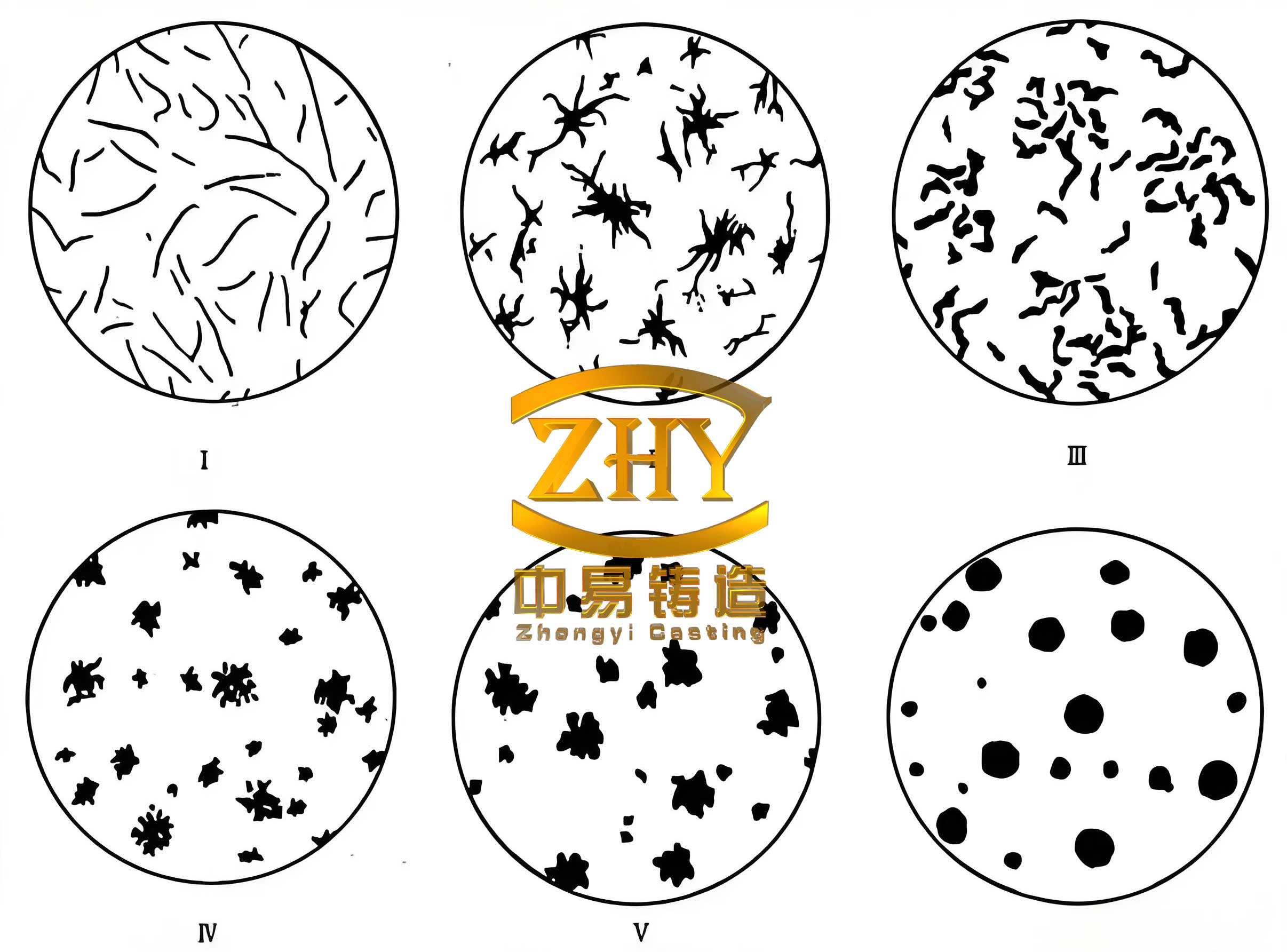
Metallographic analysis was conducted to examine the graphite morphology and microstructure of the spheroidal graphite cast iron samples. Using optical microscopy at high magnification, we captured images of the graphite structure and matrix. Software tools were employed to quantify graphite ball count and diameter, with nodularity rated according to standards. The results, presented in Table 4, include nodularity percentage, graphite size distribution, pearlite and ferrite content, and graphite ball count per square millimeter. Group 1, with silicon-barium-zirconium inoculant, exhibited an average graphite ball count of 144 per mm², slightly higher than Group 2’s 140 per mm². Nodularity was comparable, averaging 91.9% for Group 1 and 91.3% for Group 2. Graphite size was primarily in the 5 to 7 grade range, with a predominance of ferrite matrix (>95%), indicating good ductility typical of QT400-18AL spheroidal graphite cast iron. The sulfur-oxygen inoculant led to a more uniform graphite distribution in some samples, as evidenced by lower variability in ball count dispersion.
| Sample | Nodularity (%) | Graphite Size (Grade) | Pearlite (%) | Ferrite (%) | Graphite Balls per mm² |
|---|---|---|---|---|---|
| 1-1 | 91 | 5 (8%) + 6 (67%) + 7 (25%) | <5 | >95 | 133 |
| 1-2 | 92 | 5 (2%) + 6 (82%) + 7 (15%) | <5 | >95 | 151 |
| 1-3 | 91 | 6 (63%) + 7 (36%) | <5 | >95 | 157 |
| 1-4 | 93 | 5 (1%) + 6 (60%) + 7 (38%) | <5 | >95 | 196 |
| 1-5 | 93 | 5 (4%) + 6 (61%) + 7 (34%) | <5 | >95 | 171 |
| 1-6 | 92 | 5 (14%) + 6 (74%) + 7 (12%) | <5 | >95 | 112 |
| 1-7 | 91 | 5 (8%) + 6 (72%) + 7 (20%) | <5 | >95 | 130 |
| 1-8 | 94 | 5 (29%) + 6 (59%) + 7 (11%) | <5 | >95 | 104 |
| 1-9 | 90 | 5 (2%) + 6 (74%) + 7 (24%) | <5 | >95 | 139 |
| 1-10 | 92 | 5 (6%) + 6 (68%) + 7 (24%) | <5 | >95 | 145 |
| Group 1 Mean | 91.9 | 5 (7.4%) + 6 (68.0%) + 7 (23.9%) | <5 | >95 | 144 |
| 2-1 | 91 | 5 (2%) + 6 (76%) + 7 (20%) | <5 | >95 | 146 |
| 2-2 | 91 | 5 (10%) + 6 (71%) + 7 (19%) | <5 | >95 | 137 |
| 2-3 | 93 | 5 (7%) + 6 (58%) + 7 (33%) | <5 | >95 | 190 |
| 2-4 | 90 | 6 (62%) + 7 (36%) | <5 | >95 | 210 |
| 2-5 | 90 | 5 (5%) + 6 (71%) + 7 (23%) | <5 | >95 | 127 |
| 2-6 | 92 | 5 (40%) + 6 (54%) + 7 (6%) | <5 | >95 | 78 |
| 2-7 | 93 | 5 (3%) + 6 (82%) + 7 (15%) | <5 | >95 | 128 |
| 2-8 | 90 | 5 (40%) + 6 (55%) + 7 (5%) | <5 | >95 | 76 |
| 2-9 | 92 | 5 (6%) + 6 (76%) + 7 (18%) | <5 | >95 | 176 |
| 2-10 | 91 | 5 (6%) + 6 (76%) + 7 (18%) | <5 | >95 | 134 |
| Group 2 Mean | 91.3 | 5 (11.2%) + 6 (67.5%) + 7 (21.3%) | <5 | >95 | 140 |
The dispersion analysis for metallographic parameters revealed interesting trends. For nodularity, both groups had similar standard deviations (approximately 1.2%), indicating comparable stability in graphite spheroidization. However, for graphite ball count per unit area, Group 1 showed a standard deviation of 27.12 balls/mm², while Group 2 had 43.50 balls/mm², suggesting that the silicon-barium-zirconium inoculant provides more consistent graphite nucleation density. This consistency in spheroidal graphite cast iron microstructure can be linked to the role of inoculant elements. For instance, the sulfur-oxygen inoculant contains cerium (Ce), which constitutes 1.5–2.0% of the rare earth content. Cerium has a strong affinity for sulfur and oxygen, forming stable oxides, sulfides, and oxysulfides that act as effective nucleation sites. This enhances graphite nodularity and reduces chilling tendency, contributing to improved metallographic quality. On the other hand, the silicon-barium-zirconium inoculant includes zirconium (Zr), which can absorb nitrogen from mold materials, and high barium content, which prolongs inoculation effectiveness in slow-solidifying castings. Barium compounds, such as BaO and BaS, have higher density and slower floating rates, promoting uniform graphite distribution and stable mechanical properties in spheroidal graphite cast iron.
To deepen our understanding, we can model the relationship between graphite morphology and mechanical properties using theoretical formulas. For example, the nucleation density \( N \) of graphite balls can be expressed as a function of inoculant efficiency and cooling rate:
$$ N = N_0 \cdot \exp\left(-\frac{E_a}{kT}\right) \cdot f(I) $$
where \( N_0 \) is a pre-exponential factor, \( E_a \) is the activation energy for nucleation, \( k \) is Boltzmann’s constant, \( T \) is temperature, and \( f(I) \) represents the inoculant effect. In spheroidal graphite cast iron, higher \( N \) typically correlates with improved ductility and toughness, as finer graphite disperses stress more effectively. The impact energy \( U \) at low temperatures can be related to graphite ball count and nodularity \( \eta \):
$$ U = \alpha \cdot \eta + \beta \cdot \sqrt{N} + \gamma $$
where \( \alpha \), \( \beta \), and \( \gamma \) are material constants. From our data, Group 1’s higher impact energy may stem from its slightly higher \( N \) and consistent \( \eta \). Similarly, tensile strength \( \sigma_t \) and yield strength \( \sigma_y \) can be approximated by:
$$ \sigma_t = \sigma_0 + k_t \cdot \eta \cdot \frac{1}{d_g} $$
$$ \sigma_y = \sigma_{y0} + k_y \cdot \eta \cdot \frac{1}{d_g} $$
where \( \sigma_0 \) and \( \sigma_{y0} \) are base strengths, \( k_t \) and \( k_y \) are coefficients, and \( d_g \) is the average graphite diameter. Since both groups had similar \( \eta \) and \( d_g \), the close tensile and yield strengths align with these formulas. The variability in properties can be attributed to fluctuations in \( N \) and \( d_g \), influenced by inoculant type and process conditions.
In discussion, we consider the practical implications for wind turbine bearing housings. The silicon-barium-zirconium inoculant offers advantages in low-temperature impact toughness and stability in yield strength and elongation, making it suitable for applications where cryogenic resilience is paramount. Its ability to maintain consistent graphite ball count also reduces the risk of defects like shrinkage or porosity in thick sections of spheroidal graphite cast iron castings. Conversely, the sulfur-oxygen inoculant provides better stability in tensile strength and superior metallographic uniformity, which may enhance fatigue resistance under cyclic loading. For wind turbines operating in diverse environments, a balanced approach might involve selecting the inoculant based on specific performance criteria. For instance, in regions with extreme cold, silicon-barium-zirconium could be preferred, while sulfur-oxygen might be chosen for high-stress applications where tensile consistency is critical. Further optimization could involve blending inoculants or adjusting addition rates to tailor the properties of spheroidal graphite cast iron.
In conclusion, this study demonstrates that both silicon-barium-zirconium and sulfur-oxygen secondary inoculants effectively enhance the performance of spheroidal graphite cast iron for wind turbine bearing housings. The silicon-barium-zirconium inoculant contributes to higher low-temperature impact energy and stability in yield strength and elongation, while the sulfur-oxygen inoculant improves tensile strength stability and metallographic quality. These findings underscore the importance of inoculant selection in achieving desired mechanical and microstructural characteristics in spheroidal graphite cast iron. For future work, we recommend exploring combined inoculation strategies or novel inoculant compositions to further optimize the trade-offs between toughness, strength, and consistency. By advancing inoculation techniques, we can ensure that spheroidal graphite cast iron components meet the rigorous demands of wind energy systems, supporting sustainable and reliable power generation.