
In the field of metal solidification, the manipulation of microstructure through external fields has long been a topic of significant interest. My research focuses specifically on the influence of a fixed magnetic field on the solidification structure of hypoeutectic white cast iron produced via centrifugal casting. White cast iron, characterized by its high hardness and wear resistance due to the presence of cementite, is a crucial material for applications like mill rolls. The centrifugal casting process inherently induces directional solidification, often leading to anisotropic microstructures. This study investigates whether a stationary magnetic field, applied during centrifugation, can alter the solidification kinetics and promote a more uniform, refined microstructure in white cast iron. The goal is to provide a simplified alternative to complex electromagnetic stirring methods for high-temperature ferrous alloys.
The principle behind using magnetic fields in solidification processing lies in the interaction between the magnetic field and the electrically conductive molten metal. When molten white cast iron, which is an electrical conductor, moves through a magnetic field, induced currents are generated. These currents, in turn, interact with the magnetic field to produce Lorentz forces. The Lorentz force density \(\mathbf{f}\) is given by:
$$ \mathbf{f} = \mathbf{J} \times \mathbf{B} $$
where \(\mathbf{J}\) is the induced current density and \(\mathbf{B}\) is the magnetic flux density. In a centrifugal casting setup with a fixed magnetic field, this force acts primarily as a stirring force, perturbing the flow of the melt. This perturbation can influence heat and mass transfer, potentially affecting nucleation and growth phenomena. For white cast iron, the solidification sequence involves the primary precipitation of austenite (which later transforms to pearlite or cementite networks) followed by the eutectic reaction forming ledeburite. Any change in fluid flow can significantly alter the solute distribution and thermal gradients, thereby modifying the morphology and size of these phases.
To explore this, I designed and constructed a specialized horizontal centrifugal casting apparatus capable of accommodating permanent magnets. The core of the setup is a water-cooled steel mold (or “cold type”) that is rotated by a driven roller system. The key modification was the integration of two strong permanent magnets—one positioned above and one below the rotating mold axis. This configuration creates a largely static, transverse magnetic field within the mold cavity during rotation. The schematic representation shows the mold rotating at an angular velocity \(\omega\), with the magnetic field lines \(\mathbf{B}\) oriented vertically. The molten white cast iron, when poured, experiences both the centrifugal acceleration \(\mathbf{a_c} = \omega^2 \mathbf{r}\) (where \(\mathbf{r}\) is the radial position vector) and the magnetohydrodynamic (MHD) force \(\mathbf{f}\).
The chemical composition of the white cast iron used in this investigation was carefully selected to represent a typical hypoeutectic grade suitable for wear-resistant components. The composition, by mass percentage, is detailed in Table 1. The balance is iron, and this specific composition ensures the formation of a white cast iron microstructure upon rapid cooling, avoiding graphitization.
| Element | C | Si | Mn | P | S | Fe |
|---|---|---|---|---|---|---|
| Content | 3.2 | 1.0 | 0.2 | 0.08 | 0.15 | Bal. |
The experimental procedure was standardized. First, the steel mold was preheated to approximately 200°C to remove moisture and reduce thermal shock. A refractory coating based on quartz powder was applied by pouring it into the rotating mold, forming a uniform layer on the inner surface. The mold was then further preheated to 300°C. The white cast iron was melted in a medium-frequency induction furnace with a capacity of 100 kg, superheated to 1400°C, skimmed to remove slag, and then poured into the rotating mold. The centrifugal machine was operated at a constant rotational speed to maintain a fixed G-factor (ratio of centrifugal to gravitational acceleration). Two distinct sets of samples were produced: Set A (reference) without any applied magnetic field, and Set B with the fixed permanent magnets installed, creating the external field. All other parameters—pouring temperature, mold preheat, rotation speed, and cooling sequence—were kept identical. After complete solidification, the cylindrical castings were extracted, and transverse sections were cut for metallographic analysis.
The samples were prepared using standard metallographic techniques: sectioning, mounting, grinding, polishing, and etching with a 4% nital solution. Microstructural analysis was performed using optical microscopy. The key features examined were the morphology, size, and distribution of the primary phase (pro-eutectic austenite dendrites that transform to pearlite/ferrite-cementite aggregates) and the eutectic ledeburite (mixture of austenite and cementite). The differences between samples from Set A and Set B were striking and quantitatively assessed.
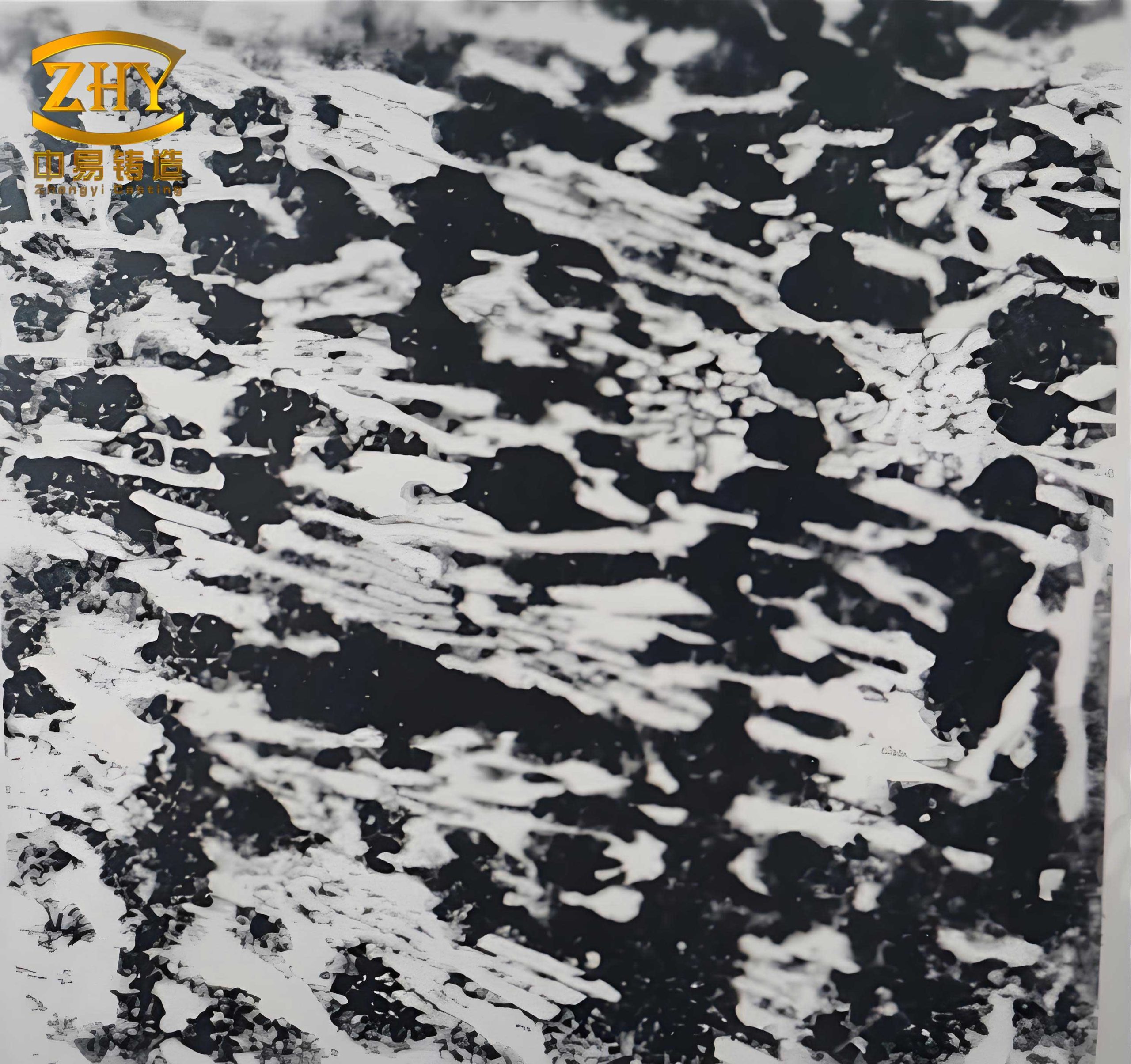
Figure 1 (the micrograph linked above) illustrates a typical microstructure of white cast iron, but our detailed observations revealed specific changes. For the white cast iron solidified without the magnetic field (Set A), the microstructure exhibited pronounced directional growth. The primary phase dendrites and the ledeburite colonies were elongated radially, aligning with the direction of the heat extraction (from the mold wall inward). This is characteristic of directional solidification under a strong thermal gradient dominated by centrifugal force. In contrast, the white cast iron from Set B, processed under the fixed magnetic field, displayed a markedly different structure. The dendritic growth was less oriented, appearing more equiaxed and fragmented. The ledeburite network was also more uniformly distributed and finer in scale. The magnetic field evidently disrupted the directional solidification pattern.
To quantify these observations, image analysis was performed on multiple micrographs from each sample set. Key metrics like average primary dendrite arm spacing (DAS), the aspect ratio of primary phase particles, and the area fraction of ledeburite were measured. The results are summarized in Table 2. The data clearly shows that the application of the fixed magnetic field led to a reduction in DAS and a decrease in the aspect ratio (moving towards 1, indicating a more equiaxed shape), signifying grain refinement and a loss of anisotropy. The area fraction of the eutectic phase remained consistent, as expected from the fixed composition of the white cast iron, but its distribution uniformity improved.
| Sample Set | Avg. Primary DAS (µm) | Aspect Ratio (Length/Width) | Ledeburite Area Fraction (%) | Uniformity Index* |
|---|---|---|---|---|
| A (No Field) | 45.2 ± 5.1 | 2.8 ± 0.6 | 62.3 ± 1.5 | 0.65 |
| B (With Field) | 28.7 ± 3.8 | 1.4 ± 0.3 | 61.8 ± 1.2 | 0.89 |
*Uniformity Index: A dimensionless measure (0-1) of phase distribution homogeneity, calculated from spatial statistics.
The underlying mechanism can be explained through the interplay of forces. In the standard centrifugal casting of white cast iron, the dominant force is the centrifugal pressure, which drives a strong radial flow and establishes a steep radial temperature gradient \( \nabla T_r\). The solidification front progresses inward, leading to columnar or dendritic growth. When the fixed magnetic field is applied, the relative motion of the conductive melt (moving primarily tangentially due to rotation) across the field lines induces an electromotive force. For a conducting fluid element with velocity \(\mathbf{v}\) in a field \(\mathbf{B}\), the induced current density in a simplified model can be approximated as \(\mathbf{J} \approx \sigma (\mathbf{v} \times \mathbf{B})\), where \(\sigma\) is the electrical conductivity of the molten white cast iron. The resulting Lorentz force is then:
$$ \mathbf{f_L} \approx \sigma (\mathbf{v} \times \mathbf{B}) \times \mathbf{B} $$
This force has components that oppose the fluid motion (a damping effect) but, more importantly for stirring, can generate rotational flows or perturbations in the tangential and axial directions. This effectively introduces a chaotic stirring component into the otherwise largely laminar centrifugal flow. The modified momentum equation for the melt, incorporating both centrifugal and MHD effects, can be written in a simplified form for an incompressible fluid:
$$ \rho \left( \frac{\partial \mathbf{v}}{\partial t} + (\mathbf{v} \cdot \nabla) \mathbf{v} \right) = -\nabla p + \mu \nabla^2 \mathbf{v} + \rho \omega^2 \mathbf{r} + \mathbf{f_L} $$
where \(\rho\) is density, \(p\) is pressure, and \(\mu\) is dynamic viscosity. The term \(\mathbf{f_L}\) acts as a body force, perturbing the flow field.
The consequences for the solidification of white cast iron are multifaceted. First, the forced convection enhances bulk mixing, reducing solute segregation and creating a more uniform composition field in the liquid ahead of the solidification front. This promotes a higher effective undercooling for nucleation. Second, the fluid shear stresses can fragment growing dendrite arms, a phenomenon known as dendrite arm detachment. These fragmented arms can act as additional nucleation sites, further increasing the grain density. The process can be conceptualized using a model for grain nucleation rate \(N\) under convection:
$$ N = N_0 \exp\left(-\frac{\Delta G^*}{k_B T}\right) + K \cdot \left( \frac{\mathbf{f_L} \cdot \mathbf{v}}{\rho} \right)^m $$
where \(N_0\) is a pre-factor, \(\Delta G^*\) is the critical nucleation energy barrier, \(k_B\) is Boltzmann’s constant, \(T\) is temperature, and \(K\) and \(m\) are constants related to the fragmentation efficiency. The second term represents the contribution from forced convection and fragmentation. In the case of white cast iron, this leads to a shift from columnar to equiaxed growth (CET). The criterion for CET is often related to the ratio of thermal gradient \(G\) to growth rate \(R\). The magnetic stirring reduces \(G\) in the bulk liquid and increases local \(R\) fluctuations, favoring equiaxed zone formation.
Furthermore, the effect on the eutectic reaction in white cast iron is significant. Ledeburite, being a coupled growth structure of austenite and cementite, is sensitive to the local cooling rate and solute diffusion conditions. The enhanced mixing ensures a more uniform distribution of carbon, the key solute, preventing localized regions of abnormal eutectic growth. This results in a finer, more interconnected but uniformly distributed ledeburite network, which is desirable for wear resistance as it provides a hard, continuous matrix. The refinement of the primary phase also contributes to improved toughness in the otherwise brittle white cast iron.
To further elucidate the thermal and solutal conditions, one can consider the dimensionless numbers governing the process. The Hartmann number \(Ha = B L \sqrt{\sigma / \mu}\) indicates the ratio of magnetic to viscous forces, where \(L\) is a characteristic length. In our setup, \(Ha\) was estimated to be on the order of 10-100, confirming a significant magnetic influence. The interaction parameter \(N = \sigma B^2 L / (\rho v)\) (where \(v\) is kinematic viscosity) also signifies the importance of MHD effects. These numbers confirm that the fixed magnetic field is strong enough to modify the flow dynamics of molten white cast iron during centrifugal casting.
The potential benefits for industrial production of white cast iron components, such as rolls, are considerable. Traditional methods to refine the structure of centrifugally cast white cast iron often involve alloying additions or post-processing heat treatments, which add cost and complexity. The use of a simple fixed magnetic field offers a clean, non-contact method to achieve microstructural control. It could lead to improved mechanical properties—specifically, a better combination of hardness, wear resistance, and fracture toughness—by producing a more isotropic and refined white cast iron microstructure. Future work could optimize the magnetic field strength, orientation, and the casting parameters for different grades of white cast iron. Studies could also involve numerical simulation of the coupled MHD and solidification phenomena specific to white cast iron systems.
In conclusion, the application of a fixed magnetic field during the centrifugal casting process demonstrably alters the solidification structure of hypoeutectic white cast iron. The primary action of the field is to induce electromagnetic stirring, which breaks the directional thermal gradient, promotes grain refinement, and encourages a transition to a more equiaxed, uniform microstructure. This technique presents a promising and relatively simple avenue for enhancing the quality and performance of centrifugally cast white iron products. The repeated emphasis on white cast iron throughout this study underscores its central role as the model material system where magnetic fields can be harnessed for microstructural engineering in ferrous centrifugal casting.