
In my research on wear-resistant materials for mining applications, I have focused extensively on low-chromium white cast iron, a material widely used in grinding media for large-scale ball mills. The corrosive wear resistance of white cast iron is critical in wet grinding environments, where abrasion and corrosion synergistically degrade components. This study delves into how silicon and copper additions influence the microstructure, hardness, and corrosive wear behavior of vanadium-titanium modified low-chromium white cast iron. Through laboratory experiments, I aimed to optimize the composition of white cast iron to enhance service life in acidic, neutral, and alkaline slurries, thereby reducing operational costs in mineral processing. The findings underscore the intricate balance required in alloy design for white cast iron, where elements like silicon and copper can either bolster or impair performance depending on their concentration and interaction with the matrix.
White cast iron, characterized by its high carbon content and cementite-dominated microstructure, is renowned for exceptional abrasion resistance. However, in corrosive media, its susceptibility to electrochemical degradation often limits durability. Low-chromium variants of white cast iron, typically containing 2-5% chromium, offer improved corrosion resistance due to chromium’s ability to form protective oxides, but further enhancements are sought through alloying. In this context, I investigated the roles of silicon and copper, both common alloying elements in white cast iron, known to affect graphite formation, carbide morphology, and matrix properties. The impetus for this work stems from industrial needs, such as in large overflow-type mills where white cast iron grinding segments must withstand harsh conditions. By systematically varying silicon and copper levels, I evaluated their impact on corrosive wear, leveraging a three-body abrasion-corrosion test to simulate real-world scenarios.
The fundamental chemistry of white cast iron revolves around the iron-carbon system, where carbon exists primarily as cementite (Fe3C) in a metastable state. The corrosion wear mechanism in white cast iron involves both mechanical removal of material by abrasive particles and chemical dissolution of the matrix. The electrode potential difference between carbides and the matrix drives galvanic corrosion, accelerating wear. Alloying can modulate this by altering microstructure and electrochemical properties. For instance, silicon in white cast iron raises the matrix’s electrode potential, reducing the potential gap with carbides, while copper enhances passivation. However, excessive silicon can promote graphite formation, which detrimentally affects wear resistance. Thus, optimizing these elements is key to advancing white cast iron performance.
To quantify these effects, I derived a simplified model for corrosive wear rate in white cast iron, integrating abrasive and corrosive components. The total wear volume loss, \( W_v \), can be expressed as:
$$W_v = W_a + W_c + \Delta W_{syn}$$
where \( W_a \) is the pure abrasive wear volume, \( W_c \) is the pure corrosion loss, and \( \Delta W_{syn} \) is the synergistic term due to interaction. For white cast iron, the abrasive component often dominates, but corrosion exacerbates material removal. The hardness of white cast iron, primarily from carbides, resists abrasion, and can be approximated by a rule-of-mixtures for composite materials:
$$H = f_c H_c + (1 – f_c) H_m$$
where \( H \) is the overall hardness, \( f_c \) is the volume fraction of carbides, \( H_c \) is carbide hardness, and \( H_m \) is matrix hardness. Silicon and copper influence \( H_m \) through solid solution strengthening and pearlite refinement, respectively. In corrosive environments, the wear resistance of white cast iron also depends on the corrosion current density, \( i_{corr} \), which relates to the electrode potential difference, \( \Delta E \), between phases:
$$i_{corr} = k \cdot \exp\left(\frac{\Delta E}{b}\right)$$
where \( k \) and \( b \) are constants. By alloying, we aim to minimize \( \Delta E \) in white cast iron, thereby reducing \( i_{corr} \) and synergistic wear.
In my experimental approach, I prepared a series of low-chromium white cast iron samples with varying silicon and copper contents, as summarized in Table 1. The base composition included carbon, chromium, vanadium, and titanium to mimic industrial grades of white cast iron used in grinding segments. All melts were conducted in a medium-frequency induction furnace, cast into sand molds with chills to promote rapid cooling—a critical step for suppressing graphite in white cast iron. After casting, samples underwent a low-temperature stress relief anneal at 250°C to minimize residual stresses without altering the carbide structure. This process is typical for white cast iron to retain hardness while improving toughness.
| Sample ID | C | Si | Mn | Cr | V | Ti | Cu | Carbon Equivalent (CE) | Si/C Ratio |
|---|---|---|---|---|---|---|---|---|---|
| 1 | 3.86 | 1.49 | 0.98 | 2.12 | 0.20 | 0.10 | 0.00 | 4.30 | 0.39 |
| 2 | 3.86 | 1.94 | 0.98 | 2.12 | 0.20 | 0.10 | 0.00 | 4.51 | 0.50 |
| 3 | 3.86 | 2.15 | 0.98 | 2.12 | 0.20 | 0.10 | 0.49 | 4.52 | 0.56 |
| 4 | 3.86 | 2.66 | 0.98 | 2.12 | 0.20 | 0.10 | 0.00 | 4.69 | 0.69 |
| 5 | 3.86 | 2.98 | 0.98 | 2.12 | 0.20 | 0.10 | 0.00 | 4.80 | 0.77 |
The carbon equivalent (CE) for white cast iron, accounting for silicon’s graphitizing effect, was calculated using the formula:
$$CE = C + \frac{1}{3}(Si + P)$$
where C and Si are in weight percent. This metric helps predict microstructure transitions in white cast iron, with higher CE favoring graphite formation. In this study, CE ranged from 4.3 to 4.8, spanning hypoeutectic to hypereutectic regimes for white cast iron. Silicon content varied from 1.49% to 2.98%, while copper was added at 0.49% in one sample to isolate its effect. I measured hardness using a Rockwell scale and conducted corrosive wear tests via a modified three-body apparatus, simulating mill conditions with quartz sand abrasives in slurries at pH 3, 7, and 12. Relative wear resistance, \( \beta \), was defined as the ratio of weight loss of a standard mild steel reference to that of the white cast iron sample, providing a normalized measure of performance.
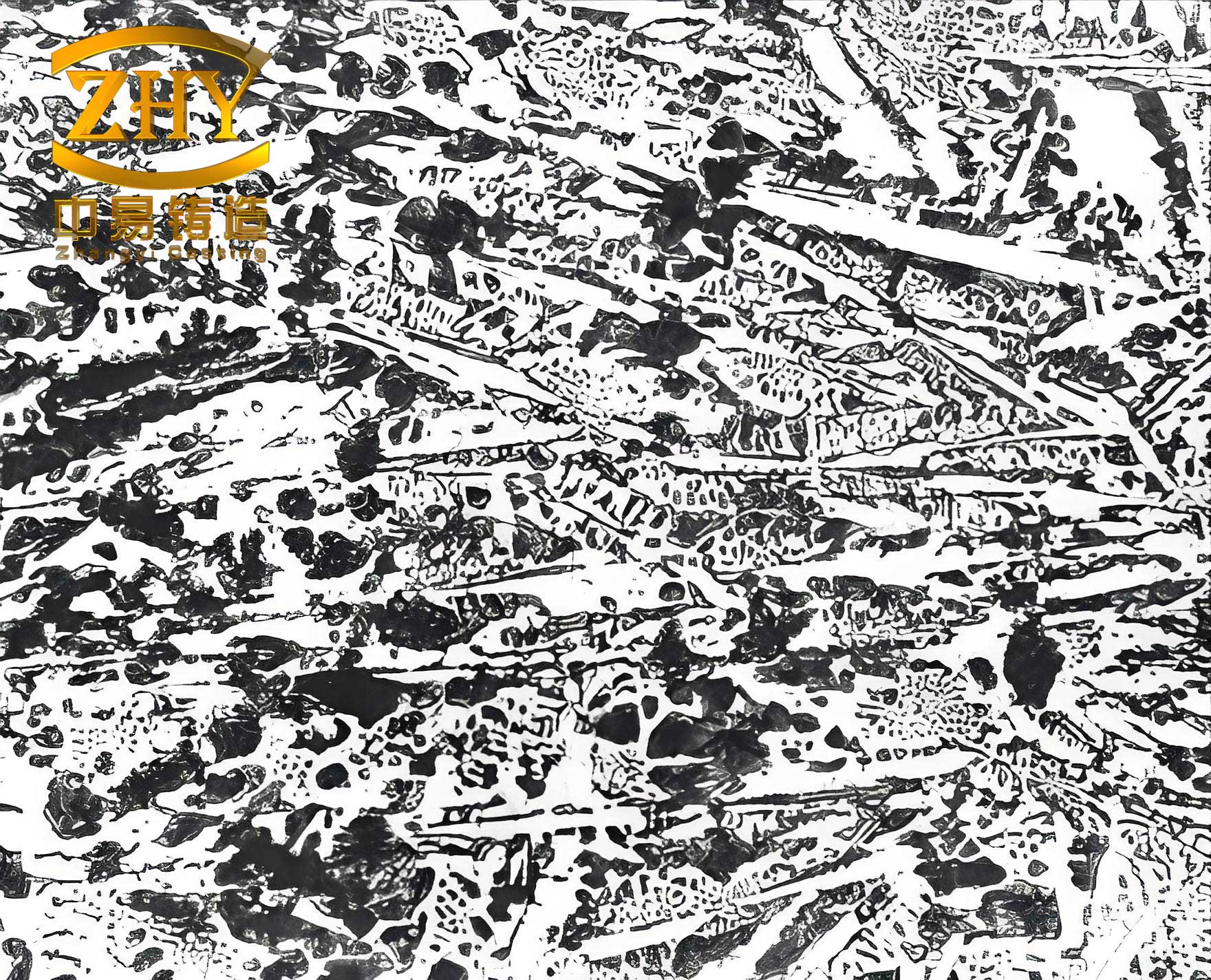
Microstructural analysis revealed profound changes in the white cast iron with increasing silicon. At lower silicon levels (≤2.0%), the microstructure comprised a metallic matrix—primarily pearlite and some martensite—with interconnected eutectic carbides in a ledeburitic pattern, typical of white cast iron. Carbides appeared as fine, fishbone-like structures, providing a continuous hard phase resistant to abrasion. As silicon exceeded 2.0%, I observed a shift to hypereutectic compositions, where primary carbides precipitated alongside eutectic carbides. At 2.66% Si, graphite nodules began to appear, predominantly as type D undercooled graphite, indicating that the carbon equivalent had surpassed a critical threshold for graphite stability in this cooling regime. By 2.98% Si, the white cast iron exhibited substantial graphite, including type F flakes, and the eutectic carbides transformed from fishbone to a honeycomb morphology. This evolution underscores silicon’s graphitizing power in white cast iron, which can compromise the carbide network essential for wear resistance.
Copper addition, at 0.49%, did not markedly alter the carbide morphology in white cast iron, as expected from its weak graphitizing tendency. Instead, copper dissolved in the matrix, refining the pearlite and enhancing solid solution strength. This microstructural stability is advantageous for maintaining the abrasion resistance of white cast iron while improving corrosion properties. The images from scanning electron microscopy (SEM) corroborated these findings, showing that silicon-rich white cast iron had more graphite pockets and coarser carbides, which likely act as stress concentrators during wear.
The hardness data for the white cast iron samples, plotted against silicon content, demonstrated a positive correlation up to a point. Hardness increased from approximately 59.5 HRC at 1.49% Si to over 60 HRC at higher silicon levels, peaking around 2.15% Si. This rise stems from silicon’s solid solution strengthening and the increased volume fraction of hard carbides in white cast iron. However, beyond 2.5% Si, hardness gains plateaued or slightly declined due to graphite softening. Copper’s inclusion had a negligible effect on hardness, consistent with its role in matrix modification rather than carbide formation. These trends are summarized in Table 2, which also includes relative wear resistance values across different pH media.
| Sample ID | Si (%) | Cu (%) | Hardness (HRC) | Relative Wear Resistance, \( \beta \) (pH=3) | Relative Wear Resistance, \( \beta \) (pH=7) | Relative Wear Resistance, \( \beta \) (pH=12) |
|---|---|---|---|---|---|---|
| 1 | 1.49 | 0.00 | 59.5 | 1.55 | 1.69 | 1.66 |
| 2 | 1.94 | 0.00 | 60.0 | 1.80 | 1.85 | 1.82 |
| 3 | 2.15 | 0.49 | 60.0 | 2.07 | 1.99 | 1.80 |
| 4 | 2.66 | 0.00 | 59.0 | 1.65 | 1.90 | 1.75 |
| 5 | 2.98 | 0.00 | 58.5 | 1.50 | 1.70 | 1.60 |
Corrosive wear performance of white cast iron showed a non-linear dependence on silicon. In acidic media (pH 3), relative wear resistance improved from 1.55 at 1.49% Si to a maximum of 2.07 at 2.15% Si with copper, then decreased to 1.50 at 2.98% Si. This peak corresponds to the optimal balance where silicon enhances matrix corrosion resistance without inducing excessive graphite. The decline at higher silicon is attributed to graphite formation and carbide coarsening, which weaken the white cast iron’s integrity. In neutral and alkaline slurries (pH 7 and 12), the trend was similar but less pronounced, with wear resistance remaining higher overall due to reduced corrosion aggressiveness. Copper universally boosted wear resistance across all pH levels, elevating \( \beta \) by up to 25% in acidic conditions. This improvement highlights copper’s efficacy in mitigating corrosion in white cast iron, likely by raising the matrix potential and promoting passivation films.
To delve deeper, I analyzed the wear mechanisms via SEM of worn surfaces. In low-silicon white cast iron, the dominant wear mode was micro-cutting by abrasive particles, with shallow grooves and minimal plastic deformation—characteristic of hard, carbide-rich materials. As silicon increased, the wear scars featured more pits and spalls, indicative of carbide-matrix interface degradation. Graphite-containing white cast iron exhibited accelerated material loss, with graphite acting as corrosion sites and reducing local hardness. The synergy between abrasion and corrosion was quantified by calculating the synergistic wear increment, \( \Delta W_{syn} \), from weight loss data. For white cast iron, this term becomes significant when graphite or porous carbides are present, as they facilitate electrolyte penetration and galvanic couples.
The electrochemical behavior of white cast iron can be modeled using mixed-potential theory. The corrosion current, \( i_{corr} \), for a white cast iron sample in slurry depends on the anodic dissolution of the matrix and cathodic reactions on carbides or graphite. Silicon reduces \( i_{corr} \) by shifting the matrix potential, \( E_m \), closer to that of carbides, \( E_c \). The potential difference is given by:
$$\Delta E = E_c – E_m$$
With silicon addition, \( E_m \) becomes more noble, decreasing \( \Delta E \) and thus corrosion rate. Copper further augments this by forming copper-rich phases that catalyze protective oxide layers. However, graphite has a much lower potential than cementite, so its presence in white cast iron increases \( \Delta E \) dramatically, exacerbating corrosion. This explains why silicon’s benefits diminish beyond a threshold in white cast iron.
From a practical standpoint, these findings guide alloy design for white cast iron in corrosive-abrasive environments. For acidic slurries, I recommend limiting silicon to ≤2.0% in low-chromium white cast iron, corresponding to a carbon equivalent ≤4.5, to avoid graphite. Copper additions around 0.5% are beneficial for enhancing corrosion resistance without harming abrasion properties. In neutral or alkaline conditions, silicon can be pushed to 2.5% (CE ≤4.7) before performance drops, but copper should still be incorporated for optimal durability. These guidelines help extend the service life of white cast iron grinding media, reducing replacement frequency and downtime in mining operations.
To generalize, the performance of white cast iron under corrosive wear is governed by a complex interplay of microstructure, hardness, and electrochemistry. The volume fraction of carbides, \( f_c \), directly influences abrasion resistance, as per Archard’s wear law modified for composites:
$$W_a = K \cdot \frac{L}{H} \cdot f_c^{-n}$$
where \( K \) is a wear coefficient, \( L \) is load, and \( n \) is an exponent reflecting carbide effectiveness. In white cast iron, high \( f_c \) from hypereutectic compositions can backfire if carbides become discontinuous or graphite forms. Thus, maximizing wear resistance in white cast iron requires optimizing \( f_c \) through carbon and silicon control, while alloying with copper to bolster the matrix against corrosion.
In conclusion, my investigation into silicon and copper effects on low-chromium white cast iron reveals that both elements can significantly improve corrosive wear performance, but within specific bounds. Silicon enhances matrix potential and hardness up to ~2.0%, after which graphite formation degrades white cast iron integrity. Copper provides a consistent boost by refining microstructure and promoting passivation. For industrial applications, tailoring white cast iron composition based on slurry pH is crucial—lower silicon for acidic media, moderate silicon for alkaline, and always consider copper addition. Future work could explore synergistic effects with other elements like molybdenum or nickel to further advance white cast iron technology. This research underscores the importance of holistic material design in developing durable white cast iron components for harsh environments.