
With the rapid advancement of modern manufacturing, metal matrix composites (MMCs) have become indispensable for technological progress. Among these, MMCs reinforced with ceramic particles exhibit outstanding specific strength, specific stiffness, elastic modulus, wear resistance, and dimensional stability, along with reduced thermal expansion and enhanced electrical and thermal conductivity compared to monolithic alloys. Such materials are extensively applied in aerospace, automotive, electronics, and transportation industries. Various fabrication routes exist, including powder metallurgy, stir casting, hot pressing, and liquid pressure infiltration. However, these methods often suffer from high cost, complexity, or particle agglomeration, which degrades performance. To overcome these limitations, we have adopted lost foam castings (LFC) to produce particle-reinforced high chromium cast iron (HCCI) components. In our study, TiC particles of varying sizes were selected as the reinforcement, and both test blocks and actual slurry pump rear guard plates were manufactured. The objective was to systematically investigate the influence of TiC particle size on the hardness, relative wear resistance, and impact toughness of the resulting lost foam castings. Our findings provide valuable insights for industrial applications using lost foam castings.
1. Experimental Materials and Methods
Commercially pure TiC particles (99.9% purity) with nominal sizes of 600, 1000, 1500, and 2000 mesh (corresponding to particle diameters in the range of 6.5–23.0 μm) were used as reinforcement. The physical properties of TiC are summarized in Table 1.
| Crystal system | Density (g/cm³) | Hardness (HV) | Elastic modulus (GPa) | Melting point (°C) | Thermal expansion coefficient (×10⁻⁶/K) |
|---|---|---|---|---|---|
| Cubic | 4.92 | 3000 | 269 | 3300 | 7.40 |
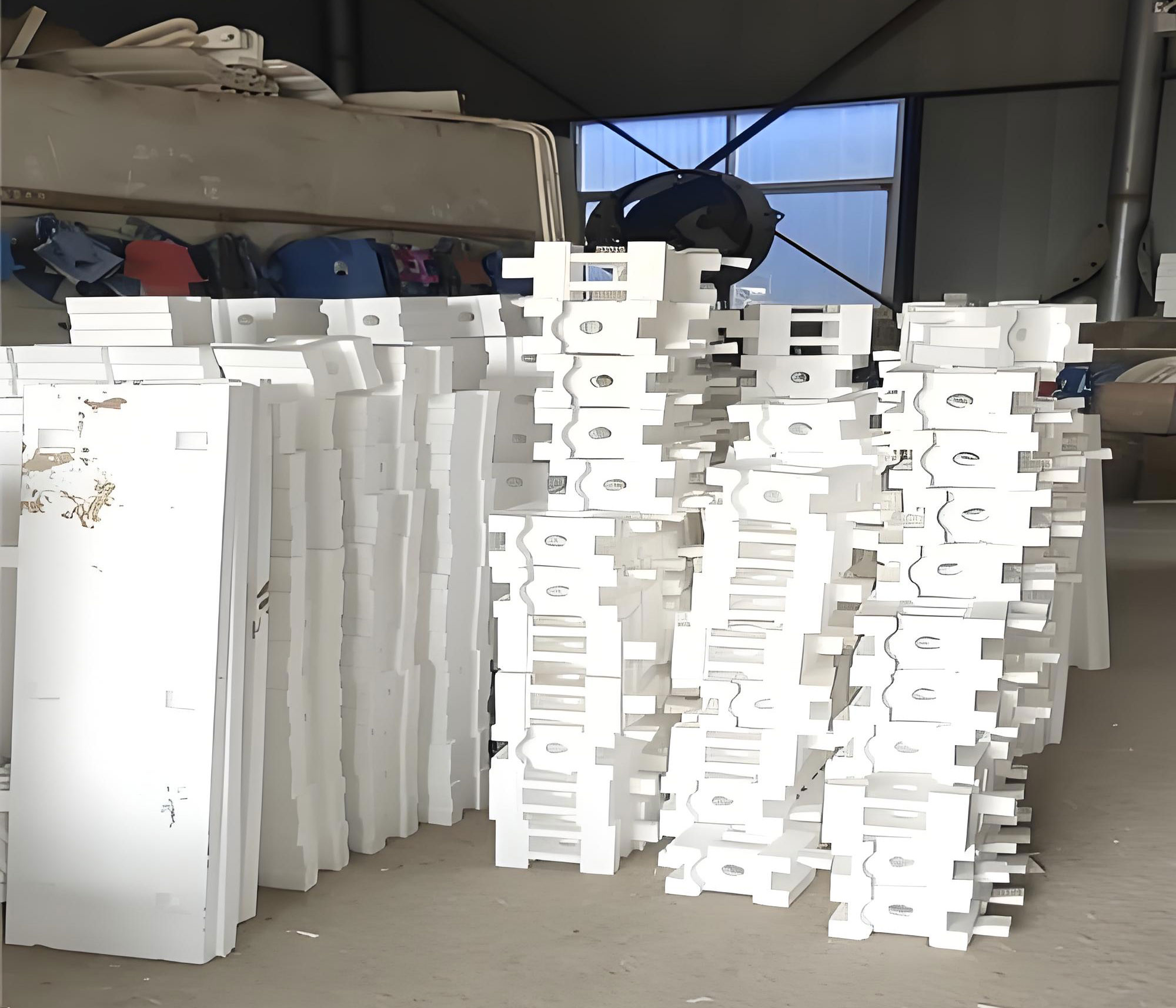
Expandable polystyrene (EPS) beads with a density of 22–24 kg/m³, bead size of 1–2 mm, gas evolution of 105 cm³/g, and residue of 0.015% were selected as the pattern material. The TiC particles were first mixed with the EPS beads and a type-A binder solution (concentration 0.2 g/mL) in a blender at 120–200 rpm for 30–50 s until a uniform coating was achieved. The coated beads were then blown into a preheated mold and steam-cured at high temperature for 3–5 min to solidify the pattern. After cooling, the pattern was removed. For our experiments, several test blocks (30 mm × 30 mm × 60 mm) and slurry pump rear guard plates (diameter 350 mm, thickness 25 mm) were produced using the lost foam castings technique. A slit-gating system with no risers was employed to minimize the loss of TiC particles into the riser cavity, ensuring that the final composite retained the intended volume fraction of reinforcement (8 vol%).
Wear testing was performed under conditions simulating actual slurry pump service, using a custom-built erosion wear tester. The relative wear resistance (RWR) was defined as:
$$
\text{Relative wear resistance} = \frac{J_2 – J_1}{M_2 – M_1}
$$
where \(J_1\) and \(J_2\) are the masses of the reference (matrix) specimen before and after wear, respectively, and \(M_1\) and \(M_2\) are the masses of the test specimen before and after wear.
2. Results and Discussion
2.1 Effect of TiC Particle Size on Mechanical Properties of Test Blocks
Figure 1 presents the microstructures of the high chromium cast iron matrix and the TiCp/Fe composites fabricated via lost foam castings. The matrix (Fig. 1(a)) displays abundant long rod-like carbides. Upon adding 1500 mesh TiC particles (Fig. 1(b)), we observed the formation of hexagonal carbides, a reduction in the number of rod-like carbides, and a refinement of primary carbides and austenite grains. When 2000 mesh TiC particles were introduced (Fig. 1(c)), the rod-like carbides almost disappeared, the hexagonal carbides became finer, and the overall carbide content decreased, but noticeable particle agglomeration occurred.
The mechanical properties of the test blocks are listed in Table 2. Compared to the unreinforced matrix (30.3 HRC), all composites exhibited significantly higher hardness. As the TiC particle size decreased from 600 mesh to 1500 mesh, the hardness increased monotonically, reaching a maximum of 35.0 HRC at 1500 mesh. Further reduction to 2000 mesh resulted in a slight decrease to 34.5 HRC, still higher than that of the 1000 mesh composite. The relative wear resistance followed a similar trend: the matrix had a baseline of 1.0, while the composites showed enhanced values. The 1500 mesh composite achieved the highest RWR of 1.60, which was 1.60 times that of the matrix. The 2000 mesh composite gave an RWR of 1.47, which remained above that of the 1000 mesh composite (1.35).
| Specimen No. | TiC mesh size | Hardness (HRC) | Relative wear resistance | Impact toughness (J/cm²) |
|---|---|---|---|---|
| 1 (Matrix) | – | 30.3 | 1.00 | 6.7 |
| 2 | 600 | 33.1 | 1.28 | 10.3 |
| 3 | 1000 | 34.3 | 1.35 | 11.0 |
| 4 | 1500 | 35.0 | 1.60 | 12.3 |
| 5 | 2000 | 34.5 | 1.47 | 11.8 |
The impact toughness also improved substantially with TiC addition. The matrix exhibited a toughness of 6.7 J/cm², while all composites exceeded 10 J/cm². The maximum toughness of 12.3 J/cm² was recorded for the 1500 mesh composite, representing an 84% increase over the matrix. The toughness of the 2000 mesh composite (11.8 J/cm²) was still higher than that of the 1000 mesh composite (11.0 J/cm²). These results clearly demonstrate that incorporating TiC particles via lost foam castings effectively enhances the mechanical performance of high chromium cast iron.
2.2 Effect of Particle Size on Hardness and Wear Resistance of Rear Guard Plates
Using the same slit-gating system, we fabricated rear guard plates reinforced with 600, 1000, 1500, and 2000 mesh TiC particles. All plates underwent an 850°C annealing pretreatment prior to testing. The hardness and relative wear resistance as functions of particle size are summarized in Table 3. The microstructures of the rear guard plates (Fig. 2) mirrored those of the test blocks.
| Specimen No. | TiC mesh size | Hardness (HRC) | Relative wear resistance |
|---|---|---|---|
| 1 | 600 | 43.1 | 1.47 |
| 2 | 1000 | 44.7 | 1.60 |
| 3 | 1500 | 47.1 | 1.80 |
| 4 | 2000 | 45.9 | 1.68 |
The trends were consistent with those observed for test blocks. Hardness increased with decreasing particle size, reaching a peak of 47.1 HRC at 1500 mesh—a 55.4% improvement over the unreinforced matrix. The relative wear resistance peaked at 1.80 for the 1500 mesh composite, then slightly decreased to 1.68 for the 2000 mesh composite, still superior to the 1000 mesh composite. These enhancements can be attributed to the dispersion strengthening mechanism of TiC particles. Under an applied load, dislocations in the matrix interact with the hard TiC particles. According to the Orowan bypassing theory (Fig. 3), when a dislocation encounters a particle, it bends around it, leaving a dislocation loop. The shear stress required to bypass particles with spacing \(\lambda\) is given by:
$$
\tau = \frac{Gb}{\lambda}
$$
where \(G\) is the shear modulus and \(b\) is the Burgers vector. A smaller interparticle spacing \(\lambda\) leads to a higher strengthening effect. In our composites, finer TiC particles (down to 1500 mesh) were more uniformly distributed, resulting in smaller \(\lambda\) and thus greater resistance to deformation. However, when the particle size became too fine (2000 mesh), agglomeration occurred, as seen in the microstructures, which locally increased \(\lambda\) in some regions and caused a slight drop in properties.
In wear tests, previous studies have shown that the wear surface of TiC-reinforced composites exhibits less severe ploughing and fewer adhesion pits than the matrix. The hard TiC particles protrude above the softer matrix during wear, protecting the underlying material and reducing material removal. This explains the significant improvement in relative wear resistance observed in our lost foam castings.
2.3 Effect of Particle Size on Impact Toughness of Rear Guard Plates
The impact toughness of the rear guard plates is presented in Table 4. The same non-monotonic behavior was observed: toughness increased from 600 mesh to 1500 mesh, reaching a maximum of 12.8 J/cm² at 1500 mesh—1.91 times that of the matrix. The 2000 mesh composite showed a slight decrease to 12.6 J/cm², still higher than the 1000 mesh composite (12.3 J/cm²).
| Specimen No. | TiC mesh size | Impact toughness (J/cm²) |
|---|---|---|
| 1 | 600 | 11.8 |
| 2 | 1000 | 12.3 |
| 3 | 1500 | 12.8 |
| 4 | 2000 | 12.6 |
Scanning electron microscopy (SEM) of impact fracture surfaces revealed a clear change in fracture mode. The unreinforced high chromium cast iron exhibited a typical cleavage fracture with river patterns and distinct cleavage steps, characteristic of brittle fracture. The cracks initiated at the carbide-matrix interfaces and propagated along the carbides. In the TiC-reinforced composites, the river patterns were interrupted, and deep pits appeared around the TiC particles, indicating a transition from intergranular (brittle) fracture to transgranular (blocky) fracture. This transition is responsible for the improved impact toughness. Furthermore, X-ray diffraction (XRD) analysis of the TiCp/Fe composites (Fig. 4) detected the formation of an intermediate phase, Fe0.975Ti0.025, which enhances the bonding between TiC particles and the matrix. The compositional gradient from TiC to Fe0.975Ti0.025 to FeCr (M7C3) suggests a strong interfacial bonding, facilitating load transfer and delaying crack propagation. The slight reduction in toughness for the 2000 mesh composite is attributed to the presence of agglomerates that act as stress concentration sites and induce premature failure.
3. Conclusions
Based on our investigation of TiC particle size effects on high chromium cast iron produced via lost foam castings, the following conclusions can be drawn:
- The addition of TiC reinforcing particles significantly improves the hardness and relative wear resistance of high chromium cast iron. For rear guard plates fabricated by lost foam castings, the optimum hardness of 47.1 HRC (55.4% increase over the matrix) and a relative wear resistance of 1.80 (1.80 times that of the matrix) were achieved with 1500 mesh TiC particles.
- The fracture mode changes from brittle cleavage fracture to transgranular blocky fracture after incorporation of TiC particles. The impact toughness of the rear guard plate reached 12.8 J/cm², which is 1.91 times that of the matrix.
- As the particle size of the reinforcement decreases, the mechanical properties generally improve. However, when the particles become excessively fine (2000 mesh), partial dissolution and agglomeration occur, slightly diminishing the strengthening effect. Therefore, 1500 mesh TiC particles are recommended for optimal performance in lost foam castings of TiCp/Fe composites.
Our results demonstrate that lost foam castings offer a cost-effective and efficient route for producing high-performance metal matrix composites, and the findings provide practical guidance for industrial applications requiring enhanced wear and impact resistance.