
In my research, I focused on addressing the limitations of traditional high manganese steel casting, such as inadequate wear resistance and low yield strength, by investigating the impact of V-Ti alloying on the microstructure and impact wear properties. High manganese steel casting is widely used in demanding applications like mining and construction due to its excellent toughness and work-hardening capabilities. However, under severe impact and abrasive conditions, its performance can be insufficient, leading to frequent replacements and high costs. Through this study, I aimed to enhance the mechanical properties and wear resistance of high manganese steel casting by incorporating vanadium and titanium elements, which are known to refine microstructure and promote precipitation hardening.
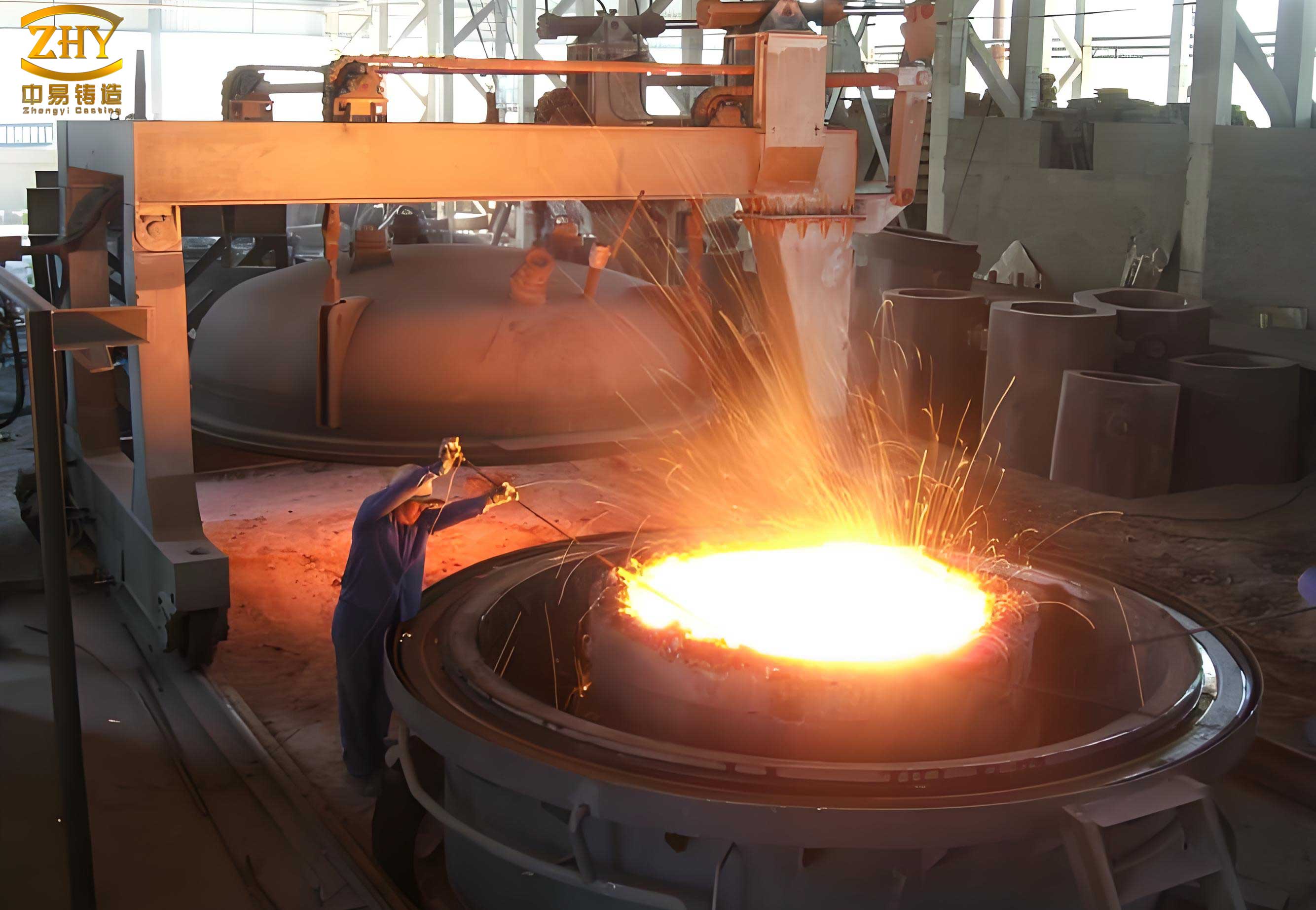
The experimental approach involved melting V-Ti alloyed high manganese steel casting in a vacuum induction furnace, with a comparative analysis against standard Mn13 high manganese steel casting. Both materials underwent identical heat treatment processes to ensure consistency. The chemical compositions of the alloys are summarized in Table 1, highlighting the addition of V and Ti in the modified high manganese steel casting. This modification was intended to alter the precipitation behavior and grain structure, ultimately improving the material’s performance under impact wear conditions.
To evaluate the effects of V-Ti alloying, I conducted a series of mechanical tests and impact wear experiments. The microstructure was examined using optical microscopy and scanning electron microscopy (SEM), while mechanical properties, including yield strength, tensile strength, elongation, impact toughness, and hardness, were measured according to standard protocols. The impact wear tests were performed using an MLD-20C dynamic load abrasion testing machine under a 4 J impact energy, with quartz sand as the abrasive medium. The wear resistance was quantified by measuring mass loss over time, and the worn surfaces were analyzed to understand the wear mechanisms. Additionally, the subsurface hardness gradient was assessed to correlate with the work-hardening behavior of the high manganese steel casting.
The results demonstrated that V-Ti alloying significantly refined the austenitic grain structure of the high manganese steel casting, reducing the average grain size from 190 µm in Mn13 to 170 µm. This refinement was accompanied by a change in the morphology and distribution of precipitates, which became more spherical and uniformly dispersed within the matrix, as opposed to the elongated and angular precipitates observed in Mn13. These microstructural improvements contributed to enhanced mechanical properties, with the V-Ti high manganese steel casting showing a 14.8% increase in yield strength and a 14.0% improvement in impact toughness compared to Mn13. The hardness also increased by 13.7%, indicating better resistance to deformation.
Under impact wear conditions, the V-Ti high manganese steel casting exhibited superior performance, with a 13.27% improvement in wear resistance over Mn13. The wear mechanisms shifted from predominant ploughing and cutting in Mn13 to fatigue-induced spalling and pitting in the alloyed variant, due to its higher work-hardening capacity. The hardened layer thickness reached 500 µm in the V-Ti high manganese steel casting, compared to 450 µm in Mn13, further confirming its enhanced ability to withstand repetitive impacts. The subsurface hardness distribution followed a gradient pattern, which can be modeled using the following equation for hardness decay with depth: $$ H(d) = H_0 + \Delta H \cdot e^{-k \cdot d} $$ where \( H(d) \) is the hardness at depth \( d \), \( H_0 \) is the base hardness, \( \Delta H \) is the maximum hardness increase, and \( k \) is a decay constant specific to the material. This relationship highlights the work-hardening characteristics of high manganese steel casting under impact loads.
In terms of precipitation behavior, the addition of V and Ti led to the formation of fine carbides and nitrides, such as TiC, V4C3, and VC, which acted as effective grain refiners and strengthening agents. The average precipitate size decreased from 8.47 µm in Mn13 to 5.24 µm in the V-Ti high manganese steel casting, as detailed in Table 2. This reduction in size and improved dispersion contributed to the observed increases in strength and wear resistance by impeding dislocation motion and crack propagation. The wear volume loss over time was analyzed using the Archard wear equation: $$ V = K \cdot \frac{F_N \cdot L}{H} $$ where \( V \) is the wear volume, \( K \) is the wear coefficient, \( F_N \) is the normal load, \( L \) is the sliding distance, and \( H \) is the hardness. For the V-Ti high manganese steel casting, the lower wear volume correlated with its higher hardness and refined microstructure.
Overall, my findings confirm that V-Ti alloying is an effective strategy for enhancing the performance of high manganese steel casting in impact wear applications. The improved mechanical properties and wear resistance stem from microstructural refinements and optimized precipitation hardening. This research provides valuable insights for developing advanced high manganese steel casting materials with prolonged service life in harsh environments.
| Material | C | Mn | Si | Cr | Mo | Ti | V |
|---|---|---|---|---|---|---|---|
| V-Ti High Manganese Steel Casting | 1.0-1.2 | 12.0-14.0 | 0.3-0.5 | 1.7-1.9 | 0.5-0.7 | 0.10 | 0.25 |
| Mn13 High Manganese Steel Casting | 1.0-1.2 | 12.0-14.0 | 0.3-0.5 | 1.7-1.9 | 0.5-0.7 | 0 | 0 |
| Material | Yield Strength (MPa) | Tensile Strength (MPa) | Elongation (%) | Impact Toughness (J/cm²) | Hardness (HV) | Average Precipitate Size (µm) |
|---|---|---|---|---|---|---|
| V-Ti High Manganese Steel Casting | 402 | 667 | 18 | 171 | 224 | 5.24 |
| Mn13 High Manganese Steel Casting | 350 | 570 | 16 | 150 | 197 | 8.47 |
The refinement in microstructure due to V-Ti alloying in high manganese steel casting can be attributed to the pinning effect of precipitates at grain boundaries. The Zener pinning equation describes this phenomenon: $$ D = \frac{k \cdot r}{f} $$ where \( D \) is the grain size, \( k \) is a constant, \( r \) is the precipitate radius, and \( f \) is the volume fraction of precipitates. In the V-Ti high manganese steel casting, the smaller precipitate size and higher dispersion density result in a finer grain structure, enhancing strength and toughness. Additionally, the wear resistance improvement aligns with the empirical relation for abrasive wear: $$ W = C \cdot H^{-n} $$ where \( W \) is the wear rate, \( C \) is a material constant, \( H \) is the hardness, and \( n \) is an exponent typically around 2 for metals. The higher hardness of the V-Ti high manganese steel casting leads to a lower wear rate, confirming its superior performance.
In conclusion, the integration of V and Ti elements into high manganese steel casting offers a promising avenue for advancing material properties in impact wear scenarios. The combined effects of grain refinement, precipitation hardening, and enhanced work-hardening capacity contribute to a more durable and reliable high manganese steel casting, suitable for extreme operational conditions. Future work could explore optimizing the alloying ratios and heat treatment parameters to further push the boundaries of high manganese steel casting performance.